


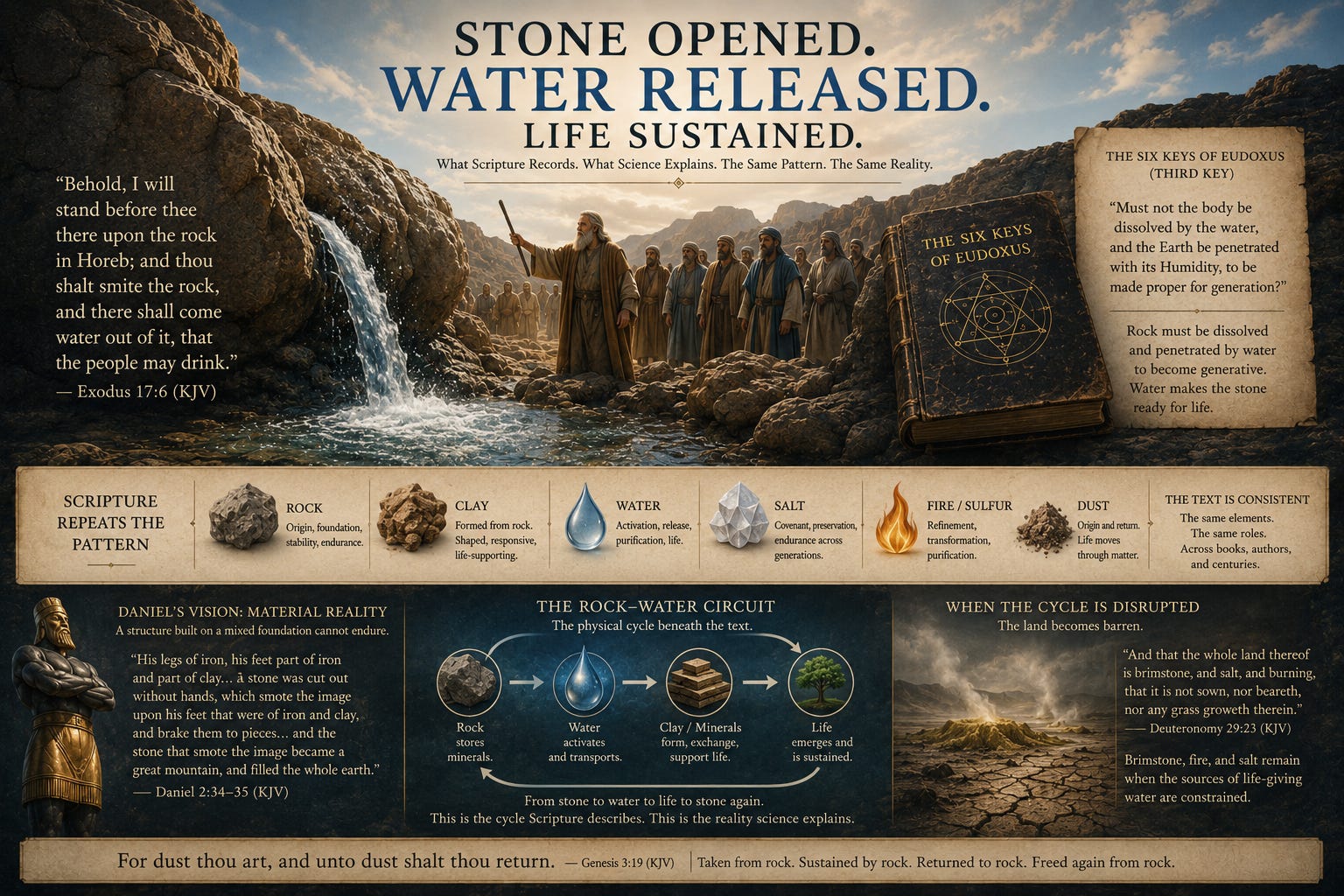
*Excerpted from “The Blueprint of Life,” which is shipping early to the middle of next month.
Before we explore Scripture for ancient echoes of modern scientific insights, since most readers probably do not have either the time, interest, or aptitude for exploring the three heavy science posts in which I laid out the foundations of what we call the Rock-Water Circuit Theory, here is as brief a recounting of it as possible:
The Rock–Water Circuit Theory
The Rock–Water Circuit Theory was constructed by integrating consensus science across origin-of-life research, biochemistry, geohydrology, geology, and physics, then extending that synthesis into a proposed planetary cycle linking mineral chemistry, water, and life.
Life depends on only three forms of matter: carbon, water, and minerals. No, oxygen is not a requirement, as much of life survives without it. Carbon supplies structure, water supplies the mobile medium, and minerals supply the charge, catalysis, conductivity, and control for metabolism. 1, 2, 3
Modern origin-of-life science points toward rock–water interfaces as the most plausible birthplaces of cellular life. Helen Hansma’s mica hypothesis proposes that life may have originated between mica (biotite) sheets, where layered mineral surfaces confined water, potassium-rich compartments, and mechanical movement that could have supported early molecular organization. Others, such as Nick Lane, have proposed alkaline hydrothermal vent models in which mineral interfaces, iron-sulfur chemistry, hydrogen, carbon dioxide, and natural proton gradients may have provided the first energy architecture later inherited by cells. 4, 5
Iron-sulfur chemistry is ancient and central to biological energy. Iron-sulfur clusters mediate electron transfer in respiration, photosynthesis, carbon fixation, and many core metabolic processes, suggesting that biology retained a deep geochemical logic. 6, 7, 8
The Rock–Water Circuit, focused on biotite-derived vermiculite, names the core mineral-water engine as ISAW: iron, sulfur, aluminum, and water. In this model, iron moves electrons, sulfur mediates proton activity and redox coupling, aluminum supplies the stable aluminosilicate scaffold, and water activates, opens, carries, and coordinates the system. 9, 10, 11
Biotite is the key mineral body in this model. It forms deep within Earth under heat and pressure, then reaches near-surface environments through uplift, erosion, and crustal cycling, where water, oxygen, acids, and time begin opening its layered structure. 12, 13
Weathering of biotite toward hydrobiotite and vermiculite is a known geological process. Biotite weathering involves potassium loss, hydration, interlayer opening, and transformation toward mixed biotite–vermiculite phases and vermiculite-like structures. 14
That opening matters because vermiculite-like structures are more hydrated, expanded, ion-exchanging, and biologically available than closed biotite. In the theory, this is the point where mineral order locked in rock becomes mobile mineral chemistry carried by water. 15, 16
Water is the control layer. Without water, minerals remain locked in crystalline lattices; without minerals, water remains largely unable to perform the organizing work nature asks of it. When water interacts with reactive mineral surfaces, it can carry dissolved ions, redox relationships, buffering chemistry, and charge organization into soils and living systems. 17, 18, 19, 20
The full Rock–Water Circuit is recursive. Mineral chemistry forms in biotite rock below Earth’s surface, rises over geological time, is weathered by the carbonic acid and sulfate in rainwater, emerges into soil and biology, performs energetic and structural work, then returns through death, decay, and geological cycling. 21, 22, 23, 24, 25
Convergence with Ancient Texts
We saw in the Emerald Tablet a description of the Rock–Water Circuit with Shimanishi’s biotite, or black mica, at its center: “all things arose from this one thing,” “by a single act of adaptation,” meaning through water. The line “that which is above is like to that which is below, to accomplish the miracles of this one thing” refers, in our reading, to the geohydrological deep-Earth cycle in which biotite forms, rises toward the surface, and meets the atmospheric sulfur cycle, which weathers it open again. Its broad mineral composition is then released into water, soils, and biology before returning to the deep Earth through death, decay, and the transport of water — a regenerative cycle described as “the power thereof is perfect.”
What surprised me was that this same architecture could be seen beyond Hermetic literature as well. Once we had constructed all the links in the Rock–Water Circuit, I started noticing a similar pattern in Scripture, in a recurring grammar of creation, provision, judgment, and renewal. Rock, water, clay, dust, salt, sulfur, fire, springs, fountains, and wells appear with too much consistency to treat them as symbolic language alone.
I am not saying that Scripture speaks as if it were a bio-geochemistry textbook, but at the same time, as a physician and researcher, I began to recognize within it a body of observational knowledge about the material order of creation. Scripture repeatedly returns to the same earthly pattern described by the Rock–Water Circuit, founded upon modern scientific concepts: stone opened, water released, life sustained, matter returned, and creation renewed through the meeting of Earth and water.
Stone Opened, Water Released
In Exodus, Moses strikes the rock and water flows. The scene carries symbolic force, but it is also scientifically instructive: vitality comes from water conditioned by rock and brought forth to sustain life.
This pattern repeats throughout Scripture: wells uncovered, springs released, fountains opened, living water emerging where hardness once prevailed. Such passages present Earth’s processes as real and repeatable. Stone and water are shown participating in a generative relationship, one from which life emerges and on which it continues to depend.
In the Third Key of The Six Keys of Eudoxus, the same insight appears: “Must not the body be dissolved by the water, and the Earth be penetrated with its Humidity, to be made proper for generation?” The “body” is the mineral body of Shimanishi’s black mica, the stone in its closed condition. Dissolution and penetration by sulfated rainwater describe the transition into a state ready for generation, which, in my reading, corresponds to the opening of biotite toward vermiculite, thereby making the rock porous enough that water can enter and release its mineral chemistry into the world.
The point in both cases is preparation: water makes the stone generative.
How Scripture Describes Matter
Scripture uses salt, fire, and dust repeatedly. Salt seals covenants through preservation. Fire purifies by refining what passes through it. Dust marks both the origin and the return because, as we learned from the Rock–Water Circuit, matter moves through life and then returns to Earth.
Scripture treats formation, degeneration, purification, and renewal as events in which matter is formed, broken down, and made ready again. I was surprised by the recurrence of specific physical nouns repeating throughout Scripture, wherever it spoke of origin, stability, endurance, collapse, and renewal. What emerged was a tight, constrained vocabulary that felt structural, as if these words were carrying the architecture of a system rather than serving merely as metaphor or symbolism.
A covenant, for example, is a binding agreement meant to endure across generations. It defines identity, obligation, inheritance, and continuity. Covenants are built to outlast individuals. So when Scripture grounds a covenant in rock or seals it with salt, it reaches for elements of matter that are closely associated with endurance.
Rock itself appears with remarkable consistency. God is called a Rock. Humans are described as being hewn from rock. Salvation is anchored to rock. The language returns to stone whenever Scripture speaks of origin, stability, and endurance.
“Of the Rock that begat thee, thou art unmindful, and hast forgotten God that formed thee.”
—Deuteronomy 32:18 (KJV)
