


We now move deeper into the Hermetic alchemical texts.
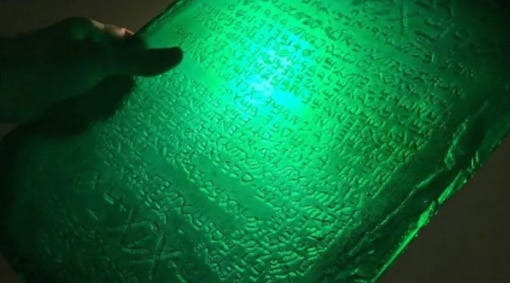
The Emerald Tablet is the first of the three texts we will decode, and the most foundational: It is the most widely known, the most studied, and the most frequently misunderstood.
I begin with it not because it proves our interpretive framework, but because it names the larger order: ascent and descent, reception and activation, opening and release, circulation and return. Its language is compressed, ancient, and less operationally precise than the texts we will decode in the next posts, so some of the mappings may initially feel provisional, even forced.
Attributed to Hermes Trismegistus and preserved in early medieval Arabic sources, the Tablet is typically read as mystical or symbolic literature—a set of poetic aphorisms about the unity of nature. It is rarely read as a compressed description of a planetary cycle.
We read it differently.
In what follows, we present a materially specific interpretation of the text—one tested against the Rock–Water Circuit Theory and against the operational chemistry of Asao Shimanishi. In our reading, the Tablet preserves, in symbolic language, the same recurring cycle described in Chapters III through V: Earth’s cycle of opening, circulation, transformation, and return linking rock, water, and life.
I ask for patience here. The roles we assign in the Tablet—to sulfur-bearing rainwater, biotite, vermiculite, and the mineral essence brought forth from stone—will be tested repeatedly in the texts that follow. Letter from a Woman Alchemist on the True Stone of Wisdom will give a portrait of the essence once produced. The Six Keys of Eudoxus will give the guarded procedure by which it is extracted.
By the end, our claim is not that one striking line happens to fit. It is that all three texts lock together around the same materials and processes we have identified. If our interpretation was incorrect, it would have broken somewhere across these texts. We believe that it does not.
I do not offer that lightly. To our knowledge, these texts have not been mapped onto a physical process with this degree of chemical and operational precision. If that claim is too strong, it will fail under scrutiny. If it holds, then one of the most famous documents in the Hermetic tradition may be read in a way that has not been available before.
For those more inclined to listening, I’m including a deeply evocative reading of The Emerald Tablet by professional voice actress Laura Anderson, also known as Conscious Voice. Laura is a colleague from the World Council for Health, though I had no idea she was a professional voice actress until she sent me this recording after yesterday’s post.
She reads carefully and slowly, and I found that, reading the words in time with her voice, made the Tablet feel newly alive to me, even after months of living inside it.
I begin with the text itself. The translation used here is the Steele and Singer rendering, whose English most closely aligns with the phrases analyzed below. I reproduce it in full so the reader can see the whole before we turn to selected lines.
True it is, without falsehood, certain and most true.
That which is above is like to that which is below, and that which is below is like to that which is above, to accomplish the miracles of one thing.
And as all things were by contemplation of one, so all things arose from this one thing by a single act of adaptation.
The father thereof is the Sun, the mother the Moon.
The wind carried it in its womb, the earth is the nurse thereof.
It is the father of all works of wonder throughout the whole world.
The power thereof is perfect.
If it be cast on to earth, it will separate the element of earth from that of fire, the subtle from the gross.
With great sagacity it doth ascend gently from earth to heaven. Again it doth descend to earth, and uniteth in itself the force from things superior and things inferior.
Thus thou wilt possess the glory of the brightness of the whole world, and all obscurity will fly far from thee.
This thing is the strong fortitude of all strength, for it overcometh every subtle thing and doth penetrate every solid substance.
Thus was this world created.
Hence will there be marvellous adaptations achieved, of which the manner is this.
For this reason I am called Hermes Trismegistus, because I hold three parts of the wisdom of the whole world.
That which I had to say about the operation of Sol is completed.
In what follows, I do not attempt to decode every line of the Tablet. For the sake of brevity, I focus on the passages that, in our reading, most clearly describe the Rock–Water Circuit. We arrived at these readings by testing one interpretation after another against the geochemistry, Shimanishi’s procedural steps, and the text’s internal consistency.
“That which is above is like to that which is below, and that which is below is like to that which is above, to accomplish the miracles of one thing.”
In our reading, “above” and “below” refer to more than sky and Earth. They describe the continuity between deep geologic formation and surface biological life. What forms below, under heat, pressure, and mineral transformation, later rises toward the surface through uplift, tectonic exposure, and crustal cycling. Once exposed above, it meets water, atmosphere, and life. The same materials then reenter circulation through weathering, release, biological use, death, sedimentation, burial, and eventual reformation. Above and below are not separate domains. They are two phases of one recurring operation.
“And as all things were by contemplation of one, so all things arose from this one thing by a single act of adaptation, and the power thereof is perfect.”
Within the Rock–Water Circuit, this describes a recursive planetary process. Minerals form deep within the Earth, are gathered into rock, lifted toward the surface, opened by weathering, and released into water. Their chemistry enters soils, organisms, and living systems, then returns again through decay, sediment, burial, metamorphism, and rock formation. The “single act of adaptation” is the mediating operation by which fixed mineral order becomes mobile biological chemistry. Water fulfills that role most consistently. It receives charge from rock, carries mineral chemistry into life, returns those materials to Earth, and later reopens the rock so the cycle can begin again. The power is “perfect” because the source is not consumed. It is transformed, circulated, buried, re-formed, lifted, and released again.
“The father thereof is the Sun, the mother the Moon.”
Here, the Sun and Moon name roles within a generative transformation rather than fixed substances. The Father, identified with the Sun, is the activating and penetrating principle. In Nature, that activity appears across two linked domains: deep geologic heat and pressure below, which form the original mineral body, and sulfur-bearing rainwater above, which later reopens and remobilizes that body after uplift and exposure. In Art, the same activating role is performed directly by sulfuric acid.
The Mother, identified with the Moon, is the receptive mineral body. In Nature, that body is biotite, formed at depth and later exposed to weathering. In Art, it is vermiculite, the already opened mineral matrix from which the spirit or fire can mobilize the seed. The Father acts. The Mother receives, opens, and yields. The child is the liberated mineral essence drawn forth from stone.
“The wind carried it in its womb; the earth is the nurse thereof.”
The Tablet now describes transport and return. The “wind” names the atmospheric phase of the cycle, especially the movement of sulfur-bearing compounds through air and water. What is carried is not the whole mineral system, but one of its mobile activating agents: sulfur chemistry returned through rain, capable of reopening rock and setting stored mineral chemistry into motion.
But the line also belongs to the larger planetary cycle. Material rises from below through geodynamic processes, enters surface and atmospheric circulation, and later returns through erosion, sedimentation, burial, and reformation. The wind carries. The Earth receives. The process moves between atmosphere, surface, life, and depth.
“The earth is the nurse thereof.”
A nurse feeds and sustains what has already been brought forth. Here, the Earth nurses because it is the enduring mineral body from which water and life are fed. Weathered rock, especially vermiculite, performs part of that nursing function at the surface: its opened lattice releases mineral charge in a slow, buffered, and governed way. Iron, magnesium, calcium, potassium, manganese, and ultratrace elements enter water and soil in forms prepared for biological use.
At the deeper scale, Earth nurses by preserving and reforming the source itself. It gathers returned matter, buries it, transforms it, and eventually brings it back toward exposure. Nursing is therefore not only surface feeding. It is the whole planetary act of storing, preparing, releasing, and renewing mineral chemistry for life.
“It is the father of all works of wonder throughout the whole world.”
In our reading, this points to the source of usable energy: the separation and attraction of unlike charges, especially proton and electron, through which potential energy is stored and made available to life. Minerals provide the structures through which this energy is held, organized, directed, and released. Their charged lattices store electrochemical potential and help govern its transfer across environments.
This occurs at both scales. At depth, heat, pressure, redox chemistry, and mineral formation store the original charge-bearing architecture. At the surface, weathering and water release that architecture into soils, waters, and organisms. In planetary terms, the same principle appears in the Deep-to-Surface Energy Gradient, where alkaline, electron-rich fluids rising from depth meet more acidic, proton-rich waters above.
“If it be cast on to earth, it will separate the element of earth from that of fire, the subtle from the gross.”
This is one of the Tablet’s clearest descriptions of extraction. When the active principle is cast onto Earth, fixed matter is separated from mobile essence. In Nature, sulfur-bearing rainwater contacts exposed mineral bodies and begins opening them. The dense mineral structure is altered, and the more mobile ionic and redox-active fractions are separated from the gross body of stone.
At the deeper scale, the same principle operates in reverse and return. What has been separated, circulated, and used by life eventually returns to Earth, where it is gathered again into sediment, rock, and mineral architecture. Separation and recombination are therefore two halves of the same cycle.
“With great sagacity it doth ascend gently from earth to heaven. Again it doth descend to earth, and uniteth in itself the force from things superior and things inferior.”
This line is the center of the Tablet’s planetary logic. It describes circulation across multiple scales at once. At the hydrologic level, water ascends through evaporation and transpiration, then descends as rain. At the geodynamic level, mineral bodies formed deep within Earth slowly ascend toward the surface through uplift, tectonic exposure, and crustal cycling. Once exposed, they are reopened by weathering and returned into circulation through water, soils, and life.
The line also describes union. What descends from above—rain, atmospheric chemistry, sulfur-bearing water—meets what has risen from below: mineral bodies formed in the Earth. Their contact unites superior and inferior, atmosphere and geology, water and rock, activation and reception. That union produces the mobile mineral chemistry on which life depends.
“This thing is the strong fortitude of all strength, for it overcometh every subtle thing and doth penetrate every solid substance.”
In our reading, this “thing” is mineralized water carrying redox-active mineral chemistry in mobile form. Iron and sulfur provide the energetic core, but water gives that chemistry reach. It moves through subtle spaces, enters mineral interfaces, and eventually penetrates what first appears solid and closed.
Biotite is the key example. Formed at depth, lifted toward exposure, and then acted upon by sulfur-bearing rainwater, it slowly opens toward vermiculite. What was dense, layered, and relatively inaccessible becomes hydrated, expanded, exchangeable, and capable of releasing its mineral chemistry into water. The line, therefore, describes both penetration and transformation: water entering stone, stone opening into a receptive matrix, and mineral essence becoming mobile.
“Thus was this world created.”
This line only makes full sense at the planetary scale. The Tablet is not describing surface weathering alone, nor atmospheric circulation alone. It is describing a recursive world-making order: deep formation, ascent, exposure, activation, opening, release, circulation, biological participation, burial, reformation, and return. This is the Rock–Water Circuit in its largest form.
“Thus thou wilt possess the glory of the brightness of the whole world, and all obscurity will fly far from thee.”
In our reading, “brightness” refers first to illumination: the clarity that appears when the process is finally seen as a whole rather than in fragments. “Obscurity” names the confusion that prevails when geology, water, minerals, life, and ancient texts are treated as separate domains. But because the Tablet describes a process active in nature, the brightness also extends into vitality itself. Wherever the cycle remains intact, mineral order, water, charge, and life remain connected.
When the Whole Came Into View
The lines “That which is above is like to that which is below” and “it doth ascend gently from earth to heaven. Again it doth descend to earth” are not separate claims. They are two expressions of the same order. The first states the unity of above and below. The second describes its circulation.
Scientifically, that order operates across atmospheric, hydrologic, biologic, and geodynamic scales. Sulfur-bearing rainwater descends from the atmosphere and meets iron-rich mineral bodies exposed at the surface. Those bodies were formed below, lifted upward, opened by water, and made chemically mobile. Their mineral chemistry enters soils, waters, organisms, and metabolic systems before returning again through death, erosion, sediment, burial, and reformation.
At the broader planetary level, the same order appears in the Deep-to-Surface Energy Gradient, where alkaline, electron-rich fluids rising from depth meet more acidic, proton-rich waters above. The Emerald Tablet presents, in compressed symbolic form, a generative order of the world itself: the recurring cycle through which energy, mineral chemistry, water, and life remain linked across formation, ascent, transformation, nourishment, and return.
What it does not yet give us is that mineral chemistry in concentrated form—the same chemistry that powers Nature’s cycle. For that, we must turn from the map of the cycle to a text concerned not with the Earth cycle itself, but with the nature of the essence brought forth from it.
We turn, then, to Letter from a Woman Alchemist on the True Stone of Wisdom.
*If you value the late nights and deep dives into all the “rabbit holes” I write about, your support is greatly appreciated.
Note to readers:
What Shimanishi produced appears to match, in both process and behavior, the kind of revered substance described across numerous cultures and traditions as a “Golden Elixir.” Aurmina, a name we arrived at before this work fully unfolded, means “golden mineral essence.” It is a diluted form of Shimanishi’s extract and part of my effort to carry this work into a practical form through drinking water.
Primora Bio emerged from that same effort, with the intent of delivering the water to soil, crops, plants, and animals.
So for those who want the work to leave the page and enter their world, these are our first attempts to carry it forward.

From Research to Practice - Links Below
Fascinating. What a wonderfully presented introduction. I am hooked.
BRAVO
I have utmost respect for you, as well as much gratefulness for all that you did during covid, but I, being a follower of Christ, cannot walk this path. The excerpt below is from https://www.gotquestions.org/
"Hermeticism is an esoteric religion based on the supposed writings of Hermes Trismegistus, whose name means “Hermes, Thrice Great” in Greek. Most likely, Hermes Trismegistus was not a historical person. The personage is thought to be an amalgamation of the Greek god Hermes and the Egyptian god Thoth. Several facts point to these two gods being synonymous or in some manner combined and having similar roles in the Greek and Egyptian pantheons. Hermes Trismegistus was a deity of writing, magic, astrology, and alchemy. The Bible does not mention Hermeticism, but it does condemn the worship of gods other than the one true God (Deuteronomy 4:15–24; 1 Corinthians 10:1).
Hermeticism claims to be an ancient philosophy that predates all religions and from which all religions stem. Hermes Thrice-Great is believed to be an ancient deity associated with the earliest dynasties of Egypt. On the Temple of Esna, to Thoth, there is an inscription that says, “Thoth, the great, the great, the great,” which may be the first instance of the thrice-great name. Some Jewish traditions teach that Abraham was taught by Hermes, and some Christian writers in the past believed that Hermes Trismegistus was a pagan prophet who foretold the coming of Christianity. The writings attributed to him, called the Hermetica or Hermetic Corpus are pseudepigraphal—that is, they were written by someone other than the purported author. This collection of wisdom texts about the divine, the cosmos, the mind, nature, alchemy, and astrology is dated to around the first century AD. Followers of Hermeticism in ancient times were alchemists and magicians or sorcerers.
Today, students of Hermeticism and the occult believe that there is a secret library containing the “forty-two essential texts” of Hermes Trismegistus that are a kind of New Age holy grail of wisdom. Other New Age philosophers have claimed to have been taught by Hermes Trismegistus while in a trance state. Mystic Edgar Cayce claimed Hermes Trismegistus was an engineer from the lost city of Atlantis who helped construct the pyramids of Egypt. Other spiritualists have called him a new incarnation of Thoth.
A prime characteristic of Hermeticism appears to be the search for secret wisdom or knowledge. For this reason, and because Hermeticism and Gnosticism rose to popularity during the same era, the two systems are sometimes confused with each other. There is undeniably something tantalizing about the idea that somewhere out there is a hidden vault or secret book that explains all of life’s mysteries and opens doors to another realm of wisdom. However, according to the Bible, wisdom is not set aside for a select few who have the key to a secret door; rather, wisdom is free to all (Proverbs 8). God’s wisdom is deep and unsearchable (Romans 11:33), but He is generous to give it to those who seek it from Him (James 1:5). God’s wisdom is high above the grasp of the wise man and the scholar, and God chooses to give it to those who believe, rather than those who try to attain it with their minds and with striving (1 Corinthians 1:20–21). “For Jews demand signs and Greeks seek wisdom, but we preach Christ crucified, a stumbling block to Jews, and folly to Gentiles, but to those who are called, both Jews and Greeks, Christ the power of God and the wisdom of God” (1 Corinthians 1:22–24)."