


My colleague, “A Midwestern Doctor,” has been on fire lately. When we connected to talk about one of the most significant developments in vaccine safety in years, I realized several of the points AMD raised were especially relevant right now. I asked if we could turn the conversation into an interview. AMD agreed. Since so much of the interview touched on various aspects of their work, I hyperlinked to their relevant posts within those conversations.
PK: I know you’ve been buried, so thanks for making the time. A lot of people need to hear this. Also, congrats on the Tucker Carlson plug. He called you “kind of a genius and a very decent person” and put your work in front of his massive audience. When I first started helping you a few years ago because I loved the newsletter, I had a sense you’d add something real. I just never expected it to go this far. How has it been?
AMD: That was very kind of Tucker. Before I saw that, I always wondered if he read this newsletter, because after I put together an extensive case for the evidence that SSRI antidepressants can contribute to mass shootings (something I did because it seemed like the one viable way to draw real attention to the broader, more common debilitating harms of SSRIs), it went viral, and he then aired a Fox segment on the topic that to the best of my knowledge was the first time major media had seriously touched the issue in decades. Afterward, the Overton window opened; the serious dangers of SSRIs stopped being taboo, and people also began discussing the far more frequent side effects that have ruined a lot of lives. Now federal policies are being enacted that are causing the psychiatric profession to begrudgingly move toward (safely) deprescribing SSRIs. I appreciate the endorsement, but I appreciate even more that he was willing to take the risk of raising the subject when it still carried real cost.
PK: Tell me about that Obi-Wan line we talked about the other night, “Only a Sith deals in absolutes.”
AMD: When you told me that, it jumped out at me because it seemed to touch on the mental rigidity I see everywhere, which has always bothered me and, I feel, is the root cause of many problems that come up. I looked up the context behind the quote that I put into the tweet you saw, and found out that what it essentially means is that as people’s minds harden and they “go to the dark side,” they begin seeing everything in black and white, so that anyone who is not fully with them must be against them. ED: Obi-Wan said the line to a student he deeply cared about who had begun taking Obi-Wan’s disagreements with his actions as proof Obi-Wan was his enemy.
On a broad level, this is the societal shift which typically precedes democracies hardening into totalitarian states, like with Bush’s post 9/11 “You’re either with us, or you’re with the terrorists.” Yet, on an individual level, it frequently sends people like Obi-Wan’s student down a chain of distorted, dichotomous logic that makes them rigidly adopt positions at odds with the values they originally held. Interestingly, the statement itself is an absolute, which is useful because it shows how easily even people who criticize black-and-white thinking can slip into it.
PK: I see that constantly, and also have to admit that in some areas, although I believe there are not many of them, I too can slip into that posture as well. Where does it come from?
AMD: What I found the most interesting about the quote was learning that it touched upon why the Sith (ED: “evil Jedi”) worldview was so tempting in the first place. The appeal was never simply power for its own sake; it was that power and domination offered a way to eliminate uncertainty, which is something many people, including Obi-Wan’s student, simply cannot tolerate.
PK: Have you researched that aspect of cognition?
AMD: Actually, I did and found a substantial body of research on “intolerance of uncertainty” that describes essentially the same pattern and shows it frequently underlies emotional disorders like anxiety. The rigidity we notice is usually the visible surface; underneath it, there is often an intolerance of uncertainty that feeds the drive for control and is, in turn, reinforced by it—until the whole stance hardens into dogmatism.
PK: Man, you just hit on something I thought about for years running an ICU as Director and Chief of 17 intensivists. When I compared my practice to my colleagues, I felt strongly that what separated us in the ICU wasn't intelligence, knowledge, or experience; it was our tolerance of risk, but also what I started to call "comfort with the unknowable," or, as you put it, comfort with uncertainty. That's because we were constantly in situations where you had to make decisions based on incomplete or unobtainable data.
AMD: To that point, I’ve always been drawn to puzzles predicated on incomplete or unknown information because of the type of branching and expansive thinking that is required for them. That’s also why I try to write the way older texts often did—using careful ambiguity to create a kind of holographic depth you can’t attain otherwise.
PK: That tracks with how I’ve always approached incomplete information clinically. I remember one day a nurse pointed out to me that I ordered far fewer tests and consults than any of my partners, and she was right. It sent me down a detailed 18-month analysis using multiple databases, which let me detail the actions of every intensivist on my service and compare how much each one tested and treated against how their patients actually did, using observed versus expected ICU mortality derived from ICU APACHE scores. The bottom line: no correlation. Heavy testers searching for certainty landed all over the performance (err, survival) rankings, and I was the outlier — second from the top in patient survival while ordering by far the fewest tests. (I explore why in the full analysis here.)
AMD: That parallels my longstanding experience that the best integrative physicians I’ve worked with ordered far less labs than their colleagues.
But the deeper point is yours: the testing reflected each doctor's discomfort with uncertainty, and like any other human characteristic, fell along a bell curve, with very few able to tolerate uncertainty very much (except moi, of course, sorry not sorry).
AMD: It also describes doctors' dogmatic behavior and their tendency to distill complex topics into simple declarations that ignore much of what’s going on with each patient. On a deeper level, though, I think it’s the same dynamic underlying many of the ways our society has gone astray, as our entire mode of science and medicine revolves around dominating and rigidly defining nature rather than working in harmony with it, which effectively is an exercise in futility to force certainty onto a world that can never yield any more than the illusion of it from within an artificial model.
PK: That’s one of my favorite points. Everything runs on protocols and algorithms, but every patient is different. Each week that I would take over the ICU, I would give my team which consisted of 1 fellow 6 residents, 2 students, a rundown of what to expect from me, and what I told them was: “This week, when I ask you a question, if you don’t know the answer, you can get out of it by saying, “It depends.” The problem is you will then have to tell me what variables it depends on, why that variable matters, and what the consequences are of doing or not doing that intervention in that situation. They actually loved doing that exercise at the bedside TBH. Man, you bring back memories of my teaching days.
AMD: That’s wonderful; I would have enjoyed rounding on your team when I was in training. One of the things that has always alienated me is that I find certainty “boring,” and a big part of what drew me into becoming a doctor was knowing the sheer complexity of the body guaranteed I was signing up for a lifetime of uncertainty, challenges, and discoveries with each patient. So in my style of medicine, while there are certain principles I prioritize for restoring health, how I approach patients, even those with similar ailments, often varies immensely.
PK: How do you reconcile that with you having to send the same email to hundreds of thousands of people at once?
AMD: It’s one of the biggest challenges I face, as nothing exists that works for everyone or that can be applied and dosed in the same way. At the same time, I have the opportunity to help a lot of people, so I need to do something, and I’ve hence adopted the position of minimally discussing the therapies I use that are too variable while simultaneously trying to provide as pertinent detail as possible for the ones that are less specific to the individual.
PK: Like DMSO?
AMD: Yes—although it’s not the only one. The huge upside to DMSO is that it works for a very wide range of conditions, and while some knowledge and creativity is needed for its applications to address certain diseases, since it spreads through the body, even if it’s applied in a suboptimal way, it often still works. More importantly, it costs almost nothing so if it doesn’t work, it’s no real loss, and its toxicity is minimal, so while reactions do happen, most are either manageable or easily avoidable. However, even with that and my exhaustive efforts to supply the correct information on how to use it, people have issues from using it incorrectly, it still doesn’t work for everyone (e.g., readers have reported a 40-50% tinnitus improvement, 80-85% with pain, and likely over 90% with burns) and the less than satisfactory outcomes they share constantly weigh on me.
PK: Don’t be too hard on yourself. The results I’ve seen are beyond what I would have thought possible for any therapy a few years ago. That’s why I’ve promoted it and why at our Leading Edge Clinic, we are running a tinnitus trial that now has some encouraging early signals.
AMD: Tinnitus also illustrates a broader limitation in the usual model. To facilitate scalability, it revolves around diagnosing ailments by describing symptoms in Latin and then giving agents that counteract those symptoms. One issue is that different diseases with shared symptoms are treated as the same entity, so a treatment that addresses only a subset of causes becomes the standard of care and doesn’t help the remaining cases. Using tinnitus as an example, it has many different causes (which somewhat correlate with the different sounds people hear), and systems that successfully treat it typically consider multiple potential root causes rather than a single approach. Likewise, while DMSO addresses the root causes of some types of tinnitus, it either can’t address others, or it only works if a protocol is tailored to the specific condition present.
PK: That matches what we’re seeing. Safety, range, and cost like this are rare. Not that I don’t know the answer, but I will ask the obvious question anyway: “Why hasn’t DMSO been pushed harder?
AMD: Originally, it was because the FDA and other parts of the medical industry went to great lengths to blacklist the therapy, like when they intimidated scientists researching it. Once they lost the power to do that due to a 1994 law removing the FDA’s jurisdiction over natural supplements, the health climate changed and increasingly revolved around marketing supplements. The major challenge with DMSO is that since a single bottle of it costs virtually nothing and lasts for months if not longer, no one has any incentive to market it and it got crowded out by everything else being promoted (resulting in it just being a therapy whose discussion was restricted to smaller alternative health communities where users were collaborating to find the best solutions to their ailments). The thing I found the most amazing about the whole thing is that while I knew buried DMSO research existed, I had no idea much was out there virtually no one knows about that addressed a wide range of challenging diseases no good options exist for currently.
PK: Following your work as closely as I have, that was one of the most amazing things I learned, which was the insane amount of published research, not only in English, but in other languages as well; it was mind-boggling. So, tell me, how much published research on DMSO exists?
AMD: I spent about five months going day in and day out to try to collect every medically relevant DMSO paper that existed, and while I tried to be thorough, I’m sure I missed some of it. When I ran it through AI for a count, I had about 15,000 pertinent papers. I’m currently doing the medical ozone project, and I know there are thousands, but I do not expect to reach the 15,000 mark.
PK: That’s a massive undertaking. How are you managing it?
AMD: I’ve long been a pragmatist because I’ve had too many bad experiences sinking a lot of time into things I cared about that just couldn’t go anywhere. At the same time, I draw a clear delineation between “difficult” and “impossible,” and when I started this specific project, what needed to be done looked incredibly daunting, but didn’t feel “impossible,” so I just had faith I’d somehow figure out how to do it along the way. That happened, and the ozone project, which I thought would be much harder than DMSO because there are even more studies, is actually going much faster; in hindsight, I wish I’d known a lot of what I know now when I did the DMSO search. For example, recently when facing a really time-consuming research task, I queried a few AIs to see if a better option existed, and after the initial approaches failed, eventually found out a custom Python program was the ideal solution (which I then revised a few times). Before that moment, I had no knowledge of programming, but since I have a good enough grasp of logic, I can get AIs to write and debug Python programs for me, which makes so many of the tasks I had to do much simpler. So if you’d asked me a year ago, I never would have agreed I’d need to “learn to code,” but now that I somewhat have, it’s completely changed my life.
PK: I actually don’t think I can give an insightful answer to this question in regards to my own pace and commitment to work because I seemingly do it without planning or forethought, so I will ask you: What keeps you putting in this level of effort?
AMD: Helping others has always been one of the core values I navigate the world through, but I kept running into this: once I got involved in something my heart was called to, I often became entangled in something that ate up a lot of my time and didn’t feel like it helped people. A big part of wanting to be a doctor was just that I knew I could spend a lot less time to make a much bigger impact on a lot of people’s lives than people I’d tried to help in the past. However, I never dreamed I’d get the chance to help as many people as I do now, and while this newsletter is a lot of work, if you instead look at it as the ratio of how much effort I put in to the impact it makes for each person, it’s incomparable to everything I did before and something I never could have even conceived was possible. The entire reason I put so much effort into it is that I want the results that actually help people, and we currently have a window to reach many people who were never open to these issues before, so I feel I need to help create the stable non-polarized foundation that can actually shift how they see things.
I also had a long period where I was immersed in the alternative media (and the attached communities), and while I found it enlightening, I gradually became more and more frustrated with the fact that a lot of the people there wanted to point out how bad things were, but never would offer productive solutions to make things better. On one hand, I get the helplessness, because it does really feel like the world is against you, like when you have a vaccine injury, but that helpless stance wasn’t acceptable to me, and now that I have a real opportunity to make things better, I feel I have to take it.
PK: What do you think drives the black-pilled stance? ED: To those not in the know, black-pilled means having become deeply pessimistic or fatalistic—convinced that a problem is so entrenched that meaningful improvement is unlikely or impossible.
AMD: It’s often thought to function as a way to eliminate uncertainty; if everything is already as bad as it can be, you cannot be disappointed later. Sometimes it is mixed with pride: the person who sees the full bleakness can believe they are clearer-eyed than those who are naive enough to still hope, and is also relieved of any responsibility to try to fix anything. While I see cases where either is at play, like when I feel it’s largely an ego thing when people get very aggressive with pressuring you to validate their bleak world view, when I encountered this within the communities I’ve belonged to, a large share of it felt like a trauma response. When you attempt to interrupt something profitable and harmful, the system will go to great lengths to resist the racket being interrupted. It’s hence inevitable that those trying to make things right will be marginalized and again and again sabotaged, so as time goes on, that just becomes their default, which in many cases is a valid way of interpreting what they subsequently see transpire, as once your hopes have been dashed too many times, it’s hard to have faith something good could happen.
PK: I have to admit that on some issues, I believe I have developed a black-pilled stance and no longer work on them, but, at the same time, I do not let it color my entire worldview; I just pivot to areas I think will be more fruitful. How have you avoided sliding into it yourself?
AMD: I’d definitely had some pretty big letdowns, but I never expected this to be easy, and I know if we want anything to shift, we’ll have to work a lot for it—but even with that I’m very judicious with what I’ll take on as I know many things I care deeply about are effectively a lost cause to do anything about right now.
On one hand, studying history helps me keep everything in context, as while things often seem “bad,” there are numerous periods I can cite throughout history both where things were worse and where eerily similar things to what we’re seeing now happened, but in time, they all eventually faded away and resolved themselves. On the other hand, when I was younger, because of who I was, I was put into numerous situations where I was completely powerless, and some of those experiences left a deep imprint on me. So above all else, no matter how tempting it is to give in to despair, I hate surrendering my agency and always try to find a way to help myself or others. When you talk to people at the end of their lives, one of the most common regrets they share was that they allowed themselves to be pulled into what was fed to them rather than doing what they really wanted, so especially as I get older, I try to gravitate towards the things that give me meaning even if it’s difficult to do and I have to go against the tide I’m currently in.
With medicine, one of my core aims going in was to do something to help the people medicine had hurt and possibly find a way to shift medicine’s direction toward something that supported health. However, despite those aspirations, I had to quickly come to terms with the fact that the system had too much inertia to change, and the best I could hope for was to help the patients on the periphery who found their way to me. So, when I realized the political window was there to actually make a much larger impact, I felt I needed to take it, but at the same time, the pace I’ve been going at is not sustainable, so I will probably change what I do once this window closes, and it’s no longer as critical to do something with the once-in-a-lifetime opportunities we have now.
PK: I understand the weight. I never expected to be in the role I’m in either. Before I knew it, it just happened.
AMD: Same. One of the things that motivates me to work as hard as I do is the fear that I'll do something that negatively impacts others, which is part of why I try so hard to make the articles accurate and applicable to all the contingencies I can see coming up. However, while that fear makes me genuinely hesitant to publish anything and makes writing a lot less fun as I have to constantly vet and verify things, at the same time, I also know the fear of making a mistake can’t be an excuse to do nothing, because it’s even worse to squander the generational opportunity we have to make things better now. I spent decades complaining about the way things were, so I’m obligated to do something about them now that I can.
PK: Having followed your work, I have a few thoughts on which issues you have covered that then seemed to impact either policy or discussion around certain issues, but I want to ask you, looking back, what do you see as the most meaningful thing you’ve done so far—or the biggest win?
AMD: Helping with RFK’s confirmation. Once Trump won, I knew a major coordinated effort would be made to block him, so in November I started testing messages on 𝕏 that might counter the narratives being built against him in preparation for a future confirmation hearing. Later, immediately after the first day of his hearing, I put out a post framing much of the opposition in terms of pharmaceutical incentives. It reached about 33 million people; some of those points were raised on the second day of the hearing, and afterward I saw reporting that the corruption framing had influenced the remaining undecided votes. Since so many people were working behind the scenes to facilitate the confirmation, it’s impossible to know if what I did tipped the needle, and I’m just grateful we did the impossible and got RFK confirmed.
PK: After your recent piece on the childhood vaccine schedule, the executive order came out incorporating several of the specific things you’d suggested, including splitting the MMR. What was the thinking behind what you did?
AMD: Essentially, with vaccines there are three schools of thought: that vaccines are safe and effective no matter what, that vaccines have risks but their benefits outweigh them, and that vaccines are extremely dangerous and should be banned. Since the industry is very greedy (e.g., they will always take a mile if you give an inch), the “safe and effective” school of thought has dominated, so more and more vaccines and the cumulative toxicity they entail have entered the market, and increasingly aggressive censorship methods have been deployed to sweep up the continually increasing harm they create under the rug. However, the mistake the industry made is that because of how much harm is being created, especially post-COVID, it’s no longer possible to sweep all the injuries under the rug or end the conversation by declaring any criticism of vaccination is blasphemy and akin to murdering children).
Because of this, an unexpected window has been created to shift the dialog to the middle ground option: that real risks exist to vaccination and they need to be judiciously weighed against their potential benefits, rather than the old position that vaccine injuries were “one in a million” and hence not worth worrying about. I feel that’s important, in part because it’s a middle-ground position that can appeal to far more people and because the entire conversation becomes very different once it shifts from clashing ideologies to simple concrete facts that can be objectively brought into the discussion and highlight that the existing paradigm on vaccination is absurd.
PK: That middle-ground approach makes sense. How did you arrive at it?
AMD: For me, this started because I’ve long believed it’s more important to be “accurate” than “right,” so when I debate another party, I try to fairly represent, that is to say, steelman their position, rather than play games, straw-man them to win, and achieve a hollow victory.
PK: I agree. It’s definitely backfired on our movement when influencers took studies that supported our message, then exaggerated their findings to far beyond what was in it and made apocalyptic predictions that never bore out.
AMD: If the truth is on your side, the last thing you want to do is give the other side a straw-man they can use to dismiss all the other valid points you are raising.
So, here, I wanted to see if one could make the case that any of the vaccines on the schedule were providing a real social benefit alongside the harms they created. From that, I realized the justifications for many of the vaccines were much worse than I had originally thought, and often just a result of lobbying or historical precedent, like with the fact that every child receives diphtheria despite there having been less than one case per year in the USA for decades, yet everyone still gets it because it’s bundled with tetanus.
So, given that the harm of vaccines is cumulative and some are more harmful than others (Ed: best shown by all the sudden infant death data), if you could achieve a policy move that cut down the vaccine schedule by removing the worst offenders, while it would not prevent all the injuries they caused, it still would be an immense blessing as it would massively reduce the harm being caused.
My own read on the vaccine situation was that the absurd justifications for many of the vaccines on the schedule were one of the least emphasized points in our movement. So, if attention was brought to that, it could reach people in the middle who have doubts about vaccines but view them as necessary and hence tip the needle towards a safer vaccine policy that returns us to where the (ever-increasing) chronic illness rates were a decade or two ago. Likewise with the MMR vaccine, the entire push for the vaccine has revolved around making people terrified of measles, so most people who get the vaccine don’t give a second thought to its other poorly justified components, which is a shame as the vaccine safety movement for decades has pointed out that the harm of the measles vaccine would be significantly reduced if it was not given concurrently with mumps and rubella—and as such, the industry protected their market by making it impossible to ever get measles without the other two.
PK: If simple harm-reduction options are available, why have they been resisted so hard?
AMD: A few explanations exist for this. For instance, it has long been established that spacing vaccines out, rather than giving them all at the same time, decreases injury rates. So, spacing them out would seem like the rational option for the industry, as they would still get their sales but face less public pushback from the injuries they’ve created. However, rather than do this, each time someone proposes it, the medical industry goes after them and, in some cases, gets their medical licenses. Depending on who you ask, three things explain that behavior.
First, spacing vaccines out to reduce injuries is tantamount to an admission vaccines are not completely safe, so to prevent that, they would rather deny the injuries occur and allow them to continue than reduce them, which is in line with the industry and government’s longstanding position that nothing that creates doubt about vaccines can ever be allowed to exist. This is why, again and again, like just recently when Ron Johnson proved it with COVID-19, you see drug regulators hide vaccine injury data to prevent “vaccine hesitancy”.
Second, economically, it’s harder to sell a massive number of vaccines if children have to separate them, as at this point, prior to RFK cutting things back, they got roughly 50 total vaccines along with annual COVID and Flu shots. If a separate visit was needed for each of those, beyond it adding significantly less reimbursement onto each visit, making it potentially non-viable for pediatricians, it is unlikely most parents would even take their children in that many times. A parallel to this is that the original HPV vaccine trials showed girls who already had one of the targeted HPV infections at the time of vaccination were more likely to get cervical cancer, something that has happened to people I know, indicating the rational policy would be to test each vaccine recipient for HPV beforehand. However, as this would reduce vaccine sales, the decision instead was made to lower the age of vaccination in the hope everyone would be vaccinated before a potential sexual exposure to HPV.
Third, if you ascribe to the school of thought the vaccination program is intentionally being conducted to harm the population, which a case can be made for, any attempt to reduce vaccine harms would be opposed. However, my own experience in dealing with these types of people is it’s not so much that they want to hurt others as they just don’t care at all about the consequences of their actions. So, since there is no liability for a vaccine injuring someone, and at least till recently, no potential loss of sales from public outrage over the injuries, incentives aligned for them to keep pushing as many vaccines as possible.
PK: I’ve been going through Trump and RFK’s vaccine executive order. While more could still be done, what they actually enacted is pretty phenomenal, they eliminated roughly half of the required vaccines, including many of the worst ones, splitting the MMR, moving toward non-aluminum adjuvants, protecting exemptions at the state level, improving the injury surveillance system, which as you know, has always been deliberately opaque, and finally advancing the safety studies that were promised back in 1986. I honestly thought any of those were impossible. Watching so many vaccine proponents completely lose their minds over the last few days has been something else.
AMD: It’s understandable; they have a lot to lose once the racket they’ve put so much work into starts to unravel.
PK: What bothers me is how much of the loudest opposition is coming from people on our own side who arrived only recently. Why?
AMD: It’s definitely irked a lot of people, particularly those who are toiling day in and day out to fix things, and most of them have told me they think it’s because these people are working for the pharmaceutical industry to sabotage things. While that’s possible, since a lot is on the line for the vaccine industry, I hold a different opinion. I’ve seen something similar to this happen in many different movements I’ve belonged to, so rather than be surprised by it, I was expecting it, don’t take it personally, and have just been trying to steer the blackpill sentiment in a positive direction.
PK: Seriously?
AMD: Yes, here, ask AI right now.
What the AI returned: When a reform movement begins to achieve real, measurable progress after years or decades of struggle, a recurring pattern often appears. A vocal contingent that had previously campaigned for reforms treats concrete wins as insufficient, suspect, or even a deliberate distraction. They label the people who delivered those results as saboteurs, dismiss the advances as trivial, and insist that only maximalist, all-or-nothing outcomes count as legitimate success, thereby maintaining their relevance. Versions of this have appeared across history and the political spectrum:
In labor and socialist movements, once social-democratic parties and unions won shorter workweeks, workplace safety laws, public healthcare, or stronger bargaining rights, hardline factions frequently denounced the reformers as sellouts or agents of the bourgeoisie and insisted anything short of full socialization was worthless.
In the civil-rights struggle, after the Civil Rights Act and Voting Rights Act, more radical voices cast the moderates who secured those laws as too accommodating, arguing legal equality without deeper economic and structural change was incomplete.
In environmental politics, measurable gains in emissions standards, renewable deployment, and phase-outs of the dirtiest fuels have often been called “greenwashing” or corporate co-optation by maximalists who demand total systemic overhaul and the abolition of fossil fuels.
In anti-war movements, troop withdrawals, arms-control deals, or limits on war powers have been dismissed as cosmetic by uncompromising factions who accuse the negotiators of being controlled opposition.
On the right, policy deliveries on taxes, judges, borders, or cultural issues have routinely been branded theater or proof of “RINO”/“Uniparty” betrayal.
In the early stages, these absolutist voices often serve a vital function. They keep relentless pressure on institutions, prevent the powerful from defining the limits of reform too narrowly, and expand what eventually becomes politically possible. Without that intensity, many important changes would never gain traction. Once mainstream adoption becomes feasible and tangible institutional results start to appear, the same absolutism frequently turns counterproductive. Energy shifts from consolidating gains or taking the next practical step to tearing down the people who moved the needle. Genuine but incomplete victories are framed as proof of betrayal, and the movement fractures into purity tests rather than strategy as many who initially joined the movement excel at fighting rather than building coalitions to enact policy. The result is slower progress and demoralization of those producing results. The healthiest stance is to hold both halves of the pattern: early pressure is useful and sometimes necessary; treating real wins as inherently fraudulent hinders the cause.
PK: Wow. That reminds me of how so many people were disavowing and denouncing RFK for keeping the COVID-19 vaccine on the CDC schedule for pregnant women and children. They treated it as their red line, something not even Bobby could be forgiven for. Then not long after, when he finally got it off the schedule, they immediately forgot about it and moved on to attacking him for the next thing he hadn’t done yet.
AMD: Yes. One segment, like many movements in the past, treats any step toward vaccine harm reduction as a distraction from total abolition, like when they yell that “safer vaccines is a psyop.” Others judge that, for the foreseeable future, the realistic path is reducing damage, protecting the right to refuse, and continuing to shift public opinion, because policy ultimately follows voters, which I favor because I’d rather reduce vaccine injuries than accomplish nothing right now. I am also highly doubtful any president besides Trump, due to both his personality and personal experience with vaccine injury, would have ever cut back the vaccine schedule to even a fraction of the degree he has. Yet, even Trump, who has received a lot of blowback for his childhood vaccine decisions, along with many of the people in MAHA I’ve spoken to, have been very clear they will never ban vaccines as it is simply not politically tenable, which is why the compromise position they created on the new CDC vaccine schedule was to make many of the previously recommended vaccines optional or restricted to limited groups rather than taking them off entirely.
PK: There is a time when you need rigidity to fight, but there is also a time when you need the flexibility to take the wins that have been given to you.
AMD: The other thing a lot of people who haven’t been in the thick of this don’t see is how many people had to work their tails off, were never really recognized or widely thanked for it so that we could get to the point we were at, or just how much pushback there has been from the pharmaceutical companies across the board and just how many different coordinated attempts have been made to sabotage these reforms.
For example, over the last six months, one of my projects was to derail the pharmaceutical industry’s successful attempt to stop all vaccine reform. Briefly, they conducted a doctored poll that said the public was overwhelmingly opposed to vaccine safety reform, so if Trump or RFK pushed it, the Republicans would lose the midterms. Given this information, White House staff made the largely rational response to ban all discussions of vaccine safety until after the midterms. Not long after, a contact working on enacting those reforms said unless something could be done to shift that, before long it would become ingrained as a policy, and likely kill their generational attempts to make a safer vaccine schedule, so they asked if I could help shift that. Since give or take every other poll showed the exact opposite and that the public strongly supported vaccine safety reform, I thought there was an actual chance that narrative could be overturned, and a big focus of what I did with the limited time I had was to do that, which seems to have succeeded. However, I feel in comparison to a lot of the other people who have been working day in and day out, my contribution was minimal, it’s just that it’s hard to see or appreciate a lot of what vaccine safety reformers have to deal with in Washington unless you are in the thick of it.
In regards to the specific MMR policy decision, I did not have advanced knowledge of it, so I’m not sure if what I did tipped the needle there, I just put this message out because I suddenly had an intuition it was the right time to do it, and I tend to act on those as they’ve frequently put me in the right spot at the right time to make a tangible impact (which is why I am likewise grateful to all the critics who amplified that post and inadvertently allowed it to be seen by the right people).
PK: I’m grateful a real team came together around this. The institutional resistance is fierce.
AMD: Turning values into durable institutional change is harder than it looks from the outside. I’ve tried more times than I can count to do that and failed on things far, far easier than anything RFK is trying to do.
PK: What are you focused on now?
AMD: I have long believed that continually attacking or trying to destroy something is rarely a successful way to approach things, whereas cultivating a positive thing which displaces the existing issue is typically more effective and has a much more lasting impact. Unfortunately, this often puts me in opposition to the existing paradigm because so much of our society revolved around feeding the human need to use force and domination to simplify reality and eliminate uncertainty.
For example, philosophically, modern medicine (allopathy) originated from the idea that you needed to reverse the currently existing symptoms by shifting it to the opposite state, like when aspirin is given for fever; so many of the early interventions used increasingly forceful methods to achieve that shift, leading to it being called “heroic medicine.” Since creating those forceful shifts often required extreme, heroic measures, side effects inevitably followed, but the medical system’s solution was simply to deny the side effects or rationalize their necessity.
PK: That basically describes every vaccine-injured patient I’ve worked with. I will never forget the widely pervasive and deeply cruel extent of the gaslighting my Covid vaccine patients endured, particularly from 2021 to 2023; in fact, I remember that the first half of my typically hour+ long visits was listening to them recount the gaslighting they had endured. It lessened somewhat after that, but gaslighting is especially infuriating when there’s a clear neurological problem sitting right there, tightly and temporally associated with the jab, and the specialists still insist it’s psychosomatic or dress it up with something like “functional neurological disorder.”
AMD: One of the most interesting things I learned about gaslighting is that after mercury started being widely used in medicine and caused a variety of neurological disorders, the resulting symptoms, particularly in women, were often diagnosed as “hysteria,” which, especially in Freudian theory, was then attributed to unresolved sexual conflicts. In turn, multiple authors have made the case that some of Freud’s original famous cases, along with many other “hysterical” patients, were actually neurologically suffering from mercury poisoning.1,2 I’ve thus suspected the reason why Freud’s ideas caught on so quickly was because it gave the doctors a way to absolve themselves from injuring their patients.
PK: Just like how people who vaccinate and then get sick are allowed to blame it on the fact other people aren’t vaccinating.
AMD: I’m still amazed that line has been able to remain a viable sales pitch for vaccines, but that’s the power of propaganda.
PK: I largely agree with the allopathy framing you laid out, but I do have to push back on one point. In some situations you absolutely have to force the body into a different state—especially when you’re dealing with a critically ill patient who’s actively dying.
AMD: Completely agree, and that touches upon why modern medicine excels at treating acute conditions rather than chronic ones. Once again, it’s important not to fall into an absolutist stance. There are things conventional medicine handles effectively that should not be rejected simply because they come from a system rife with issues. At the same time, it is often difficult to accept the useful part without also being pushed by medical providers toward many other standard practices that are unnecessary or harmful, and it’s anything but easy to hold both of those realities in your mind simultaneously as you navigate the medical system.”
PK: And once you’re inside that system, the default response when something doesn’t work is often just to escalate.
AMD: Yes. The other key issue with this paradigm is that since it focuses on dominating the body to achieve a desired outcome, once that fails, the most common (human) response will be to double-down and use more aggressive measures to try to achieve that goal, which in many cases leave the patient far worse than they were. The best example of this is probably high-dose chemotherapy, which came into vogue in the 1980s and 1990s especially for breast cancer, but was eventually pulled back for that use after randomized trials showed it did not improve overall survival and carried much higher toxicity. Because there was so much inertia and money behind it, it was difficult to speak out against it at the time, by the way, you should check out a Wikipedia article that gives a good overview, but even after it was phased out for breast cancer, many in oncology continued to hold the core dose-intensity belief and remained willing to accept higher doses and side effects in the hope of better cancer control when it might work.
PK: I definitely agree on the overdosing issue. I’m surprised how often the patients we see report having been given doses they simply cannot tolerate. What’s particularly striking is that once my work with vaccine-injured people brought me into contact with so many of the “sensitive patients” you talk about, it became obvious that a lot of doctors just don’t grasp they often need to use lower doses.
AMD: I think that’s a result of three things. First, as mentioned earlier, when something doesn’t work, the human tendency is to do more, and then rationalize after the fact why it was the right choice. Second, because our medical system revolves around standardized protocols that doctors can rapidly scale and deploy to drive drug sales, there is no room for the nuance of an individual patient’s needs or the time it takes to figure out the appropriate dose for them. Lastly, in both the conventional and alternative medical system, our cultural belief “if something is good, more is better” seeps in, so even when you warn doctors or patients, they will often overdo whatever was helping and cross the threshold into something counterproductive.
PK: Totally agree, but there is some nuance there as I have worked with a number of theapeutics that have pretty impressive dose-response curves, but they are a minority, although I agree most docs tend to think they all do. Life would be so much easier if people stopped doing that.
AMD: The same principle I use in medicine, “cultivate health rather than relentlessly attack disease,” also applies to how I try to engage the larger culture. A lot of the persistent bad practices inside the medical system are simply reflections of the broader culture that produces the conditions for them, so a good deal of my focus goes into how we can shift the underlying mentality. Among other things, this means moving from polarized black-and-white discourse toward something more nuanced that can tolerate ideas we don’t fully agree with as long as they actually move things forward from where we are now. With medicine specifically, while I think it’s important to expose what’s wrong, relentlessly attacking the system is not a workable strategy on its own. People still need medical care and will end up going back to the conventional system even when they have serious doubts about it.
PK: So what’s the solution?
AMD: I settled on providing better alternatives to the existing paradigm, and on empowering people to figure out for themselves how to use them. On one hand, this frees people from being subject to the medical system and to practices they disagree with, such as care being made conditional on COVID vaccination. On the other, it creates the one thing that can motivate the medical system to do a better job, which is genuine competition. Competition forces them either to provide the results patients want or to lose a great deal of money. I believe that is the only reason the loss of trust in science and medicine after COVID is even being allowed to be openly discussed now. They need to regain that trust for the business model to work.
More importantly, it catalyzes a shift in consciousness, both by making people have a tangible realization that the suffering they went through didn’t have to happen, which moves skepticism of the system from an abstract idea to a lived experience, but also because simple remedies being able to affect so many different diseases shifts the societal perspective on how the body works from the sterile reductionist model our society revolves around to a much more vibrant and connected one.
PK: That may be one of the reasons I gave more than a year of my life to alert the public to the wonders and broad applicability of chlorine dioxide, but I have been reluctant to put my book on Amazon where it could reach a much wider audience. So how do you actually do it at scale?
AMD: While I’ve been able to do that for many individual patients I’ve worked with, it’s obviously unrealistic I could do that at scale and shift the culture. However, I’ve long believed that the shifts towards “cultural health” always have a building stage, where for years, if not centuries, some people are aware of the idea, and try desperately against all odds to have it catch on (often becoming extremely bitter and frustrated those around them simply don’t want what would radically improve their lives), but then at some point, the cultural conditions suddenly shift, and all the work that had been done previously is positioned to ignite and shift the whole culture. The fall of the Berlin wall is the most commonly cited example of this, but consider what’s happened with the vaccine issue.
Since the days of the smallpox vaccine over 200 years ago, people from all walks of life have done all they can to fight against and protest vaccination. Despite that, as the years went on, the vaccine industry only became more powerful, and each coordinated opposition to it was largely erased from memory. Yet the industry grew so overconfident and greedy that during COVID it did things so far out of line that public distrust of COVID vaccination sprouted like wildfire. That distrust spread across a recently "freed" internet, in a highly polarized political climate where one side had shortsightedly chosen to zealously endorse vaccines. Before long, doubt about the COVID vaccine and resentment toward the left turned into something else, and people began listening to the parents of vaccine-injured children whom they had previously written off. So now there is not only far more distrust of vaccines than I ever expected to see in my lifetime, but RFK is enacting policy after policy that, as you said before, people in the vaccine safety movement dreamed of for decades.
PK: I’m with ya on that, I never ever would have imagined it could have moved that fast.
AMD: Another way to think about it was that the reason people like you wanted to get involved was ultimately due to the fact we’d reached the point where a rapid shift was possible.
Anyways, due to some odd coincidences, I’ve periodically felt like I was put where I was because there was a role I was supposed to serve. For instance, I had some very odd experiences right before COVID that made me feel I was supposed to become entangled in it, and due to a series of improbable events, I eventually ended up in the position I am in now. Similarly, when I was younger, I noticed that a lot of the incredible medical discoveries people had made were gradually disappearing and getting harder and harder to find, so for some reason, I felt compelled to preserve them in the hopes I could pass them onto someone in the next generation and keep their fire alive for the time far into the future when they were ready to emerge and then somehow was repeatedly connected with their reclusive custodians.
However, when that pursuit started, I never expected something like the internet would emerge, let alone that when it reached the point where information could rapidly disseminate across the culture, I’d be in the position to disseminate it. So, all the paths lead to a simple conclusion; my role is to provide information that people can use to both positively transform the medical system and opt out of it, and I want to do that by leaving detailed summaries and records of exactly how people can do that so they have the best shot of igniting when the time is right. Because of the unusual sequence of events that led here, I treat it as something I’m directly accountable for getting right. My focus hence stays on the results rather than recognition, as the former is my priority, which is one reason anonymity helps.
That’s basically why I’ve put so much work into trying to create a comprehensive foundation for DMSO rather than letting it follow the course of a typical health fad and I did it under a very tight timeline. It is also why I’m doing the same thing with a few other therapies like ozone as that’s the best I could come up with to create a positive shift.
PK: A lot of that sounds like Carl Jung’s “Sage-Steward” Archetype. On that note, I have to thank you for the piece you put out last week on the war against chlorine dioxide and for highlighting how my book’s story folds into a broader pattern of monopolistic suppression. After you called out the absurdity of their position, a few days ago, the FDA quietly pulled the pages that had been calling CDS “toxic bleach” for years and blocking CDS research globally.
AMD: That gives me hope that with enough work it may at last be possible to overturn the FDA’s position that ozone is a toxic gas with no medical value whatsoever.
PK: Exactly. It’s another reminder that putting the evidence in one place, cleanly, does matter.
AMD: That’s it essentially. Because of all the eerie coincidences that made what I’m doing now possible, I feel I have a deep obligation to do the task I was entrusted with well. Once the foundation is solid I want others to carry it forward so it isn’t dependent on me and I am becoming increasingly hopeful that the current conditions will allow things that previously looked impossible, provided the groundwork is done carefully.
PK: Any advice for others trying to shift the conversation?
AMD: One of the more eye-opening things for me has been what the internal metrics show: the loudest, most black-pilled voices you see on social media are a clear minority. The much larger and quieter share of people are the ones who deeply value this and provide the kind of sustainable support that actually gets these messages out, in many cases precisely because the sea of outrage and AI-generated content that social media rewards feels emptier the more time you spend in it. So for anyone caught up in the daily struggle to be seen online, the same lesson applies as with the black pill itself: as tempting as it is, it rarely leads somewhere good.
PK: That’s a good way to look at it. Is there anything people can do to support the work?
AMD: The support I’ve received up to this time has been incredible and has been the thing that’s made a lot of what I’ve done possible. Some of the things I want to do are only possible if the newsletter and its support grows, but I have faith that it will happen eventually and I deeply appreciate everyone who helps make that possible. For the time being, I just want people to share the material, incorporate the ideas I put forward they agree with into their own frameworks, and if they have time, to leave a comment about experiences they’ve had with DMSO here as I’m now approaching my impossible goal of 10,000 reader DMSO testimonials.
Beyond that, there are also a lot of people doing critical work on the vaccine safety I’d like to draw attention to. A team of researchers I trust are conducting a study comparing the health of vaccinated and unvaccinated children, so if you’d like to consider filling out a brief survey, you can do so here. Furthermore, the government is about to finalize a historic autism plan, so if you can lend your voice right now (Ed: the instructions are here), especially if you had a child who was vaccine injured, please consider doing so.
PK: I’m glad I decided to support you early on. Any final thoughts?
AMD: Everyone is born with the chance to create a deep meaning from their life. They just have to set their sights on what they know in their heart they are meant to do rather than getting caught up in the endless distractions and aimlessness society feeds us. Time is limited, but I started the journey I’ve been on for decades because I knew it was vital I found the things which could provide that purpose to my life. A lot of what I’m doing now is quite arduous, but the fact that real results are possible has been more than enough for me to invest as much as I have into it. Despite my optimistic nature, for most of my life, because of how entrenched the vested interests are that exploit and harm everyone for profit, I’ve been a pessimist that things could ever change. Now that one thing after another is coming to fruition in the blink of an eye, it quite frankly feels surreal. Just a few years ago I would have said my life felt complete if even one of the things I discussed here had happened. Since I tend to focus on how things will unfold far into the future, my aim has always been to lay foundations for results that would matter years down the road, so I never imagined I’d see some of those aspirations occur so quickly.
PK: Look, I just want to say I really appreciate what you’ve done to help move things forward.
AMD: I feel the same way about you, but I don’t even know who we can even give the credit to at this point. Much of what I’m doing is only possible because so many people are helping me, and more importantly if there had not been a critical mass of people like you, Robert Malone, Senator Johnson and many more, who stepped up and stuck their necks out to try to fix this mess nothing could have happened. If my read of history is correct, this is all part of a much larger cycle, and we all just were happened to be the ones around at the time where this was meant to happen.
PK: Or as the old line goes—it’s amazing what you can accomplish if you don’t care who gets the credit.
If you’d like to follow AMD’s prolific work on Substack, you can do so here and subscribe below:
Lastly, if you value the late nights and deep dives into all the “rabbit holes” I write about, your support for my work is greatly appreciated.
The Shameless Commercialism Department:
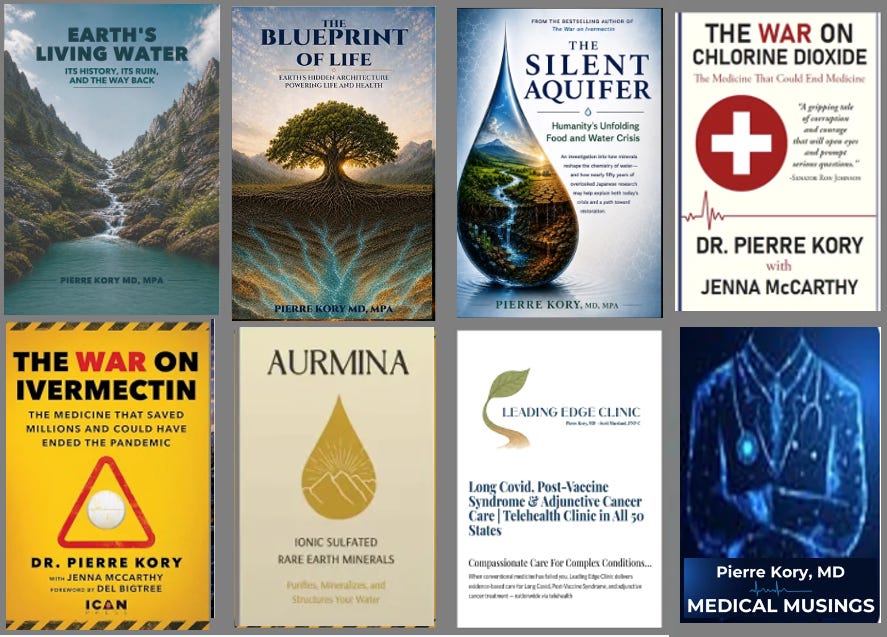
I write about minerals and water. I also sell them.
Aurmina is simply the provable, superior, and less expensive alternative to reverse osmosis for purifying drinking water. It binds and removes over 245 modern contaminants — and unlike RO, it leaves the minerals, redox activity, and ion-exchange capability restored, rather than stripping water empty and calling that clean.
Primora Bio is the same chemistry for the water that grows things: irrigation and foliar, for soil, crops, and livestock.
Both came out of a year spent on one forgotten Japanese mineral extraction that produced three books (The Stone and Water Series) and led to the retirement of my patient panel, though not from Leading Edge Clinic.

From Research to Practice - Links Below Image
as I have said before. . . Doctors like AMD and Pierre should consider forming their own med school or the USA will continue to push out students that believe every allopath professor without thinking critically. . .
Hillsdale College a place to consider as an origin!
This is one of the most incredible things I have read in a long time! Thank you Dr. Kory and Midwestern Doctor!