


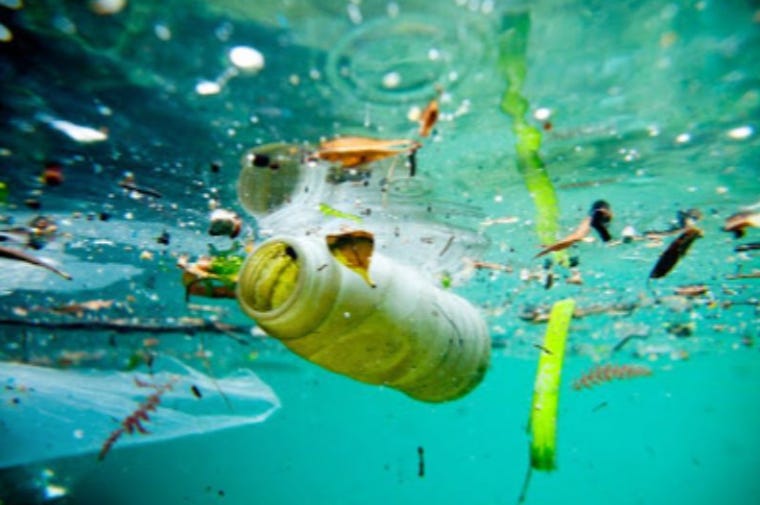
Much of today’s water contamination causes harm without acute toxicity, accumulating quietly through regulatory normalization, chemical dilution, and delayed recognition. Plumes of contaminants in aquifers often last from decades… to centuries. The reason is that groundwater moves too slowly for natural flushing to clear contaminants on human time scales.
How Polluted Drinking Water Sources Have Become
Globally, over 1.7 billion people rely on drinking water sources contaminated by feces and other pathogens. In the U.S., millions depend on sources tainted with excessive heavy metals and per- and polyfluoroalkyl substances (PFAS), a large family of man-made chemicals used since the 1950s for their nonstick, water- and grease-repellent properties (think nonstick cookware, stain-resistant fabrics, food packaging, and firefighting foams). They’re nicknamed “forever chemicals” because the carbon-fluorine bond makes them extremely persistent in the environment and in our bodies.
Other major contributors include untreated wastewater, industrial discharges, agricultural runoff (nutrient pollution), and deteriorating infrastructure. Up to 80% of the world’s wastewater returns to the environment without proper treatment.
Commonly detected contaminants include arsenic, lead, uranium, PFAS, pharmaceuticals, pesticides, nitrates, fracking fluids, disinfectant byproducts, microplastics, pathogens (bacteria, protozoa, viruses), and more.
What Is Contaminating U.S. Aquifers?
If there is a single contaminant that defines the chemical degradation of U.S. aquifers, it is nitrate. Nitrate pollution comes from synthetic nitrogen fertilizers, manure from concentrated animal feeding operations, and septic systems. It is highly soluble, weakly retained by soils, and perfectly designed, chemically speaking, to infiltrate groundwater.
USGS monitoring shows that nitrates are detected in a substantial fraction of shallow aquifers nationwide. Agricultural regions routinely exceed EPA limits in private wells. Many municipal wells hover just below the regulatory threshold.
The regulatory limit for nitrate was set decades ago to prevent acute infant methemoglobinemia. It was not set to address cancer risk, thyroid disruption, microbiome effects, or interactions with other contaminants. What is more worrisome about nitrate is that when it is found, it means that the aquifer is open, permeable, and receiving other surface-derived chemicals.
Modern pesticides are designed to degrade faster than their predecessors, but “faster” still means years to decades. Atrazine and its metabolites are widely detected in agricultural aquifers, persistent at low concentrations, and hormonally active at levels below drinking-water standards. Many pesticide breakdown products are less regulated and less studied than the parent compounds, yet often more mobile.
PFAS: A Late-Arriving Catastrophe
PFAS contamination deserves special treatment because it represents a regulatory failure of historic proportions. For decades, per- and polyfluoroalkyl substances were discharged into soil and water without restriction. They were used in firefighting foams, military bases, airports, industrial processes, and consumer goods manufacturing.
PFAS molecules are extremely persistent, weakly adsorbed by soils, and capable of traveling long distances underground. They now contaminate aquifers serving tens of millions of Americans, often without visible warning signs. Unlike nitrate, PFAS contamination is frequently point-source driven, creating sharp plumes that intersect wells unpredictably.
The most disturbing fact relates to how “background” levels were determined. For arsenic or uranium, background can be geologic. For nitrate, there is a natural soil-derived baseline. For PFAS, there is no natural background. These molecules did not exist on Earth before the mid-20th century. During the decades that PFAS were entering groundwater, no analytical methods could detect them at parts-per-trillion levels. Aquifers were therefore declared clean.
Regulatory Normalization
Once PFAS became widespread, regulators faced an impossible problem. If zero is the goal, most water systems fail. If standards are strict, remediation costs explode. If standards are loosened, exposure continues.
The compromise solution was to define acceptable limits, acknowledge “background presence,” and focus enforcement on hotspots. Today, “normal” levels are considered 1–5 ppt, and the absence of PFAS is the exception. This may be politically pragmatic, but it embeds a dangerous idea: that pervasive contamination is acceptable contamination.
Metals: Natural, but Not Benign
One of the most misunderstood aspects of groundwater contamination is metals. Arsenic, uranium, manganese, chromium, and others are often described as “naturally occurring,” which is true in a narrow geological sense and misleading in every practical one.
Human activity alters groundwater chemistry in ways that mobilize metals. Pumping changes redox conditions. Oxygen introduction oxidizes sulfide-bound metals. Chlorination alters speciation. pH shifts increase solubility. Metals that were once locked into mineral matrices become bioavailable. Arsenic contamination in parts of the Southwest and Midwest is not merely a geological curiosity; it is a hydrochemical consequence of aquifer disturbance.
Industrial Solvents: Legacy Plumes That Never Die
Chlorinated solvents like TCE and PCE exemplify groundwater’s inability to heal itself. These dense non-aqueous phase liquids sink below the water table, pool in fractures, and dissolve slowly over decades. Even aggressive remediation often fails to eliminate the source.
Instead, utilities manage risk through well abandonment, plume avoidance, blending, and treatment at the point of extraction. The contamination remains in place, quietly leaching.
Pharmaceuticals and Wastewater Fingerprints
Where aquifers are hydraulically connected to surface recharge influenced by wastewater, whether treated or not, trace pharmaceuticals and endocrine disruptors are increasingly detected. These compounds are biologically active at extremely low concentrations, are rarely regulated in drinking water, and reflect the chemical signature of modern human life.
Municipal wells are tested for a defined list of regulated substances. Private wells, serving over 40 million Americans, are often tested rarely or never. Water that passes regulatory muster can still be chemically incoherent, stripped of buffering minerals, altered in ionic ratios, and carrying dozens of trace contaminants below reporting thresholds.
Yes, this is the part where the author admits he treats his own water. Aurmina exists because, after writing all of this, I couldn’t unsee the problem. It’s a mineral-based water purifier. I use it. That’s the endorsement. Aurmina doesn’t fix aquifers (although they still need fixing). It just makes my hypocrisy slightly harder to accuse.
The Deeper Problem: Chemical Simplification
Beyond contamination lies a subtler degradation. Many aquifers have undergone mineral depletion due to ion exchange, altered calcium–magnesium balance, loss of trace element diversity, and disrupted redox equilibrium. This does not trigger regulatory alarms, but it changes how water interacts with pipes, soils, microbes, plants, animals, and human physiology.
The issue is not only what has been added to groundwater, but what has been lost or distorted.
The Honest Bottom Line
Some U.S. aquifers remain relatively clean, especially deep, confined systems with limited recharge and minimal pumping. Many do not. This is not a failure of treatment plants alone. It is a systemic consequence of assuming that dilution, depth, and time would protect us.
They didn’t.More Stuff (Aurmina and Book Publications)
If you value the late nights and deep dives into all the “rabbit holes” I write about (or the Op-Eds and lectures I try to get out to the public), supporting my work is greatly appreciated.
If you’re curious about the volcanic-mineral water purification product described above, you can find it at Aurmina.com. Think of it as a quiet act of restoration — starting with your water.

Know that not one, but two books are dropping from yours truly (at the same time?) What?

If, instead of (or in addition to) this Substack version, you prefer the feel of a real book—or the smell of paper—or like to give holiday gifts, pre-order From Volcanoes to Vitality, my grand mineral saga, shipping before Christmas.
And if you want to read (or gift) another chronicle of suppression, science, and survival, grab The War on Chlorine Dioxide—the sequel you didn’t see coming—shipping mid-January. On this one, I say: “Buy it before they ban it.” Hah!
This chapter is original material and protected under international copyright law. No part of this publication may be reproduced, distributed, or transmitted in any form or by any means, including photocopying, recording, or other electronic or mechanical methods, without the prior written permission of the author.
© 2025 Pierre Kory. All rights reserved.
Indeed. Thankyou Dr Kory. And I would add that glyphosate is another biggie: water soluble and ubiquitous throughout nature including our bodies. I remember reading some years ago that everyone in a certain UK city that was tested had harmful levels in their urine. ( any level is harmful in my book). And in another survey all commercial bread in South Africa that was tested had it.
Very much appreciate your information Dr. Kory.