


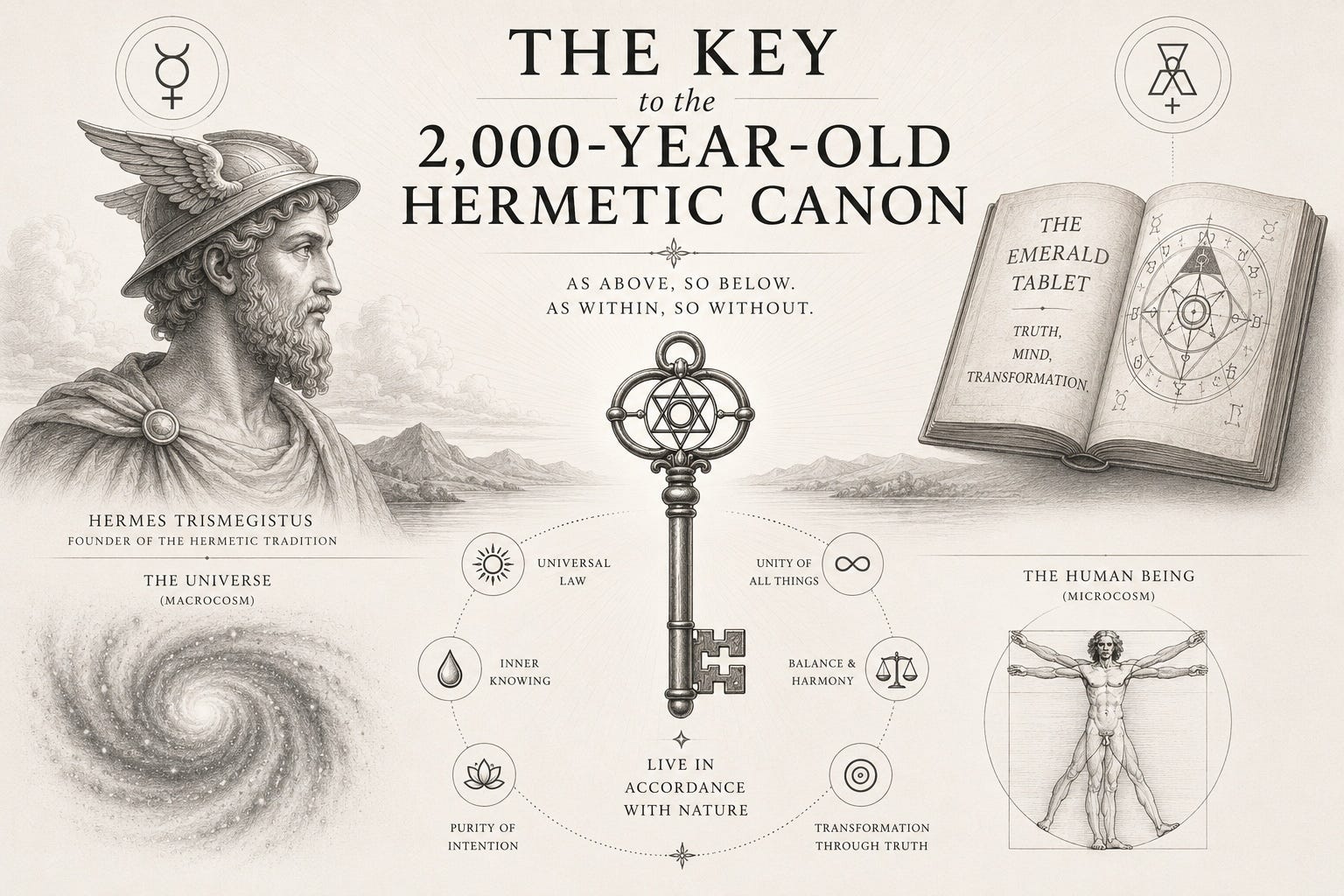
Up to this point, the focus has been on decoding the underlying operation described symbolically within three select texts from the Hermetic canon. What follows is the product of that decoding: a set of operational definitions that render the wider canon legible by anchoring its language to a real material process.
To our knowledge, this is the first operational reconstruction of the core roles encoded across the Hermetic and alchemical canon.
I am aware that the magnitude of that claim may not appear credible to most. Alchemical texts have been read symbolically for so long that another “interpretation” can sound like one more speculative reading added to an already crowded field.
However, we have gone far beyond any other single interpretation because our decoding framework applies to all texts in the canon. The key that I am about to present to you has been tested across multiple texts, multiple interpretive angles, and challenged against multiple AI engines.
Until the key can be broken or shown to fail within these or other Hermetic texts, we believe it provides the most concrete evidence to date that ancient writings preserved operational knowledge of sophisticated geochemical processes, both in Nature and in the laboratory.
Despite the guarded symbolic language in which that knowledge was preserved, the processes being described — specifically the roles, materials, sequence, and product — can now, through our framework, be understood in modern scientific language with surprising precision.
That would make this more than a set of literary interpretations. It would make it an operationally interpretive key.
For those wondering why I have detoured into this material, or how it relates to health, the answer depends on the larger argument of both books. This chapter provides a major pillar of evidence for the conclusion of The Blueprint of Life, while From Volcanoes to Vitality explains why this same mineral-water chemistry matters biologically, agriculturally, and environmentally. If both of those arguments are ever understood, this detour will no longer be remembered as one.
At the risk of brief repetition, and because the table that follows requires it, I should restate the role of each text. The Emerald Tablet, The Six Keys of Eudoxus, and Letter from Sternbuchta on the True Stone of Wisdom describe geochemical processes from three different angles: the order of the geo-atmospheric mineral-water cycle in Nature, the sequence by which its core chemistry is brought forth through Art, and the properties of the minerals which power it. Their language shifts, repeats, and sometimes appears to contradict itself because the process was being guarded. Once that process was reconstructed independently of the texts themselves, the symbols began resolving into specific meanings.
One interpretive rule matters before the reader turns to the table. In alchemical texts, terms such as Sulfur, Mercury, Salt, Fire, and Stone do not name fixed substances. They name roles within a process.
The table below does not attempt to catalog every possible referent. It presents one internally consistent decoding of those roles onto a specific, real process: the Rock–Water Circuit and its laboratory extraction in Shimanishi’s work, as described in Sternbuchta and The Six Keys. In this framework, sulfur-bearing atmospheric chemistry and sulfuric acid are treated as different expressions of the same activating role.
These two scientific constructs allowed us to see that the same word could carry different meanings depending on the stage and context of the operation, and that those meanings remained coherent across the texts. Again, the table was only made possible by anchoring the symbols to two processes that could be observed, tested, and reproduced: one in Nature (the Rock-Water Circuit Theory) and one in Art (Shimanishi’s extraction).
The one material central to both of the above is the rock called biotite, or black mica. It is that parent mineral that the Emerald Tablet describes as “the one thing all things arose from.”
The interpretive key recently underwent a final refinement when we discovered that The Emerald Tablet is not just describing the surface weathering of biotite. It also describes the larger geodynamic cycle by which this mineral body is formed deep below the Earth’s surface, lifted toward the surface, opened by water above, released into life, and eventually returned to depth through burial and reformation. “As above, so below.”
The later alchemical texts narrow that planetary process into Art: they begin with the already opened body, vermiculite, and describe the operation by which sulfuric acid draws forth its concentrated essence.
Table 1. The Ariadne Key: Role Concordance Across the Hermetic Canon
The Six Keys of Eudoxus describes the sequence of operations by which a mineral essence is drawn from its rock parent and brought into concentrated form. The Letter from Sternbuchta describes the resulting essence: what it is like, how it behaves, and what it does once produced. The Emerald Tablet describes the natural cycle itself: the cycle in Nature by which biotite is formed, opened, released, circulated, and returned to form, only to re-enter the cycle. The table below does not force identical vocabulary across the canon; it shows how the same underlying operation appears under different symbolic emphases.
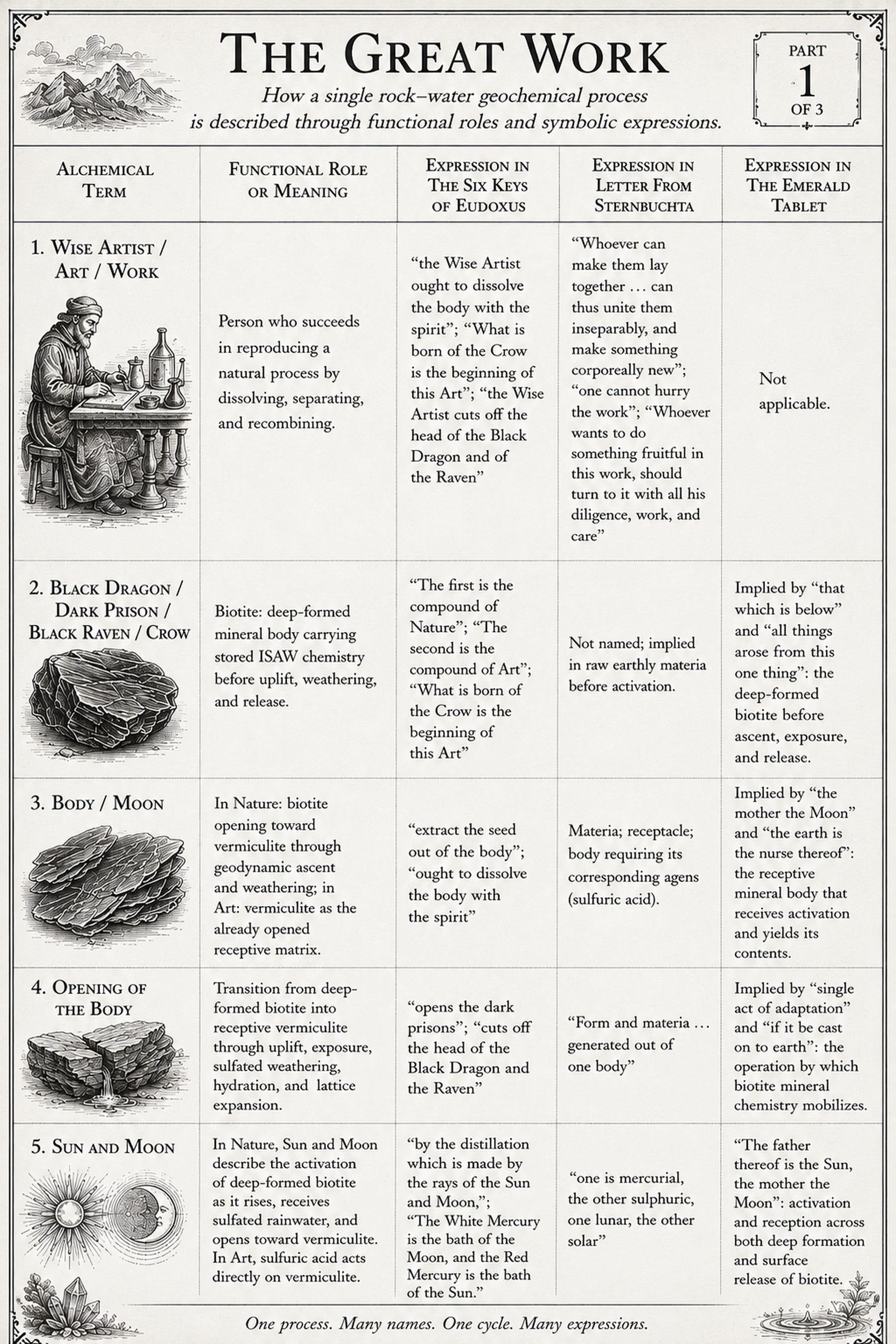
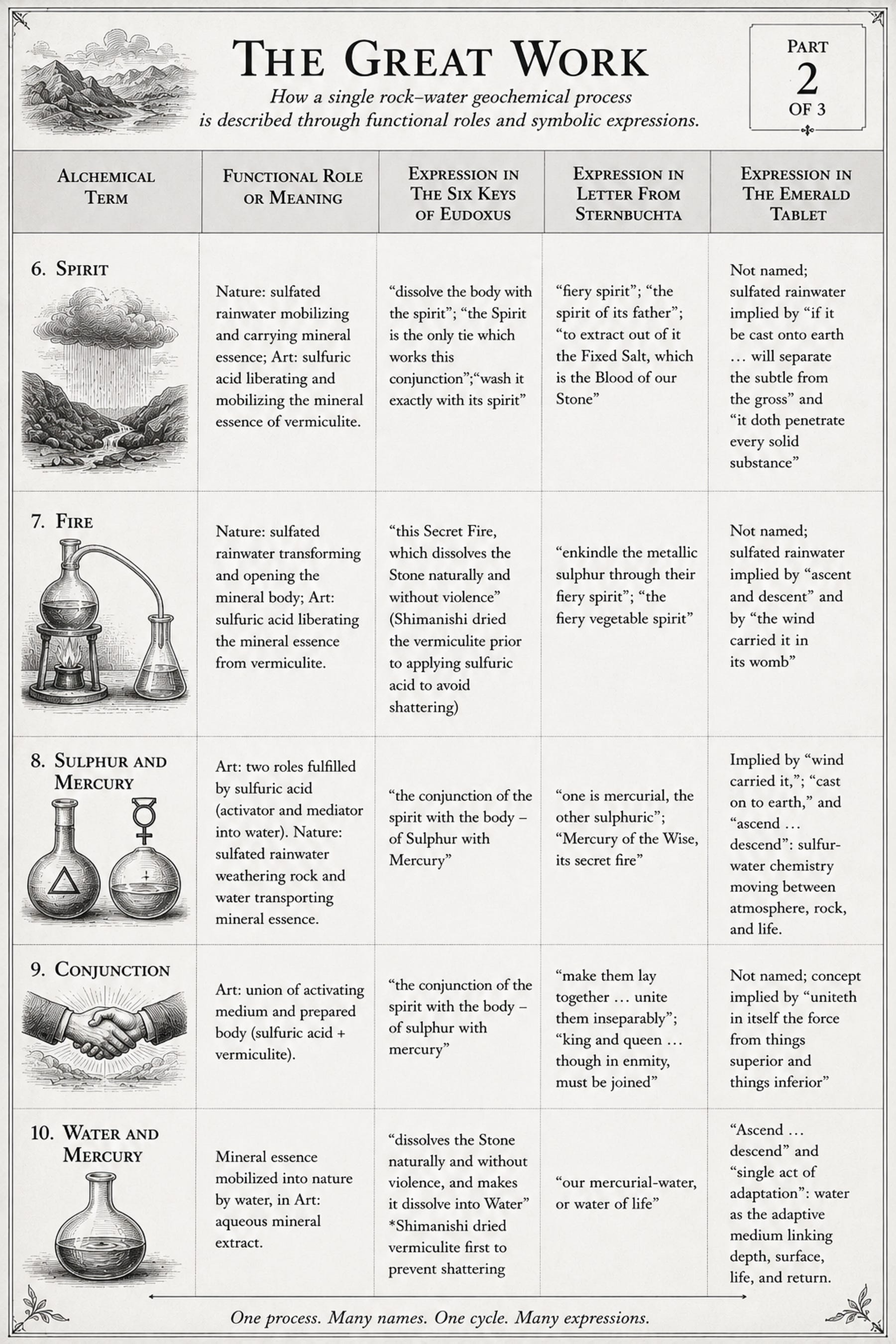
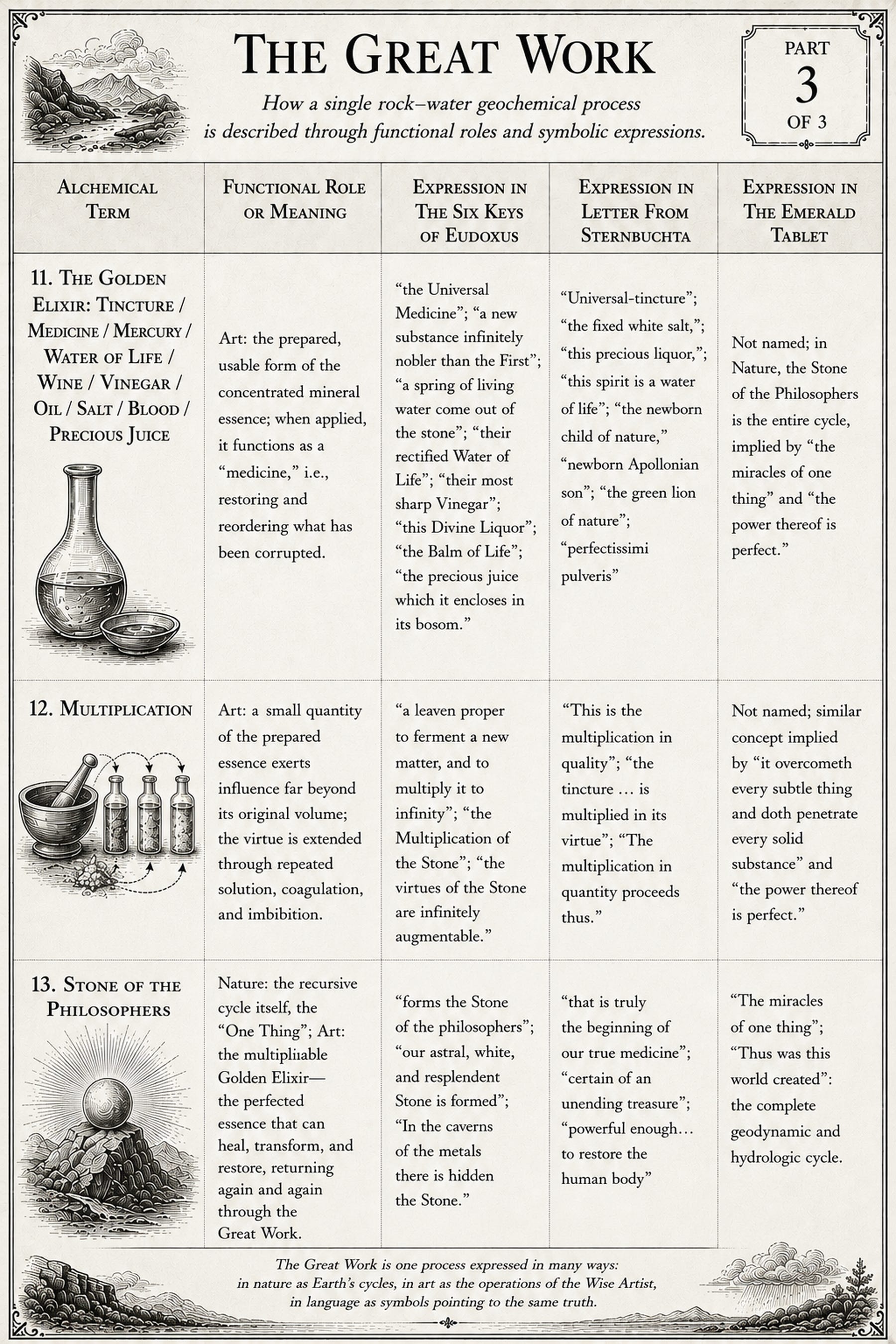
Canonical interpreters of alchemy have long agreed on the structural logic of these texts: the Stone is the product of conjunction, not the substrate; Mercury is a principle, not elemental metal; Sulfur is an activating force; and the Secret Fire is a penetrating solvent rather than literal flame. Across psychological, historical, and esoteric schools—Jung, Newman, Principe, Fulcanelli, and Canseliet—there is broad agreement on these points, even where interpretations diverge.
What our work advances is the material specificity of the terms. The canon was trying to describe a real process, but it did so without naming the substances identifiably. That is why the language stayed open for centuries. Until the process and its product were realized in the world, the symbols could not be fixed to a single meaning. What was missing was the operation itself.
In 1977, after almost 15 years of determined effort, Shimanishi’s successful method provided the missing reference. Through his work with vermiculite-derived mineral chemistry, he devised an extraction process that produced a substance whose properties correspond strikingly to what the canon had long described under different symbolic names. Once that reference existed in the modern world, the language of the texts could finally be anchored to a working operation rather than to speculation. It was only through Shimanishi’s work that the canon became legible.
The Three Works
There is one more feature of this work that needs to be addressed. We return to a line in The Six Keys that I originally interpreted in Chapter XI as referring to the three steps in the process of producing the Golden Elixir:
“But the operations of the three works have a great deal of analogy one to another, and the philosophers do designedly speak in equivocal terms.”
The Six Keys went over these three steps “or works” repeatedly, using constantly shifting language and metaphor: 1) biotite weathering to vermiculite, 2) sulfuric acid penetrating the porous stone, and 3) mineral essence being released.
I am no longer sure that is the line’s primary meaning. As I sat writing this chapter, reflecting upon the coherence of these three texts, separated by hundreds or thousands of years, another strange resonance occurred to me: our journey through the Hermetic canon was also confined, almost unbelievably, to just three works, as that line above states.
The Hermetic and alchemical canon is vast—far beyond the three texts decoded in this book. In fact, neither MB nor I have ever knowingly engaged with any other texts from the Hermetic or alchemical traditions. At one point, I tried to get a sense of how much of that literature remained outside our attention, and the scale of it was staggering. And yet the number of texts that actually entered our lives, held our attention, and ultimately yielded a coherent framework were just these three: The Emerald Tablet, The Six Keys of Eudoxus, and The Letter from Sternbuchta.
That would not be especially remarkable if these were the three most obvious, most widely read, or most accessible texts in the tradition. But they are not. The Emerald Tablet is foundational and famous, yes. However, The Six Keys is known only within a small alchemical community. It has no mainstream scientific or academic visibility, is not commonly taught, cited, or discussed, and almost no educated reader has ever heard of it. If that is not obscure enough, it is almost impossible to describe the level of obscurity that has been accorded to Sternbuchta.
It is so obscure as to be scarcely accessible at all and, in our case, only re-entered the work through an archived trace after more than two decades of inaccessibility. And yet it was precisely this most marginal of the three that proved indispensable. Without Sternbuchta, I do not think we could have defended the coherence of the whole. The Tablet gave the cycle. Eudoxus gave the guarded operations, but it was Sternbuchta that gave the missing bridge: the nature, value, and behavior of the essence once brought forth. Remove any one of the three, and the structure weakens. Remove Sternbuchta in particular, and I do not think it holds.
That leaves me with a question I cannot fully answer. Why these three? Why, out of such a vast literature, did the work remain so narrowly confined? Why did MB and I, coming to this from different directions and at different times, engage no other text—nor ever seek to? And why did it turn out that only when these three were finally placed together did the canon begin to yield a coherent, material, and operational interpretation?
Finally, why does this line from the Six Keys now affect me more and more deeply each time I read it?
“But the operations of the three works have a great deal of analogy one to another, and the philosophers do designedly speak in equivocal terms.”
I will not be answering that now. My understanding of why these texts appeared in our lives comes later in this series, when the work’s larger understanding comes into view. At present, I will only record the improbability of it. A line that speaks of “three works” that “have a great deal of analogy to each other” and which “designedly speak in equivocal terms” now strikes me as providing an uncannily precise description of the journey through the Hermetic canon that we just completed. Perhaps that is nothing. Perhaps it is only one more coincidence in a project already full of them. However, I find it impossible to dismiss it as an accident.
What the Texts Are Describing
Although neither Sternbuchta nor The Six Keys of Eudoxus uses the phrase “Golden Elixir,” both texts describe the same class of substance that Western alchemy more commonly calls the Philosopher’s Stone, the tincture, the medicine, the Universal Medicine, the Water of Life, or the elixir of life. In Chinese Daoist alchemy, the corresponding idea is named more directly as the Golden Elixir, or jindan. I use “Golden Elixir” here as cross-traditional shorthand, not as a literal quotation from these texts.
The support for that identification is not the name, but the properties. Sternbuchta calls it a “Universal-tincture,” “ our true medicine,” and “an unending treasure,” “powerful enough… to restore the human body,” and describes its “multiplication in quality” and “multiplication in quantity.” The Six Keys calls it the “Stone of the philosophers,” “Water of Life,” “precious liquor,” “Universal Medicine,” and “precious juice” drawn from the Stone. Across both texts, the same pattern recurs: a hidden essence brought forth from stone, rendered active through the Work, multiplied in virtue, and capable of restoration.
That is why, in the chapters above, I have used “Golden Elixir” as the simplest name for the substance these texts appear to describe.
The Work Completed
Nearly two millennia after the cycle in Nature first appeared in the alchemical tradition, the core chemistry it described appears to have been realized as a tangible material that can be produced, carried, and applied: a concentrated mineral essence corresponding operationally to the sequence described in The Six Keys of Eudoxus and behaviorally to the properties described in Sternbuchta’s letter.
What had been missing until now was the Rock–Water Circuit Theory, a scientific framework that could integrate deep mineral formation, geodynamic ascent, sulfated weathering, water chemistry, sulfur cycling, mineral lattices, biological uptake, and geologic return into a single coherent process. Once biotite is understood as the imprisoned body, vermiculite as the naturally opened and receptive matrix, sulfur as the activating force, and the mercurial principle as the mediating carrier, the canon resolves without contradiction.
In our reading, neither biotite nor vermiculite is itself the Philosopher’s Stone. In Art, it is the concentrated, multipliable mineral essence the alchemists described as the Golden Elixir and that Shimanishi produced as a rock extract. Although The Emerald Tablet does not name the Philosopher’s Stone, it describes something even more fundamental: a complete generative cycle. In our reading, what the later alchemical texts called the Stone corresponds to that cycle itself.
The ambiguity of the canon preserved the process by requiring that Nature complete the first transformation before Art could continue it. The closed stone, biotite, had to be opened into a receptive body, vermiculite, before sulfuric acid could extract its essence. In that sense, the Stone, in the later alchemical sense of the Golden Elixir, waited to be realized in material form; before that, it could only be named, symbolized, and pursued.
That the puzzle appears to have been solved based on the work of someone entirely outside alchemy leaves the deepest question. How could the alchemists have gained such precise knowledge of both the cycle in Nature and the means of bringing its core chemistry into form?
We will revisit that question later in the book, but for now, the operative core of the Hermetic canon is closed. Rock, water, sulfur, heat, and time remain at work.
*If you value the late nights and deep dives into all the “rabbit holes” I write about, your support is greatly appreciated.
Note to readers:
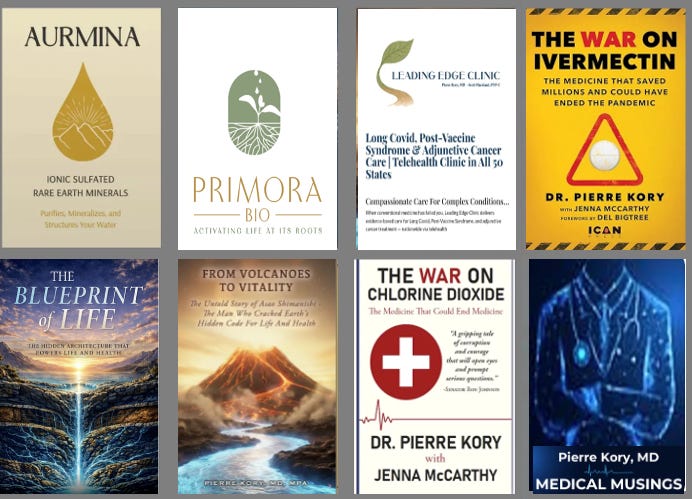
What Shimanishi produced appears to match, in both process and behavior, the kind of revered substance described across numerous cultures and traditions as a “Golden Elixir.” Aurmina, a name we arrived at before this work fully unfolded, means “golden mineral essence.” It is a diluted form of Shimanishi’s extract and part of my effort to carry this work into a practical form through drinking water.
Primora Bio emerged from that same effort, with the intent of delivering the water to soil, crops, plants, and animals.
So for those who want the work to leave the page and enter their world, these are our first attempts to carry it forward.

From Research to Practice - Links Below Image
I love what you're doing! Thank you for taking a risk on what seems like ancient madness, for recognising the power of the cryptic writings.
I have not kept up with this current unfolding of knowledge/discovery process. Very interesting morning read for me! I wonder, with my feeble thinking, what deterred the continuation, availability of these texts to a broader humanity?
As I am drawn to your writings on chlorine dioxide and DMSO, is there any correlation with these findings?
“As above, so below” in biblical terms references the divine linking with the human.
Thank you Pierre!