



Disclaimer:
The studies summarized below were performed using mineral solution products derived from the same parent Themarox complex and prepared at the same mineral composition and dilution as Primora Bio.
Novel Functional Category
Across multiple independent studies, Themarox demonstrates coordinated improvements in plant yield, photosynthetic activity, antioxidant capacity, disease resistance, and reduced uptake of pesticide residues under comparable exposure conditions.
No conventional agricultural input class—fertilizers, biostimulants, microbial inoculants, or soil amendments—has been shown to simultaneously influence growth efficiency, metabolic resilience, and contaminant handling to this extent.
The evidence suggests that Themarox functions as a redox-active, catalytic, ion-exchange-enhancing agent that influences plant metabolism, mineral handling, stress resilience, contaminant burden, and ecological function simultaneously.
Scope of Evidence
The evidence base behind this chapter draws from six independent controlled studies, an out-of-print Japanese primary source book, and a series of government and institutional agricultural evaluations conducted across Japan and Mexico. Taken together, they document more than forty distinct reported outcomes clustered across twelve independent domains of plant biology. The most rigorous of those — controlled measurements of photosynthesis, nematode survival, and antioxidant chemistry — are developed in the chapters that follow. The chapters after it go beneath that surface — into the plant cell, and out into the water around the crop.
All original studies and reports, except for the copyrighted book Rock-Water, can be accessed and downloaded from an OSF repository here.
Reported Agricultural, Soil, Water, Aquaculture, Animal, and Physiological Outcomes Associated with Rock Water
1. Increases in Yield and Photosynthesis
Rice was the most repeatedly tested crop, and the most telling — intensively managed, with stable expected yields, so deviations stand out. In a 1993 Wakayama field program, during one of the worst cold-weather rice seasons in modern Japanese history, Mineral-22-treated paddies reportedly out-yielded untreated fields by 20–25 percent, with more tillering and better lodging resistance (RW-5). The most carefully measured trial — a treatment-versus-control study on reclaimed Korean coastal farmland under the UN Development Programme with Seoul National University — found harvested ears and clean grain each up about 17 percent, while immature grain fell by roughly 31 percent (AG-13). That last number matters most: a third less wasted reproductive effort means the plant was finishing what it started. A separate foliar trial linked to the National University of Mexico saw tillers, panicles, filled grains, and yield all rise 17–37 percent, plus an 18 percent gain in germination from pre-soaking seed (AG-20).
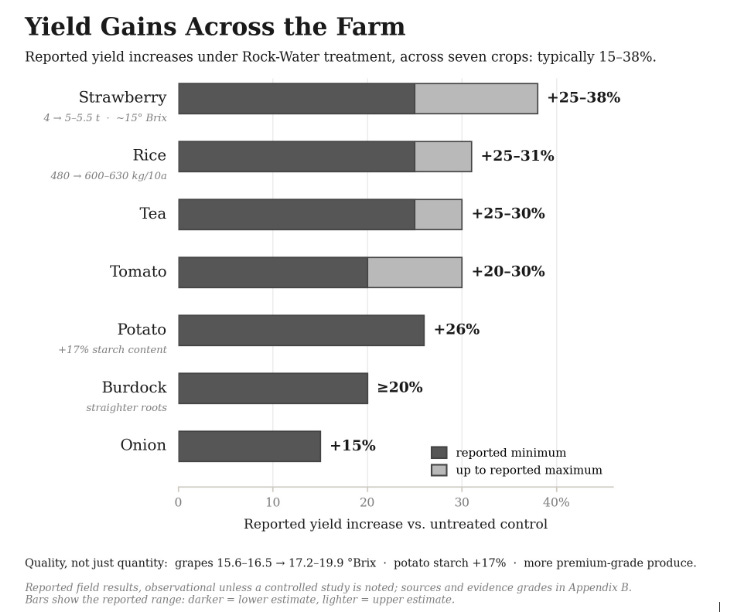
A Japanese report framed the mechanism: Themarox as a water-soluble complex-ion preparation raising photosynthetic capacity 20–40 percent and driving nitrate reduction into amino acids — plant growth as a redox process needing catalytic trace elements (AG-12). Reported yields tracked the same way across rice, strawberry, tea, and tomato, all up 20–38 percent (RW-6, RW-7, RW-24), with potatoes +26 percent and 17 percent more starch (RW-8), onions +15 percent (RW-9), and burdock over 20 percent (RW-10, RW-11). These are observational field reports, not randomized trials — best read as a consistent pattern. Across crops the gain was less about size than about maturation and quality: better-finished, better-keeping, higher-grade produce.
2. Plant Mineral Content, Maturation, and Taste
In a 100-acre San Joaquin Valley citrus grove that had gone non-productive from mineral lockout, an eleven-week foliar program of Volcanna Rain on Navel oranges moved seven of twelve measured leaf nutrients into their optimal ranges — iron and calcium roughly doubling by mid-season (AG-14, AG-15). The striking part was retention: leaf nutrients normally fall as the season closes, yet late-season levels held above optimal across the board. It was a single-arm observational record, not a controlled trial, but it showed what the yield reports imply from outside — tissue chemistry moving toward balance and holding it, several systems stabilizing at once rather than one being pushed by a single added salt.
Quality moved the same way. Sugar rose repeatedly: treated grapes reportedly hit 17.2–19.9° Brix against 15.6–16.5 for untreated (RW-27), with strawberries around 15° Brix and better color, shape, and premium-grade ratios (RW-12). Treated produce also kept longer — delayed yellowing in cucumbers and slower deterioration across categories (RW-17, RW-18, RW-19) — which matters because 30–40 percent of fruit and vegetable production is lost between field and consumer, and shelf-life gains without chemical preservation are largely absent from the conventional toolkit.
The plants were also built differently: thicker stems, better lodging resistance, deeper leaf color, more fine-root development, straighter root crops, lower fruit deformation (RW-13, RW-19). That distinction is the through-line — conventional fertilization adds mass, but stem architecture, fruit shape, and premium grade require something else. Across treated systems the gain was maturation, structure, and quality rather than size, pointing toward mineral balance and redox-coordinated development.
3. Increases in THC, Terpenes, and Reduction in Pesticide Uptake
A more recent greenhouse study tested whether Drops of Balance (equivalent to Mineral-22) could reduce contamination and affect cannabinoid and terpene production in cannabis over a 13.5-week cycle, across three groups: untreated control, soil pretreated once before planting, and plants treated during the grow (AG-16, AG-17, AG-18). Samples went to a third-party lab, tested in triplicate.
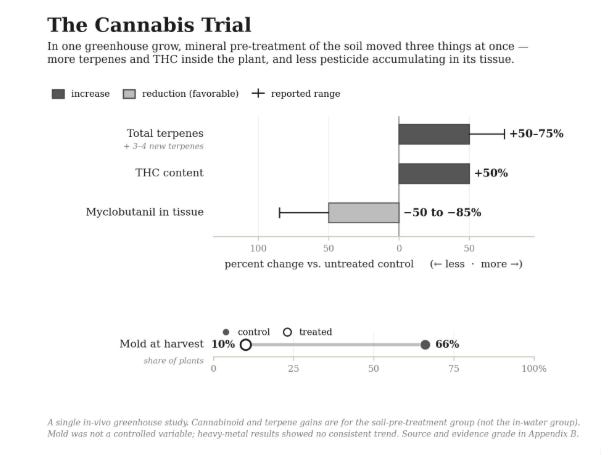
Three findings stood out. Myclobutanil — the one pesticide persistent enough to track — accumulated about 50 percent less in plant tissue after treatment, with some reductions of 70–85 percent (AG-16). The soil-pretreatment group showed up to 50 percent more THC and 50–75 percent more total terpenes than controls, plus three to four terpenes absent from the other groups — gains that appeared only with pretreated soil, not mid-cycle treatment (AG-17). And two weeks before harvest, mold struck roughly two-thirds of control plants versus about 10 percent of treated ones — though the authors noted mold was not a controlled variable, so it’s a signal, not a result (AG-18). The heavy-metal data showed no consistent trend (AG-16).
The study isn’t blinded, randomized, or definitive, but under real cultivation it associated Rock-Water with lower pesticide accumulation, higher cannabinoid and terpene output, and less mold — evidence it can alter contaminant handling and metabolic expression in vivo.
5. Increase in Photosynthetic Activity
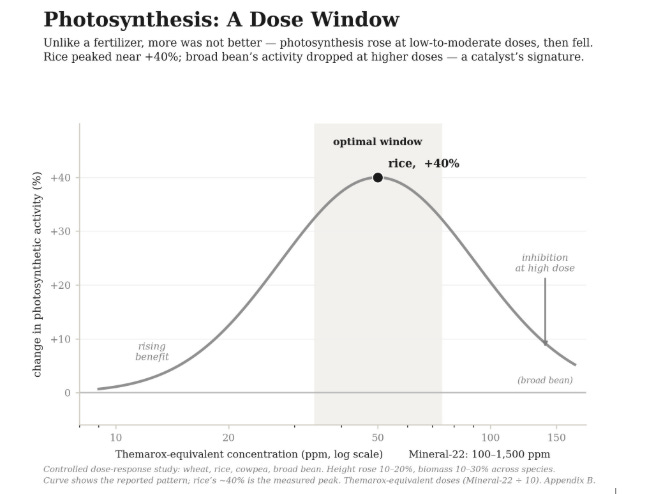
Behind the manufacturer’s 20–40 percent photosynthesis claim — a trade figure — sat a controlled laboratory dose-response study that asked whether the effect was real and where it peaked. Wheat, rice, cowpea, and broad bean seeds were soaked in Mineral-22 from 100 to 1,500 ppm, then measured for seedling height, biomass, and photosynthetic electron-transport activity (AG-11). The results were non-linear: low and intermediate doses improved growth and photosynthetic function, while excessive concentrations reduced the benefit or inhibited outright. Height rose 10–20 percent and biomass 10–30 percent across species, and rice at 500 ppm showed roughly a 40 percent jump in photosynthetic activity — while broad beans actually declined at high doses.
That dose-window shape is the key. A fertilizer model predicts more mineral, more growth; here there was an optimal dose that too much overshot — the behavior of a catalyst or regulator, which is how the authors read it. And photosynthesis is the natural place to see it: it’s an electron-transfer system at bottom, so if Rock-Water alters electron-transfer efficiency, oxidative balance, or ionic behavior near biological interfaces, photosynthetic systems should be among the first to respond.
6. In-Vitro Pest Suppression
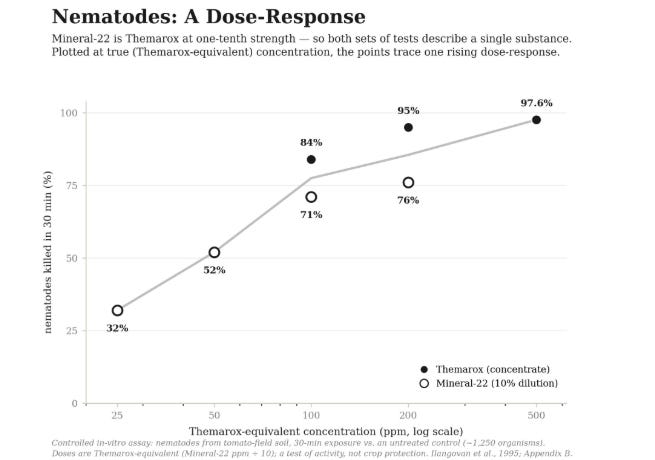
The same Mexico group ran a second controlled assay, this time on plant-parasitic nematodes isolated from tomato-field soil, exposed to graded doses of Themarox and Mineral-22 against an untreated control of about 1,250 organisms (AG-19). Both killed dose-dependently along a smooth curve: Themarox removed about 84 percent at 100 ppm, climbing to nearly 98 percent at 500 ppm, with the tenfold-weaker Mineral-22 tracking the same curve at correspondingly higher doses. At low concentrations the organisms showed a molting reaction; at higher ones, microscopy showed the body wall disintegrating, the animals collapsing as if dehydrated.
The point isn’t pest control — it’s a single in-vitro assay on isolated organisms, not a field demonstration, and shouldn’t be inflated into a crop-protection claim. The point is the clean dose-response against a counted control: the signature of a real biological action, the second such signature alongside the photosynthesis study. It shows Themarox acting on living cells at low concentration in a way consistent with oxidative, membrane, or electrochemical effects at the organism-water interface — the same interfacial mechanism that keeps surfacing across this record.
6. Antioxidant Capacity and The First Mammalian Signal
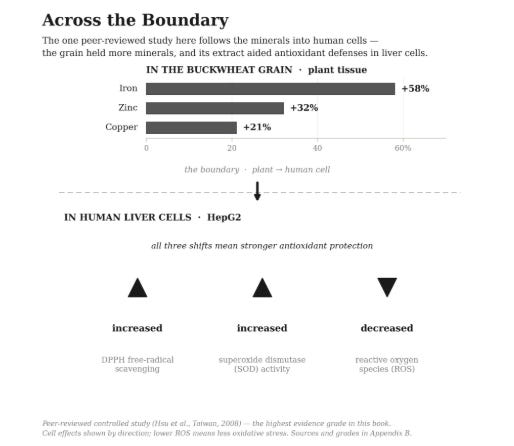
The one study that doesn’t stay inside agriculture. Hsu and colleagues grew tartary buckwheat sprouts sprayed with either deionized water or trace-element water at 100–500 ppm, with the strongest response at 300 ppm (RW-1). Treated sprouts accumulated more copper, zinc, and iron (up ~21, 32, and 58 percent) and became measurably better antioxidant systems — stronger radical scavenging, ion chelating, reducing power, and inhibition of lipid peroxidation. Tellingly, this was independent of flavonoid content: rutin, quercitrin, and quercetin were essentially unchanged, so the gain wasn’t the plant simply making more of its usual protective compounds.
Then the investigators did something nothing else in this record does: they exposed human HepG2 liver cells to extracts from the sprouts. Cells given extract from the trace-element group showed higher superoxide dismutase activity and lower reactive oxygen species than controls (RW-1). The scope is narrow — one cell line, one plant, one set of assays — but it’s the single point in the entire agricultural evidence base where conditioning a plant’s mineral environment produced a measurable effect in human cells. Whatever the conditioning did to the plant did not stop at the plant boundary.
7. Ecosystem and Biodiversity
This rests on the unspent half of the Korean study — the one genuine paired treatment-and-control entry in the agricultural record, run on reclaimed coastal rice farmland under the UN Development Programme with Seoul National University and Korean government agencies around 1999–2000 (AG-13). Beyond the grain-quality numbers (ears up ~17 percent, immature grain down ~31 percent), the investigators also monitored the surrounding ecosystem. Aquatic insect species diversity in the treated zones ran roughly 1.6 times higher than in untreated areas — while water quality held steady across pH, conductivity, dissolved oxygen, chemical oxygen demand, and nutrients, with no adverse effects.
That 1.6-fold biodiversity gain is an ecological metric, not a yield one, and it points opposite to almost everything in modern agriculture. The dominant inputs of the last century buy productivity by spending ecological function — they raise the crop and lower the surrounding life, a trade so routine we’ve stopped noticing it’s a trade. An intervention tied to higher yield, higher quality, and higher biodiversity in the same plots, with no water degradation, isn’t making that trade. Whether it reproduces under stricter conditions is open — but as a signal, it’s the quiet capstone of the agricultural evidence: more food without the usual ecological bill.
Overall Pattern
Across plants, soils, aquatic systems, and animal studies, the reported outcomes cluster around five recurring themes:
Improved mineral incorporation
Improved redox and oxidative regulation
Improved water and oxygen handling
Improved biological organization and resilience
Improved exchange between organisms and their environment
Not every outcome has been demonstrated with the same level of evidence. Some come from controlled experiments, some from field trials, some from observational reports, and some from company archives. However, the remarkable feature of the literature is the consistency of direction: biological systems repeatedly appear to become more productive, more resilient, more organized, and more efficient across multiple domains simultaneously.
Independant Studies
Across six controlled agricultural and biological studies (crop trials, soil restoration, metabolic assays, and ecosystem monitoring), Rock—Water, made from Themarox-derived solutions identical to Primora Bio, was evaluated for its effects on plant productivity, contaminant handling, antioxidant capacity, photosynthetic activity, and ecological resilience.
The collective dataset spans:
Controlled crop trials (rice, citrus, cannabis, buckwheat)
Soil and ecosystem restoration field studies
Biochemical and cellular antioxidant investigations
Government and institutional agricultural evaluations
Bottom-Line Quantitative Impact Statement (Across All Studies)
Across agronomic, biochemical, and ecosystem endpoints, Primora Bio water solutions demonstrated:
+16–17% increases in productive plant structures
~30% reductions in immature or poorly matured yield components
+21–58% increases in trace mineral incorporation into plant tissue
~15–30% increases in antioxidant capacity across assays
~15–25% increases in cellular antioxidant enzyme activity
~15–20% reductions in intracellular oxidative stress markers
~50% average reductions in pesticide residue accumulation (peaks ~70–85%)
~1.2× increases in ecosystem biodiversity metrics
No measurable environmental toxicity or water-quality deterioration
Integrated Interpretation
Taken together, the studies do not show a narrow fertilizer-like effect. Instead, they reveal a multi-domain agricultural impact profile, including:
Improved plant metabolic efficiency and photosynthesis
Enhanced trace mineral incorporation and redox capacity
Reduced contaminant uptake and oxidative stress burden
Accelerated maturation and structural productivity
Improved soil ecology and environmental resilience
If you value the late nights and deep dives into all the “rabbit holes” I write about (or the Op-Eds and lectures I generate for the public), your support is greatly appreciated.

*If what you just read raised questions about the mineral system at the center of it, you can explore it further at Aurmina.com or Primorabio.com, where we are working to make Shimanishi’s extraordinary achievement more widely available for both drinking water and agricultural applications respectively.
From Research to Practice - Links Below

Noches.
I can take a stab at the matrix tomorrow. I’m thinking your objective is twofold: 1) quickly interest the reader with where you are headed and 2) give a guide, the matrix, as to how pre existing research supports your thesis point by point.