



Thanksgiving Weekend Sale at Aurmina continues: My 4th post in 4 days, all on the Pilgrims, their relationship to water back then, and ours now. Our Thanksgiving sale runs through Cyber Monday: single bottles are 25% off, three-packs are 30% off, and six-packs are 35% off. All of it is at Aurmina.com. 3rd party lab testing shows that treating water with Aurmina, followed by filtration, reduces more than 240 contaminants (most by over 90%), with 145 below detection.
This weekend I am writing about the water the Pilgrims found in 1620 and the water we drink four hundred years later.
The men who scouted Plymouth in December of 1620 had no instruments, but they knew what they were drinking. Beside the “sand, gravel, and excellent clay” they wrote down “the best water that ever we drank.” Fourteen years later William Wood told English readers that in New England every family, or every two, had “a spring of sweet waters” between them, and that “it is thought there can be no better water in the world.”
That water was not pure in the way laboratory water or home reverse-osmosis water is pure. It was Earth’s water. It had spent years moving through soil and stone, and it came up carrying calcium, magnesium, bicarbonate, silica, and dozens of trace elements picked up along the way. That journey through stone binds and removes what does not belong and leaves in what does. For most of human history, clean water and mineral water were the same thing. Nobody had ever “drunk drink” (inside joke at this point) water of any other kind.
Then our waters started to degrade. As American cities and industries grew through the nineteenth century, the rivers people had drunk from became sewers they still drank from, and typhoid became a fact of urban life. Engineers fixed that between 1890 and 1930 with sand, a dissolved mineral, and eventually chlorine. As I wrote on Friday, major advances in water treatment largely stopped after that, because the battle was thought to be won. On Saturday I wrote about how they won: simply by building a copy of the ground where the water that came out of those plants was cleared of sewage and still carried its minerals.
I also suggested that part of the massive reductions in deaths from drinking water may have come from filtering early industrial wastes, which have since become far more numerous, diverse, and complex. The Green Revolution brought soluble-salt NPK fertilizers and an ever-growing list of pesticides and herbicides, while the Industrial Revolution continues to add to the hundreds of thousands of synthetic chemicals, on top of a mid-century shift to mechanized groundwater pumping. Together, they have led to what I propose in my book The Silent Aquifer: a Geohydrological Shift (the title boldly echoes Rachel Carson’s Silent Spring, the book about DDT’s impact on nearly all of biology that helped launch the environmental movement in this country).
Decades before MAHA, the latest iteration of that movement, with its rallying cry against the corporate pumping of toxins into our food, vaccines and medicines into our children, contaminants in our water, chemicals in our soils, and God knows what in the skies, people began adding another step in water filtration, slowly at first and now more quickly. This one starts once the water enters our homes.
Home Filtration Systems Enter the Picture
The third major turn in water purification was the adoption of home filtration systems, which continue to spread today (a good thing, I would argue). The Water Quality Association’s national survey found in 2023 that 45 percent of American households now have a water filtration system other than a refrigerator filter, up from 40 percent two years earlier. Grand View Research puts the US market for home water filtration units at about $1.5 billion in 2024.
Which brings me to the subject of today’s post: reverse osmosis, the home filtration industry’s largest and fastest-growing segment. I will argue that most people who demineralize their water are unaware of either the adverse consequences or the limits of the usual fix (remineralization). I believe RO overshoots the goal: it either causes harm or, at minimum, cancels out its own benefits. So hear me out, especially since I write and research from such an unbiased, conflict-of-interest-free perspective (ahem)..
What Reverse Osmosis Is
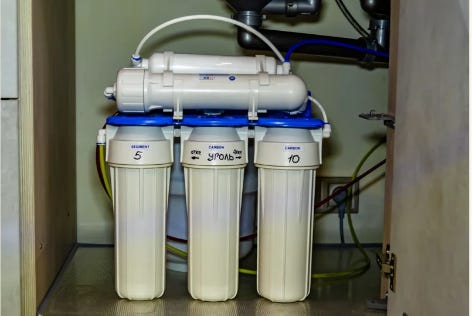
Reverse osmosis, or RO, is a way of cleaning water by forcing it through an extremely fine plastic sheet called a membrane. Its pores are so small that water molecules can squeeze through, but almost everything dissolved in the water cannot: salts, metals like lead and arsenic, fluoride, nitrates, and most chemical contaminants. Think of a window screen that lets air through and keeps the bugs out, only here the bugs are too small to see.
What is fascinating is that even water won’t pass through pores that small on its own, so the system needs pressure to push it through; the more that is dissolved in the water, the more pressure it takes. Tap water has very little dissolved salt, so under-sink units can run on household water pressure alone, though they work slowly and waste a lot of water.
Clean water comes out one side. Everything the membrane stops stays behind on the other side and is flushed down the drain in a stream of wastewater. What comes out is very pure. The membrane typically removes 90 to 99 percent of everything dissolved in the water. The problem is that this includes minerals along with contaminants, and minerals give water the chemistry it needs to support life.
Reverse osmosis was invented back in the space-obsessed age of the 1950s at UCLA, when Sidney Loeb and Srinivasa Sourirajan made the first practical reverse osmosis membrane and filed for a patent in 1960. They built it to turn seawater into drinking water for a thirsty planet, a worthy goal (which has greatly benefited largely rich countries like Israel and those on the coast of the Persian Gulf). Within a few years, the same idea was moving into homes.
In 1966, an engineer named Dean Spatz put the first home drinking-water units into a few New England wells that had been ruined by road salt. In 1970, two engineers in San Diego, Don Bray and Ross Brown, patented a complete under-sink system with its own storage tank and faucet. When they showed it to the bottled-water company Arrowhead, they were told that Arrowhead would worry about it once it took a fifth of their customers. So they sold the first few hundred through a local water-softener dealer.
Arrowhead misjudged it. Better membranes arrived around 1977, cheap ones spread through the 1980s, and today the under-sink RO unit is the flagship of a large industry. MarketsandMarkets puts the global point-of-use RO market at $3.8 billion and growing about 7.5 percent a year.
I understand why. I have spent this weekend, and most of a book, explaining why people have every reason to distrust their water. A household that installs RO is acting rationally on what it knows. And I have to openly admit that, on removal alone, reverse osmosis takes out more than Aurmina's volcanic mineral chemistry does. If the only question is how much comes out, RO wins.
What a Good Doctor Would Tell You About RO
We physicians are trained to “inform” patients (I prefer “educate”) about the risks and benefits of anything we recommend. In practice, most doctors leave the benefits implied, recite the risks, call them rare, and hand over the consent form. What almost always gets left out is the most important part: the alternatives.
I always covered all three, beginning with benefits, not risks. I hated watching patients handed a binary choice, do it or don’t, when there was nearly always a rational third path. Home filtration is the same. There are many alternatives, because there are many trade-offs: purity, health, cost, water waste, and labor. By the end of this post you’ll see several ways to skin that cat, with or without Aurmina, which has drawbacks of its own (sort of).
The other thing I learned to respect was risk tolerance. Some patients fear every risk. Others are the grizzled veteran who says, “Whatever you want to do, doc.” RO best fits the first group: people frightened enough of their water to put purity above every cost. I want my readers mindful of their water, not terrified. But for someone who is, I could see myself recommending RO (with Aurmina, of course).
The Cost of Wasted Water
OK, so I already granted the benefits of RO: it produces the highest purity water attainable in the home. Now for the downsides, of which there are several. The first is water waste. The EPA says a typical home RO system sends “five gallons or more of reject water for every gallon of treated water produced,” and inefficient ones send up to ten. In the supporting statement for its 2024 WaterSense label, the agency did the household arithmetic: a typical unit discards roughly 5,320 gallons a year in order to deliver about 940 gallons of drinking water. A labeled system, the agency estimates, saves about 3,130 gallons a year. On the same page, it says something I did not expect a federal agency to put in writing: because RO uses so much water, WaterSense “does not intend to promote the installation of RO systems for all applications or encourage their use over other water treatment technologies that do not waste as much water.” Distillation avoids the drain by boiling every gallon, which moves the cost to your electric bill and still produces water with almost nothing in it. In “Earth’s Living Water” I put it this way: “You cannot spend your way out of a water shortage by wasting it.”
The Money Cost
I have already mentioned one money cost: your water bill. Now add in the cost of the unit, installation, filters, and maintenance. And given how much water goes down the drain, don’t forget the sewer bill. Under-sink systems typically don’t require power, but tankless models, units with a booster pump for low-pressure homes, units with a UV lamp, and whole-house systems all plug in. Whole-house systems also need a pump to push the treated water back through the home’s pipes.
It goes without saying that RO is unaffordable for a good portion of this country, and, in all honesty, Aurmina is currently only modestly cheaper. One difference: Aurmina’s price is at its ceiling. I fully expect that once we, or a competitor, produce a similar solution at scale in the United States, the price will plummet, and I mean plummet, whereas RO is probably at its floor already.

The Health Cost
The larger cost is what empty water does to humans (and to animals and plants, a topic I will leave for another day). I hate being the one to tell you this, because I sell an alternative and you have every reason to hear that as marketing. So let me lean on the least excitable source available. Twenty years ago, the World Health Organization published a chapter titled “Health Risks from Drinking Demineralized Water.” It is not equivocal.
When human volunteers drank water with total dissolved solids at or below roughly 75 to 100 mg per liter (RO is typically under 25), urine output rose by almost 20 percent, serum sodium climbed, serum potassium fell, and the body began flushing sodium, potassium, chloride, calcium, and magnesium. The water does not just fail to deliver minerals. It also pulls them from food. Cook vegetables, meat, or cereals in it, and you lose up to 60 percent of the calcium and magnesium in the food itself, along with 66 percent of the copper, 70 percent of the manganese, and 86 percent of the cobalt.
What Years of It Do to a Community,
Those were changes measured over days and weeks. What years of low-mineral water do to a whole community comes from one large Russian study. In the Ust-Ilim region, G. F. Lutai examined the health and physical development of over 10,000 people living in two adjacent areas whose water differed mainly in how much mineral it carried. One supply averaged 134 mg/L of total dissolved solids, with 18.7 mg/L of calcium and 4.9 mg/L of magnesium; the other averaged 385 mg/L, with 29.5 mg/L of calcium and 8.3 mg/L of magnesium. The two populations did not differ in eating habits, air quality, social conditions, or how long they had lived there.
The people drinking the lower-mineral water had higher rates of goiter, hypertension, ischemic heart disease, gastric and duodenal ulcers, chronic gastritis, cholecystitis, and nephritis. Their children developed more slowly and had more growth abnormalities; their pregnant women suffered more often from edema and anemia; and their newborns had more illness. Morbidity was lowest where the water carried 30 to 90 mg/L of calcium, 17 to 35 mg/L of magnesium, and about 400 mg/L of total dissolved solids, and Lutai considered water like that “physiologically optimal.” (Please note: he is the only researcher I have found anywhere in the literature who has tried to define a physiologically optimal water).
What strikes me most is that the ‘poor’ water in this study was nothing like distilled or RO water. At 134 mg/L, it sat above the 100 mg/L minimum the WHO experts proposed, and the community drinking it was still measurably sicker. Again, most household RO water sits below 25 mg/L, far below what the sicker community had.
It Dissolves the Plumbing, Too
Demineralized water is also aggressive enough to dissolve metal out of the plumbing it passes through, which is one reason desalinated city water is routinely remineralized before it enters the pipes. The same WHO chapter describes three infants lead-poisoned that way, with blood-lead levels of 15, 37 and 42 µg/dL, when the level of concern was 10. In the two most severe cases, first-draw water at the kitchen tap measured 495 to 1,050 µg per liter. The German Society for Nutrition has formally warned the public against drinking distilled water, and the warning applies just as well to the reverse-osmosis water people actually drink at home every day.
In the early 2000s, households in parts of the Czech Republic and Slovakia began installing RO at the tap. Within weeks to months, the WHO review reported that they were complaining of fatigue, weakness, headache, muscular cramps, cardiac complaints, and elevated urine output. Granted, these were not randomized trials, but the timing was more than convincing: the complaints appeared in people who had just switched from mineralized water to water containing almost no calcium or magnesium.
Why Minerals in Water Matter More Than Minerals in Food
I find that many people have been focused on the decades-long decline in the mineral content of our foods (me included if you have read my books). The more concerning issue, in my opinion, is the low mineral content of our water. Why do I say this?
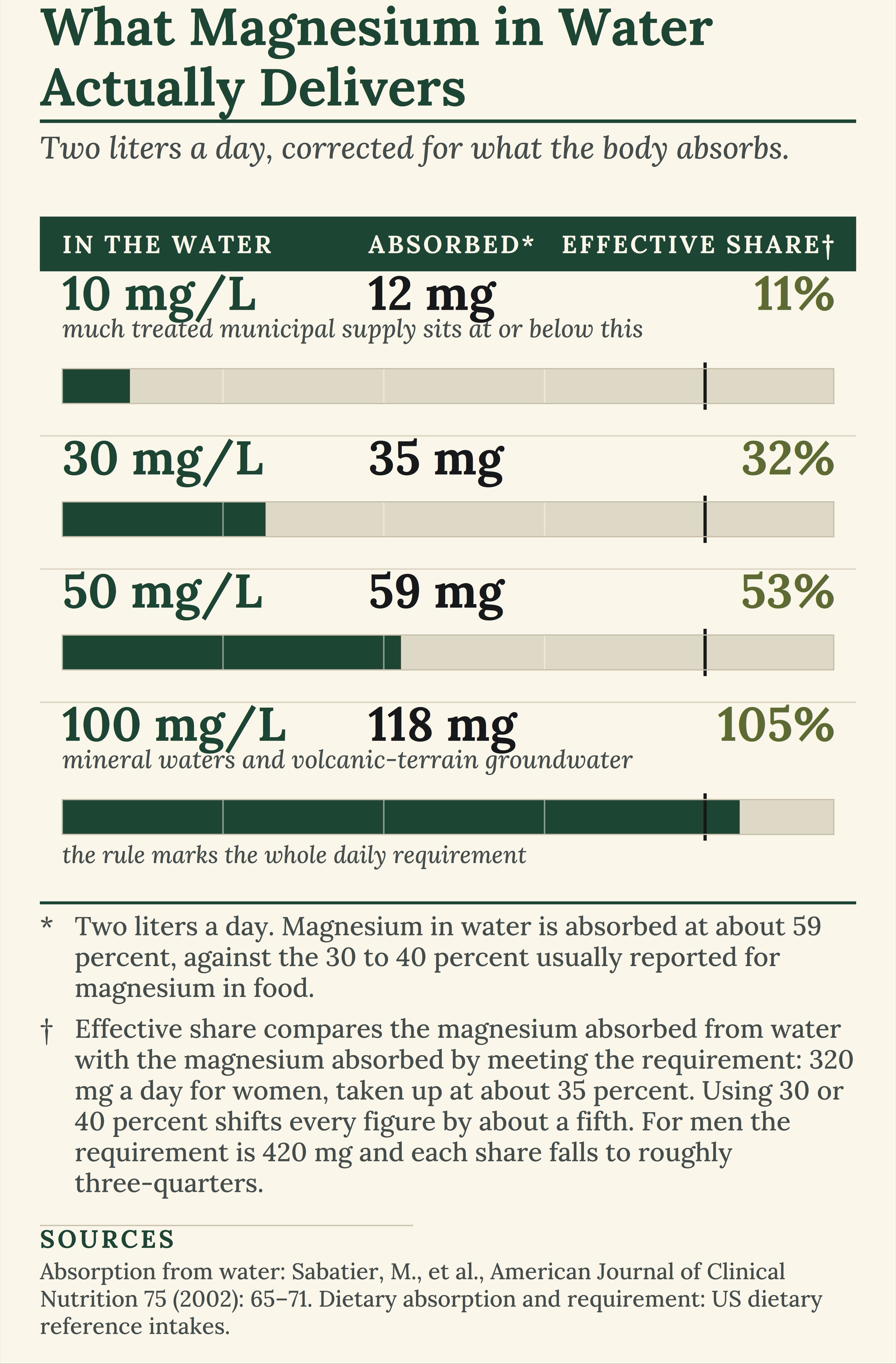
Magnesium in water is much more readily absorbed than magnesium in food (in one study, 59% absorbed from water vs. 30-40% in food) because it is already dissolved and bioavailable, whereas food magnesium is often bound to fiber, phytates, oxalates, and plant cell structures that reduce absorption. That is why even a small amount of water can make a measurable difference for populations with marginal diets.
Magnesium is where the population evidence is strongest. Across countries and decades, studies have repeatedly associated higher magnesium concentrations in drinking water with lower cardiovascular mortality. Although the current “rules” (in Science with a capital S) state that when such associations are found, we researchers must say “correlation is not causation” because of “unmeasured confounders.” Nonsense. For those interested, I recently did a deep dive into the logic and evidence behind what I call “the myth of the unmeasured confounder” and believe I credibly debunked it.
With that in mind, a meta-analysis of ten studies involving 77,821 coronary-heart-disease deaths found an inverse association, although the studies were substantially heterogeneous. A separate systematic review likewise found evidence of an inverse association between drinking-water magnesium and cardiovascular mortality, while associations with calcium, stroke, and some other cardiovascular outcomes were less consistent. Smaller studies have also reported associations between low-magnesium water and sudden cardiac death; motor-neuron disease in one geographically concentrated Japanese population also exposed to high dietary manganese; preeclampsia in one Hungarian population; and mortality from several cancers in ecological or case-control studies (see Chapter 33 of Earth’s Living Water for citations).
To be fair, several large cohort studies found no overall association. But in a Dutch study of more than 120,000 people, among men with the lowest dietary magnesium intake, higher tap-water magnesium was clearly protective against stroke. The signal shows up where it should, in the people with the least magnesium to spare.
Low Calcium Water
There is also concerning literature around low-calcium water. Recent studies found “associations” with a higher risk of fracture in children, certain neurodegenerative diseases, preterm birth and low birth weight, and some types of cancer.
I will never forget a comment from a reader after I posted an early draft of a chapter on this topic about a year ago: “I have been drinking RO water for 20 years and feel fine, perfectly healthy.” I wrote back, “I smoked two packs a day for almost 30 years, and I feel fine too!”
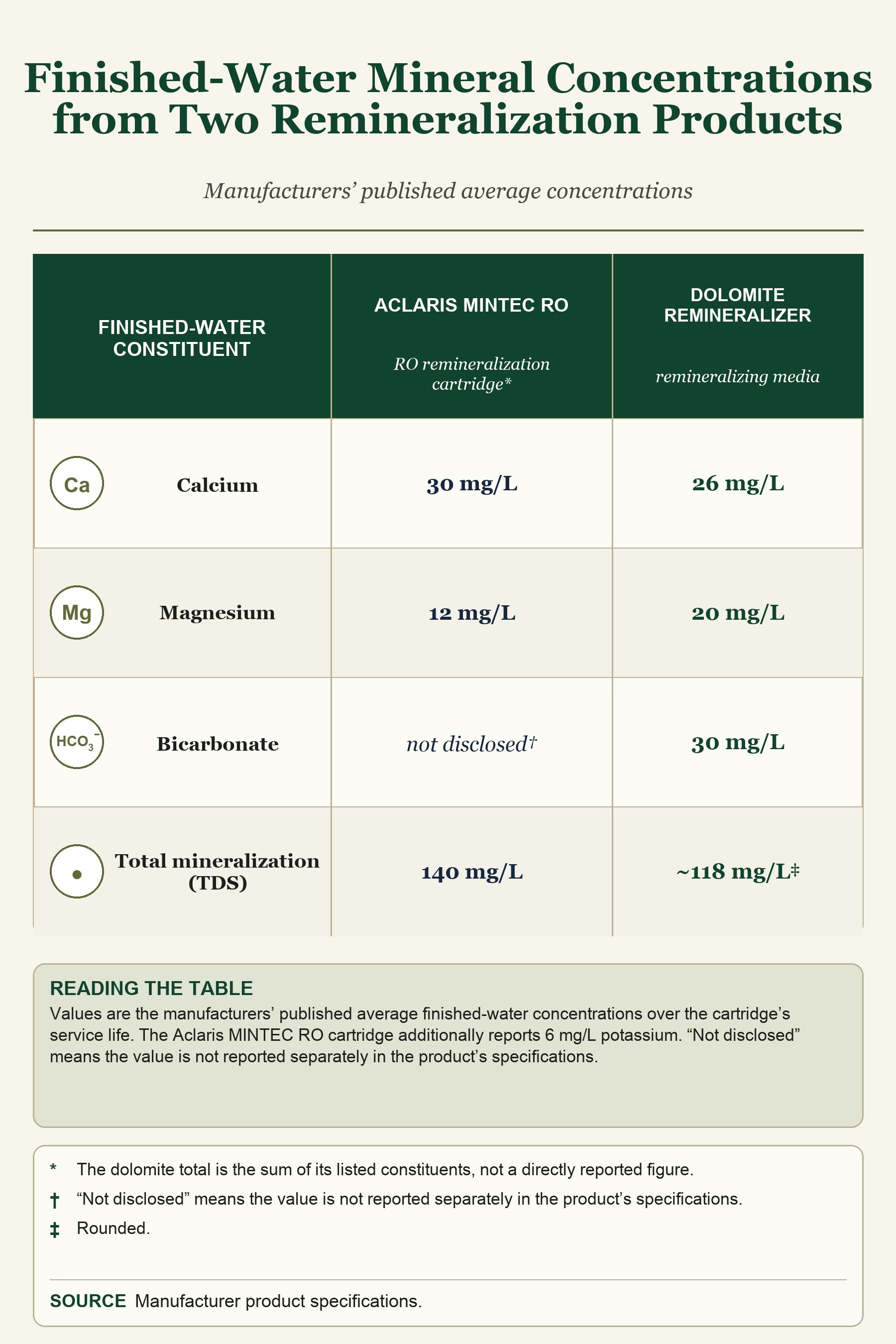
The expert team behind a 1980 report on demineralized water, later summarized in the WHO volume, proposed minima of about 30 mg per liter of calcium, 30 mg per liter of bicarbonate and 100 mg per liter of total dissolved solids, with other researchers cited there proposing at least 10 mg per liter of magnesium. Those were never adopted as official WHO guideline values. Even so, unremineralized RO and distilled water sit far below them. Remineralization cartridges exist and sell, but from my discussions with patients, surprisingly few people install or maintain one.
Of the cartridges that publish what they actually add to water, few, if any, verifiably reach even that floor.
The Taste and Pleasure Cost
Demineralized water is well known to taste flat, and some people find it unpleasant. (Then again, think back to your first beer, whiskey or coffee: most of us can develop an affinity for even the most unpleasant beverage. Take tequila, for instance. Yech.)
The best-tasting drinking water, according to the sensory literature, is neither stripped nor heavily mineralized; it is lightly and broadly mineralized, carrying a faint, balanced spread that reads as smooth and faintly sweet, while both near-empty water and salt-heavy water taste worse. That light, broad, trace-level touch is exactly what Aurmina delivers (the taste finding comes from the published literature, not from me). The amounts in Aurmina are too small to be nutrition and too broad and balanced to be salinity, which is exactly the profile of water at its most palatable.
I am rarely, if ever, down, but one sure way to lift my spirits is to read the reviews on our website (or analyze our superb return customer rate). If this section reads like a commercial, I won’t argue. Allow me this one indulgence, and I promise not to overdo it in the future. I can’t help it:
Taste
“Best water ever!!!! Better than really good mountain spring water!” (Verified customer)
“Greatly enhances the taste of our RO water.” (Larry, MD)
Our city tap water has a wonderful taste now. Reminds me of the excellent water we had when we were on well water.” (Kathleen H.)
Enjoying water again
My favorite feedback came from my Leading Edge Clinic practice manager, Tisha, who notoriously hated water (maybe a strong word, but she certainly never chose it as a beverage), but once we brought Aurmina into her life, she became a regular water drinker! She is not alone:
“I am not a water drinker but I now can drink water and enjoy it! Never thought this would happen!” (Verified customer)
“I drink more water now and enjoy it more. Easy to use.” (Bonnie R.)
“I finally feel good about the water I drink, and I drink more as a result.” (Verified customer)
Seeing what settles out
“I was surprised by how much gunk we still have in our water even after a very good softener and R.O. system.” (Rachel)
“I have a filter system installed to the water entering the house. I am surprised to see how poorly this expensive system is working! A substantial layer of sediment is at the bottom of a pitcher of water after 48hrs.” (Verified customer, France)
“I am amazed at the ‘material’ that Aurmina removes from my well water. My water now tastes so good.” (Bill F.)
Trust, ease and word of mouth
“It’s great to have a product free of hype and supported by real science and factual data.” (Jeff O., repeat customer)
“I am very impressed with this product and the ease of use and the ability to store it.” (Angela J., customer for almost a year)
“I love it. I have sent some to my family members. They love it, too!” (Cheryl C.)
The Downsides of Aurmina Mineral Chemistry
OK, OK, calm down, Pierre; why don’t you tell them about Aurmina’s limitations? Fine. I will.
I would say there are only two (or three if you count cost), but I want to argue that we're working hard on solutions for all of them.
Aurmina will not put appreciable calcium and magnesium back into water that RO has stripped, as the amounts it contains of those minerals are too small to change the measured levels in your drinking water. If you are starting from RO or distilled water, you still want a remineralization filter. Aurmina is purification chemistry, and not a mineral supplement (though we are working on one for water).
For now, using Aurmina optimally requires customers to work what we call “the Aurmina ritual” into their lives (unless you prefer to simply decant the clear water above the floc - that requires little effort). Otherwise, it means you set aside counter (or pantry) space for a gravity filter (which many people already have) and the “treatment containers.” What many people rebel against is the added daily task of keeping an assembly line going: fill the containers, add Aurmina, wait 24 to 48 hours, pour into the gravity filter, refill, and repeat. I actually love “preparing our water” and do it every morning while waiting for my coffee to brew. My partner Scott, bless his soul, keeps his filter and containers in the basement and thus runs up and down the stairs with cleaned water every day (that is insane, in my opinion). Either way, we are working on an under-counter (and above-counter) system that will drastically reduce the labor involved. Stay tuned.
Cost. Aurmina is currently diluted from Themarox, a raw material produced in small batches at a single, somewhat antiquated factory in Japan and shipped by boat, with freight, customs, and import duties added, and the price reflects that. Still, one can argue it is cheap compared with what people pay for supplements: about $12 a month, or 41 cents a day, to purify one person’s drinking water, versus $10 to $50 a month for various supplements.
The Pilgrims had no way to measure the minerals in their water, and they did not need one. What they had was water that was clean and full at the same time. That combination is still possible, and I think it is worth more than demineralized purity alone.
Happy Sunday, and thank you for reading through a long weekend of water.
Pierre
**I write about what medicine missed, what’s in your water, and what I’m seeing in my patients. Paid subscribers have access to it all.
From the Shameless Commercialism Department (as if this post needed its own department for it :)
1) The War on Chlorine Dioxide: 20% off with code BLACKFRIDAY20

2) The Stone and Water Series: Any book 20% off with code THANSKGIVING

3) Thanksgiving Weekend Sale, now through Cyber Monday: 25% -35% off everything at Aurmina.com.

Little Lazlo Department
This is starting to become a thing. Photo with Phill Coticelli, a co-founder of our non-profit Rebuild Medicine

Leading Edge Clinic

We have a whole house filtration system and a water softener. We have RO water in the kitchen. I use ½ RO and ½ tap water in my gallon jugs using Aurmina and then filtering in the ceramic and 5 layer filters this water. What a difference! Love this water and I enjoy performing the ritual of my countertop water “science experiment.”
In our home in NH we use well water and the same countertop Aurmina system. I have to say I enjoy the NH water more than the MA water.
Humans also collected dew or distilled water in jungles with bamboo shoots and leaves for thousands of years.