


Excerpted from The Silent Aquifer, the opening chapter of Act V: The Evidence, where I present decades of data showing that deploying Themarox widely in drinking water and irrigation could restore falling crop yields, water quality, and supply, rather than sliding into what the FAO and UN now warn is an impending “world water bankruptcy.”
A note before we begin: Epistemology is the branch of philosophy concerned with knowledge: what we know, how we know it, and what justifies our belief that something is true. This post's latter framing was inspired by an anonymous physician writing as Dr. Wojak, whose Substack series Epistemic Capture of Medicine masterfully shows what the phrase means in medicine (a must-subscribe IMO). For years, this Substack has exposed regulatory capture. But within it lies a subtler nexus of power, and probably the most potent one: epistemic capture. That’s what I want to drill down into today.
I have only one tattoo, which I got in 2023, two words on my left arm in big block letters:
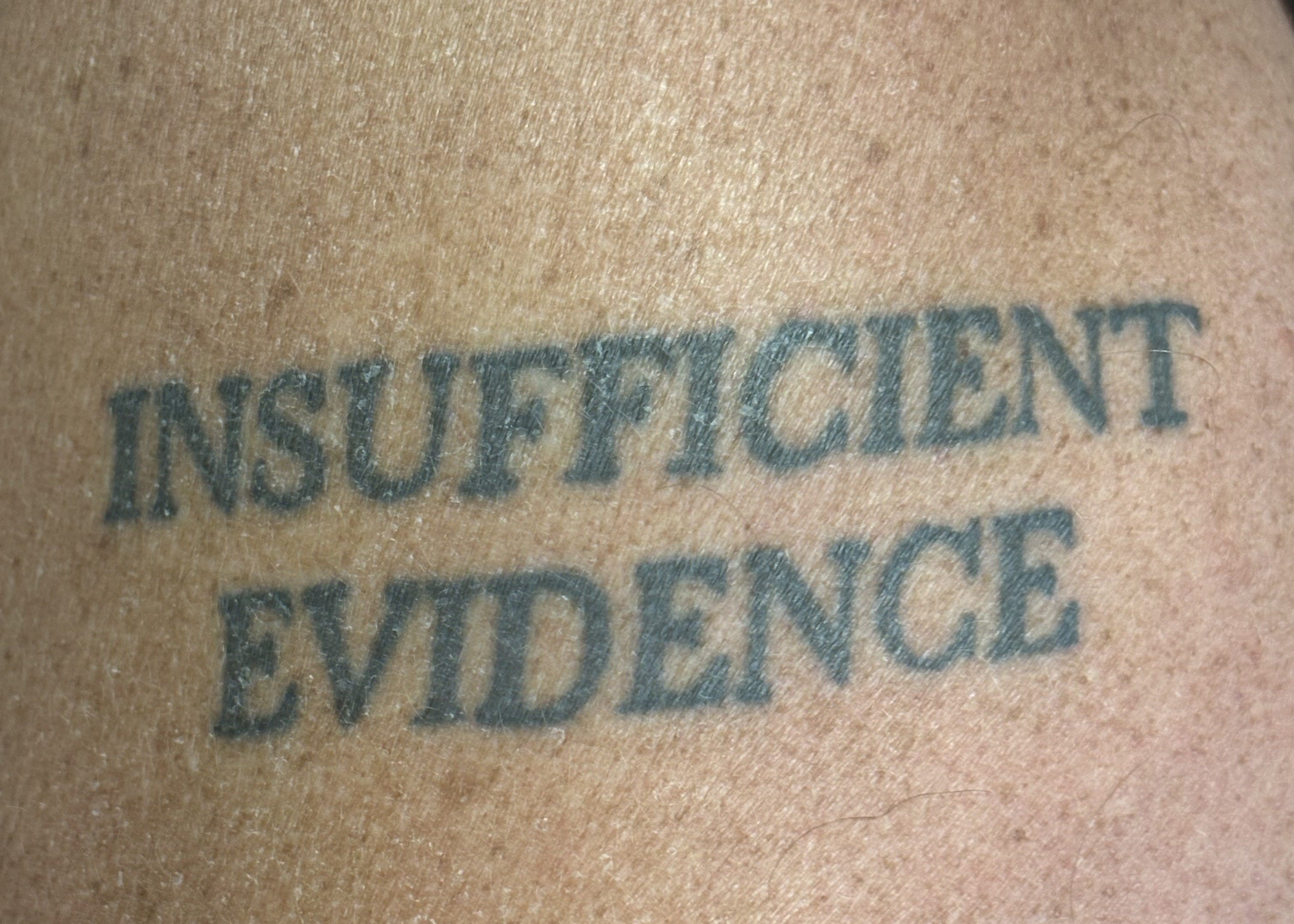
It started as a joke. After enough years of newspapers, critics, and colleagues reminding me that the treatments I used and advocated for (and against) in Covid had “insufficient evidence,” I kept joking I should get it tattooed on my arm as I figured I could save everyone the bother of attacking me. Acknowledge the objection in advance. Perhaps then we could get on with discussing what happened to the patients.
That was the thinking, anyway.
Then one day, on vacation in Puerto Rico with my three daughters and ex-wife, my doppelganger (our middle child) snuck off with her older sister and came back to the beach with her first tattoo (and now, unfortunately, many more). It was the word “Angel” in cursive on the back of her arm, the word I use whenever I address my daughters, so she used that to defend her decision, as some sort of “ode” to me. “Aren’t you happy?” she asked. After her mother and I got over our shock, I went over to her and whispered, “Evie, you got a tattoo guy? Take me to him.” Off we went.
But you don’t permanently mark your body over a joke alone. During Covid, the question of sufficient versus insufficient evidence became central to my career, my bedside decisions, and eventually my understanding of what it means to be a doctor. It became almost existential. What was I allowed to conclude from what I saw? What evidence justified acting? What justified waiting—and who bore the consequences while we waited?
I had spent decades making those decisions in intensive care, where uncertainty came with every admission and doing nothing was a decision with consequences of its own. You used the available research, your knowledge of physiology, your experience, and the response of the patient in front of you. You kept questioning yourself. You changed course when you needed to. You rarely had the luxury of certainty.
Yet “insufficient evidence” was increasingly presented as if it settled the question.
Insufficient for what? To establish a mechanism? To recommend a treatment to every patient? To justify offering it to one desperately ill person? Those are different decisions. They require different judgments.
And sufficient according to whom?
That latter one is the question behind the tattoo. It is also the question behind this post: who gets to decide when the evidence is enough for a doctor to act?
If you appreciate the late nights and deep dives into various topics, please support my work.
It's hard to get a man to understand something when his salary depends on not understanding it. —Upton Sinclair
Experts will reject the Evidence Act chapters which appear in my new books “The Silent Aquifer: Humanity’s Accelerating Food and Water Crisis” and Earth’s Living Water: Its History, Its Ruin, and the Way Back, where I present evidence showing dramatic improvements when Themarox (e.g., Aurmina, Primora-Bio) treated water is used across all of biology – soil, microbes, plants, fish, rats, and humans, repeated demonstrations in the yield, growth, and vitality. They will reject the evidence I present almost as soon as they begin reading it, not after weighing it, but the moment they recognize what kind of evidence it is.
The words will be familiar: small, uncontrolled, observational, old, translated, anecdotal, hypothesis-generating only. They sound scientific, and sometimes they are. They can also do the opposite of science when a descriptor meant for a single flawed study is turned against dozens of converging studies at once, before anyone asks whether a plausible mechanism could explain why they line up.
I say this after twenty years inside academic medicine. I analyzed myriad published clinical trials, taught guidelines, sat on committees, and helped decide whether to adopt therapies at the bedside. I also spent those years as a clinician, which meant I learned medicine in a way the modern evidence hierarchy no longer values.
Although I was a clinical leader within one of the largest academic medical centers in the country, I was never one of the highly recruited “physician-scientists,” or what my clinician colleagues and I derisively called “lab rats.” You know, the kind who spend most of their time writing major research grants, running basic science labs, and publishing in journals that bring institutions money and prestige. I belonged to a different class: the clinician-educators. We cared for patients, worked closely with nurses, taught students, residents, and fellows, held units together, communicated with families, and helped them endure the worst hours of their lives while keeping the ICU running day and night. The ICU-trained lab rats would do the same, but for far, far fewer weeks a year.
That primary clinical role built a different kind of expertise. Clinicians who live at the bedside see far more patients than most physician-scientists do. Volume builds pattern recognition, and pattern recognition is one of, if not the, defining qualities of an expert. For my first five years out of training, I worked in a really busy hospital in lower Manhattan; I saw an unusual amount of volume. The department I initially joined was chronically short-staffed (every time we hired someone, we lost someone else), and for long stretches my partner Sam Acquah (now ICU Director at Mount Sinai) and I held the service together, each of us carrying far, far more than a full clinical load.
The sheer number of patients, diseases, and complications that passed through our hands in those years set us apart, even from other hard-working physicians in what is considered one of the hardest-worked specialties; it compressed a career’s worth of cases into a handful of years. As an ICU and pulmonary physician, I regularly encountered respiratory failure, shock, infection, and multi-organ collapse in every form and at every stage, where I learned from timing, physiology, response patterns, and consequences.
Over the past few decades, the academic hierarchy (specifically, the conceptual framework called “Evidence-Based Medicine”) has come to dismiss that kind of knowledge as “anecdotal evidence.” I still remember the first time the word was aimed at me. I gave a lecture on the lifesaving benefits of intravenous vitamin C in septic shock that I had observed, and a physician (err, lab rat) dismissed it as “anecdotal.” I recoiled. How could something I had watched happen again and again, where the impact of what I did, or failed to do, was clearly written into whether a patient recovered or died, be waved away as an anecdote? I had seen it with my own eyes, more times than I could count. It was my lived experience, and I knew it to be true.
And yet here that knowledge was, filed under a word that means a story told once and never validated. I have chafed at the term ever since. An anecdote is a single tale; what I was describing was a pattern: the same cause and the same consequence, observed over and over until the link between them was as firm as anything a trial could hand me. I would learn, much later, that roughly half of all recommendations in clinical practice guidelines rest on nothing sturdier than the opinion of the people writing them.1 2 Expert opinion was permitted to establish medical truth after all. It just had to be those of the right kind of experts (e.g., the bought-and-paid-for ones). In critical care, relying on my expert opinion meant the difference between acting while the patient could still be saved and waiting for evidence that might never arrive (or worse, before those “opinions” told me I was wrong).
The gate that “Evidence-Based Medicine” (EBM) would later become could not have been built on open ground. It had to be cleared first. The 1910 Flexner Report, funded by the Carnegie Foundation and supported by the Rockefeller Institute, standardized American medical education on a single model. Within two decades, roughly half of US medical schools had closed.3 When hundreds of competing schools existed, no single set of institutions could define what a doctor learned; once the field narrowed, influencing a small number of institutions was sufficient.4
EBM is a younger idea than it feels. The phrase was coined in 1991 by Gordon Guyatt and colleagues at McMaster University in Canada, and set out the following year in a landmark paper that proposed a new way to teach and practice: that clinical decisions rest, wherever possible, on the best available research evidence, meaning on systematic, published study, rather than on tradition, authority, or a physician’s unexamined experience. It was, at bottom, a demand that medicine show its work.5
It began as a necessary corrective. Medicine needed discipline, and physicians needed humility. We needed protection from our tendency to remember a treatment’s successes more vividly than its failures, and, most of all, from the delayed harms we are poor at identifying. But the need went further than protection. We needed a disciplined way to compare two treatments and determine which was genuinely better. We also needed a way to detect benefits too small, too subtle, or too slow to show themselves at the bedside: effects that unfold over years, across a distance between cause and consequence too wide for any one clinician to trace by eye.
That distance is the crux. When cause and consequence sit far apart in time, or when the effect is small or subtle, a large, carefully conducted trial can see what no single observer, however seasoned, can, and I have never doubted it. The trouble begins only when that narrow, genuine usefulness is mistaken for a universal one.
The original model was built on three pillars on which clinical treatment decisions should rest: (1) the best available evidence; (2) clinical experience and expertise; and (3) patient preferences and values. It was a brilliant construct, and I still believe that. But over time, all three pillars weakened. Clinical expertise was downgraded to anecdotal evidence. Patient values were acknowledged politely only after the treatment decision had already been made. “Best available evidence” narrowed so severely until it meant only one thing: a large, prospective, randomized controlled trial (RCT), funded by an institution or company with enough money to run one.
The evidence pyramid stopped acting as a rational guide and started acting as a gatekeeper. The most expensive RCTs rose to the top and stayed there. Today they are very nearly the only evidence that can change a guideline or a treatment recommendation. Everything else- clinical experience, observation, case series, and the accumulated record of what works at the bedside- can grow as large and consistent as it likes and still do almost nothing to change how patients are actually cared for. Does the case of ivermectin in Covid ring a bell?
When the Wrong Tool Becomes the Standard
In the ICU, there is a deeper objection to the hegemony of RCTs than unfairness; they rarely even work. Over decades, dozens of RCTs kept returning “negative” results, with intervention after intervention yielding statistically insignificant findings, including many interventions that worked right in front of our eyes. Jean-Louis Vincent, one of the most respected critical care physicians in the world, put the case as sharply as anyone. In a 2010 article titled “We should abandon randomized controlled trials in the intensive care unit,” he argued that RCTs often fail in critical care because the ICU is too complex for crude trial design to capture: the timing of treatment, the severity of illness, and the choice of endpoint can each decide the result, and heterogeneous patients may respond in opposite directions to the same intervention.6
Vincent named what many bedside clinicians already knew. In critical illness, the right therapy given too late can look useless, and the right therapy given to the wrong subgroup can disappear inside a neutral average. A trial can be methodologically impressive and clinically blind. Vincent defended evidence by refusing to worship one form of it when the clinical environment demands judgment, physiology, observation, and better tools.
I am not saying that randomized trials do not have a critical place in science and medicine. In laboratory experiments, animal models, pharmacology, toxicology, and many human clinical questions, randomization can clarify cause and effect in ways other designs cannot. When a therapy produces small differences in outcomes that accumulate over time across large populations, and when those differences cannot be detected reliably any other way, a well-designed randomized trial may be the right tool.
Its usefulness narrows when human illness becomes heterogeneous, time-sensitive, syndromic, and biologically unstable: exactly the terrain of critical care, chronic complex disease, and many integrative or metabolic therapies.
When a therapy produces large, rapid, multidimensional effects like the kind an experienced clinician can observe across different patients, a randomized trial is simply not necessary, because the effect is already obvious. The trouble happens when the large, expensive randomized trial becomes the only instrument medicine will accept: it stops functioning as a tool for discovery and starts functioning as a gate controlled by whoever can afford to pay for it.
Pharma’s Most Powerful Epistemic Weapon: The Unmeasured Confounder
If the randomized trial has become a gate, the natural defense is that it is at least a gate worth having, that it keeps unreliable evidence out. That defense rests on a single erroneous assertion that has been taught for decades and now pervades all of academic medicine.
A randomized controlled trial (RCT) takes a group of patients and randomly assigns them to a treatment group and a placebo or control group, then prospectively follows both groups over time and compares their outcomes. A retrospective observational controlled trial (OCT) works the other way around: it identifies patients who were already treated and compares them with similar patients who were not treated.
The most important difference between the two study types is that “high quality,” “rigorous” RCT’s require tens of millions to conduct, while OCT’s, in the modern era, require nothing more than a committed group of clinicians, an electronic database, and the sweat equity of “nights and weekends” work. Keep that in mind.
Unsurprisingly, a pervasive narrative in academia developed which belittles the epistemic value of OCTs. The narrative goes like this: Because its groups were assembled by observation rather than by randomization, they may differ in ways the investigators never measured: hidden differences known as unmeasured confounders. And if the two groups differ from the start, any difference in their outcomes might be due to hidden factors rather than the treatment, so any apparent benefit cannot be trusted.
Thus, the dogma is that only RCTs can protect us from incorrect conclusions driven by unmeasured confounders. OCT findings are considered “hypothesis-generating” only or, more accurately, simply ignored. The claim gets repeated so often it starts to sound like a scientific law of physics. It is not physics. It is a belief, and when researchers tested it systematically, they quietly debunked it. Too quietly, I might add.
Multiple reviews, including a landmark Cochrane study from 2014, compared OCTs with RCTs that tested the same clinical questions in the same disease areas.7–10 If the dogma were true, the OCTs should have routinely misled us. They should have found benefits where RCTs found none, or minimized or exaggerated harms in such a way that they would frequently produce conflicting findings.
That is not what happened. Across nearly every disease model, OCTs and RCTs almost always agreed. Direction of effect, magnitude of benefit or harm, and the overall clinical picture generally aligned. In the rare cases where they disagreed, the Cochrane authors subtly noted that “factors other than study design” needed to be explored.
That sentence should have shaken the world of evidence. If study design alone does not explain the mismatch, something else does. And when you have lived long enough inside the machine, one candidate stands out: money. By money I mean more than the funding line; I mean everything that gathers around it: the institutional incentives and market gravity that decide which trials get built and which never do, which questions get asked and which stay buried, how a protocol is written, and how its results are told. Study design is what the evidence pyramid ranks. Money is the current running beneath it.
The reason the two designs yield similar findings is that modern observational science no longer relies on crude comparisons. Using advanced statistical methods, large clinical databases, and modern computing power, we can now balance groups across age, sex, disease severity, comorbidities, socioeconomic factors, baseline risk, and medication history. It can emulate target trials, adjust for time-dependent bias, use propensity methods, and test sensitivity to hidden assumptions. The old caricature of observational evidence as uncontrolled anecdote has long been made obsolete. Who knew?
What I came to call “The Church of RCT Fundamentalism” is now thoroughly entrenched, not in one institution or one country, but across modern medicine worldwide. It is preached from the journals, repeated in the medical-school classroom, and enforced most zealously by the biostatisticians who have become the field’s arbiters of what is allowed to count as real. It is one reason I left academia for private practice. I had come to feel that medicine was turning its back on reality, on truths I could see at the bedside, truths that could help patients, and that it did so most predictably at the very moment a cheap and safe therapy threatened the market for a costlier, more profitable one, and at times a dangerous one.
There is a bitter joke buried in that arrangement. In 2015, researchers put a straightforward statistical result in front of a group of epidemiologists—a p-value above 0.05—and asked what it meant. Roughly four in five got it wrong, concluding that the treatment had made no difference.11 Four of five. Wow. Absence of proof was read as proof of absence, by the very people appointed to guard the distinction. The arbiters of what counts as real cannot even read the instrument they enforce. Complete epistemic collapse.
Trial Grading and the Evidence Hierarchy
The hierarchy first sorts by trial design alone: RCTs on top, OCTs far beneath them. But a second layer of gatekeeping follows, and it is more consequential. Every trial is then graded: scored on its “risk of bias” and its “study quality” by a battery of metrics that look mathematical and objective.
In principle, the quality grade is blind to design: it scores each study on how well it was actually run, so even a randomized trial can be downgraded (for weak blinding, heavy dropout, a switched endpoint), and now and then one is. Observational trials arrive at the grading table already labeled as the lower form of evidence, and the grading vocabulary (bias, low quality, serious limitations) attaches to them almost by default. Sorted down once by design and marked down again by score, they rarely climb back to a level where they can influence a treatment decision or enter a clinical guideline.
Of course bias exists. Of course small studies can mislead. Of course blinding, allocation concealment, follow-up, and outcome selection matter. But the scores those factors feed into look far more objective than they are. How much a stretch of missing follow-up or an unblinded assessor should count is a judgment call, and turning that call into a number does not make it less of one. It only lends the judgment an aura of mathematical certainty.
And that certainty, like the conviction that RCTs are superior to observational trials, has also been proven wrong.
Among these observational studies, grading them for quality changed nothing. A 2016 analysis in nutritional epidemiology took fourteen meta-analyses of diet and cancer: nearly three hundred observational studies, each scored on the Newcastle–Ottawa Scale, the most widely used quality-grading tool in the field.12
When only the studies that the scale called “high quality” were pooled, the result matched what you got from the full set sorted by design alone: same direction, same magnitude, same conclusion. Restricting to “high quality” added nothing. And the reason is almost embarrassing: the grade barely distinguished the studies to begin with. The scale rated ninety-one percent of the cohort studies “high quality” but only a third of the case-control studies, so “quality,” as the instrument measured it, was very nearly just a restatement of study design. The second filter was the first filter wearing a lab coat.
Now stack the two findings. In the last section, study design did not affect the conclusions: randomized and observational trials asked the same questions and gave the same answers. Here, among observational studies, the quality grade did not differ either. Neither the design of a study nor its quality score changed the evidence’s conclusion, and those are the two levers the entire hierarchy uses to decide which evidence counts.
The practical effect is predictable. Large, expensive, multicenter trials rise. Smaller, independent, clinician-led, observational, or field-based studies sink. A therapy that cannot attract enough capital to run a large RCT is never taken seriously, no matter how revealing the clinical observations are.
The Heretics Inside the Church
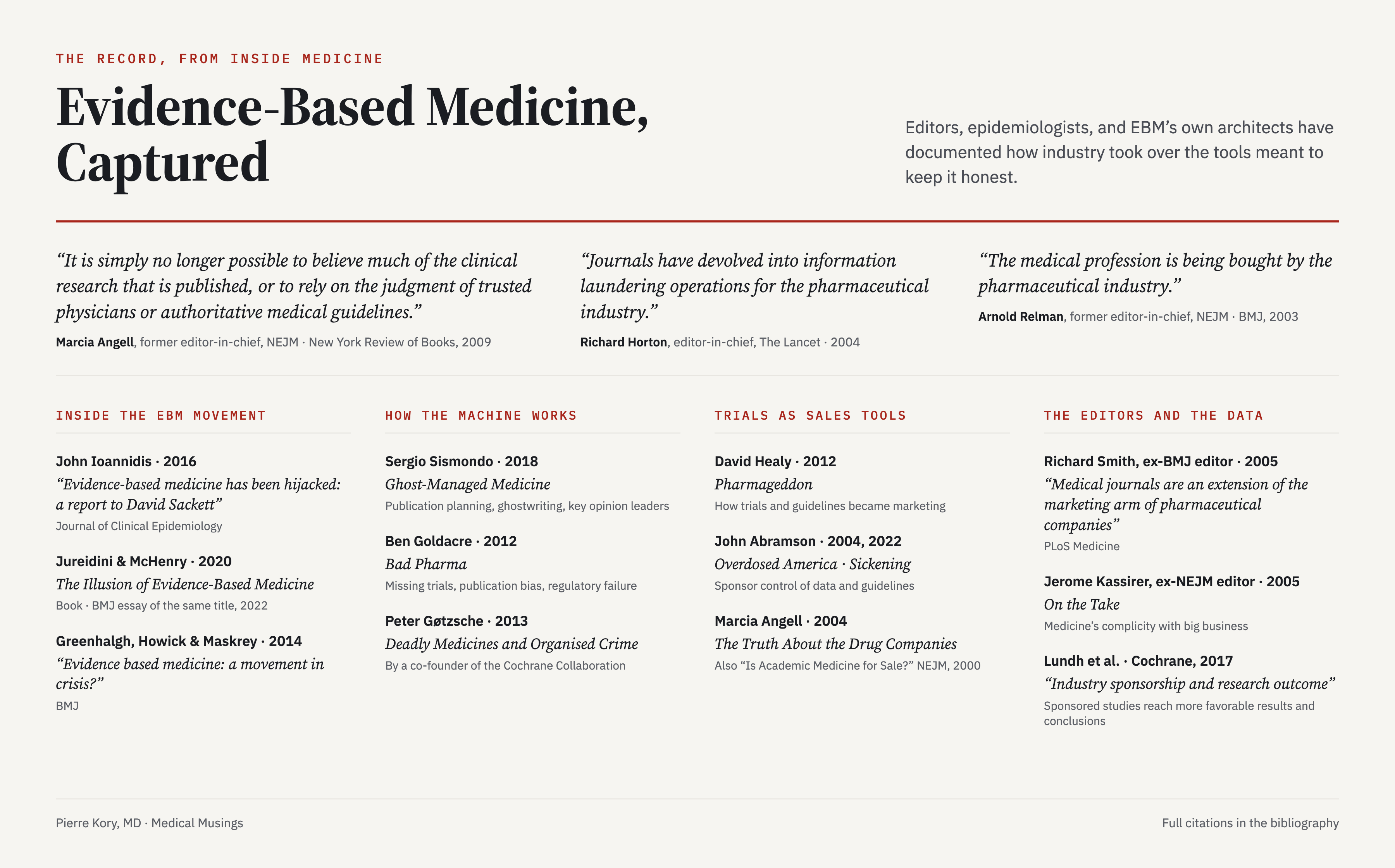
If what I have described so far were only the grievance of a clinician who walked away from academia, it would be easy to dismiss. It is not. For more than a quarter of a century, some of the most respected names in medicine have said much the same thing, in the field’s own journals. Former editors of the New England Journal of Medicine, the Lancet, and the BMJ have described medical journals as instruments of pharmaceutical marketing, and John Ioannidis, among the most cited critics of research quality alive, titled a 2016 paper simply: “Evidence-based medicine has been hijacked.”46
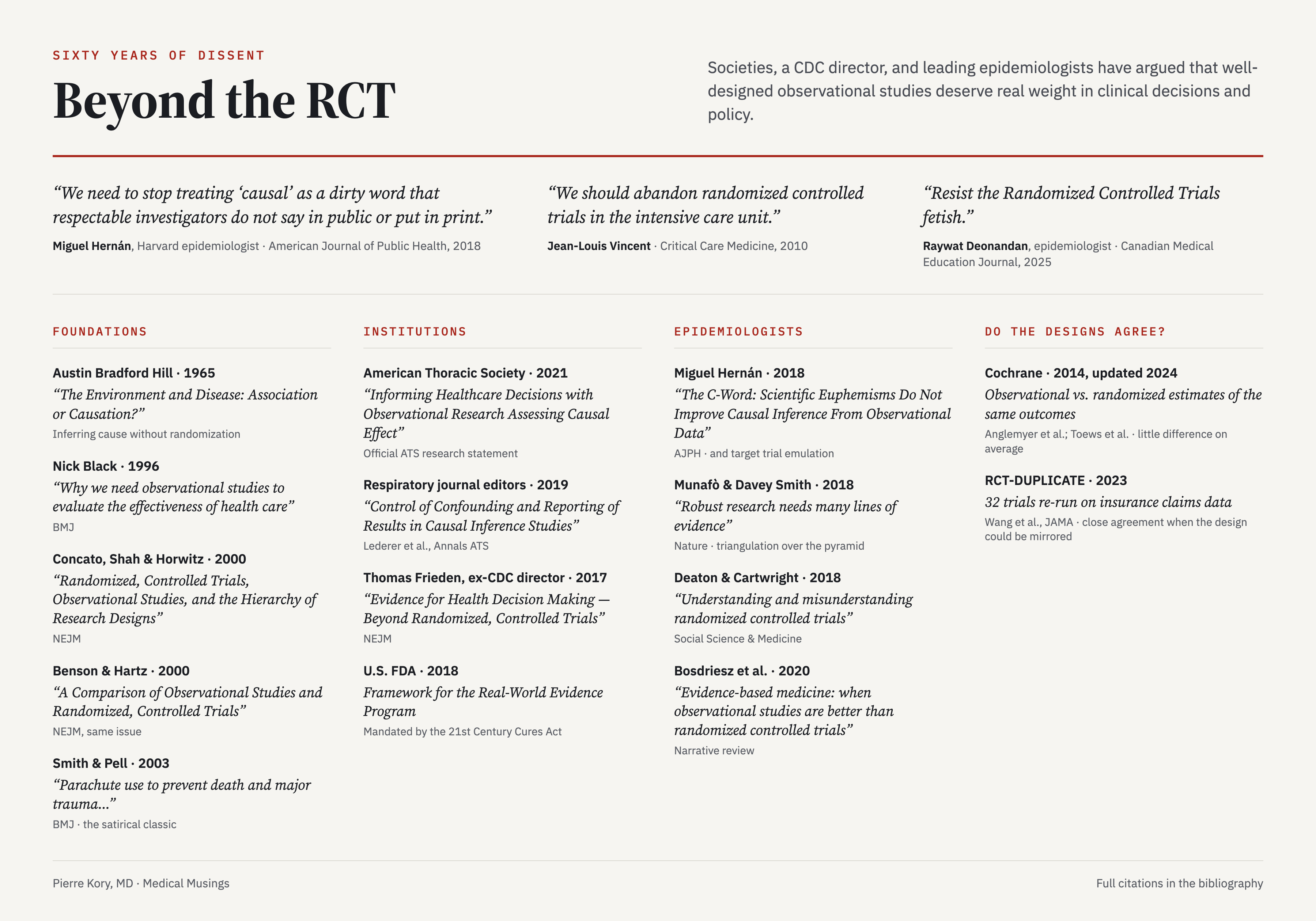
The case for observational evidence has been made just as long and just as forcefully: in two landmark papers in the New England Journal of Medicine in 2000, by a former director of the CDC, by the American Thoracic Society, my own specialty’s society, and by Harvard’s leading causal-inference methodologist, Miguel Hernán.7,8,50,51,53
So the argument has been made, loudly and from the inside. What did it change?
In the place where it matters, almost nothing. The rules that grade evidence for guidelines are the same rules that were in force when these critiques began. GRADE, the system used by the WHO, Cochrane, and well over a hundred guideline organizations, still assigns every body of observational evidence a starting grade of “low” certainty and every body of randomized evidence a starting grade of “high.”57
Cardiology’s guideline writers still reserve their top level of evidence for randomized trials. And when a 2019 review co-authored by Robert Califf, twice commissioner of the FDA, examined every current cardiology guideline from the ACC/AHA and the European Society of Cardiology, it found that only 8.5 percent of American recommendations rested on that top tier, and that the picture “does not appear to have meaningfully improved from 2008 to 2018.”56 A decade of critique, and the guidelines were still largely built on expert opinion, while the observational evidence that could have filled the gap was still graded down at the door.
Then came Covid, the real-world test of whether any of it had sunk in. The Cochrane review of ivermectin restricted itself to randomized trials and set every observational study aside.58 The WHO’s guideline panel likewise built its recommendation against ivermectin on randomized trials alone, and even though they found a highly statistically significant 81% reduction in mortality in the RCT’s (yes, 81%) when patients were treated with ivermectin, they refused to recommend its use, claiming the RCT data (yes, they even downgraded the RCT data) was of “very low-certainty” (just another way of saying very low-quality). The advocates like me had won the argument in the journals. We lost it in the guidelines, which is the only place it counts.
Published, but Muzzled
I expected to find that the journals simply refuse to publish observational studies. The data show something subtler, and in some ways worse. They publish them, in large numbers. What they withhold is the right to say a treatment works.
Consider one analysis of every clinical study published over three months of 2013 in seven of the most influential general medical journals, including the NEJM, JAMA, the Lancet, the BMJ, and the Annals of Internal Medicine.⁵⁹ Half of those studies were observational: 86 of 171. Yet when the journals chose which studies deserved an accompanying editorial- their way of telling clinicians, “pay attention to this,” they gave one to about seven in ten randomized trials and fewer than half of the observational studies.59 This was not because the observational studies were weaker. Most enrolled more than a thousand patients, and nine in ten measured hard clinical outcomes, compared with fewer than half of the trials.
Where the observational studies did get attention was in the journals’ press offices. They were nearly three times as likely as the trials to be promoted with a press release. The pattern is consistent: observational findings are welcome as news, but not as medicine. I can think of no better example than my review of all the merging ivermectin trials in 2021, which, to date, has a final Altmetric score of 15,356, placing it sixty-sixth among the almost 28 million research outputs that Altmetric has ever tracked—one of the hundred most-discussed pieces of research, in any field, in the service’s history. Did it change standard practice? You know the answer.
Then look at the language rules. JAMA and the rest of the JAMA Network journals, following AMA style, allow cause-and-effect language only for randomized clinical trials and controlled laboratory experiments. For every other design, in the words of the AMA’s own style guidance, “the expression and ultimate interpretation of the findings can’t be causal.”60 An observational study may find that patients given a treatment died half as often as patients who were not. It may not write that the treatment reduced deaths. It must say only that treatment was “associated with” lower mortality, and every reader who has absorbed the hierarchy knows what that phrase is meant to signal: interesting, but not actionable.
The rule works exactly as designed. A 2022 analysis of 1,170 non-randomized studies published from 2010 to 2019 in 18 leading health journals found that the word “cause” was the main linking word in fewer than one percent of them, while “associate” appeared in nearly half. Papers in the journals with explicit restrictions, including JAMA, were less likely to offer any recommendation for action at all, and JAMA had the weakest causal language of any journal studied.61 Yet a third of all these abstracts still recommended an action, and three quarters of those recommendations implied a causal effect. The ban did not make the inference go away. It made it deniable, which was Hernán’s point: a euphemism does not improve causal inference, it only hides it.
During Covid, the pressure went further. In 2023, my former (and later captured) colleague Dr. Andrew Hill proposed in the Journal of Antimicrobial Chemotherapy that every observational study be labeled “non-randomized” in its title, and that such studies “should not be used independently for making regulatory approval decisions.”62 Not that bad observational studies be excluded. All of them, labeled at the front door.
To be fair, there is one crack in the wall. In 2024, JAMA’s own editor-in-chief co-authored a framework acknowledging that “many medical journals, including JAMA, restrict the use of causal language to the reporting of randomized clinical trials,” and proposing conditions under which well-conducted observational studies might be allowed to speak causally.63 It remains a proposal, and its authors note that putting it into practice will require cooperation among editors, authors, and reviewers. It also concerns wording, not weight. Nothing in it changes how a guideline panel scores the evidence, and nothing in it has yet moved a single recommendation.
That is the pattern across thirty years. The critics are published, cited, invited to give lectures, and occasionally honored. The rules stay exactly where they were. A system that can absorb its critics this completely without changing is not one that has weighed their arguments and found them wanting. It is one that is not, in the end, listening to arguments at all.
There is a word for the study of how we know what we know: epistemology. I had to look it up the first time I saw it. It is the branch of philosophy that asks not what is true but how we decide what to believe is true — what counts as proof, and who is permitted to say. It is the subject of this chapter.
And there is a phrase for what happens when that machinery is taken over. “Regulatory capture” is when an agency comes to serve the industry it was built to police. “Epistemic capture” is the deeper version: the capture of the institutions through which knowledge itself is created, legitimized, and passed on.13 I take the phrase from an anonymous physician writing as Dr. Wojak, whose series on it is the best review I know.14
The difference matters. When a regulator is captured, you can appeal over its head — to the journals, the universities, the experts. When those are captured too, there is no higher authority to appeal to. Pharma has even captured the courts: using the POW pomegranate juice trial, they have literally made the legal definition of sufficient evidence for the manufacturer of any compound or health or food product to make any health claim as one supported with large, double-blind RCTs and whose findings have been adopted as a consensus by some society or institution.
This weighting system captured Evidence-Based Medicine. The industry that controls the hierarchy systematically underweights observational evidence, moving it down in ways that coincide with its interests. The entities that can fund the approved form of proof end up controlling more than the marketplace. They control the definition of medical truth.
Follow that logic to the bottom, because it is not subtle. Restrict medical truth to the large randomized trial, and you restrict it to whoever can pay for one: tens of millions of dollars, an institution, a sponsor with a product to sell. The alternative costs almost nothing: a good observational study needs little more than database access, statistical discipline, and the nights-and-weekends labor of clinicians who already have the patients in front of them. The barrier is so low that almost any motivated physician could clear it, and that is exactly why it cannot be allowed to count. If bedside observation were permitted to establish truth, truth could be established by people with nothing to sell, and the questions worth asking would no longer be confined to the ones a sponsor is willing to fund. A hierarchy that discounts the cheapest evidence is not protecting rigor. It is protecting a monopoly.
And that monopoly is not paid for in money alone. When the only therapies patients are treated with are those profitable enough to have bought their own proof, the cheap, the widely available, and the off-patent never get used: however safe they are, however well they work. This is not just about epistemology. Somewhere downstream of every discounted signal is a person who could have been helped by a treatment that was safe, available, and inexpensive, but it was not employed because the evidence for it was the wrong kind, produced by the wrong people, and therefore declared not to exist. They suffer, and many of them die, for a rule about what counts as proof.
Let me be clear about what I am claiming, because the next post runs hot and I would rather be understood than agreed with. Epistemic capture does not mean that everything coming out of academic medicine is false. It means that institutional consensus should never, by itself, make a claim more credible — that where a claim comes from tells you nothing about whether it is true, and that the answer has to be found in the evidence rather than in the degrees and titles attached. Nor does any of it require a conspiracy. It only requires that the incentives be arranged so everyone inside the system does what the incentives reward. The student who keeps their head down gets the residency. The resident who prescribes like their attending gets the fellowship. The senior physician who stays on message gets the speaking fees. Nobody has to be told.
That is how the hierarchy protects itself. But deciding which kinds of evidence count is only the beginning. Someone still has to produce that evidence, publish it, and turn it into instructions for the doctor standing at your bedside.
In the next post, I’ll follow that process: the contracts that give sponsors control over trial data, the journals that depend on pharmaceutical revenue, and the expert panels that turn the resulting literature into treatment guidelines. Along the way, I’ll return to the ivermectin trials I spent years investigating.
Because the final consequence of this system is much more concrete than a dispute over scientific evidence. It determines which treatments your doctor will offer—and which ones they may never be allowed to try.
If you appreciate the late nights and deep dives I take down various medical rabbit holes, your paid support helps keep me going.
Bonus Clip: Many of you enjoyed my recent post about the day I spent with the Nobel Prize-winning discoverer of ivermectin, Japanese Professor Satoshi Omura. After that post, I received this short (45-second) clip of our initial introduction from Mr. Kenji Torii, which I find both painfully awkward and incredibly moving (I think I see tears forming in my eyes, but I can’t remember). Enjoy; I will title it “How (Not) to Meet a Nobel Laureate.”
From the Shameless Commercialism Department:
Aurmina is a volcanic mineral water purifier that cleans water the way the Earth always has. Add it to a pitcher. The minerals bind the contaminants, the burden clumps and settles, and you pour off the clear water. Purity and mineral breadth almost always trade off. Unlike reverse osmosis, Aurmina keeps the minerals in — producing one of the purest and most broadly mineralized waters on Earth. Check out our new website here.

Primora Bio relies on the same mineral chemistry in the water that supports what we grow and love: plants, gardens, fish, and pets.

The Stone and Water Series
You can purchase the book series, in whole or in part, from my website ( where all books are personally stamped with my hanko) or from Amazon.

Bibliography
1. Pierluigi Tricoci, Joseph M. Allen, Judith M. Kramer, et al. “Scientific Evidence Underlying the ACC/AHA Clinical Practice Guidelines.” JAMA 301, no. 8 (2009): 831–841. DOI:10.1001/jama.2009.205.
2. Kim Boesen, Sarah Louise Klingenberg, and Christian Gluud. “Levels of Evidence Supporting Recommendations in Clinical Practice Guidelines: Meta-Epidemiological Study.” Preprint, medRxiv, August 11, 2025. DOI:10.1101/2025.08.11.25333132.
3. Frank W. Stahnisch and Marja Verhoef. “The Flexner Report of 1910 and Its Impact on Complementary and Alternative Medicine and Psychiatry in North America in the 20th Century.” Evidence-Based Complementary and Alternative Medicine 2012 (2012): 647896. DOI:10.1155/2012/647896.
4. Barbara Barzansky. “Abraham Flexner and the Era of Medical Education Reform.” Academic Medicine 85, no. 9 Suppl (2010): S19–S25. DOI:10.1097/ACM.0b013e3181f12bd1.
5. Evidence-Based Medicine Working Group. “Evidence-Based Medicine: A New Approach to Teaching the Practice of Medicine.” JAMA 268, no. 17 (1992): 2420–25. https://doi.org/10.1001/jama.1992.03490170092032.
6. Jean-Louis Vincent, “We Should Abandon Randomized Controlled Trials in the Intensive Care Unit,” Critical Care Medicine 38, no. 10 suppl. (2010): S534–S538, https://doi.org/10.1097/CCM.0b013e3181f208ac.
7. J. Concato, N. Shah, and R. I. Horwitz, “Randomized, Controlled Trials, Observational Studies, and the Hierarchy of Research Designs,” New England Journal of Medicine 342, no. 25 (2000): 1887–92, https://doi.org/10.1056/NEJM200006223422507.
8. K. Benson and A. J. Hartz, “A Comparison of Observational Studies and Randomized, Controlled Trials,” New England Journal of Medicine 342, no. 25 (2000): 1878–86, https://doi.org/10.1056/NEJM200006223422506.
9. A. Anglemyer, H. T. Horvath, and L. Bero, “Healthcare Outcomes Assessed with Observational Study Designs Compared with Those Assessed in Randomized Trials,” Cochrane Database of Systematic Reviews, no. 4 (2014): MR000034, https://doi.org/10.1002/14651858.MR000034.pub2.
10. I. Toews, A. Anglemyer, J. L. Z. Nyirenda, D. Alsaid, S. Balduzzi, K. Grummich, L. Schwingshackl, and L. Bero, “Healthcare Outcomes Assessed with Observational Study Designs Compared with Those Assessed in Randomized Trials: A Meta-Epidemiological Study,” Cochrane Database of Systematic Reviews, no. 1 (2024): MR000034, https://doi.org/10.1002/14651858.MR000034.pub3.
11. Blakeley B. McShane and David Gal, “Blinding Us to the Obvious? The Effect of Statistical Training on the Evaluation of Evidence,” Management Science 62, no. 6 (2016): 1707–18, https://doi.org/10.1287/mnsc.2015.2212.
12. Jong-Myon Bae, “A Suggestion for Quality Assessment in Systematic Reviews of Observational Studies in Nutritional Epidemiology,” Epidemiology and Health 38 (April 2016): e2016014, https://doi.org/10.4178/epih.e2016014.
13. Sergio Sismondo. “Epistemic Corruption, the Pharmaceutical Industry, and the Body of Medical Science.” Frontiers in Research Metrics and Analytics 6 (2021): 614013. DOI:10.3389/frma.2021.614013.
14. Dr. Wojak [pseud.]. Epistemic Capture of Medicine: Capture by the Pharmaceutical Industry across All Layers of Medical Knowledge Creation, Legitimation, and Dissemination. Version 1.0. Self-published, August 2026. https://drwojakmd.substack.com.
15. Ray Moynihan. “Who Pays for the Pizza? Redefining the Relationships between Doctors and Drug Companies. 1: Entanglement.” BMJ 326, no. 7400 (2003): 1189–1192. DOI:10.1136/bmj.326.7400.1189.
16. Richard Horton. “The Dawn of McScience.” New York Review of Books, March 11, 2004.
17. Marcia Angell, The Truth about the Drug Companies: How They Deceive Us and What to Do about It (Random House, 2004).
18. Ben Goldacre, Bad Pharma: How Drug Companies Mislead Doctors and Harm Patients (Fourth Estate, 2012).
19. Peter Gotzsche, Deadly Medicines and Organised Crime: How Big Pharma Has Corrupted Healthcare (CRC press, 2019).
20. Malcolm Kendrick, Doctoring Data: How to Sort out Medical Advice from Medical Nonsense (Columbus Publishing Ltd, 2014).
21. Michelle M. Mello, Brian R. Clarridge, and David M. Studdert. “Academic Medical Centers’ Standards for Clinical-Trial Agreements with Industry.” New England Journal of Medicine 352, no. 21 (2005): 2202–2210. DOI:10.1056/NEJMsa044115.
22. Kamran Abbasi. “A Tough Nut to Crack.” BMJ 330, no. 7485 (2005): 0. DOI:10.1136/bmj.330.7485.0.
23. BMJ 330 [cover illustration], vol. 326, no. 7400, May 31, 2003. https://www.bmj.com/content/326/7400.
24. Deepak Natarajan. “The Specious Business of Industry-Sponsored Publications in Medical Journals.” The Wire Science, May 2, 2016.
25. Robert L. Goodman and Olveen Carrasquillo. “The Corporate Co-author, the Ghostwriter, and the Medical Society: An Object Lesson.” Journal of General Internal Medicine 21, no. 1 (2006): 102. DOI:10.1111/j.1525-1497.2005.00271_3.x.
26. Pierre Kory and Jenna McCarthy, War on Ivermectin: The Medicine That Saved Millions and Could Have Ended the Pandemic (New York: Skyhorse, 2023).
27. Susanna Naggie et al., “Effect of Ivermectin vs Placebo on Time to Sustained Recovery in Outpatients With Mild to Moderate Covid-19: A Randomized Clinical Trial,” JAMA 328, no. 16 (2022): 1595, https://doi.org/10.1001/jama.2022.18590.
28. Susanna Naggie, “ACTIV-6: 1-Year Later and Trial Results for Ivermectin 400 & Inhaled Fluticasone,” Grand Rounds presentation, NIH Collaboratory / Duke Clinical Research Institute, July 22, 2022.
29. G. Hayward et al. (PRINCIPLE Collaborative Group), Journal of Infection 88, no. 6 (2024): 106130.
30. G. Reis et al. (TOGETHER Investigators), New England Journal of Medicine 386, no. 18 (2022): 1721–31.
31. Pierre Kory, “Fraudulent Trial On Ivermectin Published By The World’s Top Medical Journal. Big Pharma Reigns – Part I,” Substack newsletter, Pierre Kory Medical Musings, March 31, 2022, https://pierrekorymedicalmusings.com/p/fraudulent-trial-on-ivermectin-published.
32. Pierre Kory, “Fraudulent Trial On Ivermectin Published By The World’s Top Medical Journal. Big Pharma Reigns – Part II,” Substack newsletter, Pierre Kory Medical Musings, April 1, 2022, https://pierrekorymedicalmusings.com/p/fraudulent-trial-on-ivermectin-published-859.
33. Pierre Kory, “The False, Sinister, and Duplicitous Statements of the TOGETHER Ivermectin Trial Investigators,” Substack newsletter, Pierre Kory Medical Musings, February 21, 2022, https://pierrekorymedicalmusings.com/p/the-false-sinister-and-duplicitous. Society for Clinical Trials,
34. “David Sackett Trial of the Year Award—Awarded to the TOGETHER Trial (E. J. Mills and G. Reis, Principal Investigators),” 2021, https://www.sctweb.org/toty.cfm.
35. Maryam Mooghali, Laura Glick, Reshma Ramachandran, and Joseph S. Ross. “Financial Conflicts of Interest among US Physician Authors of 2020 Clinical Practice Guidelines: A Cross-Sectional Study.” BMJ Open 13, no. 1 (2023): e069115. DOI:10.1136/bmjopen-2022-069115.
36. Ray Moynihan, Loai Albarqouni, Conrad Nangla, et al. “Financial Ties between Leaders of Influential US Professional Medical Associations and Industry: Cross Sectional Study.” BMJ 369 (2020): m1505. DOI:10.1136/bmj.m1505.
37. American Heart Association. 2023–2024 American Heart Association Funding from Pharmaceutical and Biotech Companies and Device Manufacturers. Dallas, TX: American Heart Association, 2024.
38. Neil Barsky. “Low-Carb Diets Work. Why Does the American Diabetes Association Push Insulin Instead?” The Guardian, April 17, 2024.
39. Paul Campsall, Kate Colizza, Sharon Straus, and Henry T. Stelfox. “Financial Relationships between Organizations That Produce Clinical Practice Guidelines and the Biomedical Industry: A Cross-Sectional Study.” PLoS Medicine 13, no. 5 (2016): e1002029. DOI:10.1371/journal.pmed.1002029.
40. Camilla H. Nejstgaard, Lisa Bero, Asbjørn Hróbjartsson, et al. “Association between Conflicts of Interest and Favourable Recommendations in Clinical Guidelines, Advisory Committee Reports, Opinion Pieces, and Narrative Reviews: Systematic Review.” BMJ 371 (2020): m4234. DOI:10.1136/bmj.m4234.
41. Andreas Lundh, Joel Lexchin, Barbara Mintzes, et al. “Industry Sponsorship and Research Outcome.” Cochrane Database of Systematic Reviews 2, no. 2 (2017): MR000033. DOI:10.1002/14651858.MR000033.pub3.
42. Kelly M. Adams, Martin Kohlmeier, and Steven H. Zeisel. “Nutrition Education in U.S. Medical Schools: Latest Update of a National Survey.” Academic Medicine 85, no. 9 (2010): 1537–1542. DOI:10.1097/ACM.0b013e3181eab71b.
43. Amy Finkelstein, Petra Persson, Maria Polyakova, and Jesse M. Shapiro. “A Taste of Their Own Medicine: Guideline Adherence and Access to Expertise.” American Economic Review: Insights 4, no. 4 (2022): 507–526. DOI:10.1257/aeri.20210591.
44. Tobias Liu, Joseph S Ross, Christopher J Morten, and Reshma Ramachandran. “Pharmaceutical Manufacturer Kickback Resolutions and Associated Financial Penalties, 2000–2025.” JAMA Network Open, 13 March 2026. DOI: 10.1001/jamanetworkopen.2026.1735.
45. Denis G Arnold, Oscar Jerome Stewart, and Tammy Beck. “Financial Penalties Imposed on Large Pharmaceutical Firms for Illegal Activities.” JAMA, 17 November 2020. DOI: 10.1001/jama.2020.18740.
46. John P. A. Ioannidis. “Evidence-Based Medicine Has Been Hijacked: A Report to David Sackett.” Journal of Clinical Epidemiology 73 (2016): 82–86. DOI:10.1016/j.jclinepi.2016.02.012.
47. Trisha Greenhalgh, Jeremy Howick, and Neal Maskrey. “Evidence Based Medicine: A Movement in Crisis?” BMJ 348 (2014): g3725. DOI:10.1136/bmj.g3725.
48. Jon Jureidini and Leemon B. McHenry. The Illusion of Evidence-Based Medicine: Exposing the Crisis of Credibility in Clinical Research (Adelaide: Wakefield Press, 2020).
49. Richard Smith. “Medical Journals Are an Extension of the Marketing Arm of Pharmaceutical Companies.” PLoS Medicine 2, no. 5 (2005): e138. DOI:10.1371/journal.pmed.0020138.
50. Thomas R. Frieden. “Evidence for Health Decision Making — Beyond Randomized, Controlled Trials.” New England Journal of Medicine 377, no. 5 (2017): 465–475. DOI:10.1056/NEJMra1614394.
51. Andrea S. Gershon, Peter K. Lindenauer, Kevin C. Wilson, et al. “Informing Healthcare Decisions with Observational Research Assessing Causal Effect. An Official American Thoracic Society Research Statement.” American Journal of Respiratory and Critical Care Medicine 203, no. 1 (2021): 14–23. DOI:10.1164/rccm.202010-3943ST.
52. Shirley V. Wang, Sebastian Schneeweiss, et al. (RCT-DUPLICATE Initiative). “Emulation of Randomized Clinical Trials With Nonrandomized Database Analyses: Results of 32 Clinical Trials.” JAMA 329, no. 16 (2023): 1376–1385. DOI:10.1001/jama.2023.4221.
53. Miguel A. Hernán. “The C-Word: Scientific Euphemisms Do Not Improve Causal Inference From Observational Data.” American Journal of Public Health 108, no. 5 (2018): 616–619. DOI:10.2105/AJPH.2018.304337.
54. Marcus R. Munafò and George Davey Smith. “Robust Research Needs Many Lines of Evidence.” Nature 553 (2018): 399–401. DOI:10.1038/d41586-018-01023-3.
55. Raywat Deonandan. “Resist the Randomized Controlled Trials Fetish: Different Questions Require Different Pyramids of Evidence.” Canadian Medical Education Journal 16, no. 1 (2025). https://www.erudit.org/fr/revues/cmej/2025-v16-n1-cmej09965/1117323ar.pdf.
56. Alexander C. Fanaroff, Robert M. Califf, Stephan Windecker, Sidney C. Smith Jr, and Renato D. Lopes. “Levels of Evidence Supporting American College of Cardiology/American Heart Association and European Society of Cardiology Guidelines, 2008–2018.” JAMA 321, no. 11 (2019): 1069–1080. DOI:10.1001/jama.2019.1122.
57. Howard Balshem, Mark Helfand, Holger J. Schünemann, et al. “GRADE Guidelines: 3. Rating the Quality of Evidence.” Journal of Clinical Epidemiology 64, no. 4 (2011): 401–406. DOI:10.1016/j.jclinepi.2010.07.015.
58. Maria Popp, Miriam Stegemann, Maria-Inti Metzendorf, et al. “Ivermectin for Preventing and Treating COVID-19.” Cochrane Database of Systematic Reviews, no. 7 (2021): CD015017. DOI:10.1002/14651858.CD015017.pub2.
59. Michael T. M. Wang, Mark J. Bolland, Greg Gamble, and Andrew Grey. “Media Coverage, Journal Press Releases and Editorials Associated with Randomized and Observational Studies in High-Impact Medical Journals: A Cohort Study.” PLoS ONE 10, no. 12 (2015): e0145294. DOI:10.1371/journal.pone.0145294.
60. Paul Ruich. “The Use of Cause-and-Effect Language in the JAMA Network Journals.” AMA Style Insider, September 19, 2017. https://amastyleinsider.com/2017/09/19/use-cause-effect-language-jama-network-journals.
61. Noah A. Haber, Sarah E. Wieten, Julia M. Rohrer, et al. “Causal and Associational Language in Observational Health Research: A Systematic Evaluation.” American Journal of Epidemiology 191, no. 12 (2022): 2084–2097. DOI:10.1093/aje/kwac137.
62. Andrew Hill and Manya Mirchandani. “The Dangers of Non-Randomized, Observational Studies: Experience from the COVID-19 Epidemic.” Journal of Antimicrobial Chemotherapy 78, no. 2 (2023): 323–327. DOI:10.1093/jac/dkac437.
63. Issa J. Dahabreh and Kirsten Bibbins-Domingo. “Causal Inference About the Effects of Interventions From Observational Studies in Medical Journals.” JAMA 331, no. 21 (2024): 1845–1853. DOI:10.1001/jama.2024.8107.
64. Michael T. Abrams and Sidney M. Wolfe. “Thirty-One Years of Pharmaceutical Industry Criminal and Civil Penalties: 1991 Through 2021.” Public Citizen, May 21, 2024. https://www.citizen.org/article/thirty-one-years-of-pharmaceutical-industry-criminal-and-civil-penalties-1991-2021/.
65. Gardiner Harris. “Pfizer Pays $2.3 Billion to Settle Marketing Case.” New York Times, September 2, 2009. See also U.S. Department of Justice, “Justice Department Announces Largest Health Care Fraud Settlement in Its History,” September 2, 2009.
66. Peter C. Gøtzsche. “Big Pharma Often Commits Corporate Crime, and This Must Be Stopped.” BMJ 345 (2012): e8462. DOI:10.1136/bmj.e8462. Full version: “Corporate Crime in the Pharmaceutical Industry Is Common, Serious and Repetitive.” Nordic Cochrane Centre, December 14, 2012.
67. Richard Smith. “Is the Pharmaceutical Industry Like the Mafia?” The BMJ Opinion, September 10, 2013. https://blogs.bmj.com/bmj/2013/09/10/richard-smith-is-the-pharmaceutical-industry-like-the-mafia/.
68. David J. Graham, David Campen, Rita Hui, et al. “Risk of Acute Myocardial Infarction and Sudden Cardiac Death in Patients Treated with Cyclo-Oxygenase 2 Selective and Non-Selective Non-Steroidal Anti-Inflammatory Drugs: Nested Case-Control Study.” Lancet 365, no. 9458 (2005): 475–481. DOI:10.1016/S0140-6736(05)17864-7.
69. U.S. Department of Justice. “GlaxoSmithKline to Plead Guilty and Pay $3 Billion to Resolve Fraud Allegations and Failure to Report Safety Data.” Press release, July 2, 2012.
70. U.S. Department of Justice. “Justice Department Announces Global Resolution of Criminal and Civil Investigations with Opioid Manufacturer Purdue Pharma and Civil Settlement with Members of the Sackler Family.” Press release, October 21, 2020. On the 2007 plea by the Purdue Frederick Company: Barry Meier, “In Guilty Plea, OxyContin Maker to Pay $600 Million,” New York Times, May 10, 200
Been living this disastrous reality since the 1990s. Good times.
I just recently watched my son take his last breath after a 5 year battle with cancer. In our research over that 5 years you can’t imagine how many times we read or were told about “insufficient evidence”. If it wasn’t burn, poison, or butcher… it wasn’t worthy of consideration. All I can say is… I hope the ones who benefit from insufficient evidence are forced to watch their children suffer and die. Yes I said that and I mean it. Nobody gives a damn about these poor cancer patients getting well… just brutally torture them as slowly as you can to maximize profit