


The Stone and Water Book Series: I spent most of my career as an ICU doctor facing multi-organ failure, searching for the single cause driving it. When I began studying minerals and water, I found a different patient in multi-organ failure: global agriculture, where yields have been stalling almost everywhere. I went looking for the diagnosis, and I believe I found it in the degraded chemistry of the world’s water. I also believe there is a way to give that water back what it lost, and that is where this series is headed. If you want the backstory, it starts with my book series launch post.
Picture a wheat field in northern France in 1997. It is one of the most productive pieces of farmland on earth, worked by some of the best-trained farmers in the world, on soil that has been measured, mapped and fed for generations. For almost fifty years, that field gave a little more every year. Then, around 1997, it stopped.
Now picture a second plot, somewhere else in France. A plant breeder owns it, and it is planted with the same kinds of wheat, grown under ideal conditions to measure what each variety can really do. In that plot, the wheat kept climbing. Year after year, the genetic yield potential of French wheat kept rising.
The seed could still give more. But the field could no longer deliver it.
In the ICU, when a patient stops responding to a treatment that has always worked, you don’t blame the drug first. You ask what has changed in the patient. That question is what this post is about, because the French wheat field is not an oddity. It is a canary.
The Emergency That Gets All the Attention
Climate has everything an alarm needs. It has a single number, parts per million of carbon dioxide, that can be charted, targeted and negotiated. It has villains, summits, a global movement, and a steady supply of events cut to the length of a news cycle: a hurricane makes landfall in an afternoon, a wildfire crowns a ridge in minutes, a heat record breaks in a week. Water has none of that. An aquifer falling half a meter a year, or a soil losing its fertility over decades, never leads the evening news. Human attention, and the media built to hold it, is tuned to events rather than to slowly shifting baselines, so a catastrophe without a dramatic moment goes chronically unwatched.
I have measured that silence. Altmetric, a service that scores research by how much attention it draws, rates the 2024 State of the Climate report in BioScience at about 7,600, shared by nearly 10,000 accounts on X. The FAO’s AQUASTAT Water Data Snapshot, the UN’s own accounting of how fast the world’s freshwater is disappearing, scores 11. Yes, 11. A whopping fifteen accounts on X shared it in its first week, and none since.
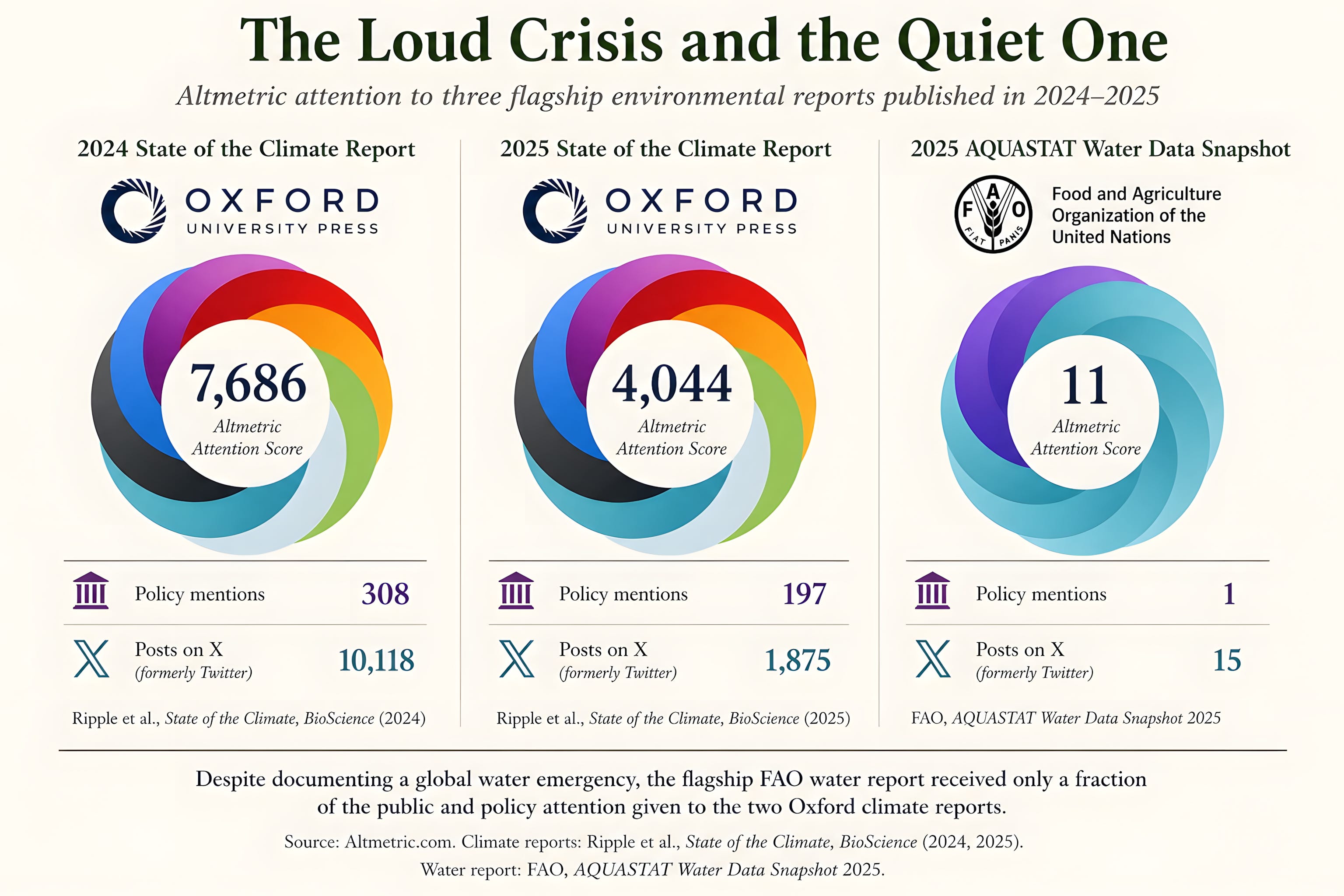
Even the climate reports themselves look past it. The 2026 edition calls itself “no longer a warning for the future” but “a diagnosis of the present,” yet the present it measures is temperature records, ice extent, ocean heat and disaster tallies. It is a diagnosis of the sky, and of the future. Across the last three reports and tens of thousands of words, the word “yield” does not appear once. There is no crop trend, no soil fertility, no salinization, and although mentioned in passing in 2025 and 2025, by 2026 there was not a single mention of water quality. I recognize this from the ICU. When a patient arrives in septic shock, one number commands the room, the blood pressure, and whole protocols are built around pushing it up. But the blood pressure is the reading, not the disease, and you can chase the number until it looks better while the patient gets worse. Carbon has become that number.
I have my own doubts about how settled the climate story is, but they are not this post’s business. What matters here is what the UN itself names as the drivers of the world’s water losses: groundwater depletion, over-allocation, soil degradation, deforestation and pollution. We do all of those with pumps, plows, chainsaws, and drainpipes, and global heating only compounds the damage. We are not losing our water to the weather. We are spending it, draining it and, most of all, fouling it ourselves. Climate may be an accelerant, but the fire is in the water and in the food that depends on it. And because we caused it, I believe it is within our power to fix it.
The point is simple: we are watching one emergency so closely that we have stopped noticing the symptoms of another, and the place those symptoms are showing up first is the farm.
What follows is what a slowly failing food system looks like when you read it the way I was trained to read a failing patient. It does not present as a sudden collapse. It shows up as declining efficiency, rising inputs, weakening resilience, flattening yield curves, at the end of a half-century in which food got steadily more abundant and cheaper yet carried less biological potency.
The Yield Curves Bend
For several decades after the Second World War, cereal yields rose rapidly across much of Asia, above all in the irrigated wheat and rice regions where improved seed met fertilizer and reliable water supplies. Between 1965 and 1990, yields climbed by nearly 4 percent a year in China and Indonesia and by more than 2.5 percent across India, South Korea, Pakistan and the Philippines.
Then the curves began to bend. In 2012, Deepak Ray and colleagues analyzed yield trends from 1961 to 2008 across the world’s major maize, rice, wheat and soybean systems and found that roughly a quarter to two-fifths of harvested area showed stagnant or collapsing yields. A follow-up study found global yield gains of about 1.6 percent a year for maize, 1.0 for rice, 0.9 for wheat and 1.3 for soybean, all below the roughly 2.4 percent annual growth estimated as necessary to double crop production and feed the world by 2050.
Those figures stop in 2008. When I went back to the raw UN yield data and applied a similar method through 2024, the picture had not improved. By my analysis, three of the four staples have slowed further. Rice, the grain that feeds more people directly than any other (and is also the most water-thirsty), fell to roughly 0.6 percent a year.
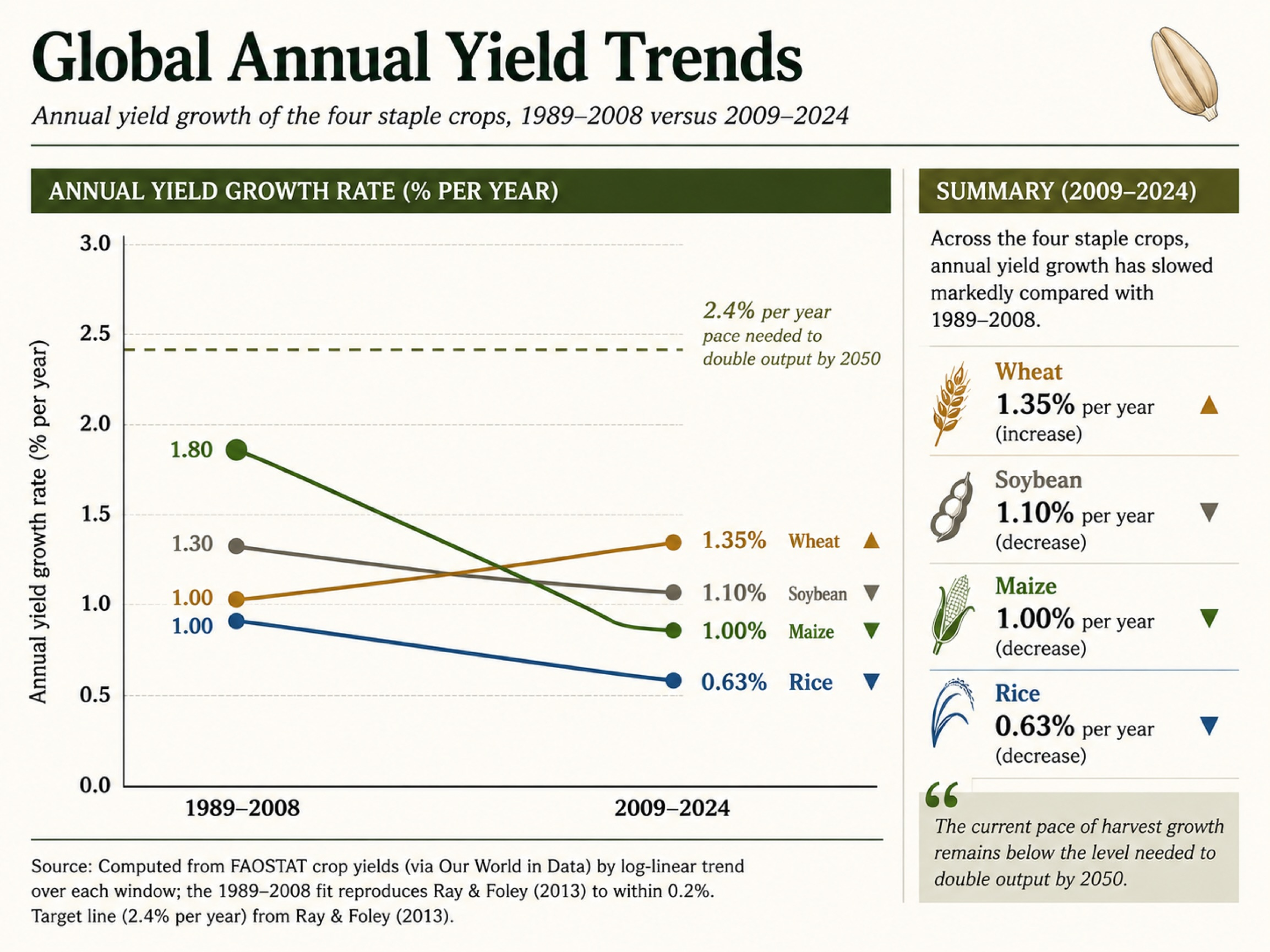
Analysis after analysis now warns that current trajectories fall short of mid-century food demand without large changes in productivity or resilience.
A word on what these numbers can and cannot show. They are worldwide averages, and they do not separate food grown on rainfall from food grown on water that is not coming back. So they prove one thing cleanly: yields are slowing across the planet. On their own, they do not prove why. The numbers set the problem. They don’t name the cause.
Global averages are the broadest form of evidence. The most precise form is national data. Where a country has kept long, clean yield records, the bend has a date and a place. France is the clearest case, and I use it for one simple reason: its records are unusually good. French cereal yields climbed sharply from 1950 through the 1980s, two to six percent a year. Then, around 1997 and 1998, they stopped, flattening to near zero or falling for soft wheat, winter barley and oats, and holding there through the 2000s.
And the stall was not from the seed. In breeders’ test plots, the genetic yield potential of French wheat kept rising through the whole period. Varieties in carefully managed test plots could still yield more, but in the fields, they no longer delivered. The plant was not the limit. The ground it grew in was.
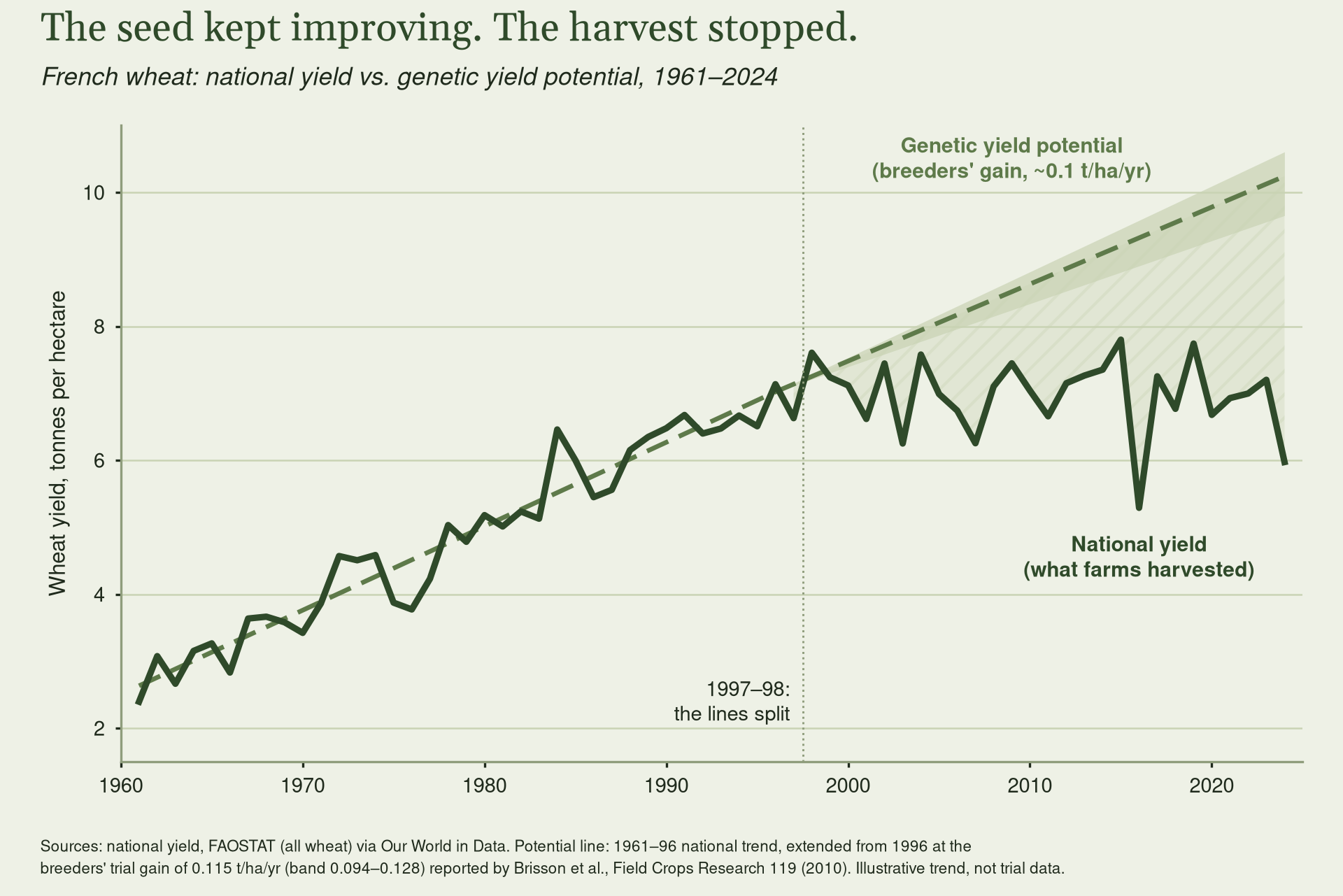
A single country can always be dismissed as a special case. But the same plateau is documented across the high-yielding wheat regions of northwest Europe, in Britain, Germany and the Netherlands as well as France, all bending in the same era. What is striking is that a generation of agronomists has not agreed on why. The proposed cause has moved from climate to farm management to no clear answer at all, and only one thing is ruled out with any confidence: that the crops reached their genetic ceiling. They did not. Something in the growing conditions is holding these fields below what they are capable of. Which is roughly where an ICU doctor wanders into a soil science debate uninvited.
*If you appreciate the late nights and deep dives I do down various health and medicine-related rabbit holes, a paid subscription is what keeps me going.
The Bill for Two Revolutions
Nature has always been able to bind, oxidize, and settle a certain burden of foreign material in water, keeping its lakes, ponds, rivers, and streams both clean and healthy. That capacity is real but finite, and for most of history whatever entered the water could be cleared from it again by the same mineral and biological processes, about as fast as it arrived. Rock, clay, iron, sulfate and time were enough.
What the Industrial Revolution began, and the Green Revolution accelerated, was not a poison that nature had never seen so much as a volume and novelty of load it had never had to clear at once. Hundreds of thousands of synthetic compounds with no established pathway entered the water. Soluble NPK fertilizer became the standard formula on the world’s farmland, and from the late 1990s glyphosate-tolerant crops allowed glyphosate to be sprayed across entire growing seasons across the planet. And the load grew with us. When the Green Revolution took hold, some two and a half to three billion people lived on Earth; the counter has since ticked past 8.3 billion. The same decades that multiplied our chemistry multiplied the mouths it fed and the waste it left behind. The capacity did not fail; it was overwhelmed.
That is the first bill. The second came from a change the history books mostly leave out. The Green Revolution’s story is told in seeds, fertilizer, and machines, but the new seeds and the new fertilizer were, in practice, a package, and the package only paid off where water could be controlled. The tube well, driven by cheap diesel engines and later rural electricity, provided that control. For the first time in history, over a few decades, the world’s breadbaskets stopped waiting for rivers and rain and began pumping water up from beneath their own fields, something agriculture had never done at scale. In the late 1940s, India irrigated around 19 million hectares; it now irrigates around 70 million. If rivers and rain are the water we spend as income, that was the day we started drawing on our savings account.
So two revolutions left two bills, one on the chemistry of our water and one on its quantity. They are not arriving at the same time, and that matters more than anything else in this post.
Two Hits, and the Timing That Tells Us Which Landed First
In medicine there is a pattern called the two-hit hypothesis: one insult primes the body, and a second compounds it. The world’s water has taken two hits. One is in water quantity: aquifers pumped faster than the earth refills them, wells chasing the water deeper until it is too far down, too costly to lift, or gone. The other is in water chemistry. As water tables drop, wells reach into deeper, older, more mineralized water; along the coasts, the sea slides in; and from above, a century of fertilizer and irrigation has laid down its own residue of nitrate and salt. I call the slow, combined change the Geohydrological Shift: the water beneath our farms becoming both scarcer and chemically different from the water agriculture was built on.
The yield data show which hit landed first, and the tell is in the timing. Across most of the world’s cropland, the wells still draw, and the fields still drink, yet the yields are already slowing. If the only danger were that the water is disappearing, the slowdown would still be ahead of us, waiting on the day the wells fail. That day has not yet come, but the slowdown has already started. So the blow doing the damage now is the quiet one, the chemistry, lowering the harvest while the water still flows.
The loud blow is still ahead, and it is the harder of the two, because chemistry slows a field down while scarcity shuts it off. When an aquifer finally fails, the crop comes off irrigation for good, and the region’s output collapses rather than merely bends. For many places, that wall already has a date. The loud crisis is coming. The quiet one is already here.
More Fuel, Less Distance
The clearest sign of a failing system, like a failing heart, is how hard it now has to work.
Global use of inorganic fertilizer reached about 190 million tonnes of nutrients in 2023, up from 142 million in 2002, and nitrogen use rose more than twentyfold across the second half of the last century. Agricultural glyphosate use climbed nearly fifteenfold between 1995 and 2014, and by 2023 some 355 million hectares were equipped for irrigation, while agriculture took roughly 72 percent of the world’s freshwater withdrawals. Around the weakening system, an entire parallel industry of corrective inputs has grown up: composts, microbial inoculants, biostimulants, humic acids, chelators and precision-agriculture sensors. The agricultural-biologicals market alone is projected to nearly double within five years, from about $18.4 billion in 2025 to $35 billion by 2030.
Those figures establish the expansion. What it means is a matter of interpretation, and I read it the way I would read a patient on three pressors: modern agriculture increasingly depends on layer upon layer of purchased intervention to reproduce what healthy, biologically integrated soil once did on its own.
That compensation shows up in the water as much as in the farm budget. The nitrogen, the salts from soluble fertilizer, the glyphosate and its breakdown products all move through the same water in the soil and the same water in the aquifers that are already being depleted and salinized. The effort spent outrunning a degrading water system is itself part of what degrades it further: more fertilizer forced into soil that no longer coordinates its own fertility, and the residue of that fertilizer added to the salt and nitrate load below. It is a treadmill: the farmer runs harder every year just to stay where he is, and this one speeds up the belt with every step.
The Price Stopped Falling
A theory earns its keep by predicting where else its evidence should turn up. If the water beneath the world’s food has been changing, the yield curves are the first place it would show. The second is the price.
For the last quarter of the twentieth century, food got cheaper. By the FAO’s own accounting, the real cost of the global food basket fell by almost half over the thirty years to 2006. That was not a mystery. It was manufactured. Cheap food was the direct product of rising yields, and the Green Revolution’s real output was not tonnage. It was affordability. So when the yield gains stalled region by region through the 1990s and early 2000s, the price decline bottomed out in the same window, in a commodity slump the FAO dates to 1995–2002. Then prices turned up, and analysts began using a phrase that would have been unthinkable a decade earlier: the end of cheap food.
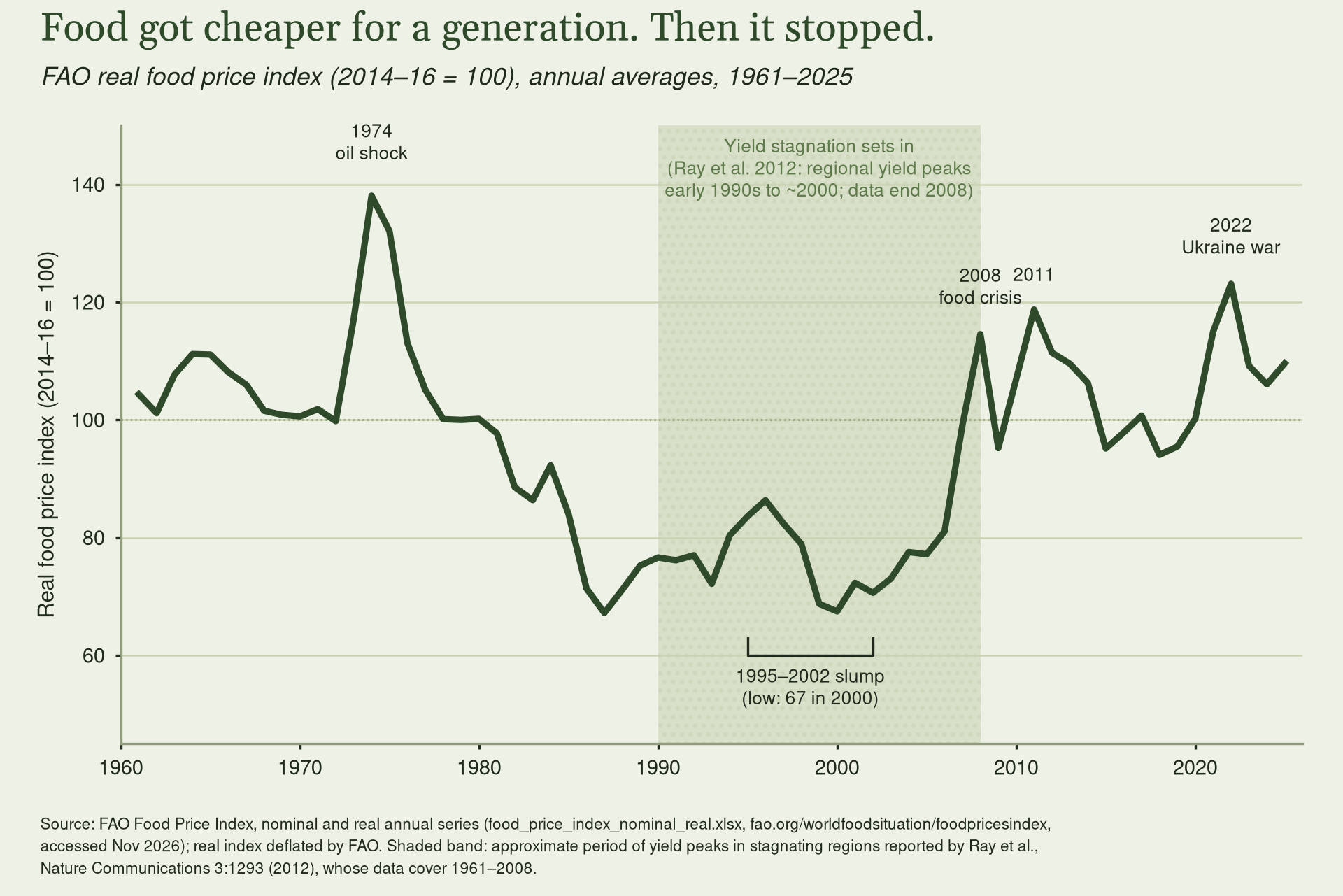
Food prices move on many things: oil, export bans, biofuel mandates, war, speculation and the weather. No one can extract a water-chemistry signal from a commodity index, and I am not going to pretend otherwise. But the largest compensatory effort in the history of farming was mounted in exactly the period the price refused to fall, and at the end of it the world still cannot make food cheaper. A shock passes and the trend resumes. This one has not resumed in twenty-five years. The price is the reading on the treadmill’s display: it tells you how hard the runner is working, and how little ground is being gained.
As I write this, the world is living through exactly the kind of shock that makes headlines. Since the Iran war began on February 28, shipping through the Strait of Hormuz has been strangled. Middle East fertilizer exports fell roughly 70 percent in September, and Brent crude closed October above $113 a barrel. In the Black Sea, Russian and Ukrainian wheat exports just had their weakest summer since 2012. The FAO Food Price Index hit 136 in September, with cereals up 17 percent in a year, and the World Bank expects food prices to rise another 7 percent in 2027.
In the ICU, I learned to treat the acute crisis without losing sight of the chronic disease underneath it. Wars end. Straits reopen. Urea went from $420 to $910 a tonne and back under $400 in a single year. Shocks spike and pass. What does not pass is the floor they rise from, and that floor has been creeping up for twenty-five years while yields stall. Each new crisis begins from a higher baseline than the last one. That baseline is what this post is about.
Food That Weighs the Same and Carries Less
A field can put out plenty of plant material while the soil beneath it loses its microbial negotiation, its water retention, and its mineral mobility. Food can still look like food, weigh like food, ship and sell like food, and register as yield. But yield is not the same as vitality, biomass is not the same as nourishment, and tonnage is not the same as resilience.
The mineral data show the gap directly. A comparison of 29 raw fruits and vegetables against British food-composition tables for 1940, 1991 and 2019 found dry-weight declines of roughly 52 percent for sodium, 50 percent for iron, 49 percent for copper and 10 percent for magnesium. Because the figures were adjusted for moisture, the losses cannot be explained by produce simply holding more water. American data run parallel: Davis and colleagues compared USDA composition data for 43 garden crops from 1950 to 1999 and found consistent declines in calcium, phosphorus, iron, riboflavin and ascorbic acid.
The wheat record is sharper still. In the Broadbalk experiment, which, incredibly, has run for nearly two centuries, zinc, iron, copper and magnesium in the grain held steady from 1845 into the mid-1960s. Then they fell significantly once semi-dwarf, high-yielding cultivars were introduced, even as the minerals in the soil remained level or rose. The grain kept coming. The chain of transfer from soil mineral to edible food had weakened.
The usual name for this, the “dilution effect,” undersells it. A crop bred to produce more grain or fruit can lift its yield without taking up minerals in proportion, so the farmer sees more output, the market sees more supply, and the body gets less mineral per bite. I will openly admit that the evidence is not uniform across all crops and datasets, and analytical methods have shifted over the decades. But the direction across these records is consistent: modern agriculture has raised production while, in many systems, thinning the mineral density of the food itself.
The Machine Runs, and Asks for More
Put the vital signs together and the picture is one I recognize from the bedside. The weakening input-output ratio is the plainest signal of all. Each unit of food now demands more water, more fertilizer, more pesticide, more breeding, more machinery and more management just to hold current yields. The machine still runs. It simply requires more to deliver less. What modern farming has worn down are the living pathways that once kept rock, water, microbes, plants, animals and people connected, and that weakening is the symptom.
A canary is only worth having if the alarm is answered in time, and only if we read it correctly. So here is my honest hypothesis, stated as plainly as I can. The seed is not the limit, and the water has not yet run out. What has changed, everywhere these curves bent, is the chemistry of the water the crops drink: what it carries, what it lacks, and what it leaves behind in the soil. It is the one variable in this system that almost no one is measuring at the scale of a farm, and almost no one is watching.
I could be wrong. A hypothesis is only worth testing if it can fail, and I intend to treat this one the way I would treat any claim at the bedside: lay out the evidence for and against, grade it honestly, and tell you where it is strong and where it is thin. Hydrogeologists have spent decades documenting what is happening to our water, and many have tied it to the farm. What no one has done is the test a doctor would insist on: treat the suspected cause and see whether the patient recovers.
The canary went quiet twenty-five years ago. It is time to treat the water and see if the harvest answers.
This series is about a solution, not just a crisis. Asao Shimanishi's Themarox, a mineral solution drawn from weathered rock, does quickly, in a glass, what rock and water once did slowly across whole landscapes: it is a geological shortcut. Two decades of records from Japanese agronomists and others convinced me it can help return the world's waters to a more biologically supportive state. Now it needs to be properly evaluated to modern standards and put to work at scale. I'm not an agronomist, so I need growers, researchers, and water managers willing to test it, develop it, and build on it. In full disclosure, I have a financial interest in products derived from this chemistry. But mine is one of several, the process is not proprietary, and I would be delighted to see others develop their own. The water belongs to all of us. You can learn more at The Stone and Water Series.

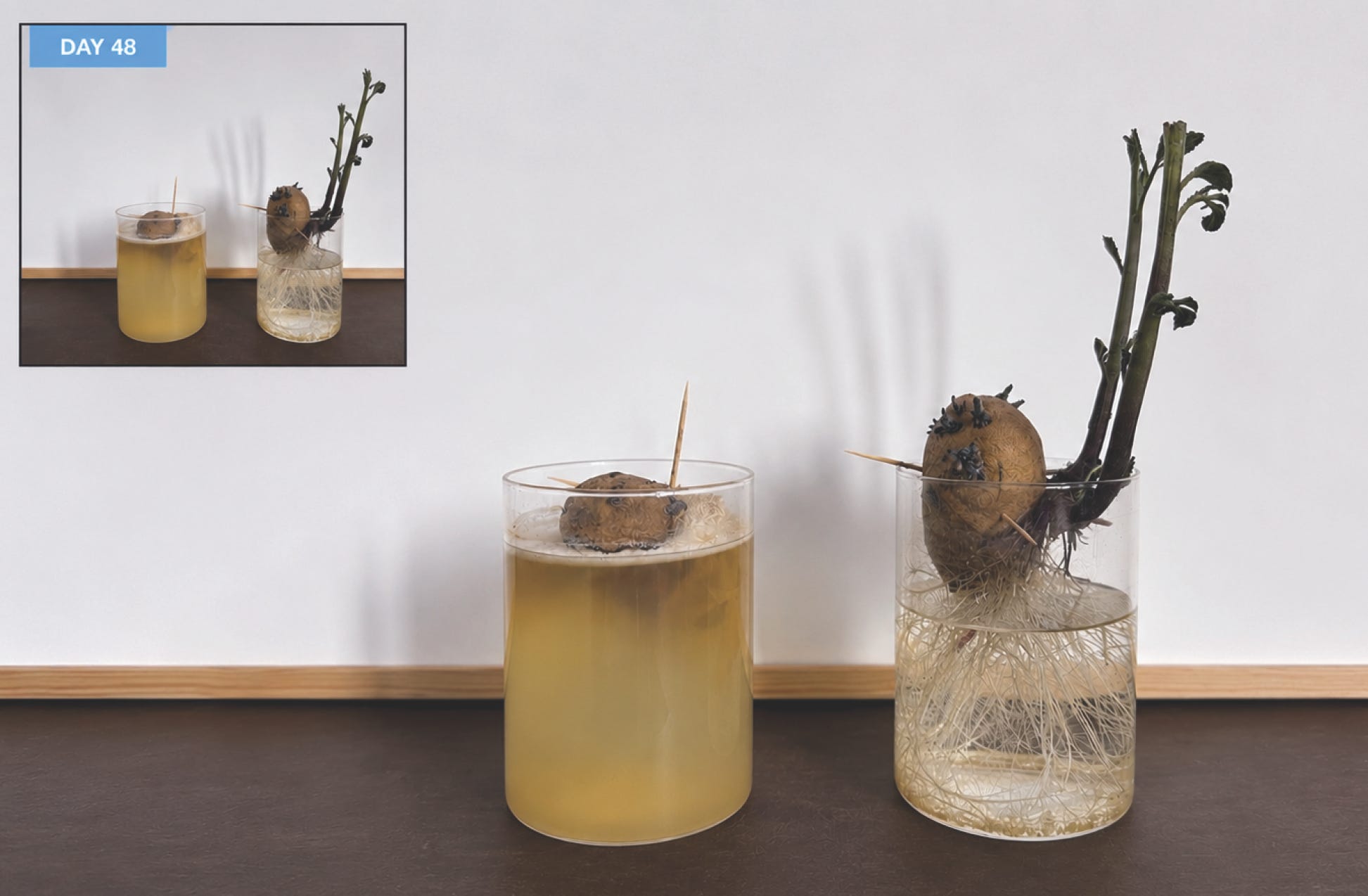
A potato half submerged in untreated tap water (left) and in treated tap water (right). One comparison, not a formal trial, which is exactly why it needs testing at scale.
From the Shameless Commercialism Department:

Aurmina is a volcanic mineral water purifier that cleans water the way the Earth always has. Add it to a pitcher. The minerals bind the contaminants, the burden clumps and settles, and you pour off the clear water. Unlike reverse osmosis, you don’t have to trade off purity for mineral breadth. Aurmina keeps the minerals in — producing one of the purest and most broadly mineralized waters on Earth. Check out our new website here (I also just learned that our 6 month return customer rate is over 45%, beating the top quartile target, an astounding testament to how much people love the water Aurmina produces).
Comparison with RO Systems


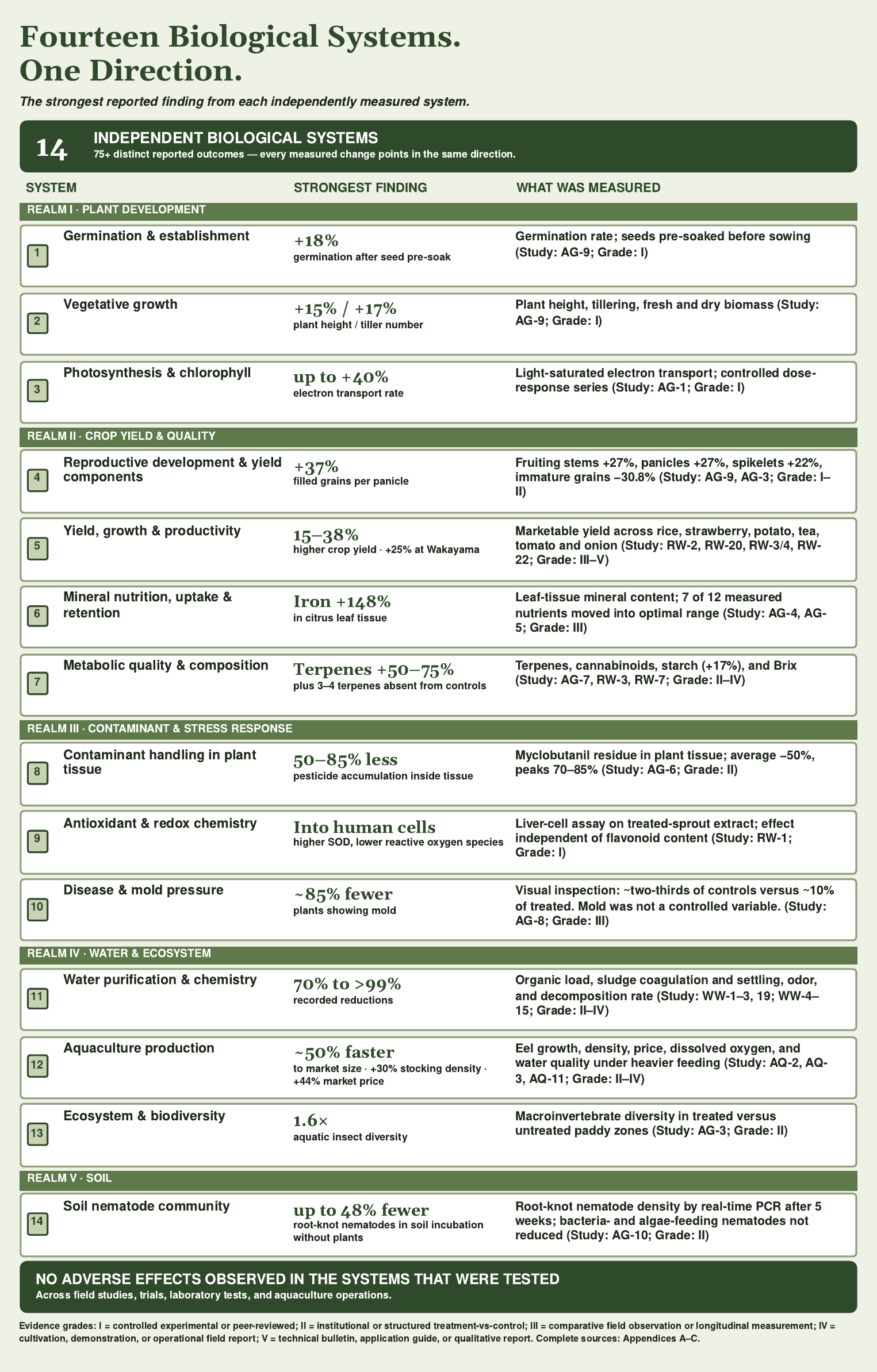
Primora Bio relies on the same mineral chemistry in the water that supports what we grow and love: plants, gardens, fish, and pets.
The “War on” Series


I love all of your articles. This one is by far my favorite. God bless you and your family and thank you for your outstanding work.
I DID buy a whole house filter a few years ago. Two years ago I added a reverse osmosis for drinking and cooking water. Our city (Calgary) decided to add fluoride to the water and I did not want fluoride in my bones. I did believe though that the water from tbe r'/o system is stripped of minerals we need. So I bought AURMINA. I tested the drops in both regular tap water and r/o water for 3 days. There was sediment in the regular tap water even with our whole house filter. No sediment in the r/'o water. I add the drops for the minerals. I hope I am on the right track.