


Well, That Took Longer Than Expected
Before we enter alchemy, I want to briefly re-ground those of you who were following The Blueprint of Life as I was serially publishing it here, and who may have wondered why I suddenly disappeared for six weeks.
The reason is simple: I thought the book was nearly finished. Then, while posting it, I discovered things that demanded more attention, more research, more decoding, and more writing. What was supposed to be a final pass became one of the deepest rabbit holes I have ever gone down, and I did not come back up until I felt the work was finally complete. The full book is now available here on Substack while it is being typeset and prepared for print.
For those of you who stuck with me, I appreciate you. For those who drifted off, welcome back.
Six weeks ago, I published three chapters over one long weekend: The Rock–Water Circuit Theory, Three Minerals and Water: The Engine of Life, and Earth’s First Energy System. They were, apparently, too heavy on the science. I say that because, for the first time in four years of writing on Substack, I lost subscribers while actively posting.
Oddly, I was unperturbed. Although I knew those chapters were too much, too soon, I also had a quiet confidence that the people who drifted away would likely come back once the destination became clearer.
Further, I had wandered far from my usual territory, even though I warned everyone we were going someplace new. Those chapters were in a domain foreign to, and probably uninteresting to, much of my long-standing readership.
What readers could not yet know was that those chapters were laying the foundation for where the book was really going next:
Into alchemy.
So stay with me. Please. It is going to get good. Like really good.
At my most delusional, I firmly believe these posts will make history — on Substack of all places. At my most sober, I hope to gain a handful of new subscribers.
Let history be the judge.
Anyway, enough of that. Let’s pick up where we left off.
In the earlier “heavy science” posts, MB and I put forth what we believe is a coherent extension of modern scientific understanding of the origins and continuance of life on Earth: a framework we named the Rock–Water Circuit.
When the Old Texts Began to Speak
The Rock–Water Circuit Theory draws on geology, hydrology, origin-of-life research, biochemistry, and atmospheric science. In brief, we propose that iron-rich biotite, once weathered into vermiculite, provides a core iron–sulfur–aluminum–water (ISAW) chemistry, along with a broader mineral matrix, that bridges geology and biology.
In this cycle, an energy-supporting mineral chemistry forms in rock, is opened by weathering, mobilized by water, carried into living systems, and eventually returned to Earth, where, over geologic time, it is reformed into rock, weathered again, and returned to circulation.
That last recursive movement—from life back to rock, and from rock back into water, using the same core chemistry—is where MB and I believe our work points toward a new understanding of Earth as a self-renewing life-support system.
What I did not expect was that this same cycle seemed to reappear—symbolically but consistently—in texts written long before modern scientific language existed. MB, the co-author of the theory and a man deeply studied in Scripture and texts from antiquity, had been pointing me toward that literature for months. At first, I did not know what to do with it.
Water was what finally caught my attention. It stood at the center of everything: modern chemistry, biology, and the older symbolic languages I had only begun to take seriously. As From Volcanoes to Vitality neared what I thought would be its completion, those scattered connections began organizing themselves into something larger, something that no longer belonged inside that book.
That is where The Blueprint of Life began. It also explains why FVTV remains unfinished. I had expected to complete it first, but this material intervened and demanded to be written. I am already hard at work since completing and submitting the final, final, final manuscript of Blueprint last week.
By then, I had followed water through mineral interfaces, charge separation, proton flow, biological organization, and the larger cycling of life itself. What I had not expected was to discover how many traditions had already described water as possessing unusual and even transformative properties.
Hermetic and alchemical texts spoke of “Living Water” and of baths in which matter is dissolved and recomposed. Scripture spoke of “waters of life,” “living fountains,” and of the Spirit moving over the waters at creation. Daoist alchemists described circulating inner fluids that renew the body.
For a long time, I would have read all of that as metaphor, or as spiritual language without a clear physical meaning. But once we had Shimanishi’s process in hand, numerous phrases from alchemy and Scripture began mapping with striking fidelity onto both his method and the Rock–Water Circuit.
What modern science now describes in the language of chemistry, physics, and biology, older traditions described symbolically. Water was treated as the active medium that carries, dissolves, mediates, renews, and enables transformation.
As the connections mounted, I began to suspect that the language was not just poetic. It might also have been recording, in symbolic language, something that modern science would later describe more precisely.
That is the question this post begins to test. But first, we have to set aside what most of us think alchemy is.
Alchemy’s Real Aim
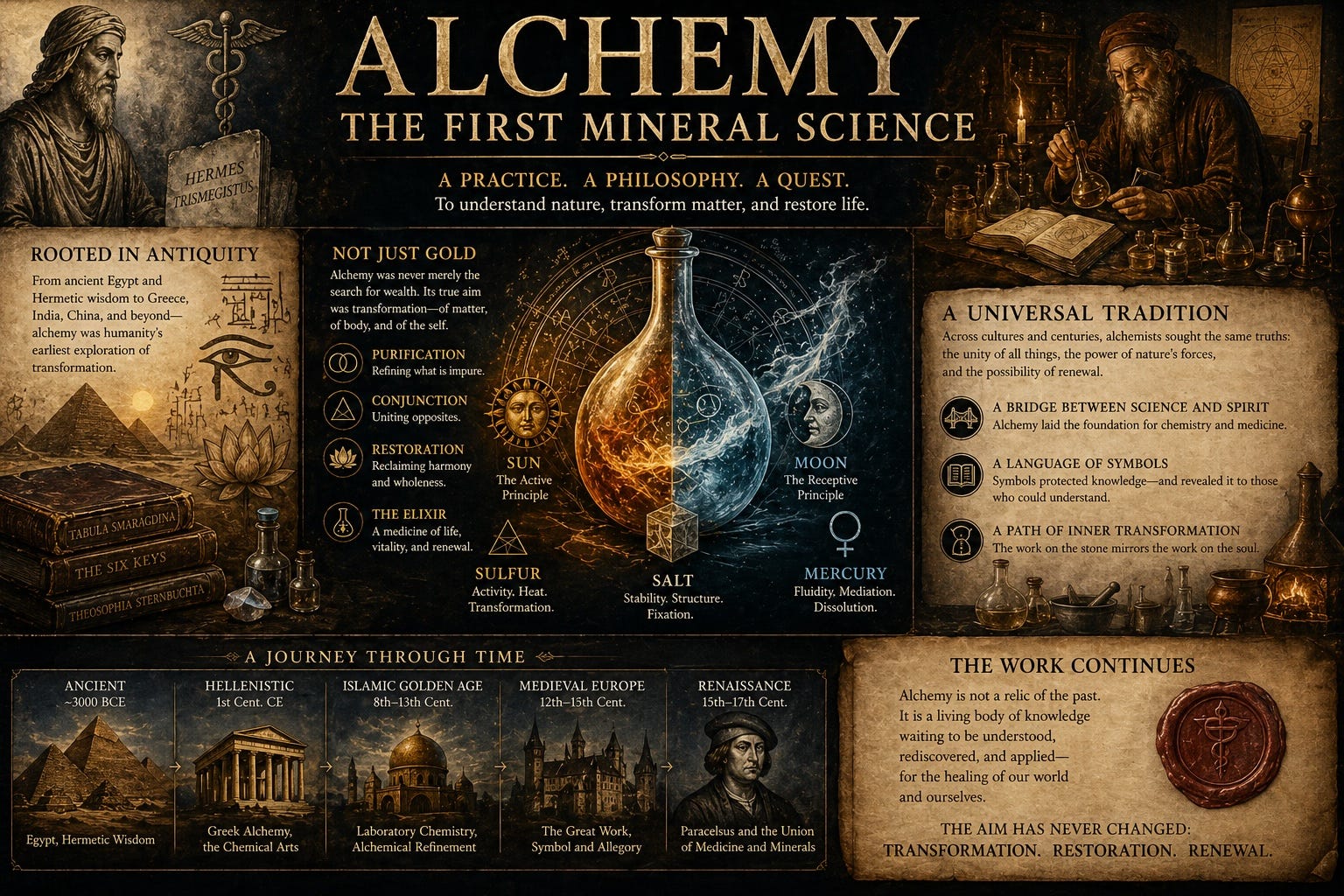
Alchemy long predates the medieval caricature most people now associate with it. Its roots span from roughly 3000 BC in Egypt, to Hellenistic Hermeticism in the first centuries AD, then to the eighth century in Islam, where the first laboratory chemistry appears, and finally into Renaissance Europe, where Paracelsus explicitly linked minerals to medicine.
However, when people hear the word alchemy, most immediately think of medieval cranks trying to turn lead into gold. That caricature obscures what alchemy actually was: the first experimental science, employing methods such as dissolving, extracting, purifying, crystallizing, and distilling. What is less widely recognized, and what took me months to understand, is that beyond chemistry, its deeper aim was restoration: the restoration of matter, of water, and of the human body.
Among the major streams of Western alchemy, the Hermetic tradition became one of its most enduring and influential, shaping how generations of alchemists understood nature, transformation, and the aim of the Work. Its legendary source was Hermes Trismegistus, “Hermes the Thrice-Greatest,” a Hellenistic figure formed from the union of the Greek god Hermes and the Egyptian god Thoth, deities associated with communication, wisdom, and sacred knowledge.
The writings attributed to him treated material and spiritual reality as parts of one intelligible order, governed by hidden correspondences between visible and invisible processes. That is why Hermetic texts mattered so deeply to alchemists: they offered a framework in which matter, spirit, nature, medicine, and divine order were not separate subjects, but different faces of one Work. From that tradition emerged the concept of the Great Work.
At first, I misunderstood that phrase, thinking it referred to a text or a body of teaching. In alchemy, it refers instead to a process: the transformation of matter from a corrupted or base state into a purified, ordered, and incorruptible state. The material expression of that process was the medicine, tincture, or elixir sought by the alchemists—what later traditions would call the Golden Elixir or Elixir of Life.
I, too, had always thought of alchemists as cranks chasing wealth. I quickly learned that the “gold” they kept referring to was metaphorical rather than literal, denoting purity, coherence, incorruptibility, and restored life. Their obfuscation of the word gold was intentional, to protect themselves, as they were trespassing into forbidden territory: natural transformation, healing, creation.
Appearing foolish was one way to escape persecution. Their heavy reliance on symbolism also served a separate, practical purpose: discouraging untrained imitators from injuring or killing themselves with mercury vapor, arsenic, acids, and explosive distillations. The gold metaphor itself functioned as a filter. As one historian put it, “the alchemists hid nothing; they wrote plainly, but only for those capable of reading.”
Entering the Labyrinth
MB had been pointing me toward these older texts for months—alchemical writings, fragments of Scripture, symbolic passages he believed preserved knowledge of mineral processes, sulfur chemistry, and the larger planetary order. At first, I did not know what to do with them. My attention was fixed on whether the modern scientific cycle we were seeing could stand on its own.
Only after that scientific map had taken shape did I begin to see—at first only in glimpses—that the language might be describing something real. By then, I had a more detailed understanding of the physical processes MB believed the texts described, but almost no fluency in the symbolic language of alchemy.
That is where the real difficulty began. It took far longer than either of us expected. The posts that follow trace how we found our way through that difficulty, one text at a time.
Now you know why I disappeared for so long.
Throughout what follows, when I use the term Art, I mean the chemistry of Shimanishi’s laboratory process. When I use Nature, I mean the larger Rock–Water Circuit as it operates in the world.
That distinction matters because what stood at the center was the possibility that a real, repeatable, material process had been recognized, encoded, and transmitted across history long before modern science possessed the means to describe it in its own language.
But before giving the reader the key we eventually built, I need to show why these texts resist literal reading so aggressively.
The Failure of Literal Reading
Alchemy is difficult in a different way than chemistry. Chemistry is difficult because it is technical. Alchemy is difficult because its central words do not behave like modern nouns.
Every word that appears central is capitalized—Sun, Moon, Sulfur, Mercury, Body, Spirit, Stone—and nearly all of them fail on first contact. At first, I assumed I was reading poorly. Then I assumed the texts were inconsistent. Then I assumed they were mostly mystical poetry, and that any mapping I thought I saw was simply pattern matching. But the failures had a peculiar quality. They were not random. They were the kind of failures you get when a wrong assumption has been baked into the problem from the start.
Of all people, I should have recognized that sooner, given that my university degree was in mathematics. You can do a great deal of math with a wrong assumption. You can even get answers that look right for a while. Then, two pages later, the whole structure collapses. That was my experience of the Hermetic canon.
The resolution came when I stopped demanding that the words behave like labels and started treating them as roles. Sun, Moon, Sulfur, Mercury, Body, Spirit, and Stone can name substances in one passage and functions in another. The mistake is deciding too early what a word “means,” then carrying that meaning forward as if the text were using a fixed vocabulary.
That is how the labyrinth works: it punishes certainty before the process has been understood.
Shimanishi’s work gave us a concrete operational system against which the texts could be tested. At first, the parallels felt uncanny, even strange. But the deeper we went, and the more rigorously we checked each term against the chemistry and the extract itself, the more his process allowed us to move forward.
We eventually realized that alchemical texts often use the same words to describe the same physical operation, even when the material being acted upon changes. The texts also repeat constantly, describing the same process while using different metaphors, terms, and emphases. To a literal reader, this feels like new steps appearing everywhere. In reality, the text is often describing the same operation from different symbolic angles.
One example may help. In The Emerald Tablet, the line “The Father thereof is the Sun, the Mother the Moon” initially led me to treat Sun and Moon as stable substances. I tried mapping biotite onto the Sun and vermiculite onto the Moon. That reading worked briefly, then collapsed.
The language was not assigning fixed identities. It was describing an interaction. The Sun names the activating principle—the force that penetrates, transforms, and brings about change. In the chemistry we had identified, that role is most consistently fulfilled by sulfur, whether as sulfated rainwater in Nature or sulfuric acid in Shimanishi’s laboratory. The Moon names the receptive body: the matrix that receives that action, opens, and yields its contents.
The words had not been inconsistent. I had been trying to hold them still
Three terms sent me deepest into the labyrinth: Sulfur, Mercury, and Salt. Because these words are so difficult and unstable in the texts, it helps to state their core meanings simply at the outset.
• Sulfur is activation: heat, oxidation, transformation.
• Mercury is mediation: mobility, dissolution, transport.
• Salt is fixation: structure, stability, persistence.
In Nature, sulfur appears as sulfur-bearing water over time, while Mercury refers to the mobile aqueous mineral medium moving through stone—that is, water. In Art, Mercury is the mercurial solvent doing the extracting and carrying—that is, sulfuric acid.
Later, when we reach The Six Keys of Eudoxus, the text even uses both Sulfur and Mercury to describe the role of sulfuric acid. It took us months to see that.
Again, the words move, but the process does not.
What follows is the interpretive framework MB and I arrived at after months of failed readings, internal contradictions, cross-checking, and repeated returns to the primary texts. To our knowledge, no prior interpretation has mapped these terms with this degree of operational and material precision. The framework stands or falls by whether it holds together across texts, chemistry, and scale.
The Key We Had in Hand
As described earlier in the book, we began with what we thought was a reasonably accurate understanding of Shimanishi’s method of extracting minerals from rock in a liquid solution. Or so we thought. For several months, we had one crucial step wrong: we assumed he started with biotite, or black mica, when in fact he started with vermiculite derived from biotite. Once we realized that error, many interpretive mistakes resolved.
Over long geologic periods, acidic, sulfated rainwater gradually weathers biotite, leaching potassium and transforming it into a more porous, hydrated vermiculite. Shimanishi did not begin with the closed parent mineral. He began with vermiculite: biotite already weathered into the receptive, expanded form from which mineral essence could be drawn.
In his laboratory process, sulfuric acid did not perform the first geological opening. Nature had already done that. The acid acted only after the mineral had been prepared.
Another crucial step took us a while to understand. Shimanishi learned that the vermiculite had to be dried first. If sulfuric acid were applied while interlayer moisture remained trapped inside, the mineral would shatter violently. Once air-dried, however, the acid could enter “without violence”—a phrase you will soon meet—and draw its mineral essence into solution.
The result was a clear aqueous extract that left the aluminosilicate framework largely intact while releasing mineral chemistry in sulfated ionic form, with iron, sulfur, and aluminum at its core, alongside magnesium, calcium, manganese, titanium, and a broad spectrum of ultratrace and rare-earth elements.
That sequence—a closed mineral body, its opening by sulfur and water, the removal of moisture, the entry of a mediating fluid, and the extraction of a concentrated mineral essence—was the operational key we began with, but only in outline. We understood the general shape of Shimanishi’s method before we understood its precision. And that lack of precision kept defeating us when we tried to map the process onto the texts.
What followed became recursive. When the texts stopped making sense, they forced us back into Shimanishi’s method. When his method became clearer, we could return to the texts and advance a little farther. That back-and-forth—between chemistry and language, process and symbol, failure and correction—is how the alchemical texts began to resolve. Over time, the three principal texts began to appear as differently angled descriptions of the same underlying process.
A Novel Interpretive Framework
Taken together, the three alchemical texts presented in the following posts span the early medieval period to the seventeenth century and, in our reading, preserve a process whose expression extends back through nearly two thousand years of Hermetic and alchemical tradition.
What follows is not the conventional understanding of these works. It is a novel interpretation MB and I arrived at over months of testing the texts against Shimanishi’s process, the Rock–Water Circuit, and the chemistry itself.
To our knowledge, these texts have not been interpreted in this operational and materially specific way before. I say that carefully. I do not mean that no one has ever seen part of what we describe. Many readers have recognized isolated themes, symbols, or structural features. What appears not to have been done is to map these three works together onto a coherent physical process with this degree of chemical, operational, and cross-textual precision.
In our reading, The Emerald Tablet presents the larger recurring cycle: the world-order in which above and below, ascent and descent, generation and return are held together. The Six Keys of Eudoxus presents the guarded sequence by which a mineral essence is brought forth from stone: the openings, dissolutions, separations, washings, coagulations, and fixations. Letter from a Woman Alchemist on the True Stone of Wisdom presents the portrait of that essence once produced: the medicine, tincture, or elixir, and its properties.
The next three posts walk through these readings one text at a time, not in historical order, but in the order most useful for decoding them.
I invite these conclusions to be criticized, tested, and weighed against alternative explanations. If they fail, we will revise, refine, or abandon them. If they hold, then something long preserved in symbolic language has become newly interpretable.
Either way, what follows should be read as an argument to be examined, not a doctrine to be accepted.
The three posts that walk through each decoding, followed by “The Closing of the Hermetic Canon,” follow below. They form the core of The Blueprint of Life and are available to paid subscribers.
The Emerald Tablet: A Map of the Rock–Water Circuit
Letter From Sternbuchta: A Portrait of the Stone
The Six Keys of Eudoxus: The Labyrinth
The Hermetic Canon: Closed
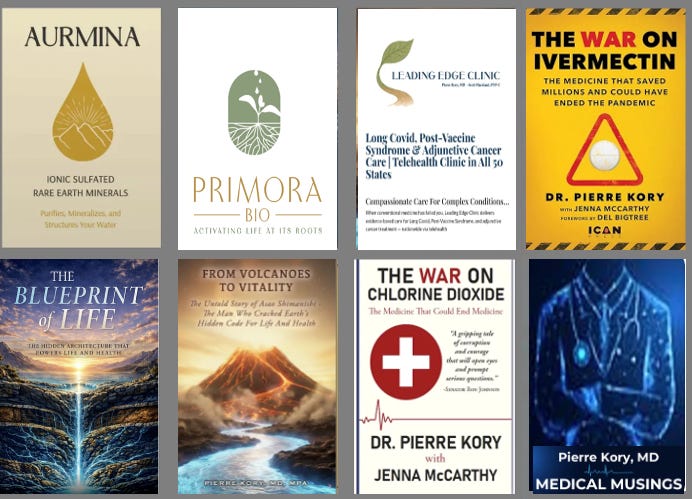
For readers curious about the mineral extracts that this journey led me towards, you can learn more at Aurmina and Primorabio.
*If you value the late nights and deep dives into all the “rabbit holes” I write about (or the Op-Eds and lectures I generate for the public), your support is greatly appreciated.
From Research to Practice - Links Below Image
Welcome back from Wonderland. Most of us know of your brilliance and have waited patiently for more......Thanks for beginning again, or should I say, finishing up. I look forward to reading the remainder of your books that I haven't read yet and yes, I believe history will be a very generous recorder and judge of Dr. Pierre Kory. You have made a dramatic difference in the lives of countless people around the world.
you're back so happy and I always want to read what you write even sometimes when it's a little over my head I will read till I get it🤪