


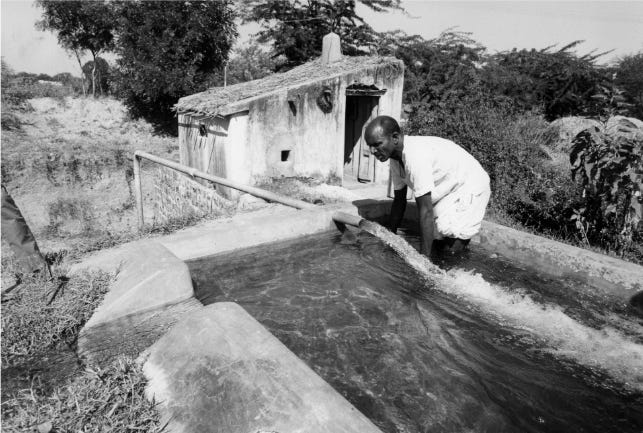
Indian farmer at his tube well, USAID Archive
The Stone and Water Book Series: For years I wrote here about what the “official” Covid story left out: suppressed treatments, hidden harms, a medical system failing the people it was meant to protect. This series is the same work on a larger patient. Global agriculture is in multi-organ failure, with yields stalling almost everywhere, and I believe the main insult is the degraded chemistry of the world’s water. It touches every meal and every glass of water you drink, and I believe we can reverse it. Each post in this series stands on its own. If you want the backstory, it starts with my book launch post. And I haven’t left medicine: posts on the revolutionary impacts of daily low-dose ketamine, young tissue extract, and more are coming at the conclusion of this series (a few weeks).
In the ICU, when a septic patient recovers, the antibiotic gets the credit. It’s in the order sheet. The fluids, the ventilator, and the nurse who turned him every two hours mattered just as much, but nobody writes those up as the cure.
The Green Revolution has been told the same way, in seeds, fertilizer and machines: Borlaug’s dwarf wheat, the Haber-Bosch plant, the tractor. All of it was real. But underneath it ran a change that rewrote where our food and water come from, and what that water carries. The intervention nobody wrote down was water, where the newly mechanized tube well started drawing down the planet’s savings while industry loaded it with chemistry.
A Well Sunk in Nine Minutes
The tool that changed the world’s water was almost comically simple. In the mid-1800s, an American named J. L. Norton patented what came to be called the tube well: a narrow iron pipe with a pointed, perforated tip, driven into the ground by repeatedly raising and dropping a weight, the way a pile is driven. Where water lay a few meters down, a hand pump on top of the pipe could bring it up within the hour.
The British adopted it overnight. At a public demonstration near Thames Ditton, on the edge of London, in March 1868, a reporter for the Illustrated London News watched a tube about three and a half meters long reach water in nine minutes, with the whole job finished in half an hour. “It will be difficult to overrate the importance of this new discovery in well-sinking,” the paper wrote. The Royal Engineers had already taken the design to war, and it served the army so well on the Abyssinian expedition of 1867 and 1868 that the British public came to know it as the “Abyssinian well”(my main source for this history is the water scientist Peter Gleick, The Three Ages of Water, 2023, chapter 17, “The Blue-Green Revolution”).
For most of a century after that, the tube well existed as a local convenience: a garden pump, a farmyard supply, a school water fountain. What changed in the middle of the twentieth century was the motor. Cheap diesel engines, then rural electrification, then subsidized power turned a pipe in the ground into a machine that could lift water from tens of meters down, all day, for almost nothing. The tube well quickly became an industrial and agricultural engine.
A Country Waiting on the Monsoon
To see what that engine did, we have to revisit what India was like in 1947. At independence, the country had roughly 340 million people, and most of its economy rested on farming. Most of that farming waited on the monsoon, which arrives in a few concentrated months and in some years barely arrives at all. Irrigation existed, but it came largely from canals along the major rivers, much of it built in the colonial era, and it reached only a fraction of the land.
A farmer who depends on the monsoon cannot do much with better seed or tractors. The high-yielding wheat and rice varieties of the 1960s were bred to turn heavy fertilizer into heavy grain, and that conversion required water delivered on schedule. A crop that is short of water at flowering does not use the nitrogen around its roots. The fertilizer just sits there, or washes away. The new seeds and the new fertilizer were, in practice, a package, and the package only paid off where water could be controlled.
The tube well supplied the control. Unlike a canal, it did not need a government-funded project, a dam, or a nearby river. Any farmer who could afford a pipe and a pump could irrigate his own field, on his own timetable, in the dry season as easily as the wet. Millions did.
The numbers themselves were revolutionary. In the late 1940s, India irrigated around 19 million hectares. It now irrigates around 70 million, much of it able to grow two crops a year because the water no longer waits on the season. Across India, Pakistan and Bangladesh, the groundwater pumped for agriculture rose from about 20 cubic kilometers a year in the 1950s to more than 250 by 2020. India alone now irrigates about 39 million hectares from groundwater, more than any nation on Earth.
Was The Green Revolution Actually A Blue Revolution?
The historian Kapil Subramanian, who studied this period closely, concluded that the spectacular growth in irrigation was at least as important to the yield revolution as fertilizer. It did more than protect crops from drought. It let farmers shift from lower-yielding crops such as millets to higher-yielding ones such as wheat.
The best-known economic accounting of the Green Revolution backs him up, although the typical historical accounts rarely mention it. In 2003, the economists Robert Evenson and Douglas Gollin estimated how much of the developing world’s yield growth came from the new crop varieties themselves. For 1961 to 1980, the peak decades of the revolution, the answer was about 21 percent. The rest came largely from more intensive use of other inputs, chiefly fertilizer and irrigation. Only from 1981 to 2000 did the new varieties account for nearly half of yield growth, and the authors attributed that shift partly to slower growth in fertilizer and irrigation.
The same story ran in the United States, a little earlier. Beneath eight states of the Great Plains lies the High Plains Aquifer, of which the Ogallala is the best-known part. In the late 1940s, farmers irrigated about 8,500 square kilometers from it. By 2005, they irrigated more than 60,000, and more than 410 cubic kilometers of water had been mined from it, nearly the volume of Lake Erie. Worldwide, the shift is now structural: of the roughly 300 million hectares equipped for irrigation in the most detailed global inventory, 38 percent are watered from groundwater, accounting for 43 percent of all the water irrigation actually consumes.
Income and Savings
Hydrologists have a useful way of thinking about this. Rain and rivers are income. Deep aquifers, filled over thousands of years, are savings. In that light, the Green Revolution was not only a bounty of seeds and fertilizer. It was a historic decision to start drawing on the planet’s savings accounts.
And a withdrawal from savings can feel exactly like a raise. The harvest grows, the price of food falls, and nothing about the experience tells you the money came from an account that will not refill. That is what makes this part of the story so easy to miss. For fifty years it looked like productivity.
It also has a property that seeds and fertilizer do not. A field can be irrigated for the first time only once. Global irrigated area grew by about 2 percent a year through the 1960s and 1970s, slowed to about 1.5 percent in the 1980s, and to barely 1 percent in the 1990s (FAO, World Agriculture: Towards 2015/2030, 2002). The best land, the shallowest water and the easiest wells were taken first. Each decade added less newly watered land than the one before.
The U.S’s Ogallala aquifer shows what happens when one of the accounts starts running low. Across the aquifer, total irrigated area kept climbing for decades because irrigation kept spreading in the north, where the water is deepest. In the south it went the other way. Nobody keeps a single count of the farms lost over the Ogallala. What does get tracked is irrigated land taken out of production, and those numbers are disturbing. In the Texas Panhandle and High Plains, irrigated acreage has fallen by about 40 percent since the early 1980s. In western Kansas, more than 232,000 acres dropped out of irrigation between 1989 and 2021. In the groundwater district that covers the state’s west-central counties, irrigated land fell by about 40 percent, from roughly 292,000 acres to 171,000.
Behind the acres are families. A 1988 USDA study of seven irrigated counties on the Texas High Plains found that by 1978 almost 2,400 operators of irrigated farms had already gone out of business, and the average irrigated farm had grown from 320 to 480 acres as those who stayed took over their neighbors’ land. Then, between 1978 and 1982, as falling water levels and rising energy costs made pumping uneconomic, irrigation stopped on another 814 farms covering 367,000 acres. Some of that land went back to dryland farming, which yields far less: in one Kansas State trial, dryland corn made 127 bushels an acre against 217 under irrigation. But most of those operators left farming, and nearly half the land went out of production altogether.
That is what the end of a withdrawal from savings looks like. It isn’t a dry tap. It’s a dryland field and fewer, larger farms. How much is left in these accounts, and when the deepest withdrawals come due, deserves its own post, and I’ll get there.
A Different Water
One half of the water crisis is driven by quantity, or more accurately, freshwater scarcity. But the switch from rivers to wells also changed the water itself, and that is the larger focus of my book, and the one I believe is the most amenable to reversing.
“Surface” water from rivers and “ground” water pumped from below arrive at a field as chemically different things. A river is young water, a few days or weeks out of the sky. It has moved continuously through air and sunlight, carrying dissolved oxygen and a living community, and it has drawn its minerals from an entire watershed along the way. In flood, it also carried silt, fresh, finely ground mineral sediment laid across the fields every season. For thousands of years, the Nile renewed the soils of Egypt this way. When the Aswan High Dam was completed in 1970, that silt began settling behind it in Lake Nasser instead, and Egyptian farmers replaced the river’s annual gift with purchased fertilizer.
Groundwater from a deep well is often old water, sometimes decades old, sometimes thousands of years. It has sat in the dark, under pressure, often with little or no oxygen, in prolonged contact with one formation of rock. Across much of the Indus and Ganges plains, that well water is rich in sodium and bicarbonate relative to calcium and magnesium. Applied season after season, the carbonate precipitates the soil’s calcium, sodium takes its place on the clay, and the soil’s structure collapses. In the Bengal delta it was worse. The shallow aquifers there hold arsenic, released from sediments under low-oxygen conditions, and tube wells brought that water up by the millions, first for drinking and then for the rice paddies. Studies of Bangladeshi paddy soils found arsenic highest where the irrigation water carried the most and the wells had run longest, at more than four times the levels of unaffected areas, with elevated arsenic in the rice grown there (Meharg and Rahman, Environmental Science & Technology, 2003). The arsenic did not stay in the field. Through the crop, it went into the food.
What the Water Carried
For nearly all of agricultural history, water entering a field from a spring, river or aquifer carried a geochemical inheritance: the minerals, ions and dissolved compounds it had picked up from air, soil, sediment and rock.
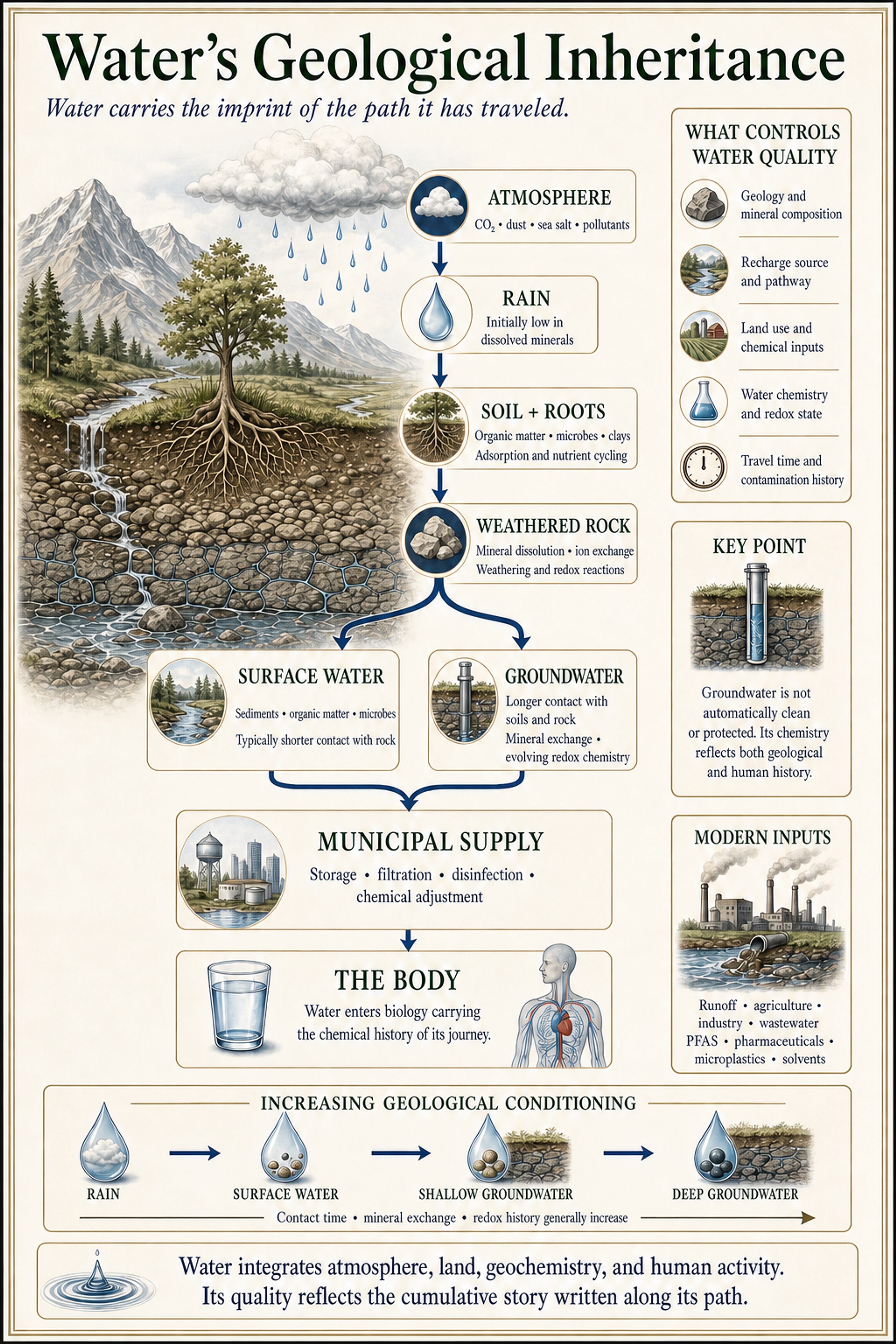
However, during the second half of the twentieth century, the water moving down through farmland increasingly carried another signature as well: fertilizer-derived nitrate and other major ions, pesticides, and changes in acidity and oxidizing chemistry. The farm’s fertility had been narrowed to three letters, NPK, applied as soluble salts. Pest control followed. Synthetic pesticides became routine after World War II, and in the late 1990s glyphosate-tolerant crops allowed repeated, large-area spraying of glyphosate across entire growing seasons.
Beyond the farm, the industrial century released a chemistry the planet had never seen. More than 350,000 chemicals and mixtures are now registered for production and use worldwide, most of them invented within living memory and many never tested for what they do in a living body. Solvents, plasticizers, flame retardants, pharmaceuticals, industrial surfactants and the 'forever chemicals' known as PFAS all end up in the same place, because water is where everything we make eventually goes. They wash off fields and streets, leach from landfills, pass through our bodies into sewers, and slip through treatment plants built to remove pathogens, not molecules. The U.S. Geological Survey found PFAS in nearly half of the nation's tap water samples. Federal drinking water law regulates fewer than a hundred contaminants. The rest move through rivers, aquifers and our taps unmeasured, unregulated, and largely unknown.
Nature has always been able to bind, oxidize and settle a certain amount of foreign material. That capacity is real, but it is finite. For most of history, whatever waste or foreign material that entered the water could be cleared from it again by the same mineral and biological processes, about as fast as it arrived. What the Industrial Revolution began, and the Green Revolution accelerated, was a volume and novelty of load that nature had never had to clear all at once. And the load grew with us. When the Green Revolution took hold, some two and a half to three billion people lived on Earth. The counter has since ticked past 8.3 billion. The same decades that multiplied our chemistry multiplied the mouths it fed and the waste it left behind. The capacity did not fail; it was overwhelmed.
You can see it in the ground. By the mid-2020s, salinization had degraded on the order of 82 million hectares of rainfed cropland and 24 million hectares of irrigated cropland, together an area larger than France and Spain combined.
This is the problem that set me on the path to this series. Nature’s own answer to a loaded water has always been rock: water moving slowly through stone, binding, oxidizing and settling what it carries, and coming out the other side restored. Having learned that, I look at a picture like the one below in a completely different way than before I embarked on this research journey:
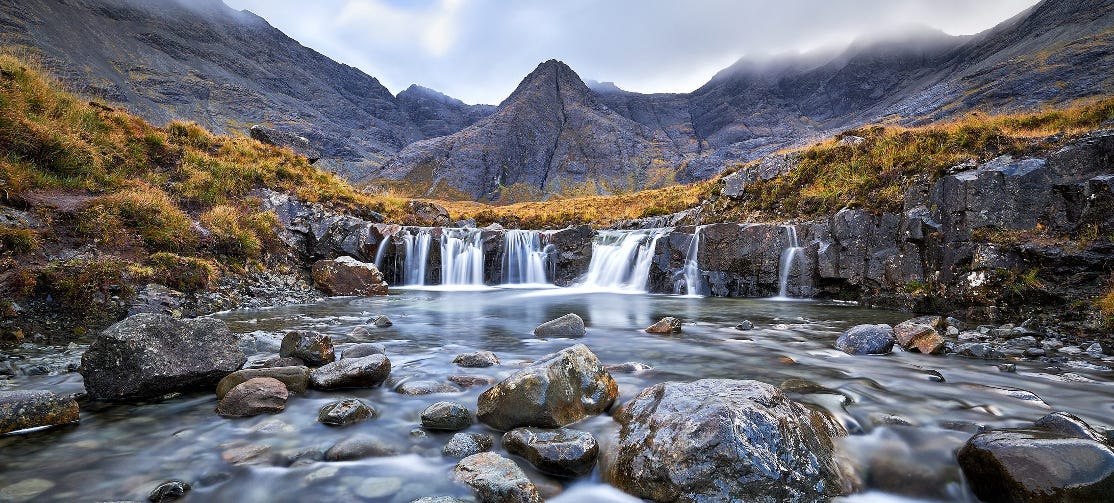
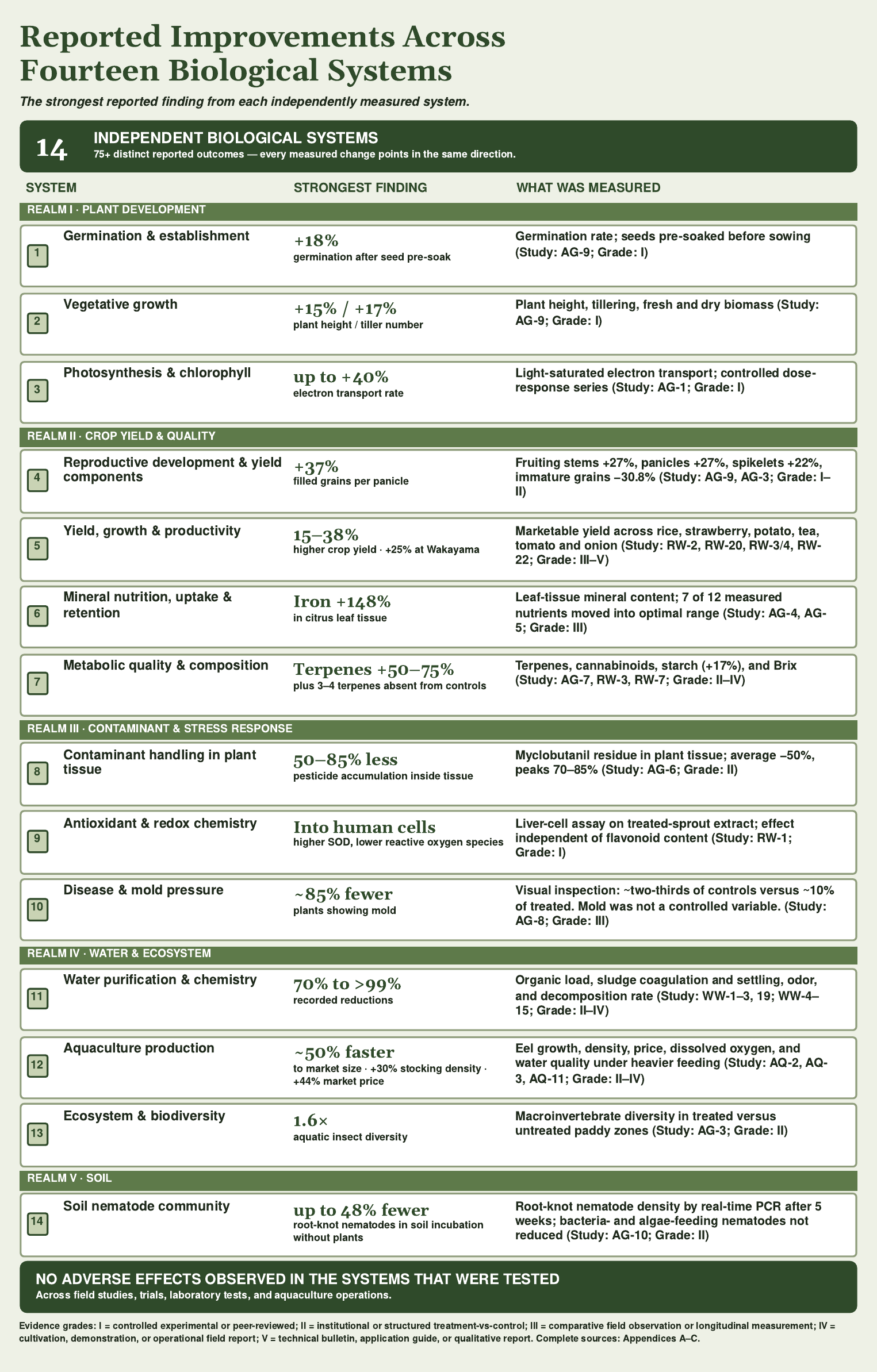
The trouble is that this earth-water chemistry works on nature’s clock, and we have outrun it. What drew me to create Aurmina and Primora Bio, solutions derived from Shimanishi’s Themarox, an aqueous mineral concentrate extracted from volcanic rock, is that they appear to do the same work on a human timescale. Irrigation water can be readied for use within minutes, and in our hands, drinking water within a day or two, including water we have already used and thrown away. That is why I have come to think of them as “geological shortcuts.” I will make that case properly in the restoration posts later in this series. For now, I want you to know where this is headed. The point of tracing the damage is not despair. It is to understand what has to be given back to the water.
The Blue-Green Revolution
The water scientist Peter Gleick calls the Green Revolution a “Blue-Green Revolution,” in which reliable water was as much the engine as the seed. I think that is exactly right, but I also need to acknowledge what that accomplished. It fed hundreds of millions of people who would otherwise have gone hungry.
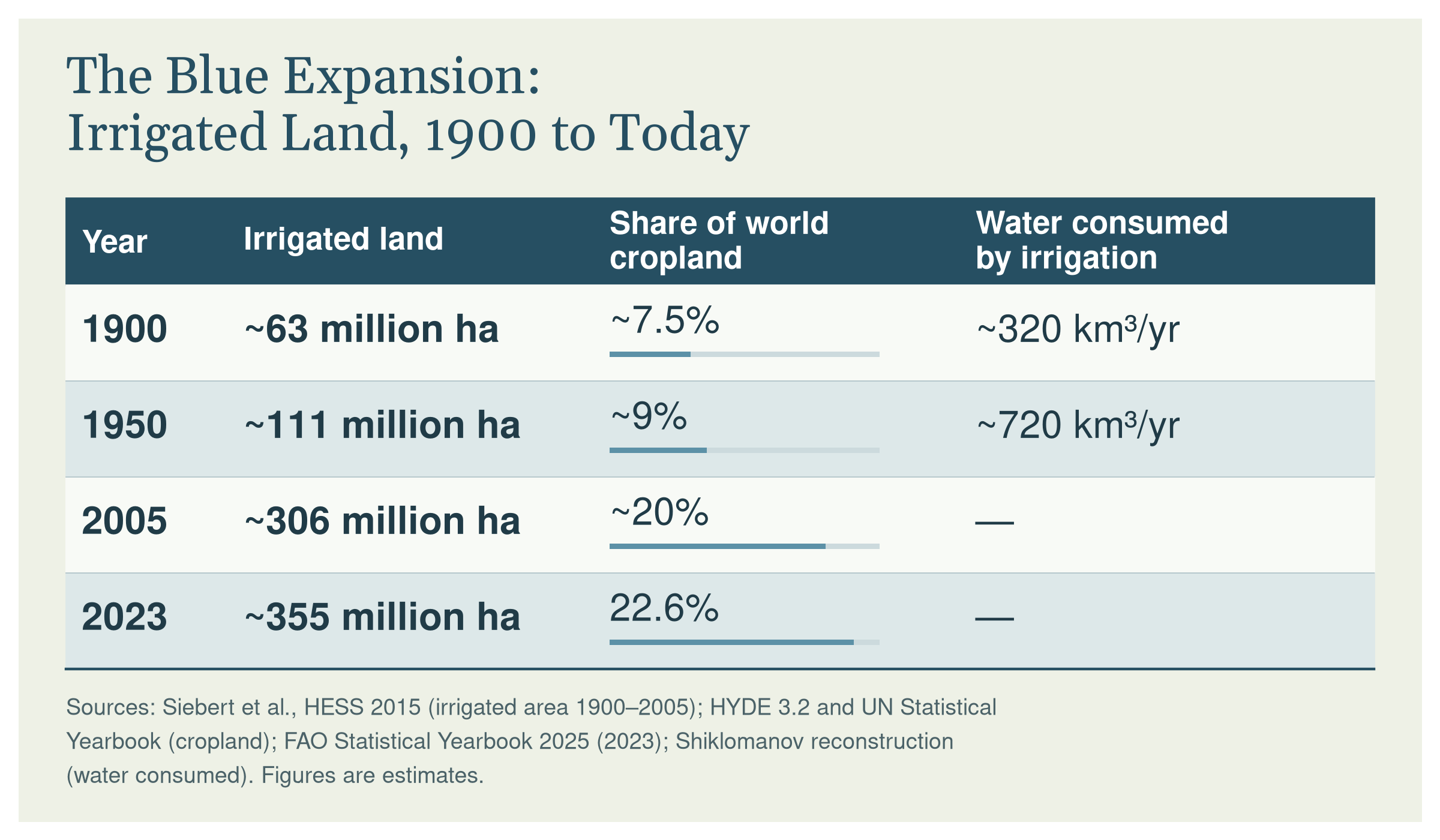
At this point, nearly a quarter of the world’s cropland is irrigated with groundwater, and roughly 40% of the world’s food comes from it.
The green half, the seeds and the fertilizer, can be bought again next season, as long as the energy behind them keeps flowing (more on that below).
The blue half is different. Much of it has come from aquifers that took millennia to fill, and it comes up as a different water from the one the fields have always known, into ground that is now simultaneously receiving a century’s worth of new chemistry from above. And under nearly every one of them, a clock is running. In Punjab, India’s breadbasket, a 2019 government projection gave the accessible groundwater until just 2039. On the Texas High Plains, pumping already peaked before the century turned, and in Kansas around 2010. These are not deadlines for our grandchildren. They fall within the working lives of farmers planting today.
So I see this history as one revolution drawing down its savings while the other loaded it with soluble salts and novel synthetic compounds. Both bills are real, and they are not arriving at the same time. The chemistry bill, which I have named The Geohydrological Shift, is already here, in the dropping annual yield gains across the globe that I presented in my last post, The Canary In the Field Went Quiet.
Energy Is Food
Famine has always come from the sudden things: a failed monsoon, a war, a blockade, a blight like the one that emptied Ireland. What I have been writing about is different. It is a slow-moving collision a century in the making, with aquifers drawn down over decades and chemistry loaded into the water over generations, and it is predictable enough that we can see where it is headed and, I believe, still turn it around. But a slow decline does not protect anyone from the sudden blows along the way.
In the ICU, the chronically ill patient is the one an acute insult kills. Right now the world’s food supply is taking one, and it is worth stopping to look at. When I wrote that the green half can always be bought again next season, I left out what it is made of. Nitrogen fertilizer is made from natural gas, which supplies the hydrogen in ammonia and typically 60 to 80 percent of the cost of producing it. Phosphate fertilizer depends on sulfuric acid, made from sulfur recovered at oil and gas plants. Take away the bag and the fertilizer is energy; thus, energy is food.
Just this week, the energy analyst Morgan Downey, author of Oil 101, was interviewed by Tucker Carlson on exactly this issue: “Most fertilizer is natural gas in a bag.”
In March, Iranian missiles took 17 percent of Qatar’s LNG export capacity offline for three to five years, in a country that supplies about a fifth of the world’s LNG. The closure of the Strait of Hormuz then bottled up the Gulf states that ship a third of the world’s urea and nearly half of its traded sulfur. In the first week of November, natural gas cost about $3 per million BTU in the United States and more than $31 in Asia (). Urea ran nearly 80 percent above its January price this spring, and sulfur has more than doubled.
Downey’s point is that the farmers who feel this first are not in Iowa. In India and Africa, he said, “the main variable on their crop yield is fertilizer,” and the harvests that fertilizer would have grown come in next year. “People will be hungrier,” he said. “That’s actually already unfortunately baked in.” This is what an acute insult does to a chronically ill patient. The shock will pass, but it lands on a food system already weakened by a century of drawing down the water beneath it, and each blow leaves less margin for the next.
This is also where my own hopes come in. Decades of fertilizer that crops never took up still sit in the soil, much of it bound in forms plants can’t reach. In The Silent Aquifer, I made the case that irrigating with Themarox-treated water could mobilize that buried reserve and let plants draw it back up. If that holds at scale, farms could need far less fertilizer from the bag, and with it far less of the natural gas and Gulf sulfur that a single missile strike can cut off. That still has to be proven in the field, and over the next three to five years I intend to see that it is. If it holds up, the energy shock I just described would land much more softly on the farms that need the most protection.
So the acute crisis will fade, as they do, and the slow one will still be there. Two revolutions ran up this bill over a century, and the groundwater bill is now rapidly coming due, which I will take up in the next post. In medicine, a good history-taking like this one tells you where to look next and what you can still do.
**This series takes a lot of late nights and deep rabbit holes. If you think this work is worth doing, a paid subscription is what makes it possible.
From the Shameless Commercialism Department:

Aurmina cleans water the way the Earth always has. Add it to a pitcher. The minerals bind contaminants, which clump and settle, and you pour off clear water. Unlike reverse osmosis, it doesn’t strip out the minerals; it keeps them in. More than 45% of our customers come back within six months, which tells me how much people love this water. Visit our new website at Aurmina.com

Primora Bio relies on the same mineral chemistry in the water that supports what we grow and love: plants, gardens, fish, and pets.
The Stone and Water Series

The “War on” Series

Leading Edge Clinic
