



ACT IV: Iron–Sulfur–Aluminum–Water (ISAW) — The Elemental Division of Labor
By the time I arrived at this stage of the investigation, a pattern had begun to reveal itself. The energy-generating logic I kept encountering in rock and water was not random, nor was it the product of a single mineral reaction unfolding in isolation. Instead, the same elements appeared again and again, each performing a distinct role within a coordinated system.
Iron moved electrons. Sulfur mediated proton activity. Aluminum provided the structural framework within which those exchanges could occur. And water, moving through rock and mineral interfaces, carried the entire process forward.
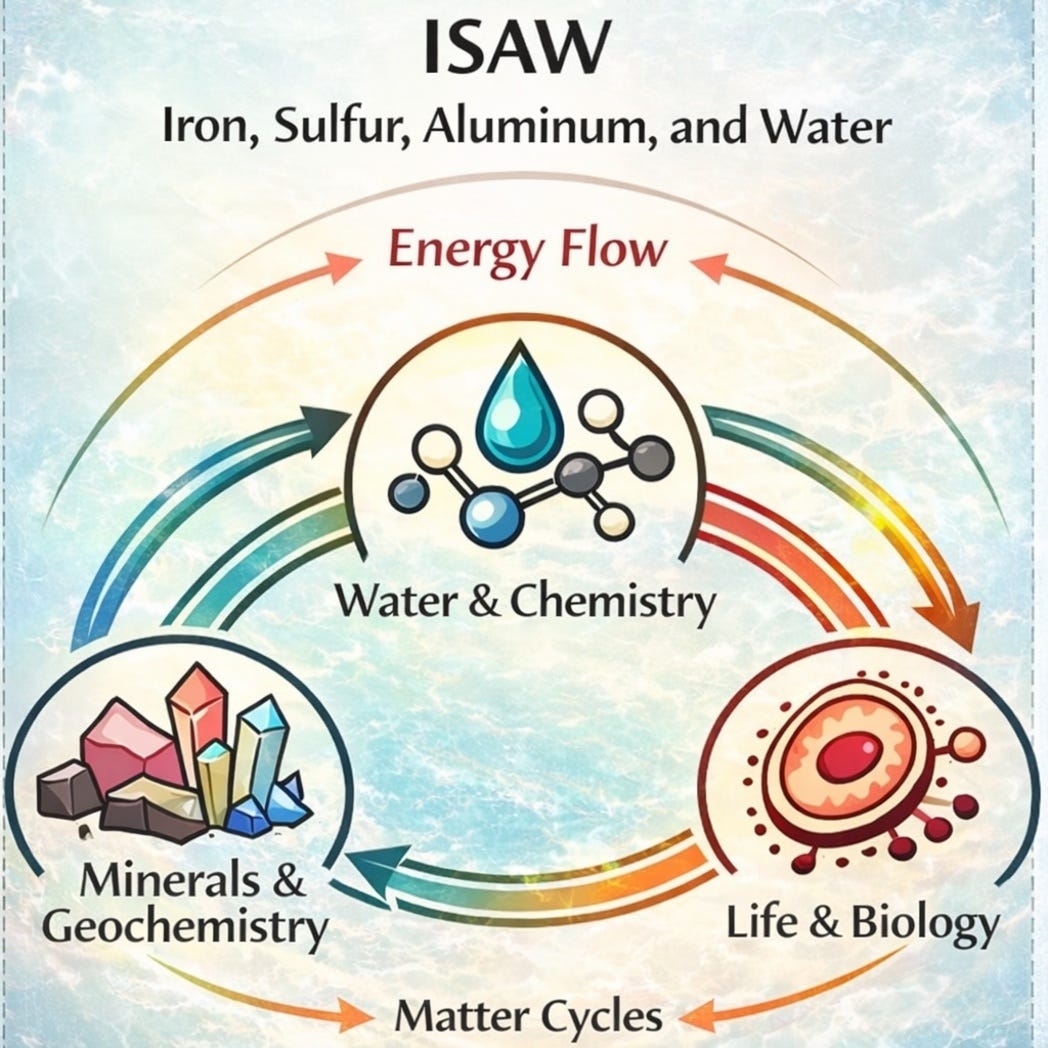
Taken together, these elements form what I have come to describe as iron–sulfur–aluminum–water chemistry, or ISAW—a recursive engine capable of generating and sustaining usable energy as it moves through rock, water, soils, and eventually living systems.
Once this pattern became visible, the division of labor among the elements began to make sense.
Electron Flow — The Role of Iron
As I followed the redox chemistry deeper into the geological literature, one element repeatedly stood out.
Iron.
Iron–sulfur redox systems embedded in rock represent one of Earth’s earliest distributive energy architectures. Yet that architecture would likely have remained confined within rock if it were not for the presence of water. Water serves as the continuity layer through which this redox logic was eventually inherited by biology, allowing it to appear inside proteins, mitochondria, cells, and organisms.
Iron stands out among the elements because of its unusual redox flexibility. It can donate electrons when the chemical environment requires it and then accept electrons again when conditions change. Energy generation depends on precisely this kind of reversible cycling. A battery that allows electrons to move only once quickly exhausts itself.
Iron, by contrast, can switch repeatedly between oxidation states, storing and transmitting energy without being consumed or structurally destroyed. It can perform this cycling indefinitely, keeping energy in motion while the surrounding structures remain intact.
Every living cell ultimately depends on this controlled movement of electrons, coupled to proton gradients, to power respiration and metabolism. For this reason, redox-active minerals—especially iron-bearing ones—sit at the foundation of both geology and biology. Iron conducts life’s current because it keeps energy moving.
Proton Flow — The Role of Sulfur
If iron excels at moving electrons, sulfur excels at mediating proton activity.
This relationship is not accidental. Sulfur exists across a wide range of charged states and participates in reactions that couple electron movement to the creation of proton gradients. Throughout Earth systems it appears in volcanic gases, reduced sulfur species, and sulfate dissolved in rain, oceans, sediments, and biological chemistry.
But sulfur becomes especially productive when it operates within iron-rich mineral systems. In those environments iron-bearing minerals stabilize and organize sulfur’s reactivity, allowing the two elements to couple tightly in proton-coupled redox reactions expressed at water–mineral interfaces.
This iron–sulfur partnership forms the energetic core of the ISAW system and underlies both ancient geochemical energy regimes and modern biological metabolism.
What took me longer to appreciate was that sulfur also performs another role: it helps reset the cycle.
Circulating continuously between rock, water, atmosphere, and life, sulfur links planetary-scale processes to local metabolic function. Delivered primarily as sulfate in mildly acidic rainwater, it participates in the slow weathering of iron-rich minerals such as biotite. Over geological time this destabilizes rigid mineral lattices and expands them into vermiculite, reopening mineral surfaces and restoring the reactivity required for continued charge transfer.
Once that transformation occurs, water assumes the next role in the sequence. It enters expanded mineral layers, mobilizes ions, buffers proton activity, mediates electron transfer, and carries liberated mineral chemistry into soils, root zones, microbial systems, and eventually into living organisms.
Sulfur renews the initiating chemistry, while water propagates it forward through the cycle.
Controlled Redox Flows — The Role of Aluminum
At first glance, aluminum seems like the odd participant in this system.
Iron moves electrons. Sulfur mediates proton activity. Aluminum appears to do neither. Yet as I examined the mineral structures where these reactions unfold, it became clear that aluminum plays a role just as essential as the more obviously reactive elements.
Aluminum does not participate directly in the constant exchange of electrons that defines redox chemistry. Instead, it locks itself into aluminosilicate lattices that form some of the most persistent mineral structures on Earth. These lattices carry a stable negative charge and remain structurally intact over immense spans of geological time.
That stability turns out to be precisely what the rest of the system requires.
Where redox chemistry involves relentless electron transfer and charged mineral movement, aluminum provides a fixed internal scaffold within which those exchanges can occur. Positively charged ions can bind to the negatively charged lattice, release when conditions shift, and be replaced by others without the structure itself collapsing.
In this way, the lattice becomes a dynamic stage on which energy exchange can take place continuously. The structure holds steady while the actors—electrons, protons, and ions—move through it.
This environment also shapes the behavior of surrounding water. The persistent negative charge of aluminosilicate frameworks organizes nearby ions and charge distributions in ways that allow energy differences to accumulate rather than dissipate immediately.
Put simply, aluminum provides the architecture that allows the rest of the system to operate without destroying itself.
Iron moves electrons.
Sulfur mediates protons.
Aluminum provides structure.
If aluminum behaved like iron or sulfur, the system would burn through its own framework and collapse.
The Aluminum Question
At this stage in the investigation an apparent contradiction presented itself.
Aluminum clearly plays a foundational role in the geochemical phase of ISAW. Yet when the same energetic logic appears inside living systems, aluminum itself is nowhere to be found.
For a time this seemed puzzling.
Eventually the answer became obvious once the system was viewed not as a set of elements but as a set of functions.
In geological systems aluminum provides the stable, negatively charged scaffolding within which redox chemistry can occur. In biological systems that same stabilizing function is performed by proteins, membranes, and enzymes that establish boundaries and organize charge.
What biology carried forward was not the element.
It carried forward the role.
The absence of aluminum from mitochondria therefore is not a contradiction. It is evidence that a successful transition occurred, in which a geochemical mineral architecture gave rise to a biological one capable of performing the same organizational work.
The mineral scaffold came first. Biology later reinvented its function using organic structures.
Water: The Control Layer
At this point in the investigation the role of water could no longer be treated as secondary.
Water is the medium through which the entire cycle operates. Without water, minerals remain locked within crystalline lattices. Without minerals, water remains chemically inert. Only when the two interact does the system become capable of generating and transmitting usable energy.
The role water plays in biology, I came to realize, is inherited from the path water travels long before biology ever encounters it.
In intact Earth systems rainwater does not simply fall to the surface and run away. Instead, it enters fractured rock and begins a much slower journey through mineral environments rich in iron, sulfur, aluminum, and silica. As it descends into these geological settings it remains confined within fractures and pore spaces for extended periods of time, interacting continuously with mineral surfaces under conditions of pressure, temperature, and time.
Through this prolonged contact water gradually acquires organized charge distributions and structured ionic arrangements. Earlier cultures described such water as living water, a term that captured its unusual vitality long before the underlying physics was understood. Today similar states are increasingly described in physical terms as structured or coherent forms of water shaped by mineral interfaces.
However one describes it, the important point is that the water biology inherits has already passed through a long geological preparation.
ACT VI: Where ISAW Drives Generative Loops
Biotite-Bearing Fracture Systems
As I continued following this chemistry through geological systems, one mineral kept appearing in places where water, charge, and mineral exchange were especially active.
Biotite.
The layered aluminosilicate lattice of black mica lines many of the fracture planes through which groundwater circulates. This geometry turns out to be remarkably well suited to sustaining ion exchange, redox buffering, and charge organization at the mineral–water interface. What emerges from these environments is not simply mineralized water, but water whose physical behavior has been shaped by prolonged contact with ordered mineral structures.
Biotite itself forms deep within the Earth, often tens of kilometers below the surface, where heat and pressure allow its layered structure to assemble. Over immense stretches of time tectonic uplift and erosion slowly carry these minerals upward toward the surface.
As biotite approaches shallower environments, a new sequence begins to unfold.
Sulfur-bearing rainwater and oxygen begin acting on the iron-rich layers of the mineral. Iron oxidation initiates electron flow. Sulfur, present primarily as sulfate, supplies protons that acidify mineral interfaces. These coupled changes weaken potassium binding within the lattice, allowing potassium to leave while water enters and hydrates the structure.
Through this process biotite gradually transforms into vermiculite, a mineral whose expanded aluminosilicate lattice becomes far more open and reactive.
The opening of that lattice serves two inseparable roles.
First, it creates the structural environment within which redox reactions and energy generation can occur. Second, it becomes a sustained source of liberated mineral chemistry, gradually releasing iron, potassium, aluminum-associated trace elements, and charge into surrounding soils and waters.
In this way the same structure that enables energy flow also supplies the material substrate from which biological systems are ultimately built.
When Energy Becomes Generative
At this stage an important question emerged for me.
It is one thing for energy to circulate through geological systems. It is another thing entirely for that energy to become generative, meaning capable of producing new structure, organization, and complexity that can move forward into living systems.
The answer, once again, pointed back to water.
Water carries these coordinated redox processes forward as an ordered medium. In doing so it performs two inseparable functions. First, it acts as an energetic participant, organizing charge, sustaining gradients, and preserving coherence across mineral interfaces. Second, it serves as the transport agent that mobilizes mineral chemistry, carrying iron, sulfur species, potassium, and associated trace elements from weathered rock into soils, microbial systems, and eventually plants and animals.
Through sulfated rainwater the rock opens. Charge organizes. Energy becomes transferable. Mineral chemistry becomes mobile.
Materials that were once locked inside crystalline lattices are redistributed through water into biologically accessible forms, entering a system in which energy generation and material supply advance together.
The Insight
The insight that emerged from following these processes was both simple and surprising. The same iron–sulfur–aluminum–water chemistry that drives the transformation of biotite into vermiculite also generates energy within the rock itself, and that chemistry is then carried forward by water into living organisms. What initially appeared to be separate domains, geology on one side and biology on the other, began to look instead like sequential expressions of a single system.
At that point I realized I was no longer looking at two different systems. I was looking at the same engine operating at two different scales.
ISAW, in other words, is not merely a mineral reaction occurring in rock. It is the underlying engine through which geology prepares the energetic and material conditions that biology later inherits.
At this point in the sequence the chemistry of ISAW is already complete. Its components are established, its reactions sustained by geological processes, and its operation does not depend on the presence of life.
What remains is time.
Through pressure, water, sulfur, and immense geological patience, nature builds this chemistry gradually, storing potential energy within the layered structures of minerals such as biotite. These minerals rise slowly from depth over millions of years, carrying within them the accumulated tensions of a planetary energy system waiting to be activated.
If what you just read raised questions about the mineral system at the center of it, you can explore it further at Aurmina.com, where we are working to make Shimanishi’s extraordinary discovery more widely available.
From Research to Practice - Links Below
Gods creation is awesome. The more we discover about the fine details of life the more we realize His wisdom and design in creation is omniscient …. HE IS The great I AM.
This document outlines a strategic vision to modernize and apply **Nikola Tesla’s advanced theories** on wireless power and universal resonance. It argues that the **Wardenclyffe Protocol** and the **3-6-9 mathematical framework** are not mystical concepts but rather blueprints for **decoupling energy from physical infrastructure**. By treating the Earth and its ionosphere as a **natural capacitor**, the text proposes a system where electricity is broadcast globally to tuned receivers. The author suggests using **natural gas surpluses** to power these atmospheric broadcasts, providing remote regions with **energy sovereignty** and making traditional power grids obsolete. Ultimately, the source frames these innovations as a shift from fragile, visible systems to a **foundation of harmonic resonance** and directed energy.