


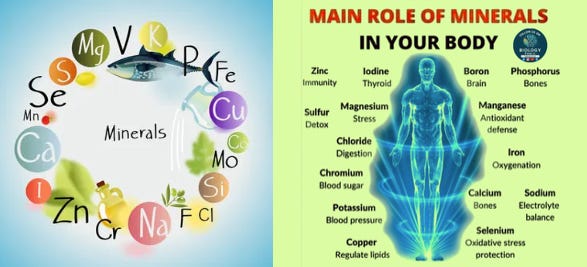
Note from the Mineral Maestro: Ok, folks, so we skipped the deep-science chapters. Perfectly fine, I get it.. We are all too busy and want the top-line takeaways—the concepts, not the enzyme maps or complex dances between protons and electrons—and that’s precisely what this chapter delivers.
In plain English, I’ll give you just enough detail (not too much) to understand why minerals matter for your life, your plants, your pets, and your water—and how to use that knowledge. No equations, no jargon. Slow and easy. Let’s go.
Introduction
Minerals are tiny, naturally occurring complexes of elements (or single elements from the periodic table) that play outsized roles in the world around us. They are more than just nutritional supplements; they drive the basic chemistry that keeps water clean, plants resilient, and biological systems balanced and functioning efficiently. Understanding their mechanisms helps explain why a mineral-rich environment supports stability and renewal across soil, water, and living systems.
Major minerals contribute to building structures, maintaining fluid balance, and providing the foundation for electrical and chemical stability. Trace minerals act as catalysts and cofactors—tiny “helper” elements that enable a wide range of natural reactions in plants, animals, and humans.
One of the most important concepts introduced earlier is that minerals often interact synergistically with metals, affecting how elements are absorbed, bound, or transported within natural systems. For example, zinc and selenium have been studied for their roles in enzyme systems and redox regulation.
Earlier in the book, I outlined the “general” mechanisms of minerals, but not those that are unique to Shimanishi’s Themarox complex. It was those critical and singular biochemical effects of Themarox that were skipped in Chapters 14B-E.
The following summarizes the science from those chapters: first, I will summarize Themarox’s observed effects on water, and then provide a focused summary of its interactions within environmental and biological systems.
Why do I keep saying that Themarox has unique properties? I am glad you asked because, in short, there is no mineral complex in all of the world and all of history where each mineral present is both “ionic” (charged) and “sulfated” (dissolvable).
When you read Chapter 16, which compares the characteristics of the six major sources of mineral supplements, you will see, over and over, how and why Themarox stands out. Another striking uniqueness is its richness in iron and sulfur - the most critical minerals in sustaining “life” (metabolism or, for you geeks, the electron transport chain).
But let’s not stop there. For me, there is one more aspect which I am beginning to realize may be more important than those I have so far listed. And that is the specific “composition,” “ratio,” or “balance” of the minerals that are present. I argue here that having me list their specific concentrations relative to each other is unimportant because the numerical amounts of each one are, in my mind, simply what the numerical amounts of each one are, and whatever that amount is, is what it is supposed to be.
No man-made calculations, experiments, or formulas could we ever devise that would lead us to formulate the ratios in this complex. Why do I say that? Because that would assume that man could create itself, in a way. Recall that Themarox reflects the unique composition of minerals found at undersea hydrothermal vents.
At the risk of foreshadowing (and sensationalizing), in the closing chapter (Appendix) to this book, I will provide evidence that only God or a Creator could have devised such a complex. That Appendix has been completed, but is as yet unpublished and will not be until we reach the end of our mineral journey.
The power and vitality this complex imparts to biological systems become apparent as you start working with it, whether in fields, water, or clinics (or with your house plants or a potato in a glass).
One overlooked aspect—which I’ve only recently appreciated in my physician-directed work—is that I explore mineral physiology in clinical contexts completely separate from Aurmina or any EPA-regulated water product. Any observations in that setting reflect my own professional experience with mineral biochemistry, not the properties, intended use, or effects of Themarox or Aurmina. The clinical patterns I see relate to mineral sufficiency in general, not to any commercial product.
However, when I explore mineral restoration in patients, I often observe shifts in patterns that are consistent with what one would expect when addressing mineral insufficiency—independent of any commercial water-treatment product.
Further, I see such shifts even when the amounts of individual minerals are really not “high” at all. In fact, except for iron, the amounts my patients take in my protocol do not, from a % basis, appreciably increase total daily intake. In fact, some mineral obsessives might even argue that “extra supplementation” of certain individual minerals I use, like magnesium, is indicated. To them I say, maybe, but I would prefer not to mess with perfection. Let’s go.
