


Aurmina End-of-Year Sale
As we close out Aurmina’s first year, really, its first few months, we wanted to mark the moment with something simple: gratitude.
Lisa, Scott, and I built Aurmina because we believed there was a missing piece in modern water treatment, and we’ve been genuinely moved by how many people immediately understood what we were trying to do. Watching this small company help real people has been deeply satisfying, and we wanted to say thank you.
Through the end of the year, we’re offering 25% off single bottles, with no limit on quantity. For those who already know they’ll be using Aurmina long-term, the 6-pack remains the best value at 34% off, so don’t outsmart yourself by buying six singles.
Discount Code: HOLIDAY
If you’ve been following my water series, you already know why this exists. Aurmina isn’t about stripping water down to nothing. It’s about restoring order, clarity, and purity after modern treatment has tried to do its job.
This is our thank-you. The sale runs through the end of the year.
Of the six “Acts” in my upcoming book, “From Volcanoes to Vitality,” the one exploring the many facets of the relationship between minerals and modern water has nine chapters. I have posted quite a few on Substack, primarily concentrated in this last week of the year, accompanying our sale above, in some combined “edu-marketing” effort. Today’s post will not be in the book, but since my research led me down this rabbit hole, I figured I'd share it.
In my previous post called “What Happens When Water Is Allowed To Tell The Truth,” we reviewed what happens when you flocculate your drinking water with Aurmina minerals, what falls out of your water (showing what it had “invisibly” been carrying), and what compounds and contaminants make up that “cargo.”
Our water quality is changing, and not for the better. It not only has changed over decades, but it also changes day to day. Let’s start with a few anecdotes that I believe you will find illuminating.
Bottle Water Anecdote
A colleague who has been working with Shimanishi’s minerals for 20 years to purify, structure, and mineralize their water told me that, when traveling, he always bought a particular brand of water, known for its high quality, pristine sourcing, and apparently superior taste.
Twenty years ago, when he first added minerals to that brand’s bottled water, nothing happened, nothing at all. The water remained clear, with no haze or sediment. Today, that same brand produces what I’d call an average amount of sediment, no different from nearly every other bottled water on the shelf that Lisa and I have tested (go to the end of this linked post if curious). Times have changed. Even our once-pristine mountain sources are now carrying the “fingerprints” of modern life.
Personal Anecdote
I have been treating my water with Aurmina (and Adya Clarity before that) since April, 2025. About 2 months ago, I was tending to my little assembly line of water containers, and I noticed that the water filling the previous day’s container had at least twice the sediment I was used to seeing. I lived in Sarasota at the time and had been treating the municipal water for months, so I well knew the average amount of sediment it discharged from day to day.
But on that day, the amount of sediment in the container was literally about 2 to 3 times the daily average. I called Lisa over and said, “Yeesh, looks like they are having a bad day at the water treatment plant.” Although it kinda freaked me out, I knew Aurmina was there to protect us from unknowingly drinking that day’s “invisibility quotient” in the water, and instead have it fall to the bottom of a container.
The Boil Water Advisory Anecdote
The third anecdote opens up a bigger can of worms and leads us to the focus of this post. A few years ago, a customer of Adya Clarity (forerunner of Aurmina) called my colleague, who owns it, asking whether “the formula” had changed, as her water did not taste as good that day and was discolored, unlike its usual clarity and taste.
Since the “formula” of Aurmina can’t and won’t ever change (aside from slight variations in mineral composition due to geology), she was told to check with her municipality, where she discovered that the municipal treatment plant had issued a “Boil Water Advisory” that day. Boil Water Advisory? What the hell is that?
This ain’t gonna be pretty, but let’s go.
Boil Water Advisories
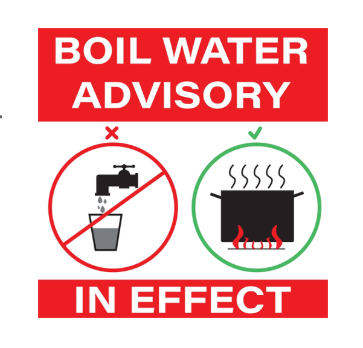
A boil water advisory (BWA), often called “boil water in effect,” is a public health emergency notice issued by a water utility or health department when there is reason to believe the municipal drinking water may be contaminated with disease-causing microorganisms.
What triggers a BWA?
A boil water notice is issued when microbial safety can no longer be guaranteed, usually due to:
Loss of pressure in the distribution system (main breaks, power outages)
Treatment failures (chlorination failure, filtration malfunction)
Flooding that may introduce surface water into pipes
Detection of E. coli or total coliform bacteria
Cross-connections or backflow events
Natural disasters (hurricanes, earthquakes, fires)
Let’s unpack that list for a bit, zeroing in on the failures that can “pull contaminated water back” into the distribution system.” Particularly, “back-flow events” and “pressure loss.”
In each case, there is a sudden loss of pressure or a pressure buildup in a connection, and water goes the wrong way. Whoops. So, what can you get pulled in?
Apparently, it depends on where the connection is, but here is the list:
Fertilizers/pesticides from irrigation systems
Boiler or cooling-tower chemicals
Industrial process fluids
Contaminated hose water (think hose in a bucket, mop sink, or chemical sprayer)
Non-potable reclaimed water from cross-connections
What Happens When It’s Detected, and What Does It Mean?
Utilities can isolate or flush the affected area, temporarily increase disinfectant residual, or issue a “do not drink” or “boil water” advisory if warranted.
A boil water notice means: The system failed its most basic safety function. The utility cannot verify microbiological integrity; regulators are choosing the simplest available risk-reduction tool.
It does not necessarily mean that the problem is fully understood or that chemical safety is intact. It’s basically a blunt instrument for an acute microbial risk.
Do you know who makes the call?
Now, before we go into what they protect against, what their instructions are, and whether they are increasing in the U.S. (they are), the thing I started to wonder about is how “embarrassing” it is for a municipality to have to issue one.
I kept imagining what that must feel like in a municipality that prides itself on delivering the cleanest, safest water possible. I started picturing a conference room, people around a table, charts on the wall, phones buzzing, someone asking whether this really rises to the level of going public, someone else worrying about headlines and panic.
So I dug in to see whether there are clear, immovable thresholds or if there is a lot of “personal judgment” involved.
Well, wouldn’t you know, there are a bunch of “grey areas” because BWAs sit at an “uncomfortable intersection” of engineering thresholds, regulatory rules, and “human judgment.”
It should not be surprising that municipalities dislike issuing BWAs. They are reputationally damaging, politically uncomfortable, and operationally expensive. They trigger media attention, public fear, customer complaints, bottled-water costs, and scrutiny from regulators. No water utility wants to issue one unless it feels unavoidable.
Second, although there are hard triggers, they are not as hard as people assume. Yes, some events mandate an advisory almost automatically, such as loss of positive pressure in the distribution system, detection of E. coli in finished water, or specific confirmed or backflow events. Those are codified in state primacy agency rules (EPA delegates authority to states). In theory, they are “hard stops.”
But, and this is what concerned me, many real-world situations fall into gray zones, like:
How long did pressure drop, and how low did it go?
Was the affected zone small or system-wide?
Was chlorine residual still present?
Was the backflow event “theoretical” or “confirmed”?
Did turbidity spike briefly or persist?
Did samples show total coliforms but not E. coli?
In these cases, professional judgment absolutely enters the picture, and further, the thresholds themselves are set by people under constraints. Regulatory triggers are built around what is measurable in real time, what historically correlated with outbreaks, and worst, what utilities could realistically comply with.
They are built to manage risk without collapsing the system, which means acceptable safety-related uncertainty is baked in.
Fourth, and this matters most, BWAs are often issued late, not early. Utilities may try a few things first, like:
Flush and boost disinfectant first
Take “confirmation samples” (ugh)
Wait for lab results (which take 18–24 hours)
Consult with the state before going public
Unsurprisingly, although the above is standard practice, it means there is often a window of risk before the public is informed, and, of course, there are incentives governing these decisions. No operator gets praised for issuing “too many” advisories. They are questioned for causing unnecessary panic. So the system subtly rewards delay until certainty rather than early warning under uncertainty. A systems-design issue.
Ultimately, my worry about how much “judgment calls slip in” was not hypothetical. It’s inherent and reveals the uncomfortable truth that water safety is probabilistic, not binary, and that regulation manages population risk, not individual exposure.
The most disturbing was the phrase “transparency competes with institutional self-protection.” So, ultimately, any system that depends on judgment under reputational pressure will often choose silence before certainty. To my fellow Covidian freedom fighters, that should sound pretty damn familiar.
What Boiling Actually Protects Against
Boiling water is about killing living pathogens, not removing chemicals because boiling kills bacteria (E. coli, Salmonella), Inactivates viruses, and kills protozoa (Giardia, Cryptosporidium). But boiling does not remove: heavy metals (lead, arsenic), PFAS, Nitrates, Pesticides, or Pharmaceuticals (in fact, boiling can concentrate the latter).
What You’re Supposed To Do When Under A BWA
They tell you to bring water to a rolling boil for at least 1 minute (3 minutes at high altitude). Then, you should use boiled or bottled water for: drinking, brushing teeth, making ice, washing fruits and vegetables, and preparing baby formula. But you can be reassured that you can usually still use tap water for showering (avoid swallowing), handwashing (with soap), and laundry.
The bottom line is that a boil water advisory is about infection control, protecting you from germs when the water system’s integrity is compromised. It does not protect from broader chemical factors that shape water quality day to day (like that day in Sarasota).
Frequency of Boil-Water Advisories
There are thousands of boil-water advisories issued across the U.S. every year. The frequency varies widely by state, system size, infrastructure age, and weather events, with some large cities reporting recurring advisories year-to-year due to aging pipes and pressure issues.
Louisiana, in particular, issues about 1,600–1,700 boil-water notices per year, and that is excluding major storm impacts. Not so fun fact: my oldest daughter goes to Tulane, and neither she nor any of her fellow students drink water from the faucet, instead they take turns going on endless Costco runs for cases of bottled water.
Are Boil Water Advisories Becoming More Common In The U.S?
Although there’s no single national reporting requirement for BWA’s, in a Kentucky water system study, the number of boil water advisories increased over 17 years (2004–2020). News and self-reported headline analyses show that mentions of “boil water notices” and related water quality reporting have risen in recent years.
Root Cause: Aging Water Infrastructure
Infrastructure failures are the leading driver of BWAs. Many U.S. water systems use pipes and equipment that are decades old, increasing the likelihood of breaks, pressure losses, and contamination, all common triggers for boil water advisories.
And that, my friends, launched me down yet another rabbit hole.
The United States is widely recognized by engineers, economists, and even its own government agencies as being chronically slow and inconsistent at updating public infrastructure. And much of U.S. infrastructure is old, like very old.
Large portions of water and sewer systems were built between the late 1800s and the post-World War II boom. Water pipes in many cities are 75–120 years old. Treatment plants designed for mid-20th-century populations are still carrying modern chemical loads they were never built to handle. Replacement is always deferred in favor of patching.
Second, U.S. infrastructure funding is reactive rather than proactive. Budgets reward new construction and visible projects, not buried pipes. Politically, ribbon-cutting beats pipe replacement every time.
Third, responsibility is fragmented. The U.S. delegates most responsibility to states, counties, and municipalities, often with different tax bases, technical capacity, and regulatory rigor. Two cities a hundred miles apart can operate under entirely different standards, timelines, and risk tolerances.
Fourth, regulation often lags reality. Rules are written around historical risks like pathogens, turbidity, chlorine residuals, and not emerging challenges like PFAS or complex chemical mixtures. Updating regulations requires years of rule-making, legal review, and political negotiation, during which systems continue operating as designed decades ago.
Fifth, infrastructure is invisible until it fails. Roads, bridges, and airports get attention because failure is obvious. Water systems fail quietly, through leaks, pressure drops, corrosion, sediment, and advisories, until something dramatic happens. Yet another form of “invisibility” when it comes to water.
It is well known that peer nations that invest continuously, like Germany, Japan, and parts of Scandinavia, replace and modernize systems on predictable cycles. The U.S. tends to wait for a crisis.
So yes, the U.S. is well known for deferred infrastructure renewal, not because of incompetence or malice, but because the system rewards short-term function over long-term integrity. The bill always comes later, and usually quietly, until it doesn’t.
The Last Line Of Defense
Just as people buy firearms knowing that if community protection fails, responsibility lands at their door, I think similarly of Aurmina as a last line of defense. A way to see what the water brought with it before I drink it.
Also, it does’t just keep intruders out; it helps rebuild the house - clearer, more stable, mineral-balanced, and structured.
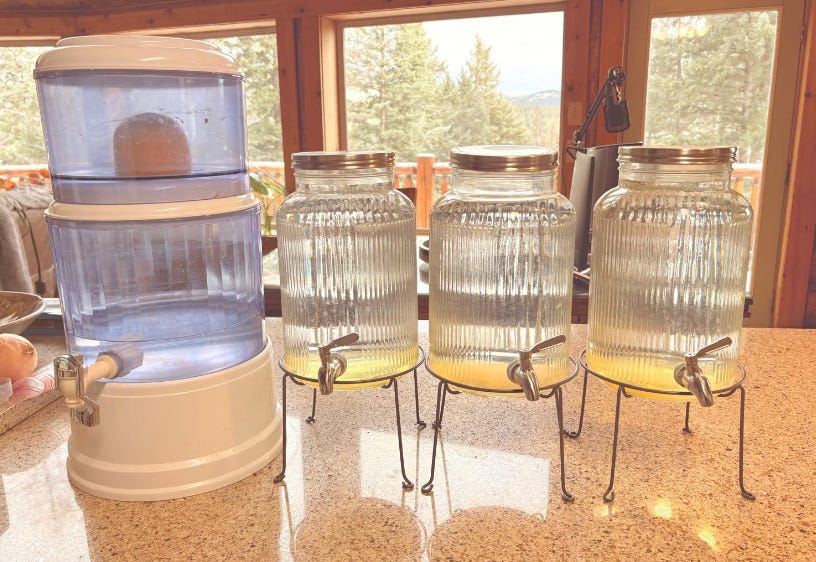
So, it should not come as a surprise that “I don’t leave home without it.” To wit, below is the Kory Family Traveling Water Treatment Plant. We came up to Montana so I could finish my book, and so we shipped our set-up here beforehand:
If you value the late nights and deep dives into all the “rabbit holes” I then write about (or the Op-Eds and lectures I try to get out to the public), supporting my work is greatly appreciated.
More Stuff: Aurmina and Book Publications
If you want to learn more about the water purifier we made from Shimanishi’s volcanic-mineral complex, go to Aurmina.com where we are running a 25% off end-of year sale, code: HOLIDAY.
Upcoming Book Publications
Yup — not one, but two books are dropping from yours truly (at the same time? What?)

If, instead of (or in addition to) these Substack posted chapters, you prefer the feel of a real book, or the smell of paper, or like to give holiday gifts, pre-order From Volcanoes to Vitality, my grand mineral saga, shipping end of January.
And if you want to read (or gift) another chronicle of suppression, science, and survival, grab The War on Chlorine Dioxide—the sequel you didn’t see coming—shipping early to mid-January. On this one, I say: “Buy it before they ban it.” Hah!
I have figured out a fairly easy method to create Aurmina water. I take a gallon of reverse osmosis water in a gallon glass pitcher. Put one teaspoon of Aurmina in it and let it sit for about an hour. I then filter it into another gallon glass pitcher through two unbleached coffee filters. I use this to drink, to water my plants. I give it to my parakeets. I put it in my ice cube maker. Initially I was hesitant because it sounded so complicated, but it’s really not.
Wow - this is frankly disgusting, and making yet another argument for carrying a personal stash of chlorine dioxide - and Aurmina - at all times! Makes me wonder, how many of our health issues - and maybe even mental health issues - are created by contaminated & dead water? bottled & tap? Trust no one.