


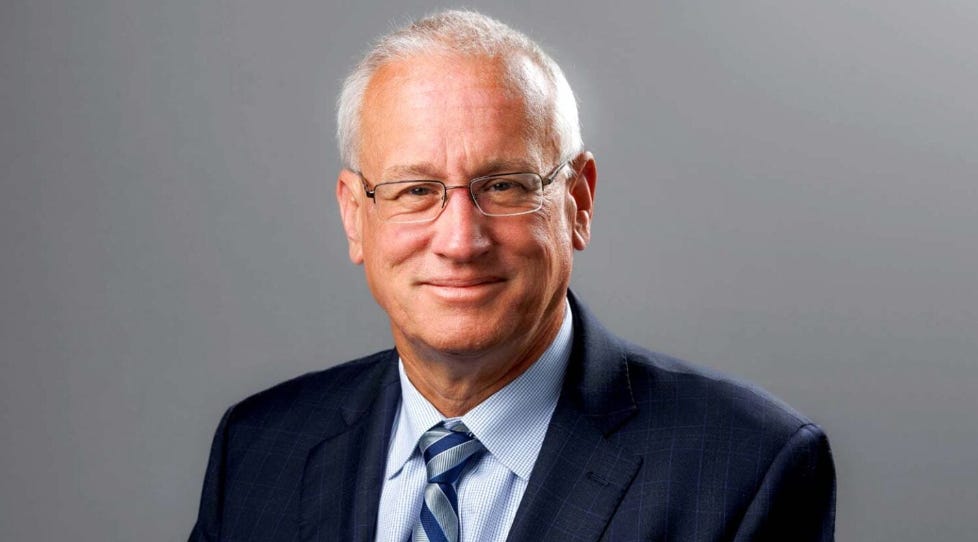
Warner, my friend,
I first wrote this as a collection of memories and thoughts about you — almost like a biography of a friendship, or an obituary written by someone who loved you— writing about you as the man and lawyer I knew. Then it started to feel off. I suddenly had a strong sense that you were still connected and would hear or read this, so I started writing to you directly. As soon as I did that, it felt right somehow.
Just know this letter comes with a lot of love, admiration, and a sadness I am still sitting with — and will be for a long time. I cry because I keep thinking about the fact that I will no longer pick up the phone and see that big goofy smiling face blown up on my screen.
Although I am sharing this letter publicly, I don’t want to make it about me. I simply want to let my little world know who you were, how you lived, and why so many loved you.
Warner, man, I miss you already.
We hit it off the first time we met. Our first conversation lasted a couple of hours, and we had many calls over the years after that — usually to commiserate, collaborate, or just share what we were learning about what we were up against — a bond forged by the sheer weight of what we had each taken on during the Covid war, which, for the Mendenhall Law Group, is still raging.
One of the things we discovered in our first conversation was our mutual love of windsurfing. You were a couple of decades behind me in the sport — I’d long since moved on to kitesurfing, then retired from that too — but for you, windsurfing was still the passion it had been for me since I was 11.
I would regale you with the joys and challenges of kitesurfing, and I could see it ignite a fire in you. I am so pissed you never got to kitesurf, but that was because you were too busy fighting injustice — just another of the sacrifices you made to your work, like sleep and sane travel.
I also teased you for being a “lake windsurfer.” I’d complain about wind holes and gusts and how miserable lakes could be, and show you the one video of me kitesurfing small waves in the Dominican Republic (the only time the GoPro on my kite caught a perfectly framed shot). It wasn’t showing off (now I am showing off :); I just wanted to inspire you to take a week off and get under a flying kite. You only smiled and told me you loved it every time you went out on your lake, whether the winds were small or big, and that it was beautiful every time. Warner, the lake windsurfing lawyer from Ohio.
The other thing we bonded on was our mutual affliction of not being able to say no when people asked us for help, or to speak, or advocate in whatever way we could. That inability wore us both down. But you know what? No matter how hard it was or how much we took on, the alternative was not possible. The guilt of not helping — it just wasn’t worth carrying. So we always said yes.
Over time, I’ll admit, I had to limit access to it because my life was becoming unmanageable. I imagine yours was too. But neither of us ever really found a way to stop.
I also remember the times we got to work directly together. I’ll never forget the last-day prep before the main physician witness testified in the Schara case, the expert reviews I did for you pro bono on a couple of tragic Covid hospital cases, and the day you won a disability case for one of our Leading-Edge Clinic patients.
One of the things I will always remember about you is that, because we traveled and spoke in the same circles, we would connect in person two, sometimes three, times a year. Each time I saw you across a room — whether I knew you were going to be there or not — as soon as our eyes met, we both broke into the biggest smile and headed straight for each other, mid-conversation, mid-sentence, whatever. There are not many people in my life like that. You were one of them. Warner, you magnificent smile-ambusher.
I’ll also never forget that night at the bar at a conference — you, me, and Lisa up against an obstinate bartender who refused to sell her a bowl of berries and nuts, the only snack she can tolerate at a bar. She was starving. The bartender kept saying it wasn’t on the menu, then she started lying that they didn’t have any in the kitchen, until Lisa pointed out the numerous items on the menu that contained exactly those things.
I kept trying, Lisa kept trying, you made one appeal — nothing. Then, quietly, you pulled out a twenty, slid it across the bar with a big smile, and asked if she could take a look in the kitchen. A bowl of berries and nuts appeared within minutes. Lisa and I will never forget that. I, a foul-mouthed guy from New York City who grew up knowing that if you need something taken care of, you slip them a little something, while you, the Midwestern lawyer, schooled me in front of my wife on how to get it done. You beautiful man.
It was such a unique friendship: me, a dissident doctor, and you, a dissident lawyer, at a unique moment not only in our lives but in the life of America. I was one of the leading Covid medical dissidents, and you were literally the leader on the legal side. You and Barnes took on Pfizer, for Christ’s sake. God bless you both.
I would share with you the lies I was uncovering and the truths I was putting out on the medical side, and you would share with me the lies, fraud, and grievous injustices you were fighting on the legal side. Those conversations showed me how much medicine and law had in common — more than I had expected. I learned that outside of your law firm and other small independent practices, the big firms stayed away from Covid litigation.
On the medical side, we were a few dozen who somehow had managed to build (or be blessed with) a public voice. It was David fighting Goliath on both sides — medical and legal. We used our independent practices, our nonprofits, and our voices to push back against censorship, fraud, and lies while trying to restore health and justice to the victims of it all. My brother in arms.
We were fighting on different fronts of the same battle. You were defending the rule of law. I was defending the practice of medicine. But underneath both of our fights was the same conviction: that the point of the institution — law, medicine, doesn’t matter — is to serve the person in front of you, and when that gets inverted, everything goes wrong.
What struck me over time was that law appeared to be suffering from the same disease that had overtaken medicine. In medicine, the profession gradually became captured by centralized institutions, financial incentives, bureaucracies, and information systems that increasingly rewarded conformity to pharmaceutical propaganda over independent judgment. The more it drifted from its first principles—the welfare of the patient—the more difficult it somehow became for physicians to resist.
From our conversations, I came to believe something similar was happening in law. Law, at its best, is supposed to be anchored to enduring principles: equal treatment, due process, constitutional limits, and the pursuit of justice. Yet more and more, it seemed as though outcomes were being shaped by ideology, political pressures, institutional incentives, and shifting cultural fashions rather than by the stable principles that once gave the system legitimacy.
I am not a lawyer and do not pretend to understand the law the way you did. But after years of listening to your stories from the front lines, I could not escape the feeling that the legal profession was experiencing its own version of institutional capture.
All over the country, corporate, government, and university lawyers literally counseled their clients to enforce mandates and to reject medical and religious exemptions. The irony was not lost on me. That counsel was everywhere. I also knew those were the cases where your batting average was highest. You made them pay, boy, and got people their #%@! jobs back! Where I might get someone’s vaccine-induced brain fog cleared or their fatigue resolved, you would return them to their livelihood.
Perhaps the darkest example during COVID was watching the ACLU support vaccine mandates. For an organization long associated with defending individual liberty against state intrusion, it literally came out in support of policies that conditioned employment, education, and participation in public life on submission to an injected medical intervention, which, to me, is the most sacred of individual liberties — bodily autonomy.
I wish the law group would gather and publish every case where justice was restored — not for spectacle, but for record. People need to remember what was done. They need to see the exemptions denied, the livelihoods destroyed, the mandates enforced, the settlements paid, and the judgments handed down from the bench when the truth finally had its day in court. Too many of those wrongs are already disappearing into the rearview mirror. I hate that. You would not have let them disappear. You would have kept reminding people what happened, who did it, and what accountability looked like when the law finally caught up.
I know there were many more cases you intended to bring, and many more people you were determined to help. For that, we will miss you terribly. But I also know you had a keen eye for good lawyers, especially the young, inspired, principled ones — the ones practicing law for its purpose, not its compensation or reputation. May the Mendenhall Law Group thrive. There is no end to the need for it.
I also remember when egotism, arrogance, and frankly, insanity infiltrated your non-profit, not too long after you had helped me get legal support for when the same had infiltrated the FLCCC. The difference was that you were a lawyer, while Paul and I were dumb doctors who did not know how to build a sound governance structure. That ended up costing us an organization that we had built with immense devotion. It did not go unnoticed that the same didn’t happen to your organization. Just another reason I will miss you: your counsel and guidance were always just a phone call away when I really needed them. I just wish I had sought it more often.
Of all the things written about you this week, the one that stands out most to me is Jeff Childers’ writing about how many pro bono cases you took during COVID. I remember the conversations where you shared that with me. You just couldn’t help yourself. You knew you were being financially reckless and taking on more than you could handle. I even remember your idea of setting up an investment vehicle to bring more cases — people could contribute money to fund a case and get a return if it won a settlement. I loved that idea. For an investor, it would have been far more honorable and far less risky than the stock market. I personally think, given your track record, it would have been almost like insider trading, because if you were going to take the case, you knew it had a high chance of winning, and if anyone was gonna win it, you were. It would have been easy money, baby.
I was beyond moved by the Children’s Health Defense article about your life and career — not because I didn’t already know you were a great lawyer. I knew that. I knew you were a deeply principled and committed man. But seeing it laid out like that — the full scope of what you gave throughout your life, to law, to politics, always principled — it hit me so powerfully. The scope, the consistency, the fact that you never once stopped. I am not just saying this, but that article, although it was written as a news article, was the best damn obituary I have ever read. I truly hope every single one of my readers reads it, shows it to their children, and uses the record of your life as a teaching example to all young people of what it means to be a man, a Christian man, and a great man at that.
But more than anything, you were just a good friend to me. You called me every few months, just to check in, not only on me, but because you and I could share and commiserate and even laugh at the accumulating folly of it all.
We all tried to help you with your cancer. Maybe even too many of us, too often. There is a reason it is called the emperor of all maladies. As much success as my practice has had treating cancer from a metabolic approach using combinations of repurposed drugs, we also fail too. Sometimes treatment, no matter how many approaches are tried, just doesn’t work.
That’s what happened to you.
I spoke with you two weeks ago. You were finally upbeat after recovering from your recent hospital stay. I offered guidance on a new approach — elegant, promising, non-toxic, though the research trials were in Mexico. You were interested. I knew you were being pushed and pulled in every direction by kind-hearted, well-intentioned, brilliant people, and it must have been disorienting. I didn’t want to push. Then a week passed. I hesitated to call and ask whether you’d reviewed the literature I’d sent. By the middle of the next week, I heard you were back in the hospital.
It’s all right, brother. You put up a damn good fight. I know that. I hope the last days weren’t too hard, although I know they almost certainly were.
And now, my friend, you are gone, and I am crying today.
You fought for the people caught underneath the machinery of evil. You did that from your first day as a lawyer. You fought for the brave, the injured, the unjustly punished, and the abandoned. You fought power in its two most destructive modern forms — governmental and corporate.
I am so angry that we don’t have you to take evil to court anymore. I firmly believe this country will not be the same without you.
This world needs you still, Warner. And if it can’t have you, we need more people to be like you. Except I don’t know how someone becomes a Warner. I think you’re either born one or blessed into one.
God, please. Give us more Warners. A whole army of them.
I’m going to miss you, my friend. Thank you for fighting the good fight. Justice lost one of its greatest soldiers this week.
Nah. Soldier doesn’t even come close.
Warner, you were one of its greatest generals.
Thank you, Dr Kory, for writing this & sharing. To say it was a blessing & a bittersweet joy to read about your friend, Warner, would be an understatement. Ultimately, I am so incredibly thankful GOD KNOWS. Our world is truly better because of you both. ❤️💔❤️🩹
Beautiful. I am So sorry for your Loss. Thank you and Warner for standing in the gap and working tirelessly for the truth and for those who were injured. May his memory be a blessing and may he rest in the loving arms of Jesus until you meet again.