
Part I: The Rock-Water Circuit: The Engine Before Life
A novel framework describing a planetary circuit linking rock, water, and life, and the mineral engine that powers it all.

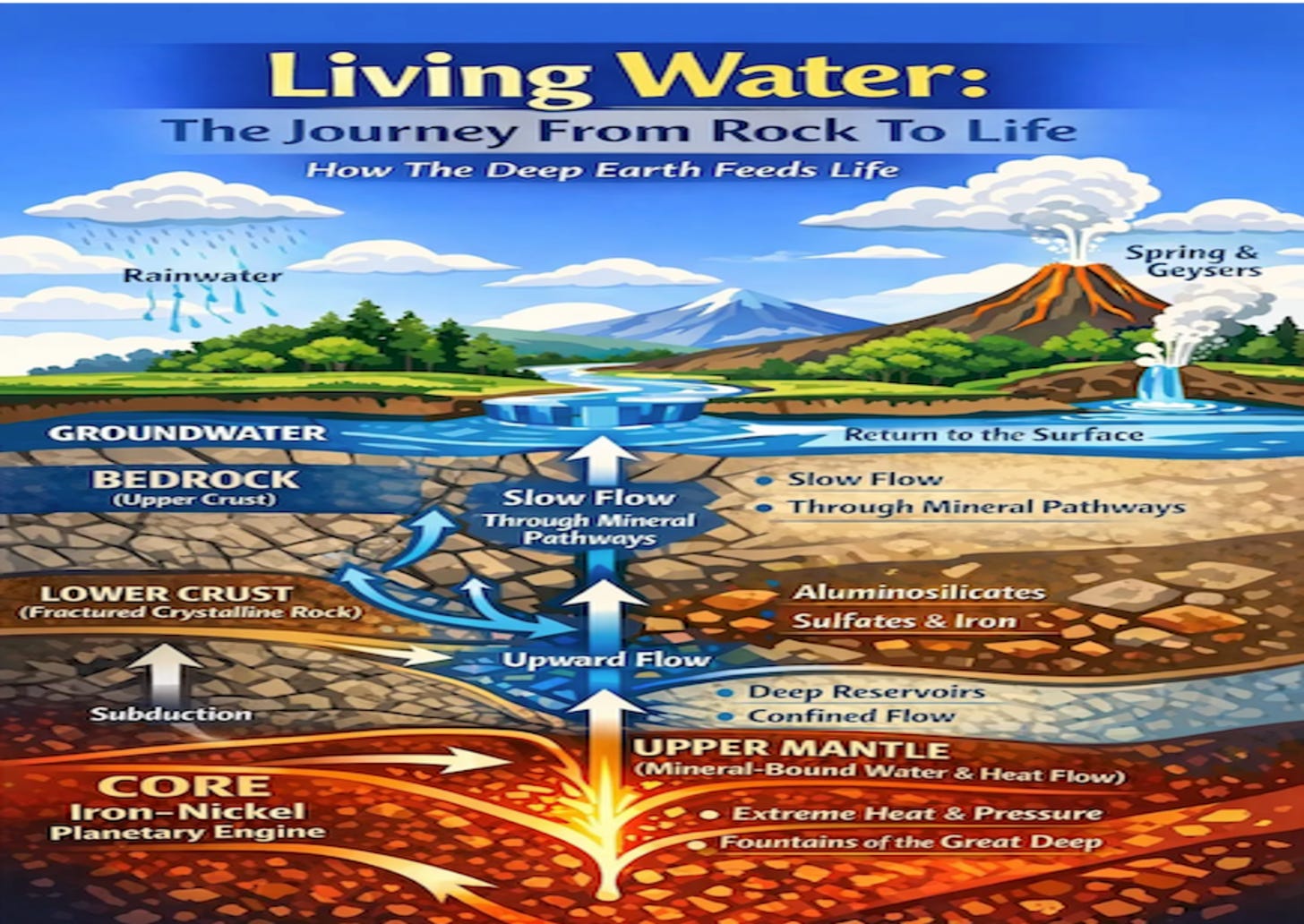
The Rock-Water Circuit Theory - by Pierre Kory and Matt Bakos
ACT I: The Rock–Water Circuit Theory - An Overview
As I described in my last post, the foundation for The Blueprint of Life grew out of From Volcanoes to Vitality (FVTV) as a result of my colleague Matt Bakos connecting our insights into mineral science to those from antiquity. What followed was an improbable series of events that led me to explore topics such as the Philosophy of Science, Theology, and Alchemy, which I never thought I would be exploring in my writing.
In this post, we present a novel scientific theory (albeit not yet peer-reviewed or formally published) that we call the Rock–Water Circuit Theory. It is a planetary systems theory, one that attempts to describe how mineral chemistry and water interact to form a continuous energetic architecture linking geology and biology across the Earth system.
(I bet you never thought you would find that in your inbox on a Friday morning - on Substack, nonetheless.)
We arrived at it iteratively through an interplay of insights between MB and me as we explored mineralogy, soil science, and modern biochemistry, guided in part by depictions found in alchemical and scriptural texts, and by our understanding of Shimanishi’s experimental work.
Before I go ahead, I need to acknowledge authorship. As with the Geohydrologic Shift Theory in FVTV, MB is again a co-author and again the senior author. This chapter carries his insights as much as mine.
Next, I must cite the work of the geochemists, biologists, physicists, and earth system scientists whose work informed ours, in particular Vernadsky, Cairns-Smith, Hazen, Russell, Lane, and Kappler, among others. Without them, our ability to make the connections below would have been impossible.
Several distinct factors set this theory apart. It did not emerge from a single discipline or even a single line of inquiry, but from an unusual convergence of fields. Its development was made possible in part by modern AI tools, which allowed us to explore connections among mineralogy, soil science, geochemistry, and biochemistry at a scale that would have been difficult to manage otherwise.
More uniquely, our work was also informed by a body of texts from antiquity, particularly those associated with the Hermetic canon, that have long resisted clear interpretation. For centuries, these writings have been treated primarily as symbolic, philosophical, or mystical literature. Through our analysis, however, we came to believe that they encode descriptions of natural processes that had not previously been fully recognized. When their depictions are examined alongside modern scientific knowledge and AI-assisted analysis, an unexpectedly coherent system begins to emerge, with each body of knowledge illuminating and extending the other.
Multidisciplinary synthesis alone has long been difficult in modern research, as geology, biology, biochemistry, and soil science tend to operate in relative isolation, with limited crosstalk between domains.
A parallel challenge involved bridging the interpretive distance between modern scientific language and ancient technical descriptions. That work required months of careful translation and cross-referencing, ultimately allowing a complete planetary energy cycle to come into view.
Orientation for the Reader
Now, to readers who may not come from a scientific background or who do not feel naturally drawn to scientific material, I ask for both patience and attention. I want you to know that this is the only chapter that leans heavily on scientific concepts, but rest assured, what follows does not require technical mastery. Also, it is long, so I have split the chapter into three posts over three days. I will not bury you with a merciless 10,000+ word post like A Midwestern Doctor (said in both jest and admiration of my close colleague’s penchant for long posts).
The science asks only for conceptual engagement. You do not need to retain granular details of how each component operates. What matters is that you grasp the overall sequence and recognize the boundary between the modern scientific framework through which Earth’s systems are currently understood and the point at which we believe this work extends that framework. This chapter has been written and rewritten with unusual care to communicate complex ideas in a way that rewards attention without requiring technical mastery. I trust the reader will find that care reflected in its clarity.
The Closed Mineral Cycle
We did not set out to uncover a unifying theory of Earth's life cycle. Instead, because of our ever-increasing fascination with the unique mineral extract that first drew MB into 20 years of study, with me arriving later but synthesizing rapidly, our collaboration began exploring multiple domains independently, following each observation as it arose.
The coherence we discovered emerged months later, once the texts from antiquity were deciphered and juxtaposed. What our efforts exposed was a closed system: a geochemistry that governs mineral formation and activation, gives rise to biological function, and then returns, intact in its logic, to the rock from which it came. After which the cycle begins anew.
A core concept is that the discrete mineral chemistry that modern science has identified as present in biotite rock, and has argued to be the origin of life on Earth, also constitutes its first energy system. That same mineral chemistry is then mobilized by water and transferred into living organisms, where it is reorganized to perform work: moving electrons and protons, sustaining gradients, powering metabolism, and enabling structure. At the end of life, that same chemistry then shifts roles. Water is again the agent, but now its main role is to dissolve, transport, and redistribute the same minerals and carbon back into the ground, where the cycle restarts, unchanged in principle only in form.
This is a “recursive process,” a term that bears defining here: “a process that uses its own output as part of its next input.”
At a macro level, the evidence is straightforward. Biological matter is continuously transformed: organisms arise, reproduce, and, at the end of life, return their constituent minerals and carbon to the surrounding environment, where those same materials are reused by subsequent life.
But the insight at the heart of this chapter is more precise: it lies in identifying a core triad of minerals and the specific roles they play in moving charge through water, which allows Earth to receive a continuous energy flow. From that discovery, we tested its presence and importance in a more expansive view, where we again discovered that the very same chemistry also powers the entire planet in a single, self-propagating system, one that does not run out of energy, because the energy each step uses then powers the energy required for the next.
What we describe in this chapter is not merely a biochemical pathway, but a planetary architecture. We refer to it as the Rock–Water Circuit, a closed system through which charge is transferred from rock into living systems and then, over time, cycles back to the geologic environment, operating across both biological and planetary scales.
Within this larger circuit, energy is generated, transferred, and regulated by a specific mineral–water chemistry that functions as the active engine at each phase of the cycle. In technical terms, that engine centers on the coordinated interactions among iron, sulfur, aluminum, and water, with water serving as the control layer that integrates and activates the three. We refer to this chemical engine as the Iron–Sulfur–Aluminum–Water system, or ISAW.
ACT II: The Opening of Rock
To understand how the Rock–Water Circuit operates, we must begin with ISAW, the mineral architecture in which the engine first takes shape, and which then powers each phase of the cycle.
The starting point for this investigation was our fascination with a rock, more precisely, a mineral, called biotite, or “black mica.” Biotite is the dominant parent mineral through which Nature generates vermiculite, the open, layered substrate that Shimanishi later employed as the foundation of his process. Vermiculite’s uniquely open structure and extraordinary capacity to exchange and deliver mineral ions make it the most important rock-derived source of biologically available mineral nutrition on Earth.
We believe that it was vermiculite’s unusually rich composition of iron, sulfur, and aluminum, and the way those elements interact with water, that led us to where we landed. What follows is a tracing of that path inward, toward the chemistry that quietly powers life, decay, and renewal on Earth itself.
Biotite
Biotite forms tens of kilometers below the surface of the Earth, where heat, pressure, iron, sulfur, aluminum, and silica co-exist. The resulting, layered aluminosilicate structure, held tightly together by potassium, stores charge and mineral potential across hundreds of years, like a battery awaiting activation.
In such crystalline basement environments, know that water moves almost entirely along fracture networks, where flow is constrained and water residence times lengthen. Under these conditions, water does not simply dissolve minerals and move on. It resides against fracture walls, repeatedly contacting and absorbing minerals from rock surfaces over extended periods.
A critical discovery was that the same iron–sulfur–water chemistry in both rock and humans also drives the transformation of biotite into vermiculite, revealing a single, continuous engine operating across geology and biology.
Once vermiculite is formed in this way, the water that enters it sustains proton gradients along its mineral surface. Vermiculite’s role is in enabling ion mobility while preserving structure. At this stage, iron–sulfur–aluminum–water chemistry becomes generative, as life enters downstream of this opening, where biological organisms also rely on iron–sulfur clusters, layered membranes, structured interfaces, and proton gradients to perform work (biology powered by geology). In this way, metabolism follows the same physical logic present in the foundational mineral systems. The key point is that life uses a mechanism that existed before it did.
To see how this mechanism works, we now have to step inside the engine itself and examine how it generates, stores, and releases energy.
ACT III: The Fundamental Energy Unit of All Life: Electrostatic Potential as the Engine of Biology
Before we can examine ISAW chemistry in rock or its expression within life forms, we must first understand the simplest engine that governs energy itself.
For anything to be alive, carbon is an absolute requirement, not only because it provides structural architecture, but because its chemical versatility underlies metabolism, energy transfer, and molecular specificity in living systems. Less commonly acknowledged is that there are two other material requirements for life: minerals and water.
That’s it. Three things. Without access to these, nothing can remain alive, as they are the critical components of the machinery that generate, store, and regulate energy.
The Fundamental Energy Unit of All Life
At the center of every atom sits its nucleus, containing positively charged protons. Around the nucleus, electrons move, carrying negative charge. The attraction between separated but oppositely charged particles is the fundamental form of stored energy, called “electrostatic potential energy,” generated by the separation of opposite charges.
Importantly, science has never been able to further understand why or how that relationship creates or holds energy.
It just does.
Asking why a proton separated from an electron creates, or is, energy, brings you to a place where there are no more words, no more explanations, similar to trying to explain the concepts of gravity or time.
The unrequited attraction between a proton and an electron is the foundational source of energy in the universe. What is even more striking is that this same logic, separation, tension, and eventual resolution, repeats across every scale of reality: charge and discharge, structure and flow, confinement and release.
Another example of this same polarity appears in “electromagnetic energy” itself. When an electric field changes, it generates a magnetic field; when a magnetic field changes, it generates an electric field. The two do not exist in isolation but in alternating tension, each giving rise to the other in a continuous oscillation that can travel through space as light or radiation.
In this sense, electromagnetic energy is another fundamental example of usable energy emerging from polarity: electric and magnetic, alternating, coupled, and inseparable. One phase stores, the other propagates; one leans, the other answers. Just as separated charges hold potential that can later be released to perform work, electromagnetic radiation is literally energy moving as coupled oscillations of electric and magnetic fields, each regenerating the other as the wave propagates through space. Life exploits both forms.
This polar relationship permeates society, literature, and human organization; parent and child, teacher and student, leader and follower, judge and accused, king and queen, while dozens of similar relational dualities can be identified across physics, chemistry, biology, and geology. All express the same requirement: energy must be held apart before it can be put to work.
Everything that follows depends on this foundational relationship structure.
Hydrogen is just a single proton with one electron to balance it. That simplicity is why hydrogen sits at the heart of life’s chemistry. Wherever protons move, hydrogen is involved, and wherever hydrogen moves, energy, stored in the attraction and separation between charges, moves as well.
The outer electrons interact with other atoms, forming bonds or moving between them. When an electron moves or binds to a different proton, energy is either stored or released. Biology constantly exploits these “redox” reactions (i.e., electron transfers). Further, this electron movement releases that energy in small, controlled steps rather than all at once.
A positive charge reflects a shortage of electrons, while a negative charge reflects an excess. Life runs on the controlled separation and reunion of these charges. Electrons flow. Protons are displaced, accumulated, and released in response.
If you value the late nights and deep dives into all the “rabbit holes” I write about (or the Op-Eds and lectures I try to get out to the public), your support is greatly appreciated.
The Primacy Of The Proton Gradient
Although protons repel one another, when protons accumulate more on one side of a boundary than on the other, this forms a “gradient” between the two sides. Their innate repulsion becomes usable when narrow, structured pathways through the membrane allow the protons to flow, releasing their stored pressure energy, which is converted into motion that can push, turn, or build something else.
Across biology, i.e., across all living things, energy generation is powered by proton gradients: differences in proton concentration and charge across a membrane or interface. The analogy is simple and exact: A dam holds water on one side; when the spillway opens, that stored energy is released and converted into usable energy. In living systems, proton gradients serve the same function.
Proton gradients are built up by electron flow, and when those gradients are allowed to flow back toward equilibrium, they drive work by directing electrons once again. In this chapter, the word “redox,” as above, will be used frequently. Think of it as simply describing an electron moving to or from a charged mineral center. In biological systems, redox reactions allow electrons to step down in energy in controlled increments, and the energy released at each step is used to pump protons uphill across a membrane, creating a proton gradient.
Humans/Animals
In humans, proton pumping is accomplished by electron flow, which induces precise conformational changes in mitochondrial membrane-embedded protein complexes, allowing them to function as mechanical levers that pump protons “uphill,” against their gradient.
What I want to stress is that the conformational changes in mitochondrial protein complexes are driven by electron transfer through embedded iron–sulfur clusters, the foundational units that couple redox energy to mechanical motion.
This action effectively converts electron energy into stored electrochemical pressure, known as the proton gradient. When protons are permitted to flow back through narrow, highly ordered channels, that pressure is converted into ATP, the transferable energy currency of the cell. Electron flow charges the system; proton flow discharges it; ATP is the measurable product of that exchange.
Plants
In plants, a slightly modified version of this system operates within chloroplasts (the plant's mitochondrial counterpart), beginning with the Sun’s photons exciting the electrons in photosystem II, which then split water to generate the protons and free electrons needed, thereby forming proton gradients that drive ATP synthesis.
Microbes
Microbes represent the earliest biological expression of the same redox systems that operate in rock. Some rely directly on iron-, sulfur-, and hydrogen-based chemistry at rock–water interfaces, while others generate energy through mitochondria-like systems similar to those used by animals and humans. In either case, the same underlying metabolic logic persists.
Ultimately, as long as humans receive a continuous supply of electron-rich molecules through food, the metabolic battery continues to cycle. Oxygen acts as the terminal electron acceptor, allowing those electrons to move and release energy. Minerals sit at every junction of this process, forming the structural framework and catalytic centers through which biological energy systems operate.
The critical point is that life did not invent this engine; it inherited it.
That bridge is built from a specific set of elements, each governing a different dimension of this flow, and it is to those elements that we now turn.
*If you don’t want to wait until tomorrow, then keep going: Part II: Three Minerals and Water: The Engine of Life
If what you just read raised questions about the mineral system at the center of it, you can explore it further at Aurmina.com, where we are working to make Shimanishi’s extraordinary discovery more widely available.
From Research to Practice - Links Below
Just amazing. It's bringing all the disparate bits of my knowledge and questioning to a cohesive whole. Created, not accidental IMO.
VITAL INFO! Intelligent Research equals Intelligent Findings!