
Chapter 8 - Ignored, Then Vindicated: Early Voices on Minerals, Water, and Health.
The forgotten researchers who traced vitality to the soil and wisdom to the water.


The Pull of Medical History
Throughout my career, as I repeatedly dove into researching transformative therapies, I developed a deep appreciation for the history of medicine in that I loved reading academic papers from 100 to 150 years ago—the sheer depth of knowledge always amazed me. How did they know so much back then? With such primitive scientific tools?
What they uncovered through simple, careful clinical observation was often nothing short of profound. And what fascinated me most was the prescience of early visionaries. Every time a treatment or practice eventually proved transformative, there was always—somewhere in the archives—a lone, often ignored voice calling out decades earlier for its potential value.
Of course, the darker side of that realization is harder to ignore: the countless visionary physicians and researchers whose insights were dismissed, discredited, or deliberately silenced. But let’s not go there just yet—I’m trying to stay on my best, most positive behavior here.
This chapter highlights the people who saw the “bigger picture” around trace minerals and purified, structured water before most. From soil scientists to Nobel Prize–winning chemists, all tried to point out to the world that missing trace minerals—silent and unseen—were shaping everything from crop yields to chronic disease.
Elmer Heinrich
Elmer Heinrich, author of “The Untold Truth” is one such visionary. Here’s an excerpt from that book:
Many movies have been made about the migration of the American settlers in the early 1800s. We all know they had to cross the Great Plains of the United States. What we don’t know or realize is that few of these people settled in one place for an extended period. Every few years, they would have to pick up and move. They’d start a small farm in the Midwest, such as Iowa, Missouri, Kansas, or Nebraska, with a milk cow, a couple of pigs, maybe some sheep, and a few children. After a few years, Dad would always be constipated, and the cow would quit giving milk (Ed: see Chapter 27, Section 3 for the hypothesized mechanisms for why this might have been. Short answer - magnesium depletion). The cucumber plants, tomato plants, and farm crops would not grow, so they would almost starve. If they were lucky enough to make it through the winter, they’d load all their belongings into a covered wagon and move west with the milk cow in tow. When they found a suitable place, they started another farm. In a few years, both Mom and Pop would be constipated all the time. The crops, cucumbers, and tomatoes would quit growing, and the cow would again quit giving milk. And, if they survived the winter, they’d load everything in a wagon and move farther west again.
Soil Depletion and “Bottomland Advantage”
What was the problem? Heinrich explained it as soil mineral depletion. Crops and plant growth removed too many minerals from the soil due to continuous year-to-year planting and inadequate fertilization—unless they were lucky enough to own a piece of bottomland near a river.
What was the deal with “bottomland?” Well, when the farms in those areas flooded, new topsoil, silt and additional minerals from miles upstream were deposited. Thus, the “fertilizer” came to them during the flood. As a result, if they had “bottomland,” they didn’t have to move!
The above made me recall a conversation I had with AMD about their “How to Have a Healthy Bowel Movement” post. In that post, AMD stated that 15% of people who suffer from constipation are felt to have an “idiopathic” cause (i.e., unknown). I can’t help but wonder if that “unknown cause” involves trace mineral deficiencies (or major minerals like magnesium)—just a thought.
Commercial Fertilizer and the Limits of “NPK”
Paraphrasing from Heinrich again:
Commercial fertilizers were introduced in 1908. Was the soil depletion problem solved? Not by a long shot! Study any commercial fertilizer by reviewing the ingredients listed on the package. You will see nitrogen, phosphorus, and potassium (NPK), and most times, nothing more. It’s a known fact that you can raise most crops and plants with the little nutrients still in the soil and NPK. Most farmers never fertilize with more than 4 minerals.
Why is that? Well, obtaining more than 4 to 6 minerals would be nearly impossible. Secondly, if they were obtainable and if farmers attempted to put that many back into the soil, they would soon be bankrupt. We now understand that, along with NPK, no more than 12 or 13 minerals in the soil are required to raise large, red, juicy tomatoes.
Still, many times if you were blindfolded while eating, you would have trouble identifying the tomatoes due to a lack of taste. The lack of taste is due to a lack of minerals that cause a lack of “Brix” which is a lack of sugar. This lack of minerals is the reason you would have to eat four carrots today to get the same amount of minerals as one carrot supplied 60 years ago. Soil depletion is the only reason today’s plants contain no more than 16 to 20 minerals on average, compared to more than 70 minerals thousands of years ago.
Stephen Whiting, PhD
Another historical account comes from this essay written by Stephen Whiting, PhD, where he states that:
The concept of re-fertilizing with NPK (nitrogen, phosphorus and potash or potassium) has been in vogue for decades yet there is overwhelming evidence to show that while this nutrient combination produces higher yield per acre, the plants grown on those soils are weak and subject to attack by varieties of pests which then have to be controlled with potentially harmful chemicals.
This is a key point: poorly mineralized plants are robbed of their natural ability to withstand pests, while plants raised in a mineral-rich environment often require near nil exogenous pesticides.
Dr. Weston A. Price
In his pioneer work entitled Nutrition and Physical Degeneration, Dr. Weston A. Price discussed the issue of NPK fertilization and the dangers to higher forms of animals—including man—living on plants produced with limited nutrients. Already in the 1940’s, he was warning of the differences between truly healthy plants and those raised on NPK.
Dr. Gary Price Todd
As referenced above, Dr. Gary Price Todd was another visionary—both a physician and researcher—who emphasized the critical role of mineral nutrition in human and animal health. He is noted for his assertion, “Sick soil causes sick plants, which causes sick animals, and ultimately sick human beings.”
He highlighted how mineral depletion in soils leads to poor health outcomes across species. Dr. Todd extensively researched mineral deficiencies, particularly the link between trace minerals in the soil and a wide spectrum of diseases in both humans and animals. He argued that the lack of essential minerals in farm and garden soils directly contributes to mineral deficiencies in the diet, which in turn is “the root of all disease.”
“Essential.” There is that word again.
Todd’s work contributed to awareness that restoring soil mineral content is foundational for improving food nutrient quality and preventing chronic disease.
He also used nutritional supplements and mineral-based therapies in clinical practice and reported observing marked improvements in patient health, including vision. His research and clinical insights reinforced the importance of minerals for optimal well-being, immune function, and disease prevention.
Linus Pauling
Now it is time to bring in Linus Pauling—literally one of my favorite scientists in history. Why? Let’s start with the fact that he was the only person in History to win two unshared Nobel Prizes, one for Chemistry (1954) and one for Peace (1962).
Although “he fundamentally changed the understanding of chemical bonding and molecular structure, established quantum chemistry, the concept of orbital hybridization, and the first accurate electronegativity scale,” that is not why he is my favorite!
And it’s also not because he published over 1,200 papers and books, shaping multiple fields including chemistry, crystallography, protein chemistry, biochemistry, medicine, and public health policy.
So then why is he my favorite you ask? It’s because Pauling was also the first major scientist to advocate for IV vitamin C as a therapeutic, opening new possibilities in oncology, integrative medicine, (and for me and Paul Marik), sepsis!
Another reason why I particularly liked him (or strongly identified with him) is that his reputation was also unfairly tarnished due to his advocacy for IV Vitamin C. You see, Paul Marik’s and my reputations took a big hit just before Covid (Paul’s more than mine because he was 100X more famous) for our research and advocacy for IV Vitamin C in severe sepsis/septic shock.
That “hit job” actually occurred the first time Paul and I met in person—at a globally watched critical care conference in Belfast, Ireland, in January 2020 (as if that day in Science was not bad enough, we had no idea what was coming next). The showcase of the conference was going to be the announcement of the results of the first “high-quality,” RCT of IV Vitamin C in sepsis. The whole field of critical care was watching because it was either going to validate or invalidate “the great Paul Marik’s” landmark “observational” study which showed an immense mortality reduction in his patients.
However, unsurprisingly, the trial was “negative” (no real significant impacts on anything). Shocker. Not so fun fact: they didn’t give the IVC until around 30 hours into septic shock—well after ICU admission (in Paul’s study they started it within hours of arrival to the ER, well before the ICU). My recently published research at the time (which Paul used at the conference to defend himself, albeit to no avail) showed that the mortality benefit of IVC in septic shock disappears after 12 hours from the patient’s arrival to the ER. Unfortunately (or predictably), the trialists started treatment well beyond that window.
If you think that was bad, do you want to know what they did to poor Linus after his death? He went through something eerily similar. After publicly championing the life-saving potential of vitamin C in cancer, like with Paul’s claim of its life saving properties in sepsis, “rigorous” studies were done to validate such claims. Two large Mayo Clinic trials—published in the New England Journal of Medicine in 1979 and 1985— tested the “high-dose” vitamin C that Pauling had advocated. Check them out:
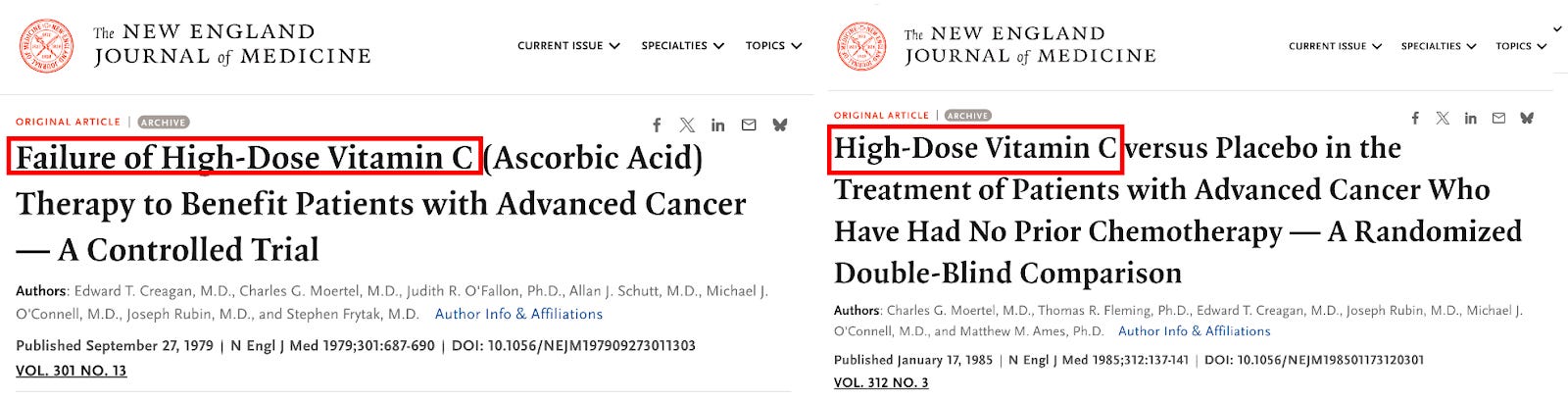
Here’s the kicker: although “high dose” was in the title, oddly, the word “oral” was missing (because that is what both trials tested). They didn’t test high-dose intravenous vitamin C, the form Pauling had actually advocated—they tested high-dose oral vitamin C. And they did it twice. In case you don’t know, oral absorption cannot come anywhere near the blood concentrations or physiologic impacts achieved with IV Vitamin C, not even close. I guess “they” really, really wanted to hammer the point home that Vitamin C has no role in cancer. Clown world.
Again, poor Linus. But here is where it gets good—really good—and will help increase even further his stellar, superlative (albeit slightly tarnished) scientific reputation. From AI:
“Linus Pauling has been widely quoted as saying (Ed: err, hypothesizing):
“You can trace every sickness, every disease, and every ailment to a mineral deficiency.”
Problem: there is no direct evidence he said the exact above quote, however his recognition of soil mineral depletion and their consequent negative physiological impacts was prescient:
How to Live Longer and Feel Better (1986):
Pauling advocated for daily supplementation of minerals—alongside vitamins—to prevent and treat disease, arguing that modern diets and depleted soils contribute to chronic deficiencies; these nutritional gaps underlie many illnesses.Linus Pauling Institute Publications:
Pauling and the Institute provided evidence backing the health importance of micronutrients (minerals and trace elements), and discussed how broad mineral deficits affect immune function, bone health, enzymatic reactions, and chronic disease prevalence.
However, this book goes beyond Pauling’s observations in that his research occurred prior to the gold standard trace mineral measurement technology ICP-MS, which would have been required to assess the needs of the ultratrace minerals and rare-earth elements outside of “the Big 14.” Still, he was a next-level researcher, having employed colorimetry, atomic absorption spectroscopy, and other classical chemical analyses.
Although ICP-MS was not part of Pauling’s scientific toolkit, his legacy inspired later researchers to use ICP-MS to further understand trace mineral roles in health and disease
So, already 40 years ago, one of the greatest scientists of modern times made the observation that widespread trace mineral deficiency—resulting from modern farming, soil depletion, and diet—created a vulnerability to nearly all forms of illness, chronic and acute.
Mic drop..
A Different Kind of Visionary: Viktor Schauberger and the Mineral Life of Water
Observations and Philosophy
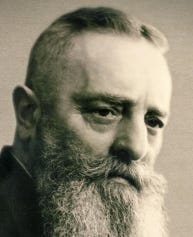
While the above highlighted the visionaries who understood both the impacts of soil mineral depletion and their importance to plant, animal, and human health, Viktor Schauberger turned his attention to their original carrier — water. Shauberger was an Austrian forester, inventor, and “mystic” of the 1930s,
This apparent savant — labeled a “mystic” in his day, based his life’s work on a kind of field-based scientific method built on keen observation. He began watching animals seek out certain springs and herbs for healing and then set about trying to replicate those same conditions — an effort to restore what he believed were nature’s original properties and thus “uniquely energizing” the water. Rather than relying on conventional laboratory science, he used iterative testing, natural analogies, and practical experimentation to guide his designs.
His methods were strikingly sophisticated and in resonance with nature, a natural beauty that defied conventional thinking yet reflected a deep coherence with it.
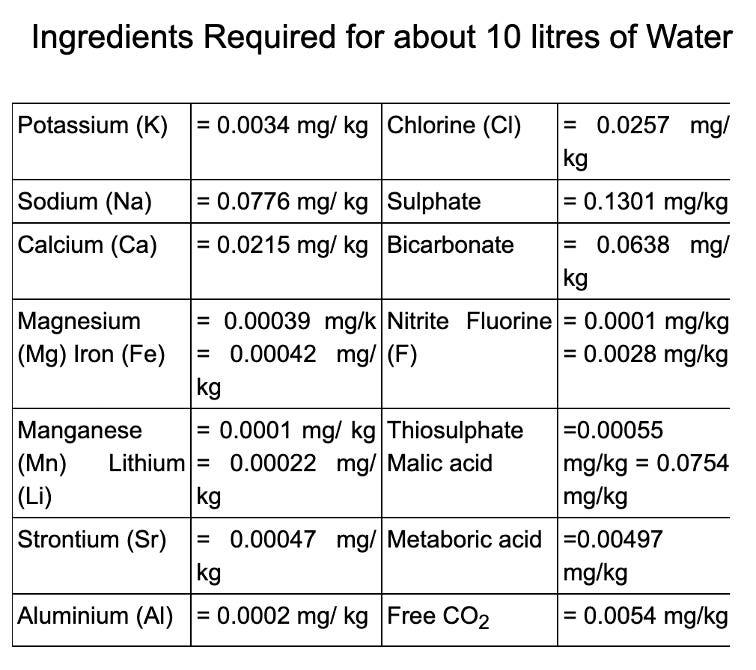
“We can command nature... if we obey her,” he wrote. Another line of his, “the highest wisdom is simple, and passes through the brain directly to the heart,” captured his approach. Long before it was common, he emphasised the need for both major and trace minerals in the water — strontium, boron, fluorine, manganese, aluminum, and sulfur — a foresight that still seems remarkable today (wake up you RO, distilled and (much less so) Berkey water filterers). An example of what he thought water needed to contain comes from one of his papers below:
What Schauberger Believed About Water
Schauberger became widely regarded as the pioneer of “life-enhancing” water through his development of what he called “ennobled water.” What the heck is “ennobled” water? The answer, as you will see, is quite complicated,I can barely understand it myself, but I will try to explain.
In his article The “Ennoblement of Water”, Schauberger laid out, in painstaking detail, his philosophy, research, and methods for artificially creating and energetically enhancing (“ennobling”) water — the principles and processes behind what he believed gave it its unique properties . My key takeaways were:
Water as the “ur-substance” of creation — carrying both earthly and cosmic energies for life and consciousness.
He observed animals seeking specific herbs and waters to heal wounds, which inspired him to explore water’s “mysterious powers”.
His apparatus passed water through rifled pipes and over cone-shaped metallic bodies, inducing vortex motion and avoiding wall contact — an attempt to charge water with subtle life energies.
The process involved alternating cycles of light/dark, heat/cold, and the addition of mineral elements that replicated the composition of spring water, all done at low temperature (around +4°C).
He maintained that this combination of temperature cycling and added elements purportedly dissolved energies from minerals and incorporated them into water without chemical alteration, maximizing its biological value.
According to his reports, naturally activated or “ennobled” water appeared to restore health to people suffering from various afflictions, prompting him to develop devices to enhance it.
Understanding that ennobled water could dissolve monopolies and societal discord (uh oh—this is where I again warn myself to be careful), ushering in new forms of social and individual development.
I don’t know that I can put Shauberger up there with Nicola Tesla (who, in my mind, was the greatest scientist ever to visit Earth:), but he was clearly a genius.
He was known for his innovative concepts around vortex motion, energy concentration, and “implosion” principles in water and air. He developed devices for water purification, log flumes, biological water management, and turbines. He even explored the idea of new forms of propulsion from water (such as the “Repulsine”).
Although his supporters claimed his inventions opened possibilities for using water as a fuel or energy source, as you will learn below, his life’s work was stolen from him and ultimately, no practical or scientifically verified vehicle using his water vortex or implosion technology was ever developed.
Health and Biological Effects
Schauberger attributed many benefits to his “ennobled” (or “activated”) water, claiming it could purge the body of crystalline deposits and support high-grade organic transformations, metaphorically describing standard human bodies as “sludge sacks” in contrast to those invigorated by ennobled water.
Similar to Linus Pauling, Elmer Heinrich, and others later on, he was the one who originally linked mineral deficiencies in natural water treatment to chronic disease, fatigue, and, “cancerous decay” in both humans and forests, emphasizing the role of proper water energetics in maintaining vitality. However, although these historical accounts describe reported benefits to such water, they have not been verified by modern clinical trials.
He also outlined methods for cost-effective home production — egg-shaped vessels, special metallic implements, temperature regulation, and the addition of salts and minerals replicating those found in high-quality natural springs — but, looking at the sophistication and complexity of his contraptions, it’s clear his process was nowhere near scalable across human populations.
I’ll resist saying too much, but this observation of “non-scalability” foreshadows a discovery of extraordinary magnitude—one that a single researcher would later bring to life, elegantly and simply, in ways science could hardly believe.
Societal Implications and Suppression
Schauberger warned that understanding the true energetics of water threatened entrenched industries and scientific paradigms. In this view, it was not just about healing individuals but for transforming agriculture, forestry, and resource management on a global scale. He knew it would lead to suppression of his work and reluctance among authorities to openly discuss these discoveries (oh boy - should I state my famous declaration that I am healthy and not suicidal?).
Nah, never mind, let’s go:
Reported Results and Controversy
Most importantly, after persevering with his experimentation, he found that when he gave the water to humans — just as with the sick animals in the forest — there were, according to his accounts, extraordinary stories of healing.
According to the reports he collected at the time, many people drinking his “ennobled” water described remarkable recoveries from chronic ailments such as kidney stones, rheumatism, malaria, and even cancer. Schauberger recounted that “hundreds of people suffering from all imaginable afflictions” claimed to have been restored to health after consuming the specially treated water, which he also believed tasted far better than standard mountain spring water. These anecdotes were never formally verified, and, under Austrian law, only qualified medical doctors were permitted to cure people; Regulatory officials insisted he not use his device.
Legacy and Foreshadowing
As fate would have it — or, some might say, as often happens when disruptive ideas meet entrenched systems (e.g. The Kory Scale)— Shauberger’s innovative technology ended up getting stolen.
From an AI summary of historical accounts:
After Viktor Schauberger moved to the United States in 1958, his final years were marked by disappointment and disillusionment. He was invited—under the promise of opportunity—to the U.S. by a group of investors and engineers interested in his water and energy inventions. Viktor Schauberger and his son were brought to Texas, where he was pressured to divulge all of his research and know-how related to his vortex-based and energy technologies. The legal documents he signed resulted in him relinquishing control and rights to his inventions, all technical documents, and models. Reports suggest he did not fully understand the agreement because it was written in English, a language in which he was not fluent.
As a result, all of his patents and documentation were appropriated by American interests.
Disheartened by the loss of his intellectual property and feeling betrayed by the people who invited him, Schauberger returned to Austria within weeks of his arrival in the U.S. Soon after returning to Austria, Viktor Schauberger reportedly fell into a deep depression and died several months later, in September 1958, essentially broken both spiritually and financially.
But his work lived on, and did not disappear into history. Modern products such as the The Vortex Water Revitalizer, trace their inspiration back to “the Austrian forester, philosopher, inventor and naturalist, Viktor Schauberger.”
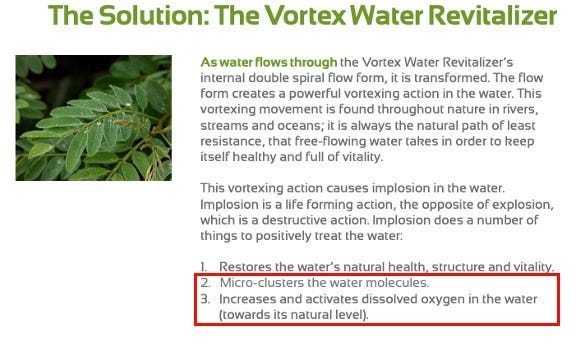
The two properties of ennobled water highlighted above will take on significant meaning in the next chapters, which introduces the breakthrough that finally made it possible to create a richly mineralized, structured, oxygen dense water at scale.
Conclusion
If a much more diverse set of minerals are now thought to be “essential” than previously recognized—and if their presence in our soils continue to dwindle—common sense suggests we should be looking for sources that provide a complete spectrum of at least 70 trace minerals either via diet, or more easily, added to our drinking water..
Based on what I see as a surprisingly thin body of scientific knowledge about the physiologic importance of dozens of these little-known minerals and rare-earth elements, it’s reasonable to hypothesize that a full complement could support a more optimal function of our bones, immune systems, tendons, nucleic acids, aorta, blood, and brain.
And—just perhaps—if future research examines higher-dose or broader-spectrum supplementation, it may reveal new ways these essential minerals influence or modulate physiological responses. If that sounds like an ICU doctor talking, you busted me. But that’s also where this book is heading: a call to action for rigorous research into their therapeutic potential.
Next: Chapter 9: Volcano Alchemist: Asao Shimanishi and the Code Hidden in Black Mica
Upcoming Book Publications
Yup — not one, but two books are dropping from yours truly. At the same time? What?

From Volcanoes to Vitality: if, instead of (or in addition to) this Substack version, you prefer the feel of a real book—or the smell of paper—or like to give holiday gifts, pre-order my grand mineral saga, shipping before Christmas.
The War on Chlorine Dioxide: if you want to read (or gift) another chronicle of suppression, science, and survival, grab the sequel you didn’t see coming—shipping mid-January. On this one, I say: “Buy it before they ban it.” Hah!
© 2025 Pierre Kory. All rights reserved.
This chapter is original material and protected under international copyright law. No part of this publication may be reproduced, distributed, or transmitted in any form or by any means, including photocopying, recording, or other electronic or mechanical methods, without the prior written permission of the author.
Great chapter Dr Kory. The so called clinical trial to determine the efficacy of intravenous Vitamin C and it's purposeful delayed use in treatment for sepsis mirrors the sham ivermectin trial performed on covid patients at VA clinic. When the corrupt medical complex wants to submarine cheap and effective repurposed drugs like IVM in order to introduce their next exorbitantly priced product (paxlovid) or deadly off the shelf failed meds (remdesivir), it's clear that 'they' will kill to make sure it happens.
Regarding the powerful evidence of Viktor Schauberger work, AMD ran an extensive piece, as is always the case, on Schauberger's work with a linked video documentary. It was very informative, convincing and given his tragic ending, a truthful science based field study that certain people and industries did not want disclosed. AMD followed up with additional articles on ZETA potential benefits of such mineral enriched water. I will come back and record the link here once I find it.
Here you go:
https://m.youtube.com/watch?v=yXPrLGUGZsw
"As you will learn later, my friends, that is what I am dedicating the rest of my research career to exploring."
Wow! Maybe you have an overarching view of how repurposed "drugs", chlorine dioxide, DMSO, essential trace minerals, toxins come together as an approach to greater health.
On to the next chapter.