
Chapter 6 - The Forgotten Elements: When ‘Non-Essential’ Minerals Become Essential for Health
Case Studies Of the Impacts of Lithium, Copper, and Boron on Health


Lithium
Lithium deficiency is a good example of how a supposedly “non-essential” trace mineral deficiency can negatively impact health. In our three and a half years treating cognitive and mood disturbances in vaccine-injured patients at Leading Edge Clinic, we noticed that many patients who were found to be deficient in lithium showed clinical improvement after beginning supplementation with lithium orotate (LO)—a form that crosses the blood-brain barrier very well.
Important: small doses of LO have nothing to do with the comparatively massive doses of lithium carbonate used in the treatment of severe mental illness.
Here I want to thank Michael Nehls, whose fantastic Substack post titled “Lithium, the Essential Trace Element” brought LO to our attention back in 2023. After reading it, Paul Marik, Scott Marsland, and I had an enlightening Zoom call with him to learn more. That call inspired my best man, Prof. Paul Marik to perform a review of the literature (excerpted for brevity):
Lithium Orotate
Many basic science and epidemiologic studies find that lithium is a crucial trace element necessary for optimum brain functioning.
The primary source of intake is drinking water; however, due to the uneven distribution of lithium in the Earth’s crust, its estimated consumption is highly diverse. (102)
People living in lithium-rich areas tend to have lower rates of mental illness (and suicide) compared to places where the land or water supply is relatively lithium-poor. (104-109)
A recent, large, population-based Danish study found that higher lithium levels in drinking water may be associated with a lower incidence of dementia. (110)
Microdose Lithium has been reported to stabilize cognitive impairment in patients with Alzheimer’s Disease. (117)
The use of filtered and bottled water may reduce lithium intake (Ed: this will become very important later).
According to published research and anecdotal reports, people taking LO have described:
feeling calmer
experiencing fewer or less intense depressive, hypomanic, or mixed affective symptoms
being less impulsive
experiencing less frequent and less intense suicidal thoughts or aggressive impulses
stress reduction. (104)
Long-term, low-dose exposure to lithium appears to exert anti-aging capabilities and may decrease mortality in evolutionarily distinct species.
Based on this body of research, I have been taking 5 mg of lithium orotate daily for a couple of years now and plan to do it lifelong (no COI here, but I like the Horbach brand—good quality, inexpensive. I take 130mg orally daily (which contains only 5mg of elemental lithium), a dose far below known toxicity levels. A six-month supply costs about $15 online.
This is my personal choice based on the research I reviewed—not medical advice. Anyone considering lithium supplementation should consult with a qualified healthcare provider.
Boron And Its Threat To the Pharmaceutical Industry
From this review of the importance of boron:
In the 1960’s Rex Newnham, Ph.D., D.O., N.D, developed arthritis. At that time he was a soil and plant scientist in Perth, Western Australia. Conventional drugs did not help, so he looked for the cause in the chemistry of plants. He realized that plants in that area were rather mineral deficient. Knowing that boron aids calcium metabolism in plants he decided to try it. He started taking 30 mg of borax a day, and in three weeks all pain, swelling and stiffness had disappeared.
He told public health and medical school authorities about his discovery but they were not interested. However, some people with arthritis were delighted as they improved. Others were scared to take something with a poison label on the container and meant to kill cockroaches and ants. Eventually, he had tablets made with a safe and effective quantity of borax.
Within five years and only by word of mouth he sold 10,000 bottles a month. He could no longer cope and asked a drug company to market it. That was a major mistake. They indicated that this would replace more expensive drugs and reduce their profits. It so happened that they had representatives on government health committees and arranged that in 1981, Australia instituted a regulation that declared boron and its compounds to be poisons in any concentration (Ed: using the Kory Scale concept—which posits a direct relationship between the efficacy of an inexpensive, unprofitable therapy and the severity of regulatory or persecutory behavior of authorities in response—his would indicate that boron is highly effective in treating arthritis. This action is similar to what Australia did with ivermectin in the context of Covid; there, they classified it as Schedule 4 under the Australian Poisons standard, and subsequently, in Appendix D, they limited off-label use only to specific specialists for approved indications, mainly scabies and parasitic infections, and specifically not Covid.
Newman was fined $1000 for selling a poison, and this successfully stopped his arthritis cure from spreading in Australia. Subsequently, he published several scientific papers on borax and arthritis. One was a double-blind trial in the mid-1980s at the Royal Melbourne Hospital, which showed that 70% of those who completed the trial were greatly improved. Only 12% improved when on a placebo. There were no negative side effects, but some reported that their heart ailment had also improved, and there was better general health and less tiredness.
Copper and Heart Disease
Continuing down the list of heretofore under-recognized trace minerals of critical importance to maintaining healthy human physiology, we come to copper. When I say “under-recognized” I also mean “under-emphasized” - even though it is supposedly an “essential” trace mineral, when was the last time any allopathic doctor tested someone’s copper levels to rule out a deficiency? Probably never, because, and I can attest to this personally, during my training and academic career, not once was I ever told that copper deficiency is or might be a problem in my patients.
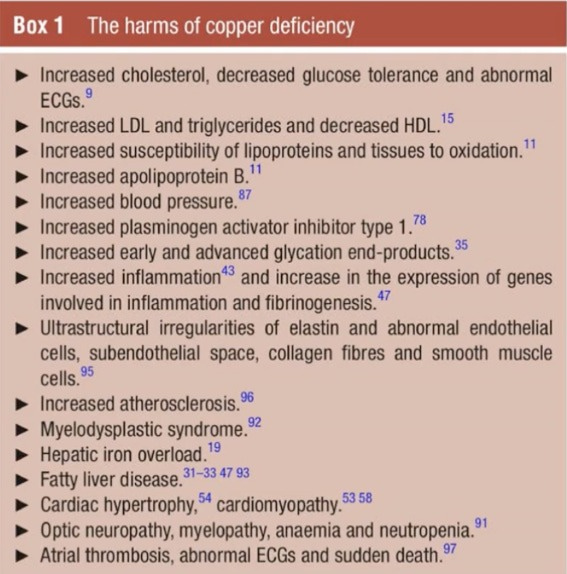
However, during my mineral research, I was astonished to find out the below about copper:
First, the list of copper-dependent proteins is dizzying: transcriptional regulators, chaperones, oxidoreductases, mitochondrial electron transport, and free radical scavenging. Copper is also important for immune function. Research indicates that low dietary copper intake can impair normal immune responses and that these effects may persist for weeks even after copper intake is increased.
Regarding ischemic heart disease (IHD), research suggests the heart may be especially vulnerable to copper insufficiency, which has been linked to reduced metabolic activity and energy supply.
Research has identified associations between copper deficiency and multiple cardiovascular risk factors.. There are many significant similarities between copper deficiency in animals and ischemic heart disease in humans, including glucose intolerance, hypercholesterolemia, abnormal ECG, hyperuricemia, and hypertension.
Now check out the effects of daily copper supplementation from this paper:
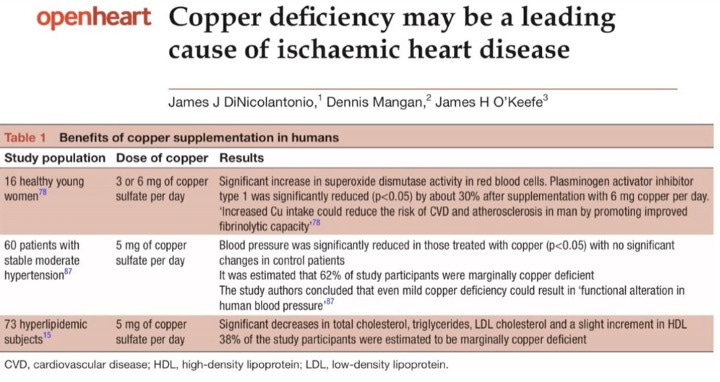
Although I believe I have convinced you of the importance of copper, I also rarely hear anyone discussing it at cocktail parties! Zinc, meanwhile, is the talk of the town—especially during Covid (yes, my friends are all health and MAHA nerds). Zinc was on our FLCCC protocols, and everyone I knew was taking zinc.
Problem: In my experience, zinc apparently won MAHA’s 2025 Essential Trace Mineral popularity contest, with iodine a distant second, followed by selenium, lithium, and boron, with copper near the bottom. Molybdenum got only one vote, surprisingly, and vanadium got none. (Not so fun fact: on my wife Lisa’s heavy metal/trace mineral test last year, she had zero molybdenum).
Just in case you are wondering, I am totally making the above “contest” up. There was no MAHA Trace Mineral popularity contest held (at least this year). Wait until next year, after everyone has read this book!
Anyway, my point is this: zinc and copper compete for absorption in the body. High levels of zinc can significantly reduce copper absorption, leading to copper deficiency and the above related health problems. All I am saying is: don’t forget about your copper needs.
(Anyone supplementing with zinc should discuss appropriate copper balance with a healthcare provider to avoid creating deficiencies.)
Other real-world examples of the consequences of various trace mineral deficiencies in our soils:
Zinc deficiency & diarrheal diseases in children: Major contributor to childhood diarrhea in low- and middle-income countries, leading to millions of acute diarrheal cases and about 500,000 child deaths annually. Zinc supplementation is a proven therapy to reduce disease severity and improve survival.
Iodine deficiency & goiter epidemics: Large outbreaks of goiter, mental retardation, and developmental delays repeatedly occurred in regions with iodine-deficient soil—notably the Himalayas, the Andes, and parts of Africa and China—before the introduction of iodized salt.
Selenium Deficiency: Areas in China with selenium-poor soil have seen outbreaks of Keshan disease, a type of cardiomyopathy (heart muscle disease) often exacerbated by viral infection. Another example is Kashin–Beck disease, an osteoarthropathy causing joint and bone disorders. Selenium deficiency also weakens immune defense and increases the risk of cognitive decline and reproductive disorders.
Cadmium Toxicity (linked to Trace Mineral Deficiency): The itai-itai disease outbreak in Japan was primarily traced to cadmium contamination. Still, symptoms and severity were modulated by the deficiency of other trace minerals (like zinc and iron) in the local diet. The disease causes weak and brittle bones, kidney failure, and severe pain, because cadmium interferes with key trace-mineral pathways when soil is also deficient in protective minerals.
Copper and Cobalt Deficiency in Cattle: One review reported trace element deficiencies in cattle grazing on soils lacking copper and cobalt have led to outbreaks of health problems such as poor pigmentation (”spectacling”) around the eyes, diarrhea, and reproductive issues. These deficiencies are seen when soils are depleted or when antagonistic elements (like iron, molybdenum) reduce trace mineral availability for animals.
Unsettling, right? To discover that modern medicine has largely ignored the vast potential of a diverse array of trace minerals in supporting human health physiology—and perhaps in preventing or reducing disease risk? Worse, these deficiencies can produce significant morbidity and mortality, sometimes at population-wide scales.
Next: Chapter 8 - Ignored, Then Vindicated: Early Voices on Minerals, Water, and Health
Upcoming Book Publications
Yup — not one, but two books are dropping from yours truly. At the same time? What?

From Volcanoes to Vitality: if, instead of (or in addition to) this Substack version, you prefer the feel of a real book—or the smell of paper—or like to give holiday gifts, pre-order my grand mineral saga, shipping before Christmas.
The War on Chlorine Dioxide: if you want to read (or gift) another chronicle of suppression, science, and survival, grab the sequel you didn’t see coming—shipping mid-January. On this one, I say: “Buy it before they ban it.” Hah!
© 2025 Pierre Kory. All rights reserved.
This chapter is original material and protected under international copyright law. No part of this publication may be reproduced, distributed, or transmitted in any form or by any means, including photocopying, recording, or other electronic or mechanical methods, without the prior written permission of the author.
I found the segment on Lithium Orotate fascinating and since I am taking Armour for hypothyroid, I wanted to dig a little deeper into any contraindications. My go to for anything Thyroid is Dr Isabella Wentz, PharmMD. https://thyroidpharmacist.com/articles/lithium-and-hashimotos/ An interesting side note in the article, ". . . lithium citrate was the original “up” in 7-Up."
I’ve been taking borax for 8 months and within 2 weeks of taking it my stiff neck was gone. I’d been going in for neck adjustments for months with no lasting effects. Borax works! My sister started taking it and her stiff knees were gone. We are both mid 50’s. Take no less than 400 mg of magnesium with it.