
Chapter 13B: Structured Water, 4th-Phase Water, and ‘EZ’ Water: Everything You Always Wanted to Know (But Were Afraid to Ask)
How a quiet revolution in physics—and a long-forgotten Japanese inventor—reveals that water is far more alive than we ever imagined.

Again, (sorry but this is Substack so I have to keep repeating this for this multi-sectioned chapter), not that I want you to, but if you are uninterested or unknowledgeable in the biochemical and metabolic pathways that I will elucidate in the following, again, I suggest skimming, or just outright skipping to Chapter 15 - “Minerals Made Simple: How Nature’s Elements Keep Water, Plants, and People Alive” This way you won’t get annoyed with me or complain that I am being too “scienc-ey.”
I still remember my elementary school science class when I first learned about the wondrous properties of water — and how life on Earth would be impossible without them. I was fascinated by the list of traits that make water almost completely unique among all substances::
Universal solvent: Water dissolves and transports nutrients, enabling virtually all biological processes in living things.
High heat capacity: It stabilizes temperatures, buffering organisms and environments from rapid change.
Ice floats: Solid water is less dense than liquid, protecting aquatic life beneath the surface.
Cohesion and adhesion: Hydrogen bonds enable water to travel upward in plants and create surface tension that supports life above and below water.
Exists in all three phases: Found naturally as solid, liquid, and gas — sustaining the water cycle and the evolution of life itself.
Every living process depends on these singular properties. Without water, Earth would be uninhabitable!
But there’s a problem: I was taught — as every student still is — that water exists in only three phases. Even AI models will insist on this… unless you ask a very specific question:
“Does water have a fourth phase?”
Answer: Yes, according to emerging research—especially work by Dr. Gerald Pollack—there is evidence for a “fourth phase of water” beyond solid, liquid, and gas.
The Fourth Phase: Exclusion Zone (EZ) or Structured Water
According to decades of research led by Dr. Gerald Pollack at the University of Washington, water exhibits a previously unrecognized state — a structured, quasi-crystalline form that exists between solid and liquid.
This “fourth phase” of water forms next to hydrophilic surfaces — including biological membranes — where it arranges itself into hexagonal, layered sheets. It is negatively charged, repels impurities, and stores light-derived energy, behaving almost like a biological gel.
Problem: many of you will have heard of this “new type” of water, with descriptions that vary - “structured water,” “fourth phase water,” or “exclusion zone water.” Fortunately for you (and me) all three describe the same fundamental phenomenon differing only in the characteristic it emphasizes::
“Fourth-phase water” – emphasizing its state beyond solid, liquid, or gas.
“Structured water” – highlighting its hexagonal molecular order.
“Exclusion Zone (EZ) water” – referring to its ability to exclude particles and impurities.
Pollack’s experiments revealed that this water, H₃O₂, carries a negative charge, while adjacent bulk water becomes proton-rich. In effect, it functions like a microscopic battery — a self-organizing, light-charged electrical system.
How Structured Water Forms — and What It Does
Definition: Structured water (SW) is water whose molecules are arranged in a repeating, ordered pattern rather than random motion.
Formation: It can form through exposure to infrared light, vortexing, magnetic fields, or contact with minerals — especially hydrophilic ones like mica and quartz. It’s naturally found in mountain springs, glacial meltwater, and inside living cells.
Functions and Proposed Biological Roles:
Cellular organization: EZ water forms structured zones along cell membranes and organelles, helping maintain molecular stability and efficiency.
Energy storage: It separates charge and holds electrical energy, recharged by light — essentially acting as a biological capacitor.
Transport: It can drive flow without pumps, as seen in plant xylem and microfluidic channels, powered solely by radiant energy.
Pollack’s group published a paper finding that substances promoting health (like turmeric, coconut water, and sunlight) expand the EZ, while toxins (like glyphosate) shrink it — suggesting that structured water dynamics might underlie wellness and disease. To wit: this paper found that a deficiency in EZ water is linked to impaired protein function and cellular health, while abundant EZ water supports optimal activity and resilience
Even more remarkable, Pollacks group also reported that sunlight — especially its infrared component — expands the EZ and increases its energy storage capacity, not through heat, but via electromagnetic resonance.
The implications are dizzying. Think of how you feel on a sunny day that’s cool enough you don’t really feel the thermal effects of the sun, but it still feels incredibly good. Is it possible that the sun is literally expanding and “charging” the EZ water with energy?
Biological and Experimental Evidence Of Structured Water
Studies in animals and plants support these observations:
In animals, drinking structured water improved growth rates, antioxidant activity, semen quality, blood lipids, and tissue conductivity across multiple species.
In plants, EZ-like layers formed rapidly inside and outside xylem vessels, driving water flow through proton movement.
Although human studies remain limited, proponents claim (hypothesize) that it boosts hydration (bioavailability), enhances nutrient delivery, and supports cellular energy. However, these claims still await large-scale validation.
Scientific Controversy
Despite growing experimental evidence, Pollack’s “fourth phase” remains controversial (shocker).
Mainstream science has not yet integrated it into textbooks, though AI summaries now acknowledge that “a fourth phase appears to exist and may explain many of water’s anomalous behaviors.” To me, that sounds like a quiet concession wrapped in scientific hedging.
Enter Asao Shimanishi, Again
What if I told you that Pollack was not the first to discover this phenomenon? And what if I told you that man was named Asao Shimanishi? Another shocker right?
Decades earlier than Pollack, in the 1960s, Shimanishi found that his extracted ionic mineral solution not only purified water but also produced water that was unique, what he described as “activated oxygen water.” Wait, a fourth term to contend with?
Yup. But don’t worry, it’s the same thing as “structured, EZ, or 4th phase” water, because the chemistry aligns perfectly with Pollack’s later discoveries.
Interestingly, Pollack, in a personal communication with a colleague of mine, stated that “structured water is also found at the bottom of the ocean near volcanic vents/systems.” Yup.
Mechanism of formation
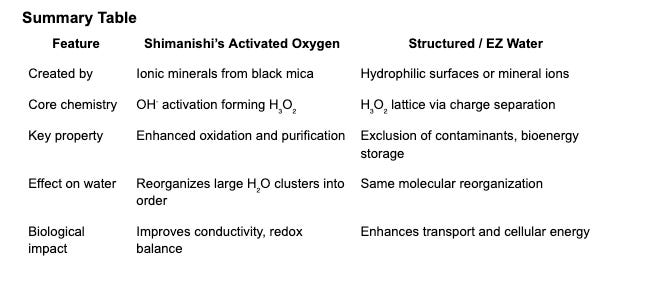
When black mica minerals are introduced to water, their ionic complexes generate hydroxide ions (OH⁻). These react within the water matrix to form H₃O₂, the same structured, negatively charged configuration observed in EZ water.
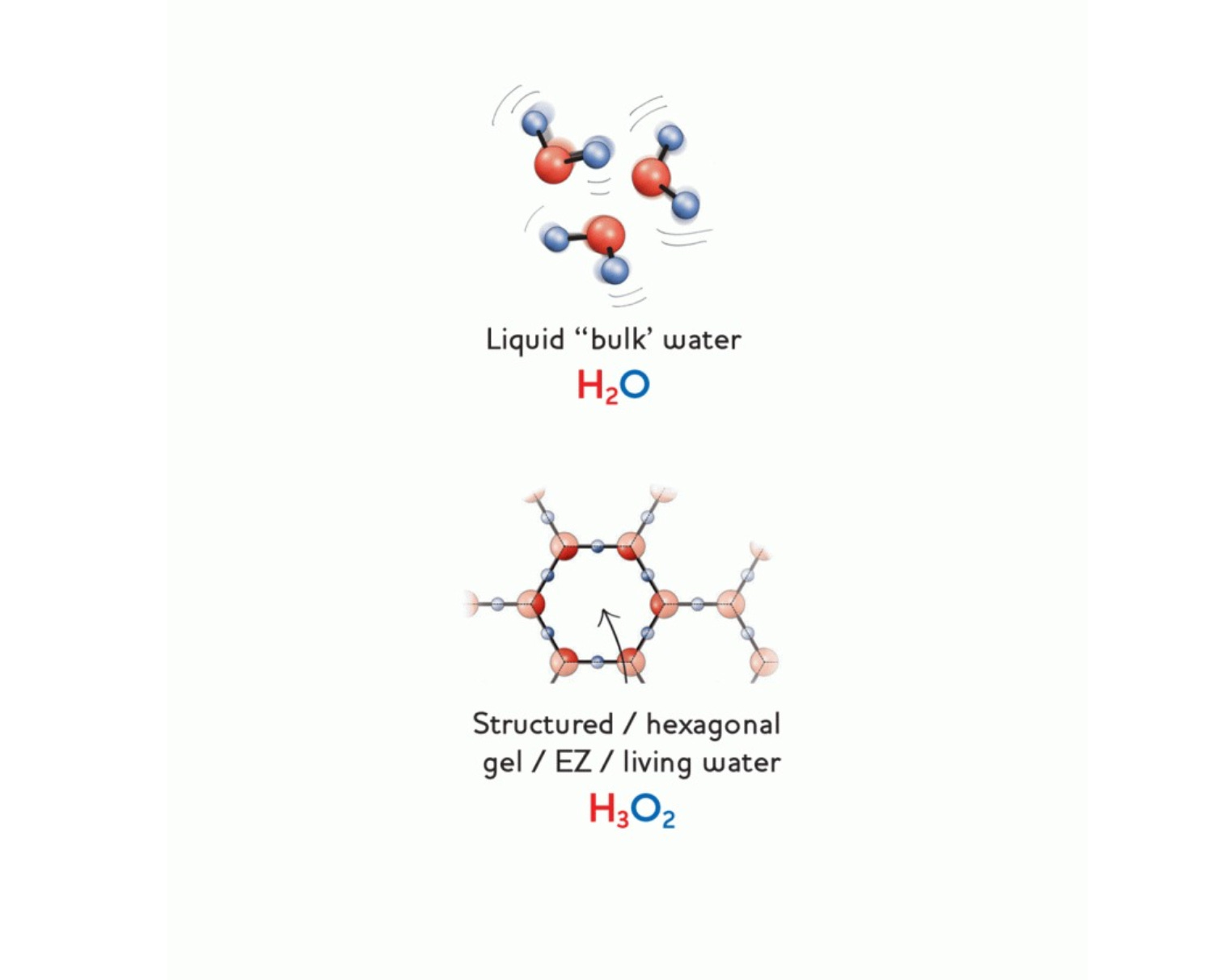
Ordinary or “liquid, bulk” water as above is composed of many H₂O molecules connected in loose, variable, and often long clusters
When ionic minerals are introduced, the resulting OH- ions electrostatic force reorganize these clusters—breaking down large, disordered groupings into smaller, hexagonally arranged clusters of about six molecules each, forming a lattice of H₃O₂ This more ordered structure closely mirrors the hexagonal geometry described in Pollack’s studies of EZ water.
In this process, the water becomes:
More ordered
More conductive
More oxidative and purifying
As large, disordered H₂O clusters reorganize into smaller hexagonal units, impurities detach and precipitate — a self-cleaning effect that mirrors the “exclusion” behavior in Pollack’s lab.
Thus, Shimanishi’s “activated oxygen” water is chemically and physically identical to Pollack’s structured or EZ water, only described forty years earlier.
Mineral Order Seeds Aqueous Order
Now, let’s compare the molecular symmetry between biotite (black mica) and structured water:
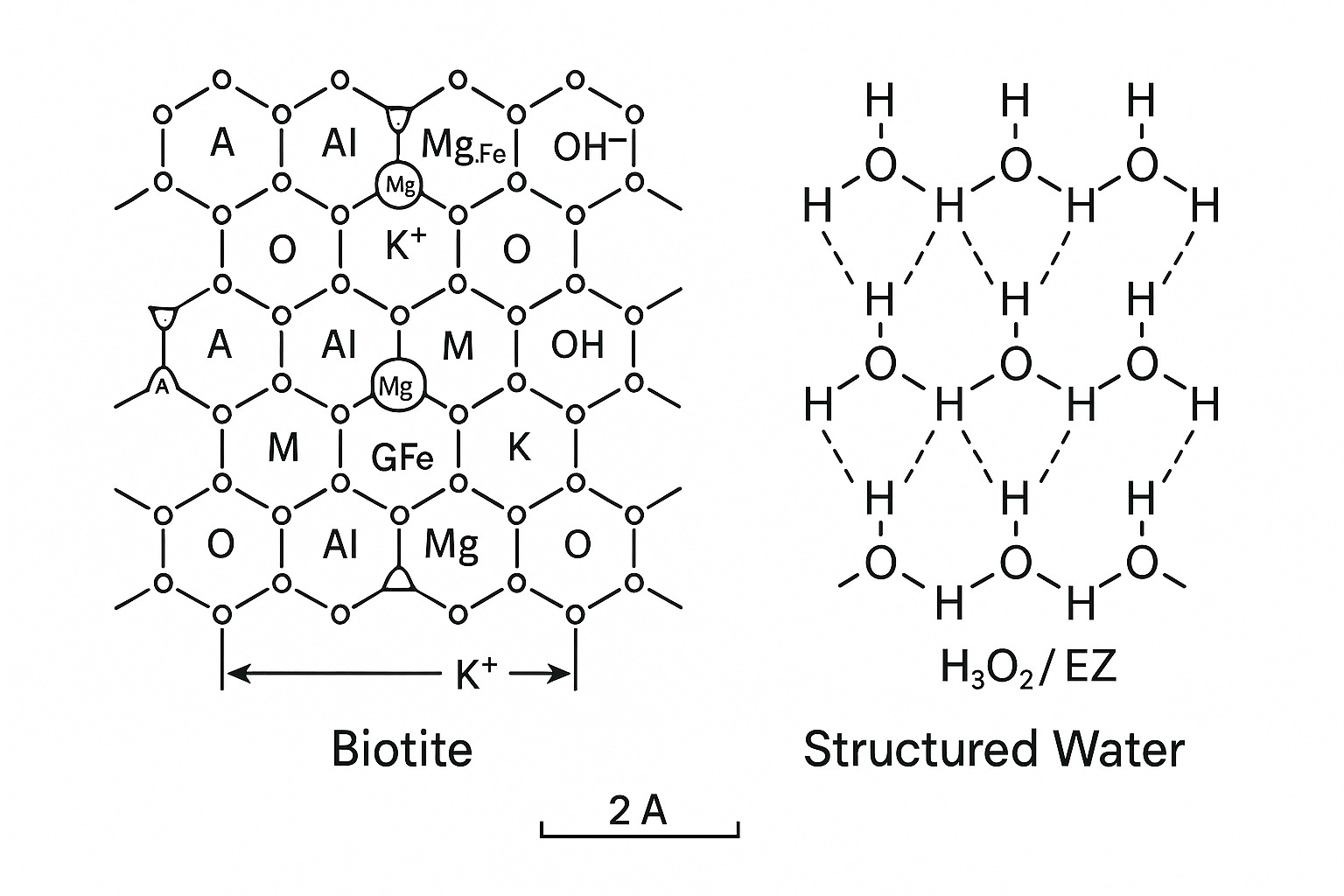
The resemblance between biotite (black mica) and structured water is no coincidence. Both share layered, hexagonal architectures stabilized by charge separation and electrostatic gradients:
Biotite: Alternating Si–O tetrahedral sheets and Fe/Mg/Al layers, bound by K⁺ cations.
Structured water: Hexagonal O–H–O sheets that expel protons into adjacent layers.
Again, the resemblance is no coincidence—it reveals a profound electrostructural kinship between layered silicate minerals like biotite and the hydrogen-bonded lattice of structured water (H₃O₂).
Both form layered hexagonal networks stabilized by charge separation and electrostatic balance:
Biotite aligns Si–O sheets and Fe/Mg/Al layers around K⁺ ions.
Structured water aligns O–H–O bonds into hexagonal sheets, expelling protons to adjacent zones.
Each sustains long-range order through electrical potential gradients—minerals via cations, water via proton exclusion. And both interact directly: EZ water forms most readily on hydrophilic mineral surfaces like mica and biotite, whose atomic geometry and surface charge template the structure of water itself. Let’s look again in more detail:
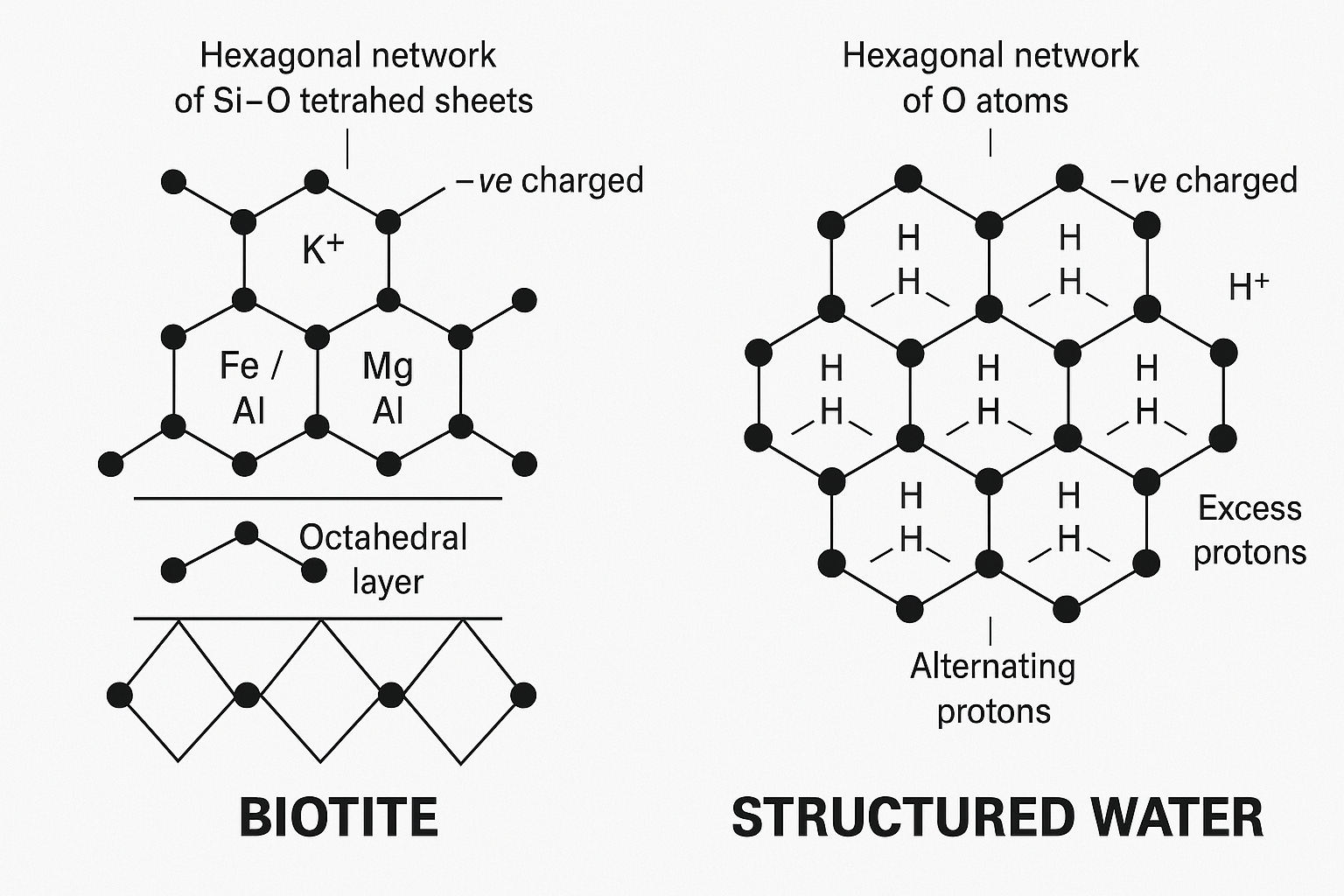
In a philosophical sense, you can think of it as “mineral order seeds aqueous order,” which merges the boundary between geology and biology. And indeed, EZ water forms most readily on mica surfaces, as Pollack’s team observed, meaning that biotite itself templates the structure of structured water.
Thus, at the interface of solid and liquid, the two become one — suggesting that the first living systems may have emerged from mineral–water lattices, with biotite-like minerals as scaffolds for proto-biological proton gradients.
In summary, these minerals offer a remarkable combination of physical and chemical properties—enhancing oxidation, purification, mineral balance, conductivity, and molecular organization—all through natural ionic interactions.
It’s all coming together now, right?
Scientific Evidence That Themarox Creates Structured Water
Data supporting the above parallels come from a laboratory analysis of water samples treated with Shimanishi’s mineral solution. Researchers used photon absorption testing to compare three types of water: tap water, Ultrapure water (a research substance made to be devoid of anything but H20 molecules), and Themarox-treated water.
The key thing to understand here is that Pollack’s experiments on EZ water consistently found a distinct ultraviolet absorption peak around 270 nanometers (nm)—a signature wavelength associated with this “fourth phase” water structure.
So what did they find? The Themarox-treated water showed a distinct UV absorption peak around 270 nm, identical to that reported in Pollack’s structured water experiments.
This spectral signature indicates increased molecular ordering and energy storage capacity — precisely what defines the fourth phase.
The Circle Closes — From Shauberger to Shimanishi to Pollack
“Scientific consensus,” of course, maintains that this distinct UV wavelength absorption range is not unique—I came across an article which argued that “bulk water” from certain springs (specifically mentioning Arrowhead Spring in California) has shown similar absorption peaks.
But here’s the irony: as we covered in Chapter 10 - The Mineral Water Hypothesis: The Science and Story of Healing Springs, bathing in that spring has been associated with remarkable vitality and restorative qualities for over a 100 years.
And if that sounds familiar— think Victor Shauberger - the early 20th-century naturalist who observed that vortexed, mineral-rich water behaves as if “alive,” restoring balance and resilience to natural systems.
Now, modern spectroscopy, electrochemistry, and biophysics all point toward the same truth:
Water becomes “alive” when it is structured — and minerals like Themarox are nature’s way of teaching it how.
Just sayin’.
Next: Chapter 13C: Understanding Oxidation-Reduction Potential (ORP)
P.S. If you’re curious about the volcanic-mineral water purification product that this book led me to help develop, you can find it at Aurmina.com. Think of it as a quiet act of restoration — starting with your water. And yes, I know — I’ve become the guy who includes links at the end. But this one just might change your water (and your mind).

Upcoming Book Publications
Yup — not one, but two books are dropping from yours truly. At the same time? What?

If, instead of (or in addition to) this Substack version, you prefer the feel of a real book—or the smell of paper—or like to give holiday gifts, pre-order From Volcanoes to Vitality, my grand mineral saga, shipping before Christmas.
And if you want to read (or gift) another chronicle of suppression, science, and survival, grab The War on Chlorine Dioxide—the sequel you didn’t see coming—shipping mid-January. On this one, I say: “Buy it before they ban it.” Hah!
© 2025 Pierre Kory. All rights reserved.© 2025 Pierre Kory. All rights reserved.
This chapter is original material and protected under international copyright law. No part of this publication may be reproduced, distributed, or transmitted in any form or by any means, including photocopying, recording, or other electronic or mechanical methods, without the prior written permission of the author.
search for "cam" there is a "came" that is missing its "e"
There's no link to the next chapter. I have moved on to 14E