


**Since so many readers appreciated the sharing of upcoming events and happenings, let’s do it again before we jump into today’s post!
HAPPENINGS
1) A Rare W In the Win Column
As many of you know, I have served as an expert witness for almost two dozen doctors, both in the country and around the world, who were persecuted for prescribing ivermectin to Covid patients and/or who were critical of the Covid vaccines. Most of my efforts have been unsuccessful, so it was with great pleasure that I received the email below earlier this week:
On Nov 9, 2026, at 9:17 PM, Dr. Eric Koperda <> wrote:
Greetings, Dr. Kory. Thank you for your support the past ~3 years as I faced the Minnesota medical board distressed by my prescriptions for ivermectin. The board sends word its inquisition is finished; there will be no disciplinary action; administrative court proceedings are dismissed; their “complaint” case is closed. Your expert witness report contributed, no doubt, as did your recent publications in the field. You may remember I’m the family doc in International Falls, Minnesota; I’m in private practice doing direct primary care (DPC) just across the border from Ontario. Your work with FLCCC was a key factor in my decision to prescribe ivermectin and adjunct treatments for COVID-19. My patients benefitted greatly, of course, and numerous deaths were averted. The concise and organized nature of your guidelines was appreciated; they were among the best I’ve seen in my career.
Distilled spirits of your choice will be sent as a token of my gratitude for the expert witness work. What do you drink?
------------------------------------------------
Eric F. Koperda, MD
Rural family medicine and obstetrics
International Falls, Minnesota
MY REPLY:
Eric!!
Amazing! You made my day my friend, so glad my work was of help to you. I have personally testified in so many actions against colleagues in this country and around the world, and so many still lost their licenses, so it is a great to get a “W” in the win column every once in a while. I don’t think this is a sign that sanity is returning to our institutions, but at least it peeks in every once in a while. I will happily accept your offer of a distilled spirit, largely because… I really like distilled spirits :) Whiskey is my friend, and I will raise a glass to you and your case immediately upon receipt (unless it is 9:00 a.m in the morning).
Thanks and I wish you the best! - Pierre
2) Healing Dementia Summit
My talk on daily low-dose sublingual ketamine for dementia and other neurodegenerative disorders was very well received, and it was an honor to share the program with such accomplished dementia experts. The summit is over so you cant watch if for free anymore, but the VIP package includes a year of access, full transcripts, and audio downloads. Register with the free-access link, then upgrade to VIP.

3) Trailer For Mikki Willis’s Bad Medicine Documentary Is Out!
Unfortunately, because of the airport mess this weekend, I couldn't make it to the Malibu Film Festival for the premiere and Q&A with Jimmy Dore (sucks), but the trailer came out last week, with clips of Paul Marik and me in it!. Check it out below- two and a half minutes- and visit https://badmedicinemovie.org to see all the states and cities it’s going to be screened in. I am going to the one by me in Sarasota on Dec. 16th!
4) Leading Edge Clinic Is Looking For Providers - MD’s, DO’s, NP’s etc..

As we approach the end of our fifth year in practice, we’re proud of its slow and steady growth. We recently hired our 32nd employee and treated our 3,800th patient. Our team now includes 10 providers, two full-time managers, 13 nurses, and 9 office and scheduling staff. We only hire experienced nurses (no medical or nursing assistants), and we try to return all messages the same day, with proactive follow-up within two weeks of every provider visit to see how treatment plans are understood, tolerated, and followed (some describe what we do as “white glove” medical care, and I won’t argue with that).
For providers who might be interested in joining us, know that we began by treating Covid vaccine injury and Long Covid. Years of research and of trialing a wide range of both standard and “unconventional” therapies have since taken us much further. Today we care for patients with neurologic, cognitive, and neurodegenerative diseases, provide adjunctive cancer care using combinations of repurposed drugs, and treat complex chronic illnesses such as ME/CFS and chronic Lyme disease.
If you’re a clinician ready to leave “system medicine” for a dynamic practice with unparalleled autonomy to learn and use a broad range of therapies conventional medicine has overlooked, ignored, or actively suppressed, write to practicemanager@drpierrekory.com.
5) Survey Poll: Is Autumn Water Cleaner?
As those of you who’ve read my books or followed this Substack know, I’ve been using Aurmina to purify and vitalize my water for almost two years, nearly all of that time living in Sarasota. I also travel a lot, and Aurmina comes with me everywhere. Of all the places I’ve treated water, Sarasota’s has been by far the worst (and New York City’s the best). Sarasota has had the most floc falling out, and the worst taste before treatment.
Lately, though, something changed. After a recent stretch of travel, I noticed my containers were showing far less floc than they used to, a real sea change (pardon the pun). I mentioned it to my partner Scott, and he’d seen the same thing a thousand miles away in Ithaca, NY.
So I have two questions for those of you who use Aurmina regularly:
Please also tell me in the comments where you live and what your water source is (city water, well, lake or river), because the pattern across places is the most useful clue.
My own first guess was the first option: that the herbicides, pesticides, and fertilizers sprayed on farmland leach far less into the water once the harvest is in. When I dug into it, that turned out to be only part of the story. The full answer is at the end of this post, but vote first so it doesn’t sway you.
This Substack requires a lot of late nights and deep rabbit holes. Your support through a paid subscription makes it possible.
*The core of this post was written after I published The Stone and Water Series, when I read “The Three Ages of Water” by the eminent water scientist, Peter Glieck.
When Rivers Burned
Who knew that rivers could catch fire? For about a century, in the industrial heart of America, they did.
On November 1, 1892, at Point Breeze in South Philadelphia, a match tossed from a boat landed on the Schuylkill River. The water there carried a scum of oil from the oil works along the bank, and the river caught. The next morning’s New York Times headline was pretty stark: “The River Set on Fire; One Life Lost, Two Men Badly Burned, and a Vessel Damaged.” The weird thing is that nobody at the time seemed to treat it as a scandal. It was reported the way you would report a boiler explosion, as one of the hazards of working near industry.
Then, in April 1899, a lighted cigar dropped from a passing streetcar onto the Chicago River at Kinzie Street. Grease pouring out of a sewer there had spread across the surface, and it went up. The Chicago Tribune reported flames fifty feet high, and the fire damaged the Kinzie Street bridge. The following year, Chicago famously reversed the flow of its river so that its sewage would run away from Lake Michigan, its drinking water, and toward the Mississippi. Moving the waste downstream, out of sight, was the standard engineering answer of the age.
Baltimore had dealt with its foul Jones Falls by burying it. Beginning in 1915, the city diverted the stream into thousands of feet of underground tunnels. In 1926, the gases and waste trapped inside exploded. Manhole covers flew through the air, downtown windows shattered, and a forty-foot wall of flame rushed out of the pipe toward the harbor. In January 1968, a workman’s torch set the Buffalo River on fire. A federal water pollution report that year called the river “a repulsive holding basin for industrial and municipal wastes,” “devoid of oxygen and almost sterile” (quoted in John Hartig, Burning Rivers, 2010).
Every one of these fires had the same cause: people treated a river as the cheapest way to get rid of what a city and its factories didn’t want, and in that era, that described nearly every river that ran past industry.
The River That Oozed
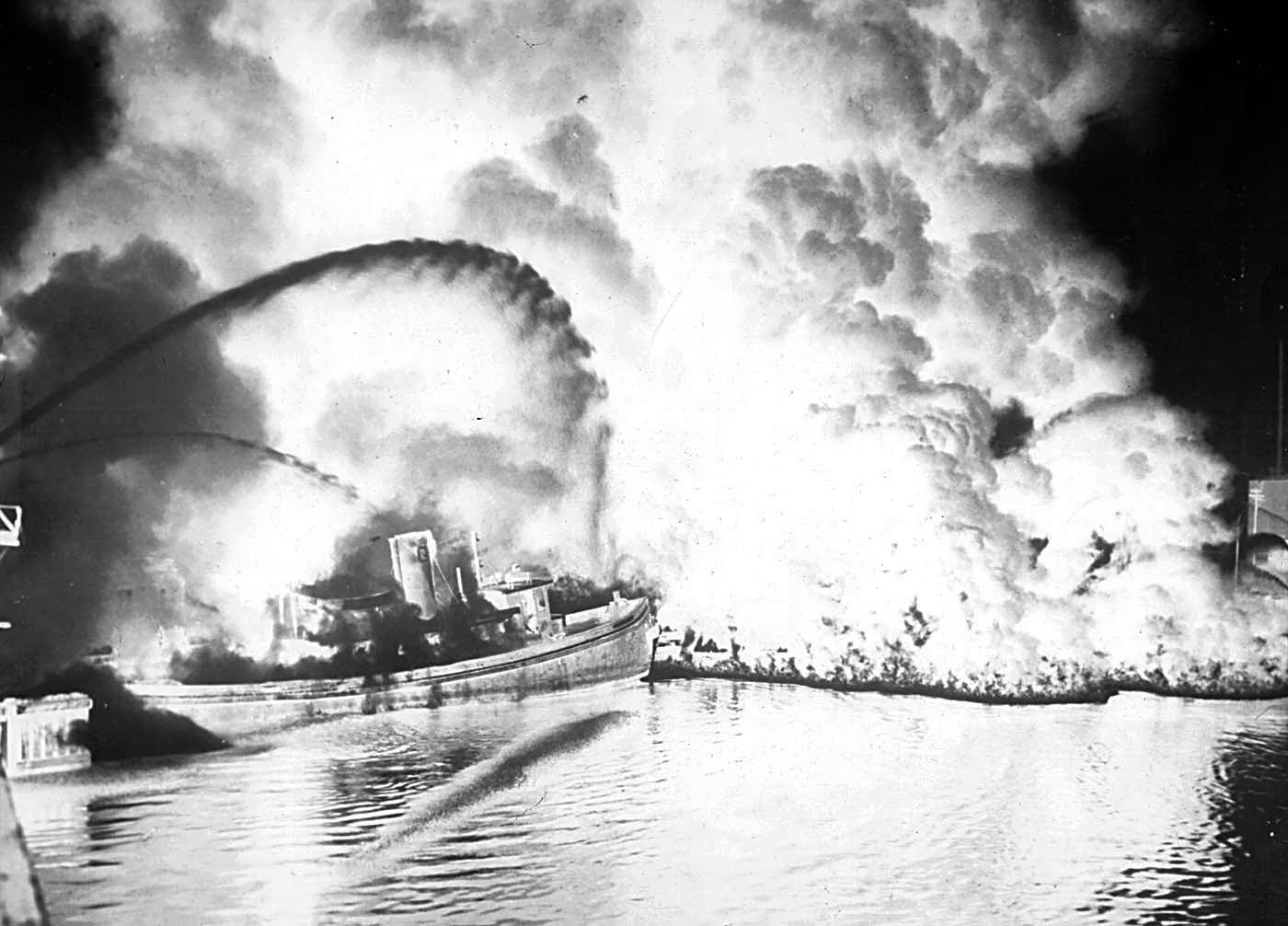
Out of all the cases I came across, no river burned more often than the Cuyahoga in Cleveland, a town that grew up from where the Cuyahoga meets Lake Erie, and after the Civil War the lower river became a corridor of steel mills, refineries and chemical works. It first caught fire in 1868. By Ohio EPA’s count, it burned somewhere between 11 and 16 times from the late 1800s on. A 1912 fire killed five dockworkers. A 1952 fire, the worst of them, did more than a million dollars in damage and was captured in a photograph of fireboats spraying into a wall of black smoke (top of post).
It all changed starting the morning of Sunday, June 22, 1969, when the Cuyahoga burned again. A spark, most likely from a train crossing a bridge, fell onto oil-soaked debris trapped against the railroad trestles near the Republic Steel works. By the river’s standards, it was nothing special. The fire was out in under half an hour and did about $50,000 in damage to two railroad bridges. No photograph of it is known to exist. The Cleveland Plain Dealer gave it fewer than two hundred words.
The difference came the next day. Cleveland’s mayor, Carl Stokes, the first Black mayor of a major American city, took reporters on a tour of the river to show them what his city was living beside. Then, on August 1, Time magazine ran the story in a brand-new section it called “The Environment.” It described the Cuyahoga as a river that “oozes rather than flows,” in which a person “does not drown but decays.” Time had no picture of the 1969 fire, so it used the 1952 photograph. Most Americans who think they remember the Cuyahoga burning are remembering a fire seventeen years older than the one that made it famous.
What I find fascinating is that the most consequential river fire in history was one of its smallest, and further, the water had been bad for decades by then. What changed was that finally, people stopped accepting it as normal and began doing something about it.
The Fire That Changed the Law
The mood had turned. 4 months later, in October, Michigan’s Rouge River caught fire when a welding torch ignited oil that had spilled into it. On April 22, 1970, the first Earth Day brought an estimated 20 million Americans out to demand cleaner air and water. That December, the Environmental Protection Agency opened its doors, created by President Nixon through an executive reorganization. And on October 18, 1972, Congress overrode Nixon’s veto to pass the Federal Water Pollution Control Act Amendments, the law we now call the Clean Water Act.
The Act’s goals were to make the nation’s waters safe for fishing and swimming by July 1, 1983, and the discharge of pollutants into navigable waters was to be eliminated altogether by 1985. Neither goal has been met to this day.
But the law did change things. Factories could no longer dump whatever they liked; every pipe now needed a permit with limits on what it released. Cities built and upgraded sewage treatment plants. The Cuyahoga has not burned since 1969, and in March 2019, U.S. EPA agreed with Ohio that restrictions on eating fish caught in the lower river, from the Gorge Dam to Lake Erie, could be eased to match the state’s general guidance. Fish came back, and so did the people who fish for them.
A permit is only as good as its enforcement, though, and enforcement has always been thin. In 2018, nearly 11,000 facilities significantly exceeded their permit limits, and the Government Accountability Office found that EPA can’t vouch for the accuracy of the very data that would reveal violations. This year, the Environmental Integrity Project counted 3,001 facilities that had been in “significant noncompliance” for at least three years, and found that only 2 percent of facilities with water pollution violations faced any enforcement at all. Many still operate on permits that expired years ago, under standards written in the early 1990s.
Something similar happened across the nation. When economists Joseph Shapiro and David Keiser assembled some 50 million water quality measurements from 240,000 monitoring sites, they found that most of the 25 pollution measures they tracked improved after 1972, with more dissolved oxygen and less fecal bacteria. The share of waters safe for fishing rose by 12 percentage points between 1972 and 2001. Twelve points, after thirty years and, by Keiser’s estimate, more than a trillion dollars. And “safe for fishing” set a low bar: enough oxygen, not too much sewage, mud or organic waste. It never measured mercury, PCBs or the thousands of chemicals that never made it onto a list. Still, it’s a real achievement, and I want to give it its due. When we decide to stop fouling a river, the river can recover. Just don’t get too excited, because that is the most hopeful thing in this post.
Still Burning
I wish we could file the burning rivers away as an embarrassment of last century. But we can’t.
In March 2014, an oil-slicked stretch of the Meiyu River in Wenzhou, China, caught fire, with flames reported at about five meters high. Weeks later, on April 30, a CSX train carrying crude oil derailed in downtown Lynchburg, Virginia; three tank cars went into the James River, one ruptured, and the oil on the water burned.
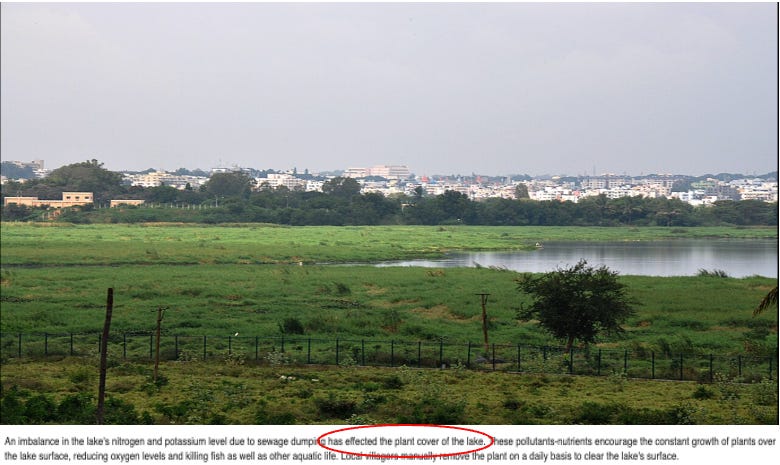
Bellandur Lake is the largest lake in Bengaluru, India’s technology capital, a city that once called itself the City of Lakes. As the city grew past ten million people, its sewage outran its treatment plants, and Bellandur became the place a large share of it went. National Geographic reported in 2018 that about 40 percent of the city’s untreated sewage flowed into the lake every day, along with industrial effluent and dumped construction debris. The lake began producing great banks of toxic white froth that blew across the roads, and in May 2015 it caught fire. It burned again in 2016, in February 2017, and on January 19, 2018, when flames spread across the weed-choked, sewage-laden lakebed and more than 5,000 Army personnel and firefighters were called in. National Geographic reported that it burned for more than 30 hours. Within weeks, the lake was burning again. The Guardian’s headline in 2017 gave the city a crueler name: “City of burning lakes.”
The lake’s decline began on the land around it. Researchers at the Indian Institute of Science found that the built-up share of Bellandur’s catchment rose from about 5 percent in 1973 to more than 92 percent by 2016 (reported in the Indian Express). Fields, wetlands and the old chain of connected tanks that once slowed and cleaned the water on its way downhill were paved over, and what came down the drains instead was the sewage of a boomtown.
No one agrees on what ignites Bellandur: methane bubbling up from oxygen-starved sludge, hydrocarbons in the foam, or dry weeds set alight on the shore. But every explanation leads back to the same source: raw sewage and industrial waste poured into the water faster than any natural process could clear it. India’s National Green Tribunal ordered the lake restored. In January 2026, six years after those orders, the New Indian Express reported that Bellandur was still not fully rejuvenated, with experts warning that sewage was still entering through the city’s stormwater drains.
Bellandur is the Cuyahoga half a century later and half a world away. And there are plenty of rivers like it. When the UN Environment Programme surveyed river water quality across Latin America, Africa and Asia, it found that severe organic pollution, the kind that strips the oxygen out of a river, affected about one of every seven kilometers of river. Pathogen and organic pollution had risen in more than half of all river stretches on those three continents between 1990 and 2010.
What the Laws Were Built to Stop
Here is what I think the burning rivers teach, and why I have spent so long on them in a series about farming.
The laws that came out of those fires were built to stop what people could see, smell and photograph: oil slicks, foam, dead fish, flames. They work by naming a substance and setting a limit on how much of it may come out of a pipe. That approach rescued the Cuyahoga, and it has saved a great many lives. But it was built around a particular picture of pollution, one pipe, one factory, one river, and it has little to say about the water that doesn’t come out of a pipe.
The Clean Water Act regulates “point sources,” and in its own definition it carves out two exceptions: “agricultural stormwater discharges and return flows from irrigated agriculture” are not point sources (33 U.S.C. § 1362(14)). The water running off the world’s most productive farmland, carrying fertilizer, manure and pesticide residues, falls largely outside the permit system. The EPA itself describes this “nonpoint source” pollution as the leading remaining cause of water quality problems in the country.
The EPA’s own survey shows the cost. In its 2018–19 National Rivers and Streams Assessment, 47 percent of America’s river and stream miles were in poor biological condition, judged by the insects, snails and worms that live on the riverbed. Only 28 percent were healthy. The most widespread stressors were nutrients: 42 percent of river miles were in poor condition for phosphorus and 44 percent for nitrogen. Fifty years after the last fire, nearly half of our flowing water fails the most basic test of whether it can support life on its own bottom.
Sometimes the quiet failures get loud again. The Cuyahoga empties into Lake Erie, and in August 2014, an algal bloom in the lake’s western basin, fed largely by phosphorus washing off the farmland drained by the Maumee River, put a toxin called microcystin into the treated water of Toledo, Ohio. About 400,000 people were told not to drink their tap water for nearly three days, and not to boil it either, since boiling concentrates the toxin. No river caught fire. The water simply carried what the land had given it.
It happens again every summer at the mouth of the Mississippi, which drains most of America’s corn and soybean country. The nitrogen and phosphorus the river carries feed a bloom in the Gulf, and as the bloom dies and decays it strips the oxygen from the bottom water. In 2025, NOAA-supported scientists measured that “dead zone” at 4,402 square miles, a year they called below average. Below average, for a stretch of ocean bigger than Delaware and Rhode Island put together, where the bottom water holds too little oxygen for fish and shrimp to live. That is how normalized the quiet failure has become.
Quiet Failures
No pollution law even attempts to close what I think is the deepest gap. Every water law I know is written in the language of subtraction: what must be removed, and how much may remain. None asks what water should still carry. None sets a standard for its mineral balance, its ionic character, or its oxidation-reduction state, the properties that once let a river feed a floodplain, sustain a fishery, and deliver to a field something more than wetness. A river can meet every standard on the books and still have lost the qualities that made it alive.
That is what I mean by a quiet failure. In the ICU, we used to talk about patients who were “normal on paper.” Every lab value sat inside its reference range, every monitor was quiet, and yet anyone who had looked after them for a week could tell you they were slipping. The reference ranges described populations, and they told you nothing about which way the patient in front of you was heading. Like that patient, a river can be legally compliant and biologically diminished at the same time, and nothing in our monitoring is built to sound an alarm for it. Boil-water advisories exist for the loud failures. Nobody has ever issued an advisory for the quiet ones.
And this is where the burning rivers meet the farm. Much of the world’s irrigation water comes from rivers and the shallow groundwater connected to them. The UN survey found that salinity pollution had risen in nearly a third of the river stretches it studied across three continents between 1990 and 2010. Agriculture is one of the main sources of the river’s quiet decline, and also the patient that drinks the result. The nitrogen and phosphorus that leave one field arrive in the river that irrigates the next. What I have called the Geohydrological Shift, the slow change in the chemistry of the water beneath and around our farms, did not need a fire to happen. It happened in the decades after the fires stopped, in water that looked better than it had in a century.
So I am convinced the yield curves I described in earlier posts began bending while the rivers were getting cleaner by every measure we had. We fixed the water we could see burning. We never measured what we had taken out of it.
Putting Back What Was Lost
I don’t raise any of this to despair. The Cuyahoga is proof that a river written off as a sewer can come back when people decide to stop fouling it. Harder still is to do more than subtract, and give water back some of what it lost.
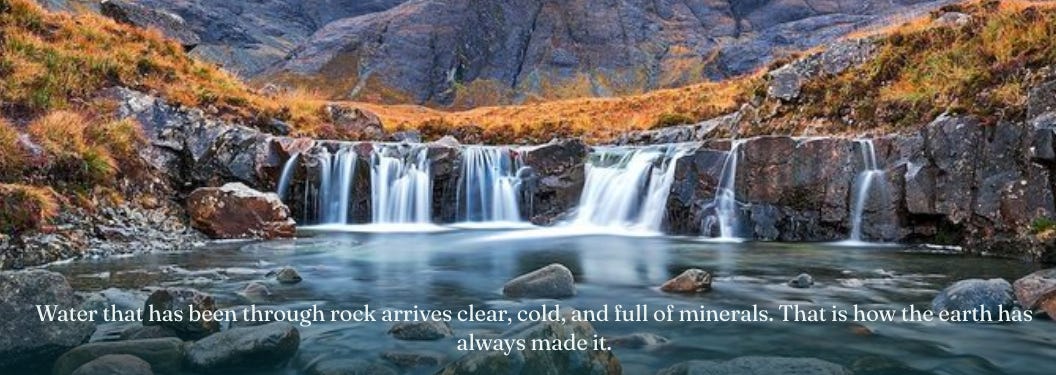
Nature’s own answer to polluted water has always been rock: water moving slowly through stone, where minerals bind, oxidize, and settle what it carries.
What drew me to Asao Shimanishi’s Themarox, an aqueous mineral concentrate extracted from weathered volcanic rock that Aurmina is made from, is that it appears to do that work on a human timescale, which is why I call it a “geological shortcut.” And before Shimanishi’s minerals were ever applied to a field, formulations made from them, sold in Japan under the name Sapro, were being tested on the foulest water there is (the difference between Sapro and Themarox is that Shimanishi added extra flocculating minerals to Sapro).
In Earth’s Living Water, I lay out the wastewater records in detail, and I will give them a full post later in this series.
Pig-farm slurry entered at a biochemical oxygen demand of 11,000 milligrams per liter, forty to fifty times the strength of household sewage, and left at 190.
A slaughterhouse stream thick with blood and fat went in at 900 and came out at 10 (huts in the Northern Alps, too cold for the bacteria that conventional treatment relies on, had been discharging their waste into the mountains largely untreated).
A pilot plant using Sapro brought it within discharge standards, removing about 99 percent of its oxygen demand, solids, nitrogen, and phosphorus.
In December 1985, engineers at the Orange County Sanitation Districts in California ran Sapro through raw sewage alongside their usual chemicals and recorded an 84 percent cut in oxygen demand.
I want to be objective about what these are. Most are vendor demonstrations and small pilots; none has been independently replicated, and every result came from a full treatment train that included ordinary coagulants and lime, not from a few drops in a tank. But they are specific and dated; licensed laboratories analyzed most of them, and in four cases someone paid to build the plant.
I also need to be clear about what this is not. Aurmina and Primora Bio, the products I created from Themarox, are small-batch, artisanal products made for a pitcher on a kitchen counter, a garden, a pond. They are not the answer to Bellandur, or to the Maumee, or to the irrigation canals of the world’s breadbaskets. Treating water at that scale would first require field trials to modern standards that no one has yet run, followed by large-scale industrial manufacturing, which I argue in my books could easily be accomplished. That is the work I want to see done, and I am actively trying to make that happen.
Next time, I’ll turn from the water that burned to the water you can see from orbit: the lakes, the rivers that no longer reach the sea, the snowpack the West depends on. It is draining too, and almost nobody adds it up.
This series takes a lot of late nights and deep rabbit holes. Your support through a paid subscription is deeply appreciated.
From the Shameless Commercialism Department:

Aurmina cleans water the way the Earth always has. Add it to a pitcher. The minerals bind contaminants, which clump and settle, and you pour off clear water. Unlike reverse osmosis, it doesn’t strip out the minerals; it keeps them in. More than 45% of our customers come back within six months, which tells me how much people love the water it produces. Visit our new website at Aurmina.com

Primora Bio relies on the same mineral chemistry in the water that supports what we grow and love: plants, gardens, fish, and pets. For a sense of the vitality of Primora Bio-conditioned water, check out the famous potato experiment comparing it with water straight from the tap:


The Stone and Water Series

The “War on” Series

Leading Edge Clinic

Claude’s Answer to the Survey Question:
My farm-runoff theory has some support. Farm chemicals don’t wash off fields evenly through the year. Runoff peaks when heavy rain follows application, which is spring and early summer in upstate New York and the June to September rainy season in Florida. By November, both places are past their peaks.
But Sarasota and Ithaca have little in common except the season and the product, and other explanations fit just as well:
The source changes. Much of Sarasota County’s water comes from the Peace River, which is pumped during the summer rainy season and stored in a reservoir. In fall and winter, the utility draws down that stored water, which has had months to settle.
There’s less organic matter. Summer rain washes tannins and plant matter into Florida rivers, and warm water grows algae in rivers and lakes alike, including Cayuga Lake. Both drop off in autumn. Utilities also add more disinfectant in summer, which produces more disinfection byproducts.
Treatment plants adjust with the season. Doses of coagulant and carbon change through the year.
Cold water slows floc formation. In the same 24 to 48 hours, colder water can simply show less floc.
Something on our end may have changed. Scott and I used the same batch, at the same time of year, with the same habits.
One honest caveat about my own observation: most of the floc you see forms when the minerals bind with the water’s natural hardness, alkalinity and organic matter. Pesticides are present at parts per billion, far too little to see. So less floc tells us the water’s overall chemistry has changed. It can’t tell us, on its own, whether the farm chemicals have gone down.
That’s why your answers matter. If readers in very different places report the same autumn change, the explanation is probably seasonal. If it’s mostly Scott and me, I’ll be looking at the batch.
That is an extremely helpful explanation Pierre. So we're actually looking at Step 1 - to recover/repair the world's water and soil. Fascinating process actually. If you can spark this awakening/revolution, you will in fact be more powerful/influential than Musk:)