


*Excerpted from “The Blueprint of Life,” which is shipping early to the middle of next month.
Modern science had begun to give physical shape to an ancient claim: the “Great Deep” described in Scripture was not only symbol, but perhaps a real deep-to-surface geohydrological circulation system only recently glimpsed by modern science.
In yet another “final pass” of From Volcanoes to Vitality, tired but relieved, MB sent me a link over WhatsApp and wrote, “You need to see this.” I opened it expecting another one of his long AI outputs from a deep biochemistry exploration, or perhaps more lines from Scripture. Instead, it stopped me.
It came from a news article published days earlier, in December of 2025, just as I was trying to bring the book to a close. The Rock–Water Circuit Theory had not yet taken shape. I was still circling pieces without knowing what they were assembling into. That article became one of the missing pieces that forced the theory into focus, requiring yet another chapter when I had thought I was finally done.
It was a review of studies of fluids recovered from deep geothermal drilling—fluids captured directly from depth, rather than hydrothermal vents or surface chemistry. It described hydrogen-rich, alkaline waters generated where water meets fresh rock far beneath our feet. A natural proton-gradient engine was running inside the Earth itself.
The Deepest Source Yet Reached
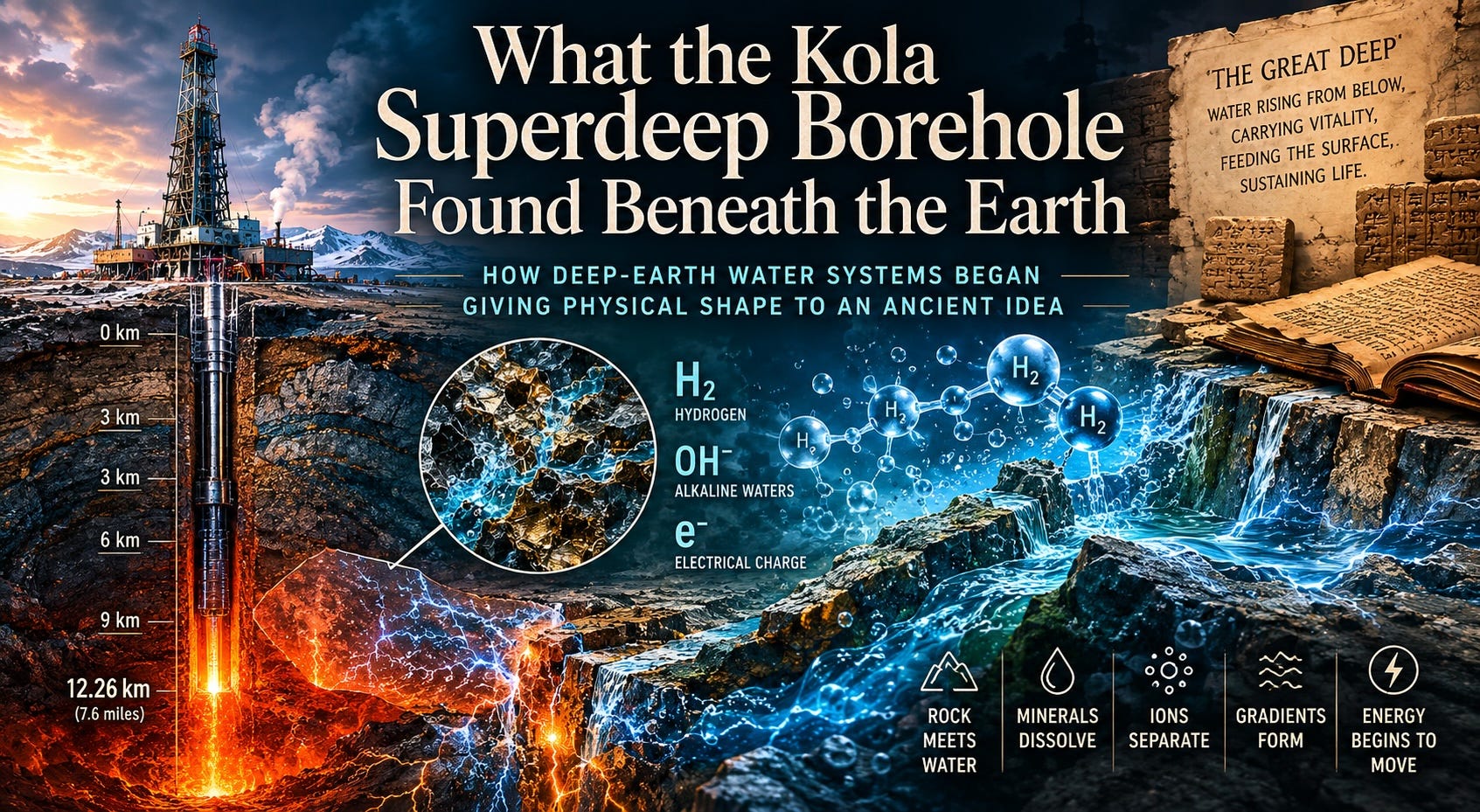
The direct sampling of those fluids was recent. The effort to reach the deep Earth was not. Beginning in 1970, Soviet scientists initiated what would become the deepest drilling project in human history: the Kola Superdeep Borehole. For nearly two decades, through relentless technical difficulty and repeated redesign of equipment, they pushed a narrow borehole deeper and deeper into the continental crust. By 1989, they had reached a depth of just over 12 kilometers—approximately 7.6 miles beneath the surface.
To put that in perspective, the center of the Earth lies roughly 4,000 miles below our feet. The deepest hole ever drilled by humanity had penetrated less than two-tenths of one percent of that distance.
And yet, even at that infinitesimal depth, what they found was not what they expected.
Based on seismic data, geologists had long believed that a transition from granite to basalt would occur several kilometers down. It never appeared. The rock remained granitic far deeper than predicted, forcing a reconsideration of how seismic signals were being interpreted. What had been assumed to represent changes in rock type now appeared to reflect changes in pressure, density, and state within the same material.
Even more surprising was the presence of water.
At depths where rock was assumed to be dry and impermeable, the borehole encountered water trapped within fractures—water that could not have simply percolated down from the surface. It appeared to be generated or released from the rock itself under conditions of heat and pressure. Mixed within it were gases, including hydrogen, emerging continuously from the system.
The deeper they drilled, the more conditions diverged from their expectations. Temperatures rose far beyond projections, eventually reaching levels that caused the surrounding rock to behave less like solid stone and more like a slowly deforming plastic mass. Drill bits warped. Equipment failed. Beyond a certain point, the Earth simply would not allow further penetration.
The project did not end because they reached their goal. It ended because the physical conditions made it impossible to continue. But what matters here is not that they stopped. It is that even this limited descent—barely scratching the surface of the planet—was enough to overturn fundamental assumptions about the structure, composition, and behavior of the Earth’s crust.
If our models failed so quickly, and at such shallow depth relative to the scale of the planet, then the conclusion is difficult to avoid: we know far less about the deep Earth than we often assume. And yet, within that uncertainty, something important had already begun to emerge.
Water was present. It was mobile. It interacted with rock. It carried dissolved material. It generated gases. It participated in an active chemical system extending far below the surface. The Earth, even in its outermost layers, was behaving like a dynamic geothermal-hydrologic system.
I sat with that a long time. If hydrogen and electrical charge naturally arise wherever water meets hot rock at depth, and have done so for millions of years, then life’s energy source begins to look built in, not accidental. Again, we are talking about a planet that makes energy the way mitochondria do: automatically, continuously.
Minerals moved to the center of the story. Rock met water. Water pulled chemistry from stone. Ions separated. Gradients formed. Energy began to move. The source had a place, and the mechanism had direction.
*If you value the late nights and deep dives into all the “rabbit holes” I write about, your support is greatly appreciated.
Long before the Soviet Kola Superdeep Borehole reached twelve kilometers beneath the surface in 1989, and long before scientists sampled hydrogen-rich, alkaline fluids directly from deep geothermal systems, ancient texts were already describing something they called “the Great Deep” as a source system: water rising from below, carrying vitality, feeding the surface, and sustaining life. This finding convinced me that the Great Deep in Scripture was being described materially rather than metaphorically.
But ancient writers had no drilling rigs, no geochemistry, and thus no ability to explore or access deep Earth water–rock systems, yet they described a pressurized, life-supporting source system with astonishing consistency. Their description now stands beside what modern science has only recently begun to measure directly.
Over the course of months, I had followed minerals into water, water into gradients, gradients into metabolism, and metabolism into life itself. Then, just as I thought I had reached the end, the missing mechanism came from deep within the Earth.
Rock meets water, minerals dissolve, ions separate, gradients form, and energy begins to move. Under the right conditions, matter organizes into something living. Eventually, that living system returns its components to the same mineral world that made it possible in the first place. Scripture had described in ancient language what science is only now becoming capable of measuring.
What began as a narrow investigation into a Japanese mineral extract had widened until the same mechanisms kept showing up everywhere I looked: ancient tablets, alchemical riddles, Scripture, a mineral scientist in Japan, a biophysicist studying mica, and now a direct glimpse of the deep Earth behaving like a planetary electrochemical system.
I had not begun with an architecture and then gone looking for evidence. I had followed the evidence until an architecture emerged. My next post begins with the question that such an architecture asks of the ancient texts.
MEMORIAL DAY SALE
To those of you who have stayed with me through this long journey across science, alchemy, Scripture, water, geology, agriculture, and spirituality, I want to say thank you by announcing our Memorial Day weekend sale on the two products that emerged from this work: Aurmina and Primora Bio. Discount code for 25% off both: Memorialday26.

Aurmina, a name we arrived at before this work fully unfolded, means “golden mineral essence.” It is a diluted form of Shimanishi’s extract and part of my effort to carry this work into a practical form through drinking water.
Primora Bio emerged from that same effort, with the intent of delivering the water to soil, crops, plants, and animals.
So for those who want the work to leave the page and enter their world, these are our first attempts to carry it forward.
From Research to Practice - Links Below Image
I began to realize matters were not as "advertised" when I learned that oil is a renewable source which the earth creates, that Rockefeller skewed our entire paradigm by promoting the idea of it being "fossil fuel." Greedy little man. So it's no surprise that the Depths also create water - but we kinda knew that, too: deep ocean vents show water emerging. Which reminds me of the idea that at some point, earth did not have rain (which sounds ridiculous), but water "rose to the surface." Also an idea from scripture. Trust the Russians to attempt what no one else will!
More evidence of God who created all things !!!
Genesis 1 - 1
In the beginning God created the heavens and the earth.