



My exploration of the ancient texts has changed how I think about Asao Shimanishi.
At first, I went into the texts looking for insights into rock, fire, water, dissolution, and extraction, suspecting that a material operation was hidden within symbolic language. But as I moved deeper into The Six Keys of Eudoxus, I uncovered another set of descriptions that did not relate to process, but instead to the person. The text outlined the steps to follow, but it also described the character of someone capable of completing them.
That is what this post is about. I will not be attempting to decode another text from antiquity, and will instead be taking a closer look at the places where the ancient portrait of the “Wise Artist” seems to describe Shimanishi with unusual precision: his privacy, persistence, reverence, failures, and willingness to submit himself to a long, hidden discipline.
One of the most striking passages in all of The Six Keys occurs in the Second Key:
“He who knows how to sublime the Stone philosophically, justly deserves the name of a philosopher, since he knows the Fire of the Wise, which is the only instrument which can work this sublimation. No philosopher has ever openly revealed this Secret Fire, and this powerful agent, which works all the wonders of the Art: he who shall not understand it, and not know how to distinguish it by the characters whereby it is described, ought to make a stand here, and pray to God to make it clear to him; for the knowledge of this great Secret is rather a gift of Heaven than a Light acquired by the natural force of reasoning; let him, nevertheless, read the writings of the philosophers; let him meditate; and, above all, let him pray: there is no difficulty which may not in the end be made clear by Work, Meditation, and Prayer.”
I have read this passage many times, and it moves me more deeply each time because it points to a part of the journey that work or study cannot overcome. Yes, one must read, work, meditate, observe, and remain devoted to the work. But Eudoxus says openly that knowledge of the Secret Fire can only come as “a gift of Heaven.”
The Sixth Key then shows what that truth looks like inside the work itself:
“The Sixth Key teaches the Multiplication of the Stone, by the reiteration of the same operation, which consists but in opening and shutting, dissolving and coagulating, imbibing and drying; whereby the virtues of the Stone are infinitely augmentable.”
“I should much bewail, if, like me, after having known the true matter, you should spend fifteen years entirely in the work, in study and in meditation, without being able to extract out of the Stone the precious juice which it encloses in its bosom, for want of knowing the secret fire of the wise . . .”
“But I give you notice, moreover, that even after you shall be arrived at the knowledge of the Secret Fire of the Wise, yet still you shall not attain your point at your first career.”
“. . . which makes to run out of this plant (dry and withered in appearance) a water which wets not the hands, and which by a magical union . . . is dissolved into a viscous water—into a mercurial liquor, which is the beginning, the foundation, and the Key of our Art.”
The work succeeds only through repetition, patience, failure, return, and a willingness to remain with the same rock long after partial successes have failed.
Reading that, I began to think of the text as a description of a journey that selects for only a certain type of man. Those who lack patience abandon the work. Those who stay are changed by it.
The writings can point, warn, and test, but they do not carry the practitioner to the end. He has to handle the materials, get them wrong, return to them, and remain humble enough for insight to be received.
The Wise Artist
What affected me most is the extent to which the text’s portrait of the “Wise Artist” appears to describe Shimanishi. Everything I have learned about him seems to fit: intensely private, never seeking recognition, prayerful, and almost unimaginably persistent.
Eudoxus knows what it takes and expresses pity, “I should much bewail,” for a man who, after discovering the correct starting rock, “having known the true matter,” then “spent fifteen years entirely in the work, in study and in meditation,” “without being able to extract out of the Stone the precious juice,” for lack of knowledge of the “Secret Fire.”
Shimanishi lived almost that exact pattern. He worked with rock, heat, water, and acids through repetition, failure, refinement, and return for nearly fifteen years. He had one stone, one challenge, and, like Eudoxus, the discipline to remain with it until it was overcome.
Other aspects of Shimanishi’s journey deepen the resemblance. I have repeatedly been told that Shimanishi spoke of his discovery with reverence, not ownership, describing it as “a gift from our Creator.” At the only international conference he attended that I know of, during a lecture, he is said to have remarked, “Working with this material is like working with the Angels,” which is not the language of a typical scientist.
If the Great Work is, as Eudoxus says, “a gift of Heaven,” then The Six Keys is describing not only a sequence of operations, but also the sort of person who can carry such a sequence through to completion: one marked by discipline, reverence, and a willingness to labor for years without recognition.
By that measure, Shimanishi character astonishingly fits. Even more striking is that he never publicly revealed his “Secret Fire,” as the operational details remain known only to the men of the Shimanishi-Kaken company he left behind. That fact, too, places him within the circle that the 17th-century Eudoxus describes: “No philosopher has ever openly revealed this Secret Fire. “And that is only the first convergence.
Another is the path he describes. Given that The Six Keys was never translated into Japanese, Shimanishi could never have used it as a guide, let alone understood it if he tried. He instead began with nothing more than a basic understanding that acids could dissolve certain minerals from rock and a hope that those minerals could be rendered active in water. From there, he worked alone, without a theory and without any assurance that the work would succeed. If these texts describe real processes, and I believe they do, then Shimanishi appears to have arrived at them independently, through experiment, devotion, and sustained attention to a single rock.
The Six Keys of Eudoxus describes the procedure. Shimanishi independently devised one that matched it.
Sternbuchta’s Letter on the True Stone of Wisdom describes the properties of a substance. Shimanishi produced a substance with those properties.
Both Eudoxus and Sternbuchta describe the character of a practitioner who might succeed, one shaped by long obscurity, long labor, and long attention to a problem that refuses an easy solution. Shimanishi’s life fits that description with extraordinary precision.
Any one of these points could be questioned in isolation, but taken together, they add up to something much harder to dismiss.
What makes this even more striking is that the other insights and convergences we identified moved in two directions. Our scientific research helped us progress through the ancient texts, while the texts themselves suggested connections that shaped our understanding of modern science. Even now, I am not sure I could fully separate which parts of the final Rock–Water Circuit Theory came from the modern scientific literature and which from the texts of antiquity.
At this point, I do not think these convergences can be argued as forced connections, a retrospective construction, or a self-reinforcing interpretive framework. The consistency with which the texts describe the science, the process, the product, and the person points to something way more powerful. It suggests that these texts documented real knowledge of a material operation, what it produces, and the type of person required to bring it to completion, even if it was preserved in symbolic and guarded form.
That, to me, is the true significance of what has happened on this journey. I do not know how often, or if ever, history has presented a reciprocal illumination between ancient writing and modern practice. I only know that these documents appear to be real records of a scientific and material understanding that long predated the language we would now use to describe it.
What these chapters suggest is that “the labyrinth” described in alchemy has, in fact, been successfully navigated before, both in the older world and in modern times. But there is something even more powerful than these convergences: at one point, one of the ancient texts altered the course of MB’s life.
When the Text Entered the Work
Long before I entered this work, MB had once attempted to solve the same problem Shimanishi had already solved. He was introduced to Themarox in 2004, and soon after, he started a business selling it to farmers and at health and wellness events.
Soon after, he was forced to make a decision that put his business in peril. He cut off contact with his only source of Themarox because he could no longer tolerate the man’s dishonesty and unreliability. As a result, MB found himself with little choice but to attempt the extraction himself.
Working with vermiculite sourced from Canada, he applied the same general principles and succeeded, at least in part, in producing an aqueous mineral extract viable enough to sustain his business.
However, there were discrepancies he could not ignore. The color was different. The behavior was different. Most importantly, it did not clarify water as the original. He initially understood these differences as due to variation in mineral composition, especially iron, and continued because what he had made was real, useful, and, often enough, validated by others.
Then, almost two years later, an acquaintance showed him The Six Keys of Eudoxus.
He told me that as he started to read it, the First and Second Keys immediately struck him as describing a real process, one he recognized as corresponding to both Shimanishi’s work and his own efforts. But there was one line that cut through everything else with unusual power: “one must make use of the citrine Mercury,” together with the warning “not to be deceived on this point.”
That word—citrine—stopped him. The color of what he had made was clear. And he knew the color of Shimanishi’s extract: golden-yellow. He understood the passage to mean that, among the possible liquors or “Mercuries,” one had to begin with the correct one, and that it had to be golden-yellow.
Another line struck him just as strongly: “even after you shall be arrived at the knowledge of the Secret Fire of the Wise, yet still you shall not attain your point at your first career . . .” He read those phrases as warnings—not simply about error, but about direction.
In that moment, although he knew his extract was useful, he began to doubt its truth.
He concluded that what he had produced, however real and however effective, was a partial approximation of the substance described in the texts, and that it was not the one he should commit his efforts to. Out of conviction, he stopped selling it.
What makes MB’s story especially striking is that his trajectory runs in the opposite direction from the one in The Six Keys. The Keys are written for someone trying to discover the “Secret Fire.” MB, by contrast, had first come into contact with the true substance through Shimanishi’s work, knew what the Secret Fire was, and then he attempted to reproduce it himself. In that sense, the text did not lead him toward the Golden Elixir. It led him back to it.
The author, in that Sixth and last key, as he reminisces on his life, describes the same situation;
“But I give you notice, moreover, that even after you shall be arrived at the knowledge of the Secret Fire of the Wise, yet still you shall not attain your point at your first career.”
Even after the practitioner comes to know something of the Secret Fire, he will fail in his “first career.” MB had decided to stop working with the material rather than attempt to refine his method further. That is when he reached out to Shimanishi Kaken in Japan. From the outside, that decision could have looked like a retreat. In reality, it was realignment: a willingness to accept that he had come close to the process described in the texts, but had not yet arrived at the true substance.
That decision brought MB back to the original source. He reached out to Shimanishi-Kaken, began importing Themarox directly from Japan, and for a brief period the work seemed ready to enter the world more widely. Then came the next echo.
The Fifteen-Year Echo
What first appeared in Shimanishi’s life began to echo again in MB’s life.
Soon after he began importing Themarox directly from Shimanishi Kaken, MB enjoyed immense early success. Then, suddenly, in 2010, his business was nearly destroyed by the launch of a coordinated disinformation campaign. What followed, in his own words, were fifteen years of obscurity, the same obscurity that befell both Eudoxus and Shimanishi: years of persistence, study, and quiet labor.
He was able to make a living, and the business grew modestly over that period, almost entirely within Amish farming communities across the Midwest, where farmers came to value Rock-Water for what they saw it do in their fields: stronger crops, less pest pressure, and a resilience they considered essential to their agriculture. But he never regained the wider distribution and awareness that he had once achieved.
Similarly, the figure described in the Six Keys was not a man at the center of things. By the nature of the work, he was set apart, working outside recognition, outside status, and often in prolonged isolation. This recurring pattern in the lives of Eudoxus, Shimanishi, and MB seems, within these texts, a requirement of the work itself.
The same is true of companionship. Sternbuchta states it plainly:
“. . . to maintain you and your companion (because one alone cannot do the Work) then the thing becomes idle.”
That line immediately made me recall a moment in the first months of our collaboration, when MB told me that a few years earlier, he had told a colleague he needed someone who could help him move the work forward, someone, interestingly enough, whose background and character were nearly identical to mine. Our first meeting together, a dinner, ran for hours. Since that first meeting, we have been connected daily, if not several times daily.
Later, as the work deepened in complexity, breadth, and difficulty, I came to feel the same thing from the other side. One day, after calling him to discuss a highly nuanced and esoteric connection to a scientific mechanism we had recently discovered, a sudden insight came upon me that I shared with him: there was no other person in the world I could have had that conversation with.
MB laughed, reminding me that for almost the entire twenty years before our collaboration, he, too, had had no one who could truly engage with the material at the level his work had brought him to. We came to this from different directions, with different training and different instincts. Yet as I write these words, I cannot help feeling that the paths leading to our eventual intersection had been set long before.
Our work did not move in one direction. He would pour out decades of accumulated observations, intuitions, and partial syntheses, sometimes in torrents, sometimes in fragments, and they would immediately trigger questions that sent me into both modern and ancient literature. What I found there would then force us to clarify, defend, expand, and ultimately connect the insights that he had long held, while at many other moments my research would uncover a missing link that fit directly into one of his older lines of thought.
As the book drew toward its close, I was struck to find that this kind of partnership is also stated in The Six Keys: “without the help of a faithful friend, one remains undoubtedly in this labyrinth.”
Both the Letter from Sternbuchta and The Six Keys suggest that, at some point, the work may require another person—someone capable of seeing, clarifying, or correcting what the solitary practitioner cannot.
MB then recalled an old line from Proverbs that he had long held: “Iron sharpeneth iron; so a man sharpeneth the countenance of his friend.” The word "iron" hit hard for me, literally, not metaphorically, because it described a foundational aspect of our work. We had already spent months tracing the centrality of iron in the Rock–Water Circuit, from Earth’s core to ISAW, and in the deep-to-surface gradient that feeds life through mineralized water, so to encounter that same word at the point where the texts speak of companionship and sharpening again struck me as more than incidental.
Then there is a coincidence that MB and I both found amusing: my name, Pierre, literally means rock, while his, Matthew, means gift of God. Forgive me for pressing the connection too hard, but I get a kick out of the fit between our names and two conditions that seem to recur throughout The Six Keys: a source rock and something received.
When I Entered the Pattern
I should say something here that I am not entirely comfortable saying, but I do think the path I have found myself on bears mentioning, because it now seems to me to repeat, in its own much smaller way, the same pattern I have been tracing in the lives of Eudoxus, Shimanishi, and MB.
By the time I reached this chapter, I had spent nearly nine months almost entirely inside this work. What began as an intrigue with Shimanishi’s extract widened into a much larger journey through mineral science, water, agriculture, geology, and hydrology, and only then narrowed into alchemy, where the work became more demanding still—an extended cycle of reading, failed interpretations, returns to the same passages, and a kind of fixation on a single problem that did not release its hold.
What is relevant here is that this stretch of work has been unlike any other period in my life. I do not think I can assert that strongly enough. I have already lived through a highly demanding academic and medical career—two decades in one of the most intense specialties in medicine, years of teaching, writing, publishing, and working at a pace that even my ICU colleagues and superiors remarked on. That was followed by five years of uninterrupted pressure during Covid, trying to save lives while fighting institutions that weren’t, and who paid me back by ending my “system career” and revoking my three specialty certifications.
Yet, these nine months required an unprecedented amount of labor and concentration. Outside of seeing patients and trying to preserve time with my wife, I was almost continuously at my desk, reading, researching, writing, and returning to the same material. It was narrower, more isolating, and, in many ways, far more consuming than anything I have done before.
Another aspect of this labor is that it wasn't driven by speed, cleverness, or by expertly reading, understanding, and organizing information, as my typical work has unfolded in the past. For this, I was forced to stay with the material for a long time, asking the same questions again and again, reconstructing collapsed theories and failed interpretations. The easier readings and early theories came together quickly. Only then did deeper meanings and more sound theories begin to emerge. From Volcanoes to Vitality is undergoing its 5th revision currently, driven by the iterative developments of its core conceptual framework.
What I am trying to say is that, at a certain point, I began to feel trapped in the same pattern of work that the work itself was describing.
I am not claiming equivalence with Shimanishi, nor with the author of The Six Keys. But the path described in these texts—prolonged effort, isolation, and repeated failure before finally emerging—began to look like a requirement for the work itself.
Note to readers:
What Shimanishi produced appears to match, in both process and behavior, the kind of revered substance described across numerous cultures and traditions as a “Golden Elixir”: rock opened, minerals rendered mobile, and water transformed through contact with that chemistry.
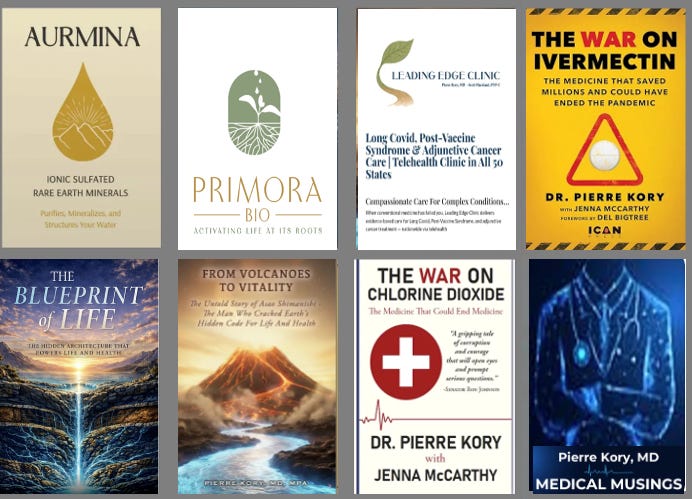
Aurmina, a name we arrived at before this work fully unfolded, means “golden mineral essence.” It is a diluted form of Shimanishi’s extract and part of my effort to carry this work into a practical form through drinking water.
Primora Bio emerged from that same effort, delivering the water to soil, crops, plants, and animals.
So for those who want the work to leave the page and enter their world, these are our first attempts to carry it forward.

*If you value the late nights and deep dives into all the “rabbit holes” I write about, your support is greatly appreciated.
From Research to Practice - Links Below Image
Thank you, what a tribute to him, as well as yourself. I think the day will come when you will have a much wider and a more appreciative audience.
I will admit, that I am just a very average wife, mother, retired homeschool mom and grandmother. But I have been following you since you came on the scene with c19. A lot of what you write is intellectually above my capabilities but I am getting the gist of it and am intrigued by what I do understand. I think men like you and your predecessors you speak of are indeed given the gift, by God, of being allowed to peek at His majesty and glory in all of creation. Thank you for writing all of this for us. And I have been spoiled now with Aurmina water. I find it very difficult to drink any other. Blessings!