


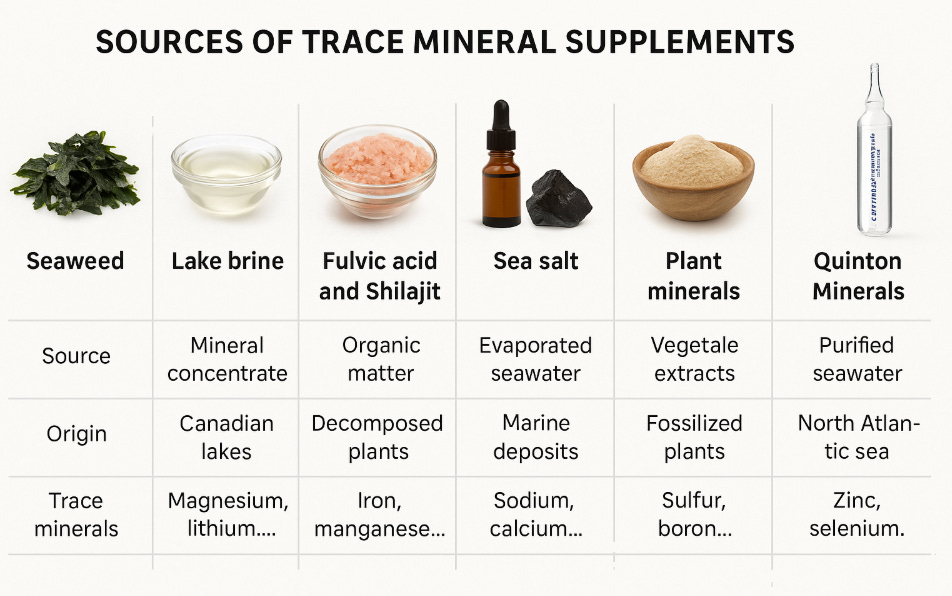
During these last few weeks of the serial publication of my book on trace minerals “From Volcanoes to Vitality: The Untold Story of Asao Shimanishi - The Man Who Cracked Earths Hidden Code To Life and Health,” I have tried to respond to innumerable reader questions about whether their supplement is as good as, better than, or, more often, which is the “the best one.” Others don't ask questions and instead pridefully boast that they have taken mineral supplement XYZ for 30 years and that it has kept them in the best of health (love those folks, actually).
So, by popular demand, today I’ll review the compositional differences, processing methods, and practical considerations among these mineral sources. You will learn more about the various sources of trace minerals than you ever wanted to, and some of it may make you uncomfortable.
Now, in complete transparency, everything I’ve learned about the mineral composition and geochemical processes involved in producing Shimanishi’s Themarox extract naturally inclines me toward it as an exciting (understatement) source of minerals.
That inclination is based on its geochemical characteristics, analytical data, and clinical experiences—not emotion or economics. It’s driven by the geochemistry and the data I’ve reviewed. So don’t be surprised if Themarox stands out when comparing mineral origins and properties.
Now, bear with me: because I started selling a water purification product derived from Themarox, for the first time in my life, I have to write with “disclaimers.” These will appear not infrequently, because I ran this post through AI for a “regulatory infractions” check, and it “killed me” on almost any opinion I expressed. Let’s start with the first one:
Nothing in this discussion is meant to claim or suggest any effect on human health, disease prevention, or treatment. These comparisons are strictly about composition, origin, and chemistry.
That said, this is just a comparison between mineral sources—not a statement about health effects; thus, it is a relative argument, not an absolute one. Any personal preferences I describe relate only to chemistry and geology, not to health outcomes or product recommendations. Any form of trace mineral intake, from any source, can contribute to overall mineral diversity, which most people lack. My goal here is to compare mineral origins, profiles, and chemical behaviors — not to recommend any single product for human use. Again, anyone paying attention to mineral intake — from any reputable source — is already way ahead in terms of thinking about an often-overlooked aspect of nutrition.
Ocean Water Minerals
Let’s begin with the ocean-water minerals — the intellectual descendants of my man, René Quinton (from Chapter 8B). However, before we go further, I want you to pronounce his name right (for a guy who fought in WWI for over three years straight, I think he earned it). So, give it a try:
René → ruh-NAY
Quin → kahn (nasal “an,” as if you’re mildly annoyed with someone)
ton → tawn (gentle, understated, like the French are pretending not to judge you)
Excellent. Now, on the count of three, let’s put it all together:
One… two… three… “ruh-NAY KAHN-tawn.”
Beautiful. Absolutely flawless. If Quinton were alive to hear that, he’d probably offer a polite smile, excuse himself, and quietly leave the room — the same maneuver my family in France pulled when I spoke French as a Long Island kid, during the many visits to France that I enjoyed as part of the American branch of the “Bouillaud” clan (a lineage which, I’ll have you know, dates back to the 1300s). My Mom was the first Bouillaud ever to emigrate to the U.S.
Fun fact: when I spent summers at camp in France, because I was “Le Americain,” the kids called me “Peter,” pronounced “Peet-AIR” — elegant, airy, practically floating (sort of). Back on Long Island, my name was “Peeyeah,” pronounced like someone yelling across a Costco parking lot. Truly a tale of two civilizations.
OK, let’s get back to seriousness. “Quinton minerals” are sourced from defined deep-ocean sites (often during plankton blooms) and microfiltered rather than chemically extracted. They contain up to 78–80 minerals and trace elements in their natural ionic form, closely mirroring the mineral balance and ratios found in human plasma.
The water primarily includes chloride, sodium, magnesium, potassium, calcium, sulfate, and trace levels of other elements, with the minerals present as natural marine salts with no phytonutrients as you get from plant mineral sources. Not all minerals occur in a sulfated form as there are various other anions (chloride, sulfate, bicarbonate, etc.) that naturally occur in seawater.
Seawater itself contains only trace amounts of metals like iron and aluminum, since these elements are largely insoluble under open-ocean conditions. In contrast, marine fulvic substances and ocean-floor mineral sediments are rich in these and other transition metals.
It is within these boundary layers — where organic matter, minerals, and redox-active metals interact — that natural purification and catalytic reactions occur, processes that seawater alone cannot sustain in solution. These are the same mineral interfaces that Asao Shimanishi reproduced through his Themarox process — the engineered recreation of the ocean floor’s catalytic environment in a concentrated, ionic form.
In the table below, red boxes indicate the parameter where I find Themarox superior, and blue is where Quinton is superior.
Themarox Compared to Quinton Minerals
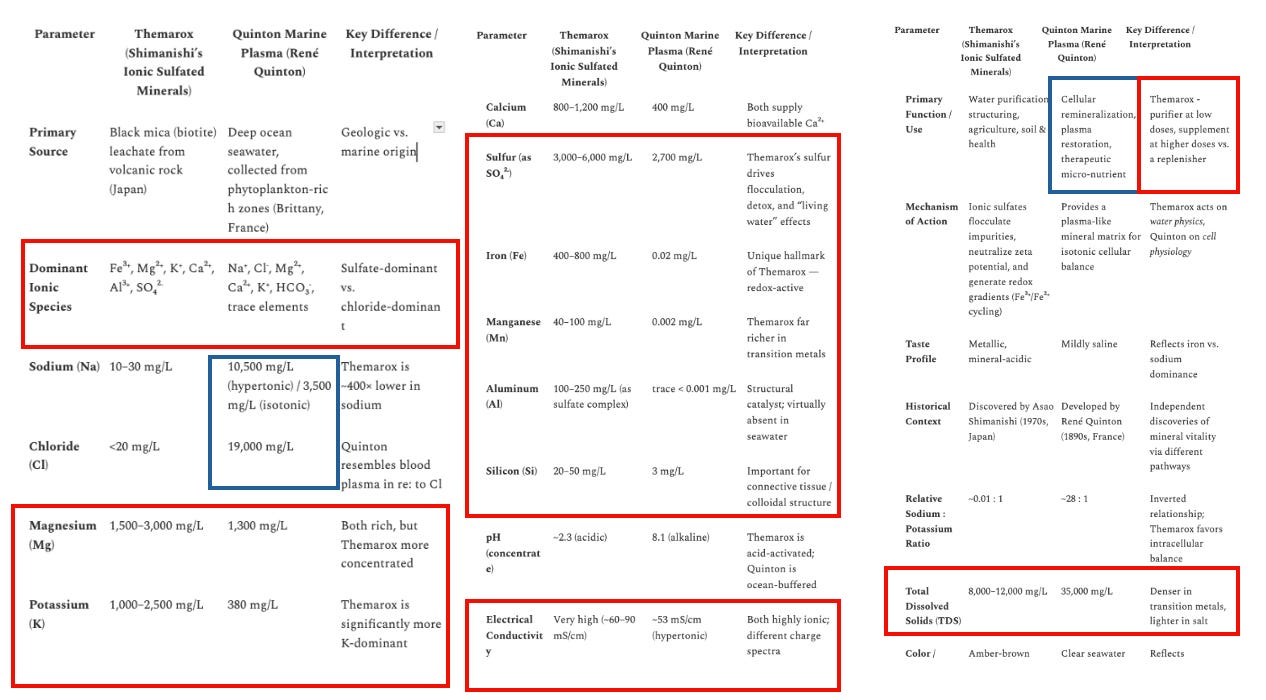
*Note the pH of Themarox, although accurate in its original concentrated state before being added to water, is not relevant to Aurmina when added to water, where it is only slightly acidic and keeps pH balanced.
Great Salt Lake Mineral Concentrates
The “Veggie Trace Minerals” that Elmer Heinrich praised in his book “The Untold Truth” are from brine concentrated from a geologic salt lake (not from plants as he described them). However, they are sometimes marketed as “plant-based” because their trace spectra resemble those of plants.
These supplements are produced by concentrating and purifying natural brine from the Great Salt Lake. The minerals are present primarily as inorganic ions and salts (e.g., magnesium, sodium, potassium, sulfate, chloride), not as plant-derived chelates. Because they’re already in ionic form, they dissolve readily and can be dosed in small amounts. Typical concerns, e.g., heavy metals/halides (As, Pb, Hg, Br⁻) and purity refer to compositional considerations evaluated in raw materials, not to any proven human health risks associated with specific products.
The main differences between lake-derived minerals and black mica-derived minerals are that in the former, iron is typically low, and although sulfate is present, it is not dominant. Thus, the lake-derived water has no flocculation/coagulation effects - it cannot be used as a water purifier. Lastly, rare-earth elements are usually present in trace amounts or not at all.
Themarox vs. Great Salt Lake Minerals
In the below, red boxes indicate the parameter where I find Themarox superior, blue is where the Lake brine minerals are superior.