


Full disclosure before we start: I wrote this series partly to support Aurmina’s Thanksgiving weekend sale, as Lisa, Scott, and I decided the best way to tell you about it was to do what I do anyway: write too much about water. But that motivation quickly turned into a fascination with the connections between Thanksgiving and water. So yes, these posts partly support marketing. They are also true; they come straight out of the book, and I hope they are worth reading whether or not you ever buy a bottle of Aurmina.
The sale: 25% - 35% off everything at Aurmina.com, now through Cyber Monday.
Before I begin, a note that arrived yesterday from a reader. The day before Thanksgiving, she and her brother learned from the Society of Mayflower Descendants that they descend from John Alden and Priscilla Mullins, and through another line from Myles Standish, the same Captain Standish who met Massasoit at the brook in yesterday’s post. Twelve generations on, she wrote, wondering whether her DNA still carries some of the atoms and minerals from the water those ancestors drank.
Yesterday I left sixteen thirsty men sitting by a spring on Cape Cod, drinking with as much delight “as ever they drunk drink” in all their lives. A month later, scouting the shore of what became Plymouth, the same company wrote down what they found there: “four or five small running brooks of very sweet fresh water, that all run into the sea.”
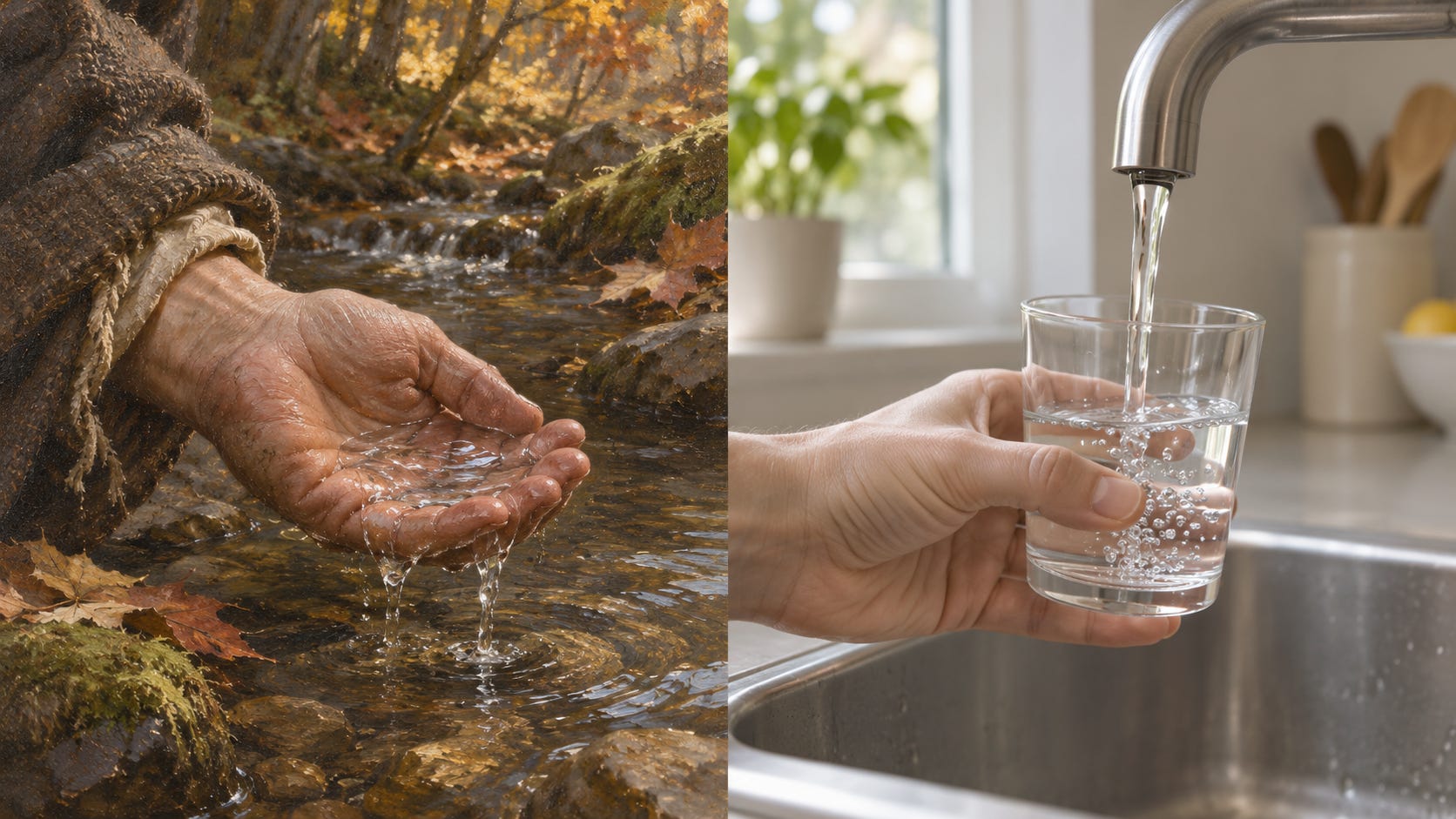
Notice how they knew. They looked at it, they tasted it, and they called it “sweet.” They had no lab and no annual water-quality report. In Earth’s Living Water I described spring water as “the kind of water you trusted on sight,” and for nearly all of human history that test, made by the eye and the tongue, was the only one anyone had. And it worked.
It doesn’t work anymore. That is what this weekend’s series is about: what happened to American water in the 406 years between that brook and your kitchen tap, and what you can do about it.
Nature Always Cleaned Its Own Water
The eye-and-tongue test worked because the earth did the cleaning before anyone took a sip. Water moving through soil, clay, gravel, and rock does more than pick up minerals. Those minerals bind what the water is carrying; the burden clumps together and settles, and what comes back up at a spring is clear, cold, and mineral-rich.
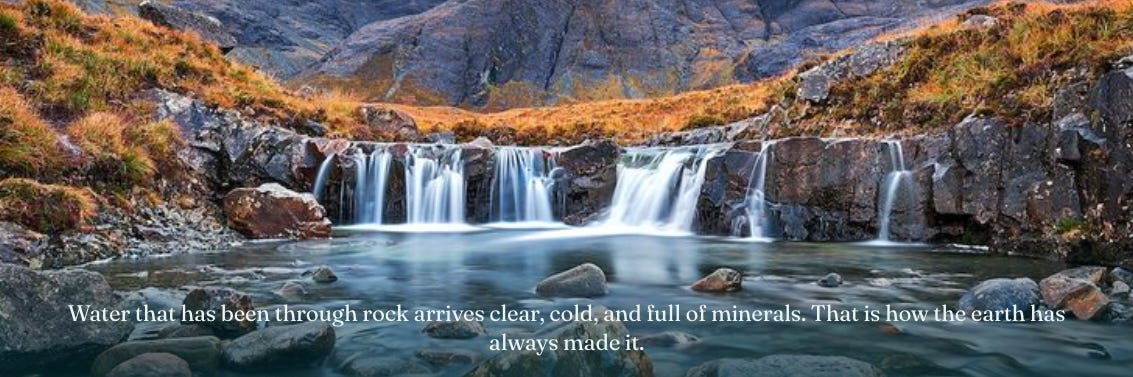
You can watch this happen. Stand at the edge of a clear mountain stream and kick up the bottom. The water clouds, then slowly clears itself. In the book, I called a clear-running stream “a continuous mineral-water reactor,” and that is exactly what the Pilgrims were drinking from.
For most of history, whatever got into water (human waste, eroded rock, the occasional natural toxin) got in slowly enough for that chemistry to keep pace. So here is the sentence I most want you to take from this post: nature’s cleaning chemistry didn't fail; we simply overwhelmed it.
Two Things Changed
The first is how many of us there are. When the Mayflower dropped anchor, there were roughly half a billion people on Earth. There are now 8 billion, and most of us are plumbed into systems that use water to carry our waste away, into the same rivers, lakes and aquifers we drink from.
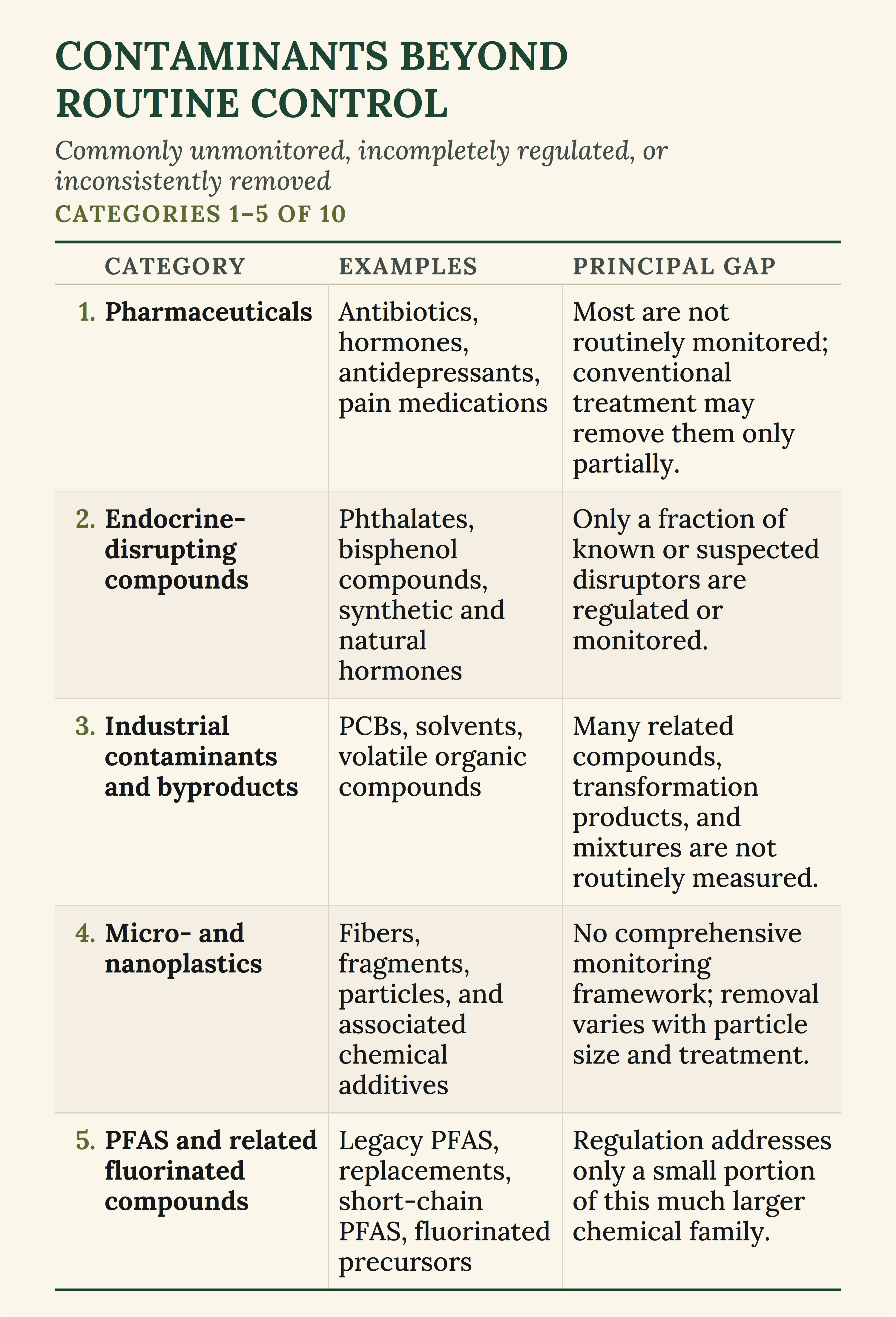
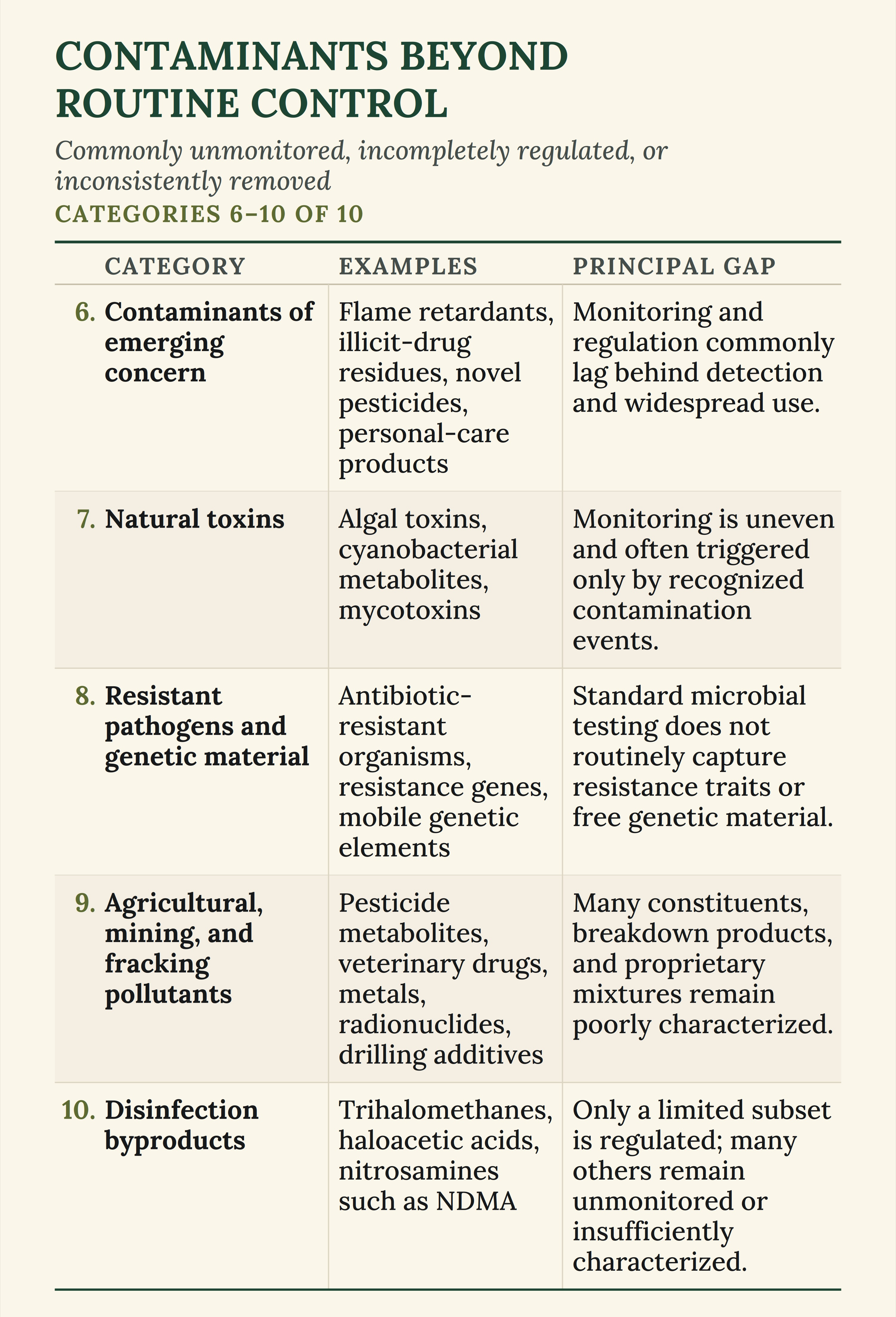
The second is what we make. More than 100,000 synthetic compounds are in commercial use today, and about a thousand new ones arrive every year. Heavy metals, industrial byproducts, pesticides, pharmaceuticals, disinfection byproducts, microplastics, and a long list of compounds now make up what the water carries from the ground to the glass.
Almost none of them existed a century ago, and nearly all of them end up in water. Testing of U.S. source waters has detected thousands of them as ordinary background in American water, not just at a few notorious sites.
Take PFAS, the “forever chemicals.” Arsenic has a natural background level, because it comes out of rock. PFAS has none because they didn't exist on Earth until the middle of last century. Every molecule of PFAS in every glass of water on Earth was made by us in the last eighty years.
The Pilgrims’ tongues could detect brackish water, stagnant water, and foul water. They could not have detected any of this, and neither can yours. Modern contamination is dissolved, invisible, and tasteless, so a clear glass tells you almost nothing.
The United States faces two overlapping water-quality problems. Surface-water pollution is widespread, complex, and closely tied to runoff, wastewater, industrial discharge, agricultural chemistry, and treatment byproducts. Groundwater contamination is more regional, delayed, and difficult to remediate once it enters the subsurface.
Of the water that public systems deliver, about 61 percent is drawn from surface sources and 39 percent from groundwater. About 87 percent of Americans rely on those public systems, while roughly 13 percent, some 42 million people, use private wells.
Groundwater Does Not Forget
“But I’m on a well.” I hear this from patients all the time, usually with pride, and I understand it. Water drawn from the earth feels older and cleaner than water from a city pipe. About 42 million Americans drink from private wells, and many of them believe they have opted out of the problem.
They haven’t. Groundwater can be more dangerous because it cannot clear itself. Surface water at least moves, dilutes, and flushes; a river carries its burden downstream and, given time and no fresh input, can partly clear. An aquifer does neither. It holds what reaches it for years, decades, and sometimes centuries. Nitrate spread on Midwestern cornfields in the 1970s is still, in some places, working its way down. Solvents dumped behind factories in the 1950s are still spreading underground as plumes.
So the water a well owner pours this morning may have first met modern agriculture or industry before he was born. And unlike city water, nobody is required to test it.
Surely the Treatment Plant Handles It?
It handles what it was built to handle. Between roughly 1890 and 1930, a handful of engineers and physicians were given one job: keep human waste out of drinking water. They did it; cholera and typhoid collapsed, and it remains one of the greatest public-health achievements in history. I am grateful for it every day.
Then they stopped, because they had won. Nobody ever added a second assignment. The plant that treats your water today is a direct descendant of the ones built to stop sewage-borne disease, and it still does that very well.
But the law requires utilities to test for only about 100 contaminants, while the chemistry in the water runs to the thousands. Your water can pass every test it is given and still carry a great deal that nobody tested for. Passing inspection and being clean used to be the same thing. They have unfortunately (and quietly) come apart.
**I write about what medicine missed, what’s in your water, and what I’m seeing in my patients. Subscribe, and the next one comes to you.
So What Do You Do?
You may have noticed that this long, carefully researched argument has arrived, conveniently, at a product I happen to sell. I noticed too. I can’t help it, and I don’t know how to avoid it, so let me just tell you how I got here.
The more I learned about water, the more I appreciated how much depends on it, and the more obsessed I became with a mineral extract almost nobody outside Japan has heard of. Aurmina is the same mineral-chemistry stone that Mother Earth uses to clean its water, concentrated from a single volcanic rock. What an aquifer does over a season happens in a pitcher on your counter in a day or two. The contaminants settle out, and the minerals stay in. A geological shortcut.
Is it the most powerful water purifier? No. Reverse osmosis removes more. But reverse osmosis is expensive; it wastes most of the water it touches; it strips out the minerals along with the contaminants; and it will never scale to most of the world. (More on that tomorrow.) Yet in lab testing, Aurmina combined with our Korea Ceramics 0.2–0.5 micron gravity filter reduced 254 different contaminants (most by over 90%), with 152 of them to below detection. Aurmina is the most practical, high-quality approach I know of, and I think it is a truly novel discovery that has been overlooked for nearly fifty years.
I’m not the only one who thinks so. Paul Rosenfeld, one of the world’s experts at water quality and decontamination, said of Purinize (an identical formulation to Aurmina, owned by my colleague and co-collaborator Matt Bakos), that it was “one of the best defenses against the effects of water contamination — superior to distillation and reverse osmosis, because it allows the natural minerals to remain in the water.”
That is why I wrote the books, why they led me to start the company, and why I am spending Thanksgiving weekend writing to you about water.
I have treated the water in every home I’ve lived in since I started this work, and no two have left the same sediment at the bottom of the jug. Seeing what settles out of water you were about to drink is an education all by itself.
One more thing, since I’m confessing. My real goal is to make this cheaper, bigger, and available to far more people than can afford to buy a bottle from me today, where it is produced “artisanally " in the volcanic foothills of Japan. A sale is a small step in that direction, but it’s the one I’ve got this week.
Tomorrow: the two things most people do instead, bottled water and reverse osmosis, and why the Pilgrims, who carried beer because they didn’t trust strange water, would recognize both. Sunday’s post explains how the chemistry works, and Monday’s lays out the independent lab data, including what it does not remove.
**Also, inspired by the sale spirit of this weekend, starting today, Black Friday, I decided to offer 20% off the Stone and Water Series; use discount code THANKSGIVING

Thanksgiving Weekend Sale, now through Cyber Monday: 25% -35% off everything at Aurmina.com. No limit on how many you can buy.

Little Lazlo
I think the comments on yesterday’s post got to his head because he asked to be featured again, this time with his namesake, Lazlo Sr.

The “War on” Series

Leading Edge Clinic
