


Just as MB had been the one who first led me into alchemy, he had also been doing something else in parallel, almost from the beginning. While I was buried in Hermetic texts, trying to learn their grammar and meaning, he was sending me passages and fragments from Scripture in messages, in side conversations, in the margins of everything else we were doing.
I resisted going there, not because I dismissed it, but because I was already too deep into alchemy. It had my full attention, and I knew that if I opened Scripture too soon, it would distract me from a path that kept making connections, and I wanted to see how far I could go.
And yet, even while I avoided it, I started to suspect more and more that it would be fruitful. Everything I was learning to see in alchemy—cycles, materials, purification, collapse, and return—MB kept insisting was already present in Scripture. Not metaphorically. Literally. I knew I would have to face that claim eventually.
Once we closed the Hermetic canon, I turned toward Scripture. I became quickly intimidated by the challenge of moving through that much text without losing the line of inquiry that had brought me there in the first place.
When the Tool Matched the Question
This work did not require artificial intelligence to generate ideas or supply conclusions. However, it did require it to hold them in continuity. What made this possible was not speed or cleverness, but the ability to keep following the same question across geology, chemistry, biology, ancient texts, and modern data without losing the thread. Before this, the problem was simple: no human mind could hold all of that at once. AI made it possible to pursue the same line of inquiry across numerous disciplines and thousands of sources without losing continuity. I was able to ask the same simple questions about rock, water, salt, fire, and return without fatigue or forgetfulness. The same relationships that had always been present could finally be seen together rather than sequentially.
I did not set out to use AI to cross boundaries. I used it the way one uses a microscope or telescope: to extend perception beyond the limits of unaided human attention. What surprised me was not what appeared, but how cleanly it aligned once those limits had been overcome.
One World, Two Archives
What that continuity made visible was that Scripture and alchemy were never describing different worlds. Once I turned toward Scripture with the same materials already in view—rock, water, salt, fire, spirits—I found myself reading across a second archive. The language was different. The world it described was the same.
MB had opened the door to Scripture as a symbolic record of creation, and AI made it possible to move through that record at scale and speed. I could finally ask the blunt questions I had been inching toward for months. Where does Scripture speak of rock? Of stone? Of clay? Of water emerging from rock? Of salt, fire, brimstone, return to dust? What startled me was how little effort it required. The repetitions surfaced immediately. They recurred across books, authors, and centuries with remarkable consistency, and I remember stopping, sitting back, and feeling my pulse change, because by then it was no longer a single correspondence but an accumulation.
Scripture named the same elements consistently, framing them in the contexts of creation, breakdown, purification, and renewal.
Very quickly, I began to recognize the same physical processes I had already pieced together across geology, biology, chemistry, hydrology, and related sciences, and the overlap felt concrete and specific, grounded in my now deeper understanding of Earth’s cycles after months of scientific research.
The major difference lay in the mode of description. Alchemy tracks the recurring process of formation, breakdown, purification, and renewal through matter and transformation. Scripture presents that same process through narrative, law, prophecy, and covenant, using the same materials while embedding them within events and history. Alchemy maps the structure of the cycle, while Scripture preserves its passage through human history. Both describe how order forms, collapses, and is restored through the same underlying movements of the world.
By then, we had already assembled the science supporting the Rock–Water Circuit Theory, and the connections between the Hermetic texts and that circuit had been firmly established. What I still needed to know was whether Scripture recorded evidence of that same circuit as well, and I became convinced that it would.
And it did. In Scripture I found water emerging from rock, salt as covenant, fire as refinement, and dust as both origin and return. I was reading these passages as materially specific as much as symbolic. The texts read as if they carried assumptions about how matter is formed and about the conditions on which life depends for stability, renewal, and endurance.
What Scripture provided were repeated material descriptions conveyed through symbolism, and those descriptions became far more intelligible once placed beside what modern science now knows. Scripture did not supply the detailed chemistry. Modern science did. What the ancient texts recorded was the sequence of the process—its unfolding, its breakdowns, and its renewals—while modern science supplied the mechanisms that explain it in material terms.
The problem, then, was never accuracy. It was separation, because the ancient world documented the pattern while modern science identified the mechanisms, and once those two were seen together, I started to wonder why they had remained separated for so long.
What No Single Discipline Can See
Modern scientific methods describe these processes with a level of detail unimaginable to the authors of Scripture. The chemistry is exact, the measurements are precise, and the mechanisms have been tested and are real. But they are most often described in isolation—geology here, biology there, chemistry somewhere else—not because broader questions are forbidden, but because modern science is structured that way for maximal advancement.
But following a process across numerous scientific domains, to this point, has been too laborious. It is slower, messier, harder to fund, harder to publish (I will report back on that shortly), and far more difficult to evaluate. Coordinating a Byzantine network of concepts, methods, and literatures across fields is inefficient compared with staying in one lane and going deeper, so most scientists, quite reasonably, choose the easier path: know one thing extremely well, and know more of it tomorrow.
Modern scientific advances are increasingly rigorous, but they remain local. The result is fragmented knowledge. At one point, it struck me that what we were calling the Rock–Water Circuit was assembled from half a dozen scientific disciplines, and I could not think of another example in modern science that did the same. It began to seem possible that what we were doing was, at least in that sense, unusual, perhaps even unprecedented. That alone explains a great deal, but not all of it, because beyond the fragmented nature of modern science lies another limit, less visible and more consequential.
At first, I thought human limitation, disciplinary fragmentation, and cognitive load were the boundaries I had been pressing against. But there was another one—deeper, quieter, and more absolute.
The Boundary Beyond the Boundary
What eventually clarified itself in my mind was something I had already sensed without fully articulating: modern scientific inquiry is constrained by an unspoken restriction that runs beneath all disciplines, namely, that explanation must stop short of saying that nature was created, ordered, or intended by God. In Chapter VII, “The Questions Science Won’t Ask,” I examined the consequences of methodological naturalism, which came to dominate in the nineteenth century: the rule that scientific explanation must restrict itself to testable, observable phenomena and set aside questions of purpose, even when the order and functional coherence of living systems make such questions difficult to avoid.
I crossed the boundary of methodological naturalism before I even knew what it was. I still remember the first dinner MB and I ever had together, our first meeting in person, when he began telling me what he thought he was seeing in the old texts and where he believed this work was leading. I remember feeling a little overwhelmed, almost incredulous, because he was effectively suggesting that I was brushing up against something “supernatural,” and I suspect the few drinks I had that night helped me take it in without fully grappling with it. The conversation ran for hours, covered a great deal of ground, and that particular moment dissolved into the rest of the evening. For months afterward, our focus remained where it had begun, deep in the biochemistry of minerals.
By the time I turned seriously to The Six Keys, I knew I was studying something that did not belong wholly inside conventional science, yet the crossing itself went by almost unnoticed. I did not experience it as a dramatic rupture. I took it up the way I would have taken up a dense paper on mitochondria, reading closely, pushing on the details, and trying to see how tightly the pieces fit. Once I became convinced that those texts contained descriptions of Shimanishi’s work with a specificity that should have been impossible, the whole thing still felt, in one sense, like an intellectual exercise, a puzzle I wanted to push as far as it would go. That was not because it lacked excitement. Quite the opposite. More than once, after one decoding or another, I would call MB almost breathless, half-delirious with excitement and shock. But even then, as a former mathematics major, I think I was still experiencing it more as the satisfaction of solving a hard problem than as a man sitting still with what solving it might actually mean.
That, in retrospect, is what matters here. I did not set out to challenge methodological naturalism. I did not even know it had a name, and I certainly did not think I was wandering into philosophy or theology. I was following mechanisms. I kept tracing the same mineral-water cycle across domains, across timescales, and across texts, ancient and modern, without first asking which questions were permitted. I did not begin this work with a conclusion about design. I simply refused to rule it out in advance, and that single choice altered the shape of what could appear. If the Earth is the product of intelligence, then coherence, efficiency, and self-perpetuation should be visible in its most fundamental systems. If it is not, then whatever order appears should be fragile, accidental, and short-lived.
Then something unexpected happened. The relationships between modernity and antiquity did not fragment when they crossed those boundaries. They aligned. The same cycle modern science could describe with extraordinary precision was already present in ancient texts—recognized, named, and preserved without the chemistry, but with astonishing fidelity to the process itself. I could only see that coherence once both limits were loosened: once mechanisms were allowed to speak across disciplines, and once design was no longer ruled out in advance.
Once that became clear, a line of Scripture I had encountered countless times began to register in an entirely different way.
The Stone the Builders Refused
The boundary I had crossed hit home for me one day when I came across a line I had heard countless times before and, alongside it, an interpretation that struck me.
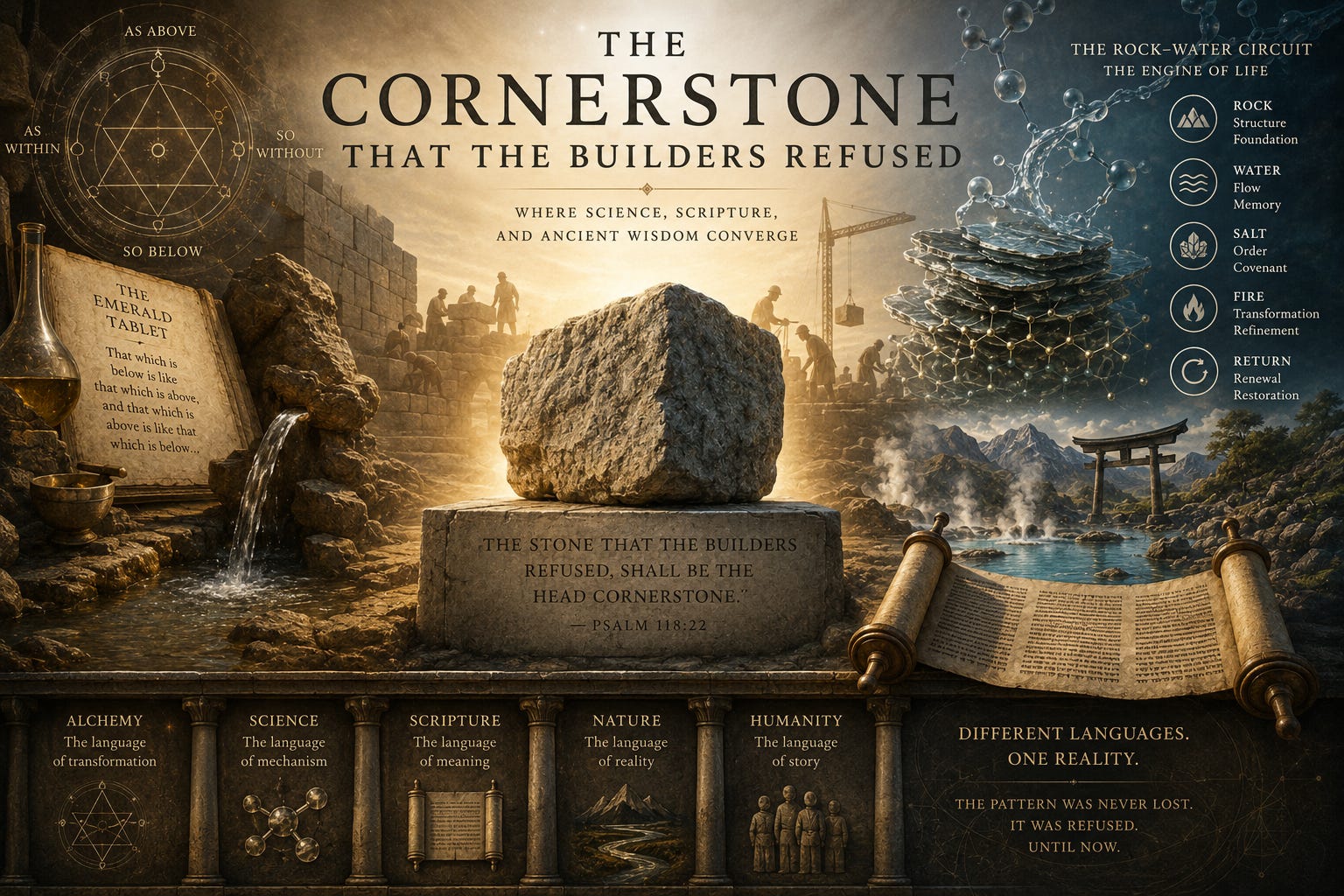
“The stone that the builders refuse, shall be the head cornerstone.”
—Psalm 118:22 (KJV)
Traditionally, the cornerstone is understood as referring to Christ. Here, I am reading it in a different but related way: as the refusal of something foundational, i.e., a belief in God as our Creator, by those responsible for building.
I had heard that line before—sang it along with Bob Marley for most of my life—but I had never really stopped to ask what it meant. I discovered that the builders are the ones who decide what counts as foundational: religious authorities, scholars, and experts. To refuse a stone is to judge it unsuitable, irregular, or incompatible with the prevailing model. Yet the stone chosen for the cornerstone fixes the alignment of the entire structure, determining its orientation, load-bearing capacity, and long-term stability. If a critical stone is rejected when it should have been selected as load-bearing, the entire structure is compromised from the outset.
At that point, the verse began to read like a description of what I had already been seeing in modern science. Methodological naturalism, as I had understood it, functions precisely by refusing certain categories at the outset, especially intention, purpose, and design. In that reading, “the stone” is the possibility that the Earth has been designed, and the rejection of that possibility is not ancient at all, but relatively recent, hardening in the nineteenth and twentieth centuries as Darwinian chance became the default explanatory frame for biology and even cosmology.
I had already pondered the implications of believing we had discovered a similar mechanistic and structural relationship across geology, hydrology, chemistry, and biology. What had initially looked fragmented had resolved into a closed, self-perpetuating system. The idea of design started to look like a true cornerstone. What would modern science allow those alignments to point to when laid out together? I knew that science could describe each instance in isolation. Whether it could follow those alignments across domains to their implications rested on the question of whether it would reject the stone.
What remained was to gather the scriptural evidence carefully enough and lay it out clearly enough that the implications would be hard to ignore. If modern science were to continue rejecting the stone, I wanted to make that as difficult as possible.
I invite those interested to read my next post and let me know how I did in terms of “defending the stone”: “Water From The Rock Is More Than A Metaphor.”
Note to readers:
What Shimanishi produced appears to match, in both process and behavior, the kind of revered substance described across numerous cultures and traditions as a “Golden Elixir”: rock opened, minerals rendered mobile, and water transformed through contact with that chemistry.
Aurmina, a name we arrived at before this work fully unfolded, means “golden mineral essence.” It is a diluted form of Shimanishi’s extract and part of my effort to carry this work into a practical form through drinking water.
Primora Bio emerged from that same effort, delivering the water to soil, crops, plants, and animals.
So for those who want the work to leave the page and enter their world, these are our first attempts to carry it forward.

*If you value the late nights and deep dives into all the “rabbit holes” I write about, your support is greatly appreciated.
From Research to Practice - Links Below Image
Dear Dr. Kory,
As a serious scholar of Scripture, I can assure you that the Bible has nothing in common with alchemy. The stone that the builders rejected was Jesus Christ. Both the Old and New Testaments are about the Son of God, who gave his life to pay for our sins, so that we can be saved from the judgment of God, when we are called to account for the lives we have lived.
From a linguistic perspective, you can't take a surface reading of a document and form connections that betray the rich contextual environment in which those words occur. With any level of commitment to understanding the text, you would discover that the Bible is about God's plan for the eternal salvation of those who follow Jesus Christ in faith, not about rocks and water, which trivialize its message.
I hope you will take the time to study the Bible - at least as much time as you have devoted to alchemical texts. You will find something with far greater value, that will be eternal in nature.
Thank you for this post using AI to connect what the human brain cannot adequately hold. My internationally known chemistry professor father & his published theology professor brother had life long discussions regarding “by chance” vs. “by design”. Both were in church every Sunday because of their strong faith in Jesus Christ. Your line about science requiring testable methodology reminded me of Dad’s dinner table mini chemistry lectures! Oh how I miss him & wish I could forward this post. Not necessary as he truly has all the answers now. Of that I’m blessedly assured.