


I was so happy to learn that my last post about my meeting with Nobel laureate Satoshi Ōmura, was so well received. The response was unexpectedly emotional, and reading your comments meant a great deal to me. Then, on top of that, I heard from Mr. Kenji Torii of Tiger gyroscope fame that he liked it so much he wanted to translate it into Japanese right away and share it there. He also told me it had reached Professor Ōmura, who enjoyed it as well.
Now on to the other half of this slide-show travel diary. As I explained last time, two Japanese researchers inspired the trip. Ōmura’s work became the high point of my former career, then helped end it. Shimanishi’s work launched me outside of medicine (sort of, but not really) into a new career and mission. Without trying to sound grandiose, that mission is twofold: to raise awareness of the world’s rapidly unfolding food and water crisis, and, more importantly, to spread the word about Shimanishi’s 1977 discovery. My books lay out the evidence for how the world could scale up Themarox and deploy it widely, preserving and expanding our food and water supplies and sparing immense suffering in the process.
I suspect few people really “get” what I’m talking about yet. I’m hoping to change that, which is why I took the 768-page, 71-chapter, 230,000-word behemoth that is Earth’s Living Water: Its History, Its Ruin, and the Way Back and wrote a more focused, concise version called The Silent Aquifer. It’s hard to get a message across with an encyclopedia these days. So, another plug:
The Stone and Water Series
You can buy the series, whole or in part, from my website (where all books are stamped with my hanko) or from Amazon.

So it’s no exaggeration to say I’ve gone from pulmonologist and intensivist to self-taught agronomist and environmentalist. Heck, I titled the flagship book The Silent Aquifer to echo Rachel Carson’s 1962 Silent Spring, widely credited with helping launch the modern environmental movement and arguably the most influential environmental book of the 20th century (my grandiosity returns).
Now, the man behind my career pivot: Asao Shimanishi. Where Ōmura is world-famous, Shimanishi was his mirror opposite: deeply obscure and intensely private. History, with a capital H, somehow failed to record the significance of his unprecedented achievement: extracting an aqueous mineral solution from volcanic black mica, one of the most broadly mineralized and abundant minerals in the Earth’s crust.
After seeing the solution’s effects in my own clinical practice, I quickly became obsessed with his story. First there was the path to the discovery itself: nearly fifteen years of one man working alone on a technical problem until he finally solved it. Then I discovered how far his mineral extract reaches across biology, from soils to microbes to plants to animals to people, and how it can both purify water and restore biological properties to the world’s altered and rapidly shrinking freshwater supply. The Industrial Revolution degraded those waters first, and the Green Revolution degraded them far more. I call that change the Geohydrological Shift: a global alteration in water chemistry that, around the turn of the century, began driving annual crop gains down.
If you read my last post, you’ll remember the problem that haunted me while writing the books: how little record of the man survives. One textbook chapter, a 12-page manual and a single interview. Almost everything else I learned about him came thirdhand, from people who knew people who knew him. Heck, I couldn’t even find a record of his death. The people at the company told me they hadn’t seen or heard from him in many years. He would be 100 this year, and given how famously long-lived the Japanese are, I tried to find out whether he was still alive. I couldn’t confirm whether he was, or wasn’t.
Japan was my chance to change that: to finally sit down with the one person I could find who had known him directly, and to meet in person the Shimanishi-kaken executives I had spent months corresponding with through careful, translated email.
And beneath it all was the question I raised last time and still can’t shake. Why did two career-altering obsessions, ivermectin and Themarox, both lead back to two Japanese men of the same era, both trained in pharmacy and chemistry, both choosing nature’s chemistry over the synthetic chemistry where all the money was?
By Way of Maui
We actually left for Maui a full ten days before flying to Japan. Why, you ask? Easy: we’re lucky to have a good friend, Gavin de Becker, who, in my opinion, is one of the most interesting men in the world. An expert in both personal protection and vaccine (non) safety, he wrote the bestselling The Gift of Fear and, more recently, a tour de force of an investigation, Forbidden Facts: Government Deceit & Suppression About Brain Damage from Childhood Vaccines. To understand why I call him “the Most Interesting Man,” listen to his interview on Joe Rogan's podcast. His life story and accomplishments are among the most uniquely remarkable I’ve ever come across.
Most importantly, he is one of the kindest, smartest, and most generous men I have ever met. He lives on Maui and keeps more than one “guest house” there, where his friends are always welcome to stay. Coolest. Friend. Ever.
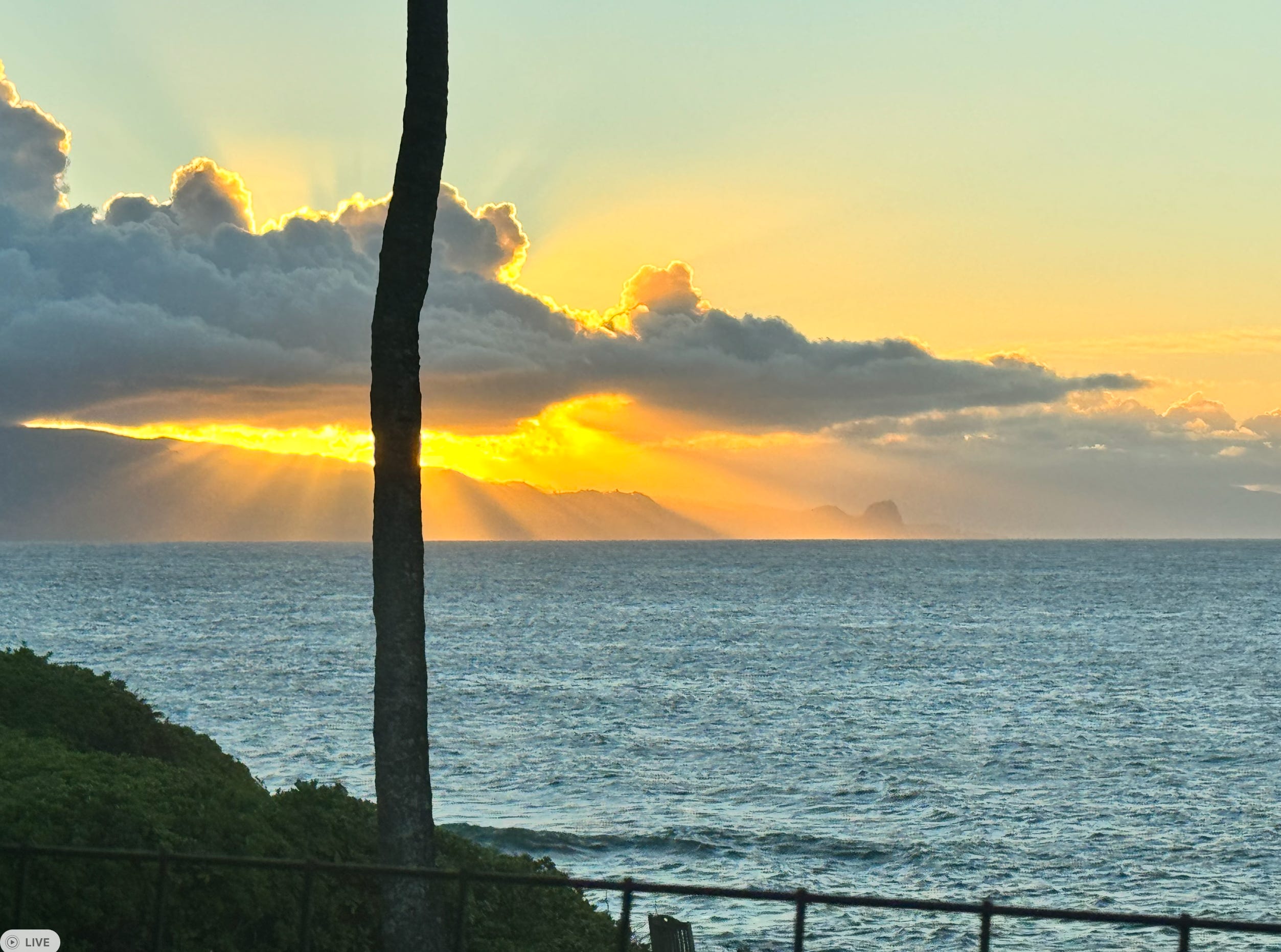
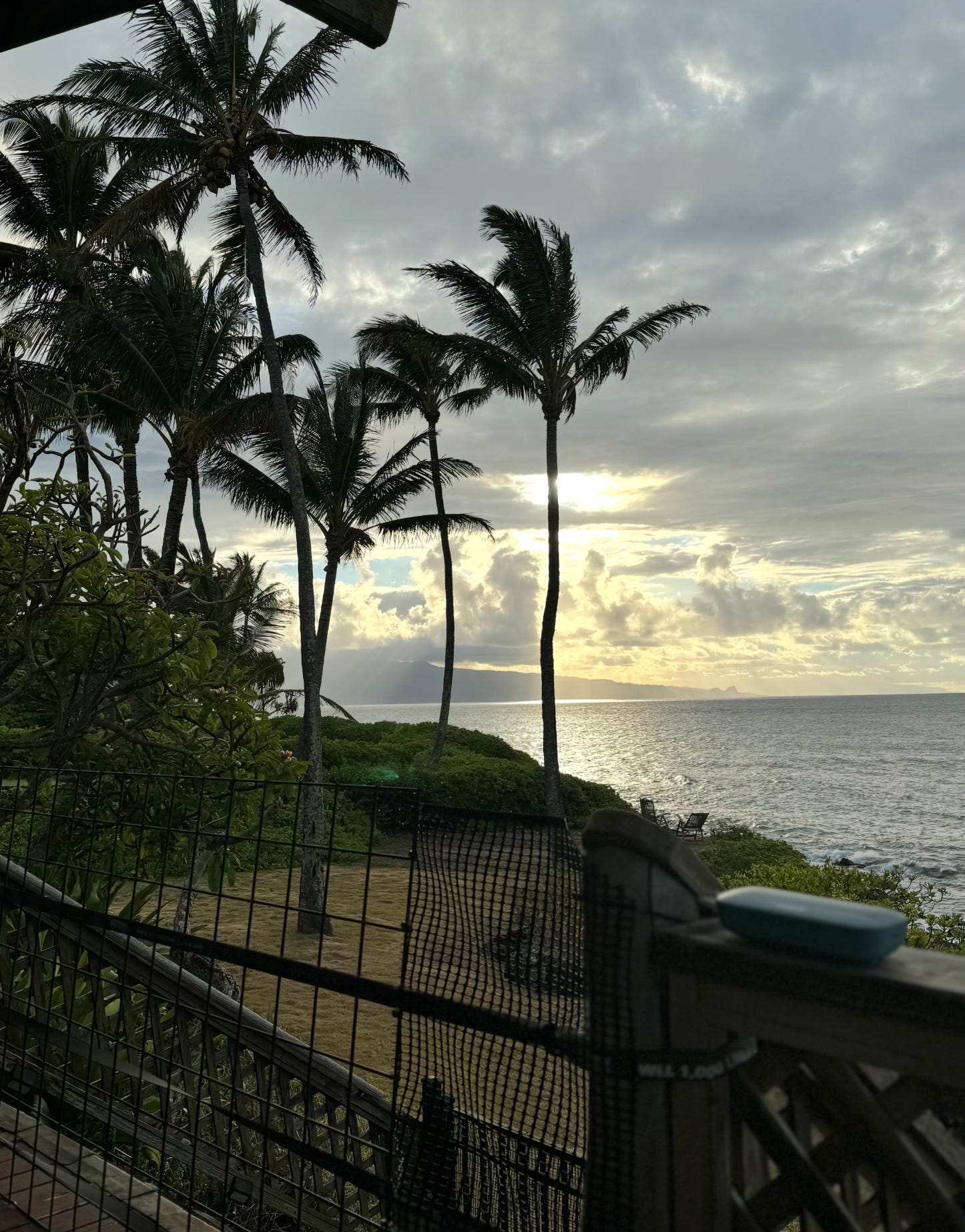
Lisa and I have probably abused this. Lisa is infatuated with Maui and keeps asking me to ask Gavin if we can come “visit” (err, stay at his house). The crazy part is that every time I test the waters by texting him that we’re thinking about visiting around a certain date, he immediately replies, “The house is yours.” The one he gives us sits on a small cliff above the ocean, with a view unlike anything I’ve ever seen. I can sit on that deck listening to music for hours. Here’s the view:
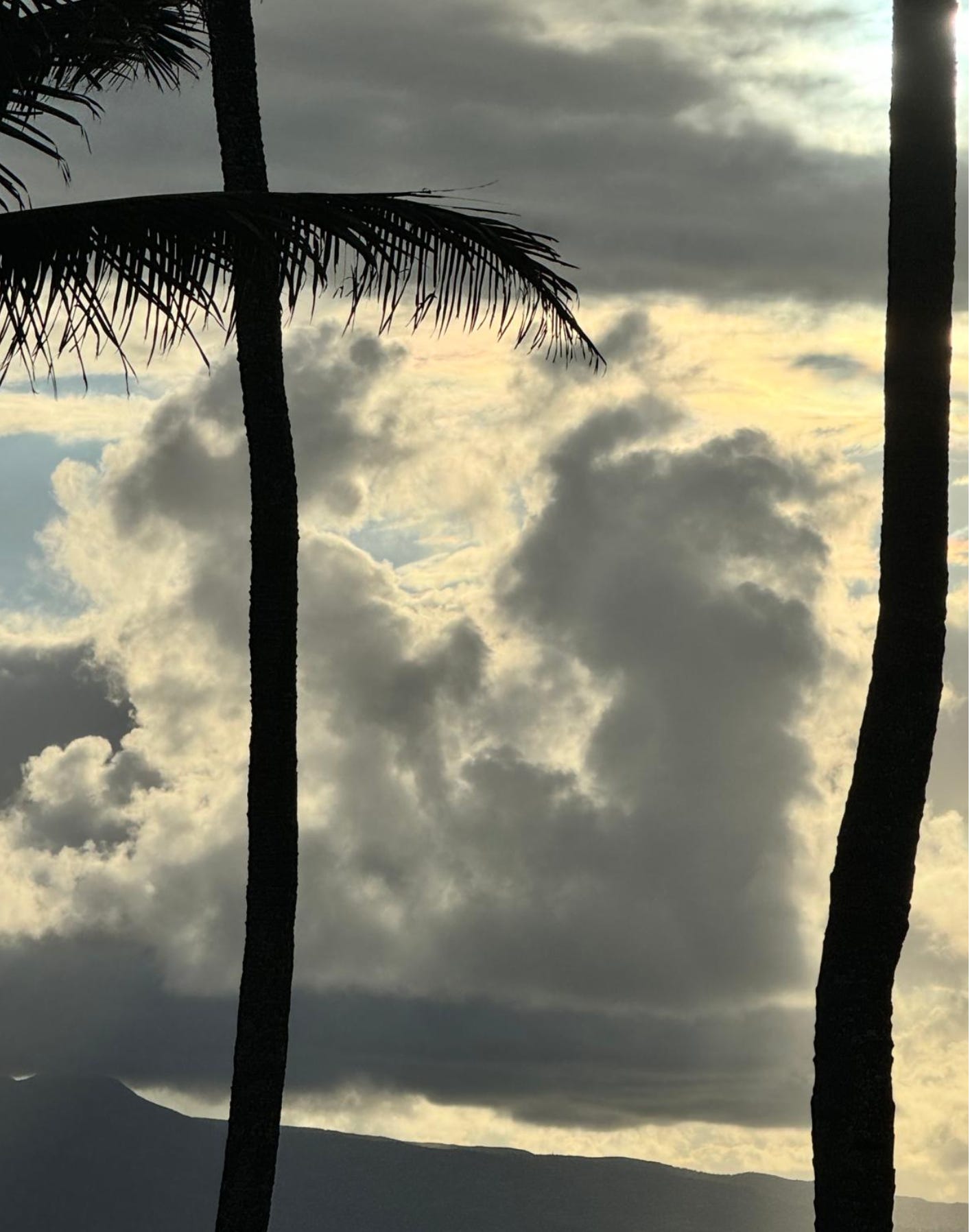
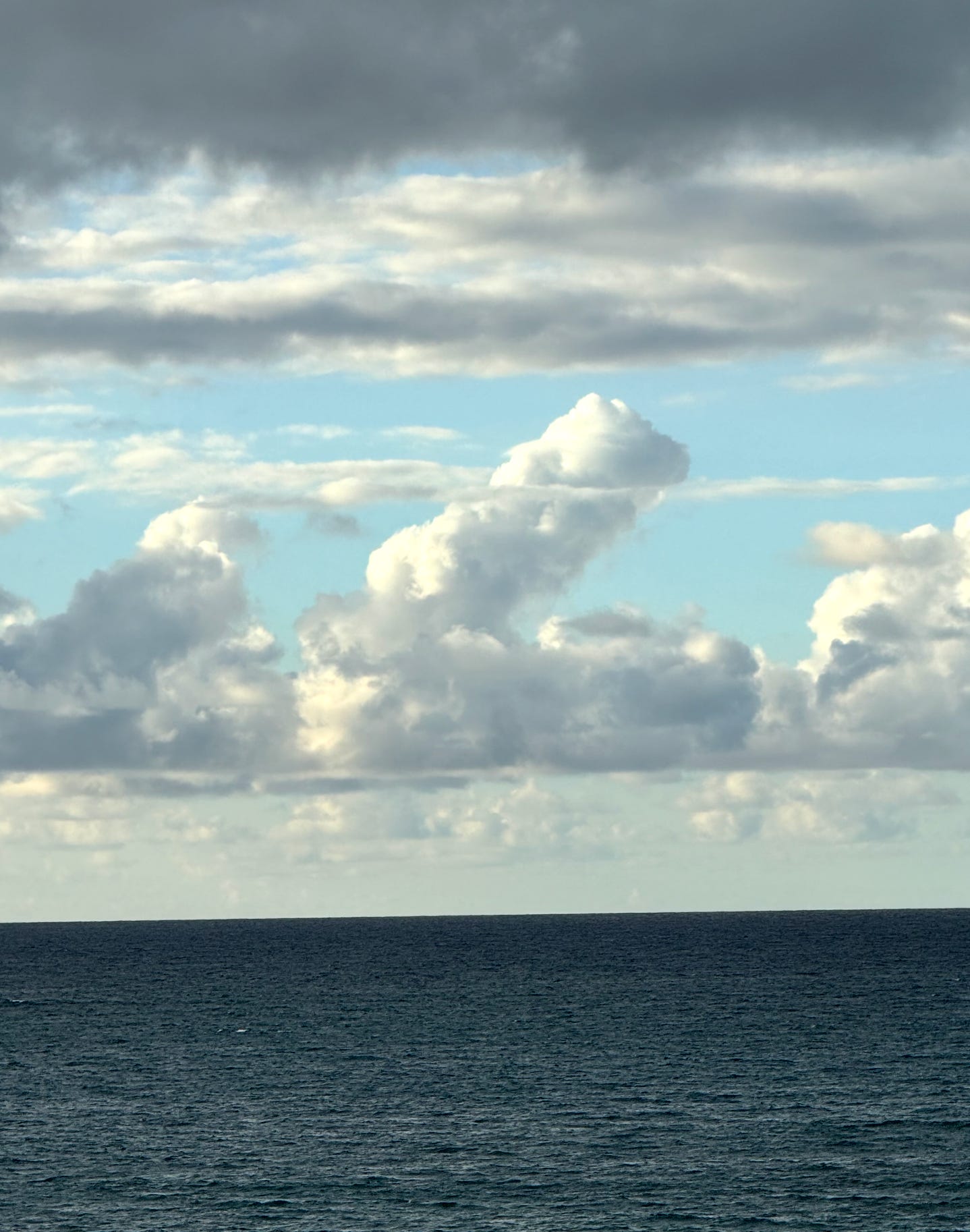
One of my favorite activities is watching the most amazing clouds form and dissipate. I call out to Lisa every time I see something anthropomorphic, ranging from various animals leaping, couples about to embrace, and semi-erect phalluses. To wit:
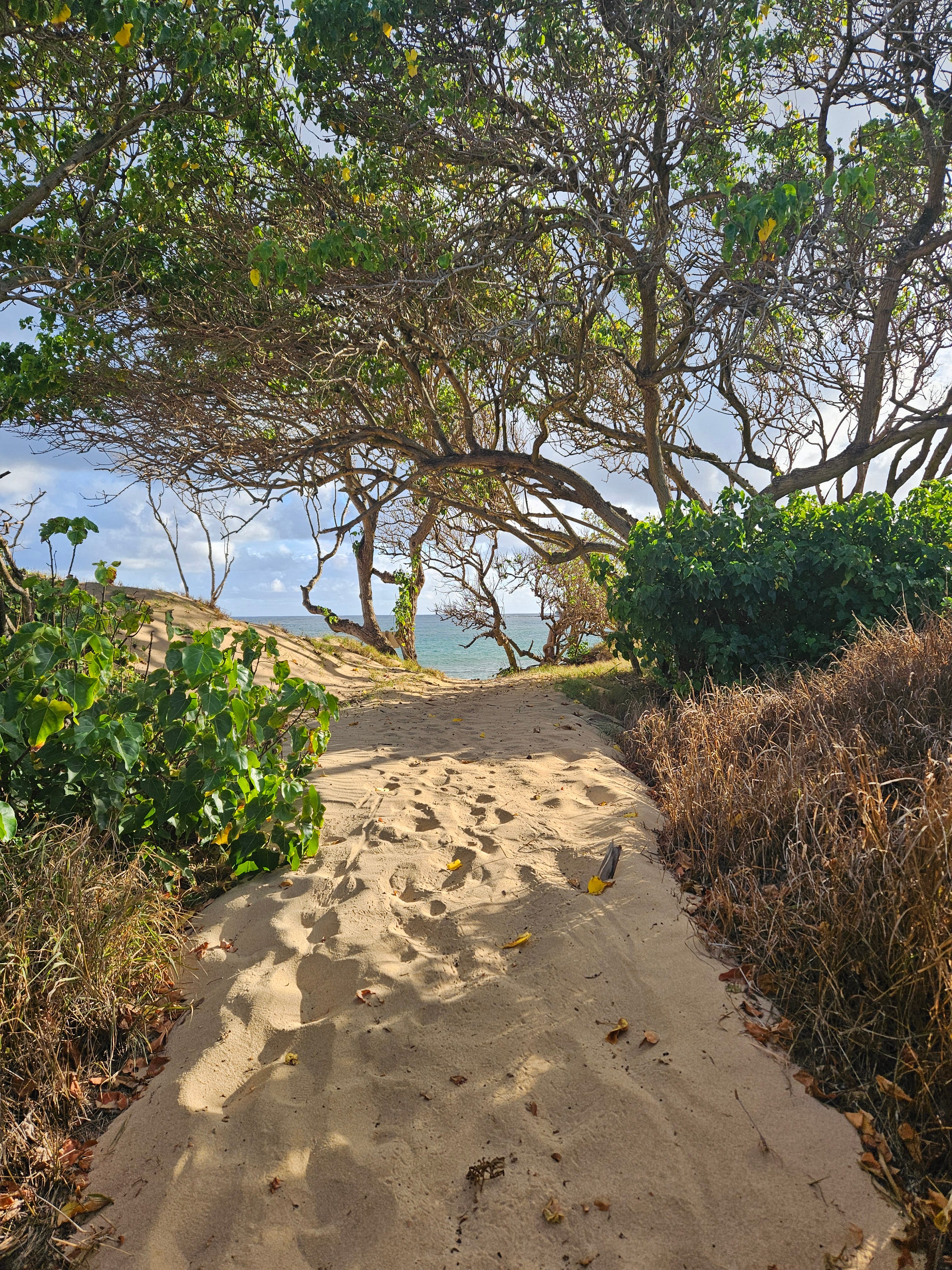
The path to the secluded beach a stone’s throw from the house
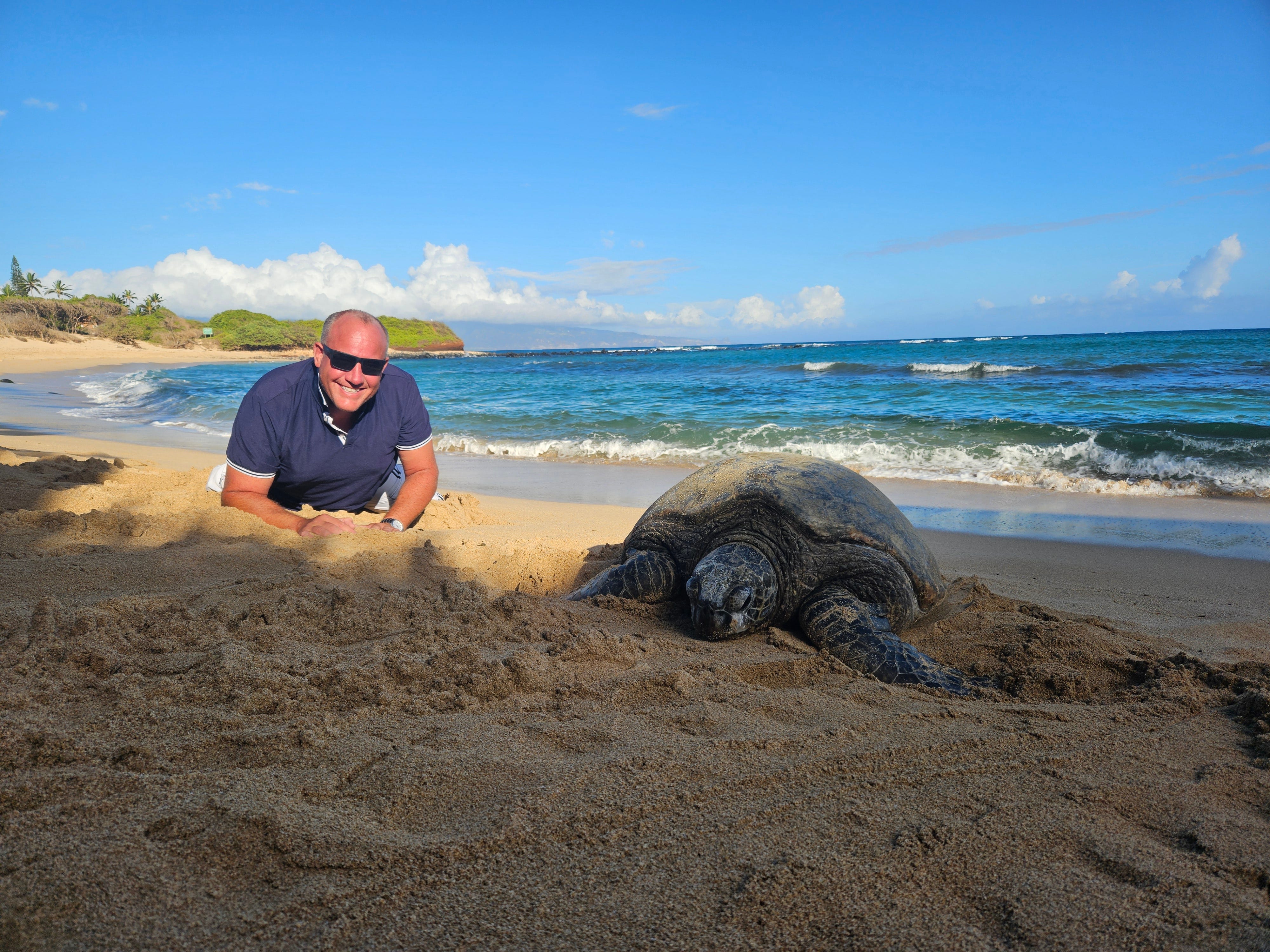
Me hanging out with a buddy at the beach:
Here we are on one of our daily rounds of gold, on this day with Dr. Joel Friedman, not only the best physician on Maui, but one of the most impressive I have ever met:
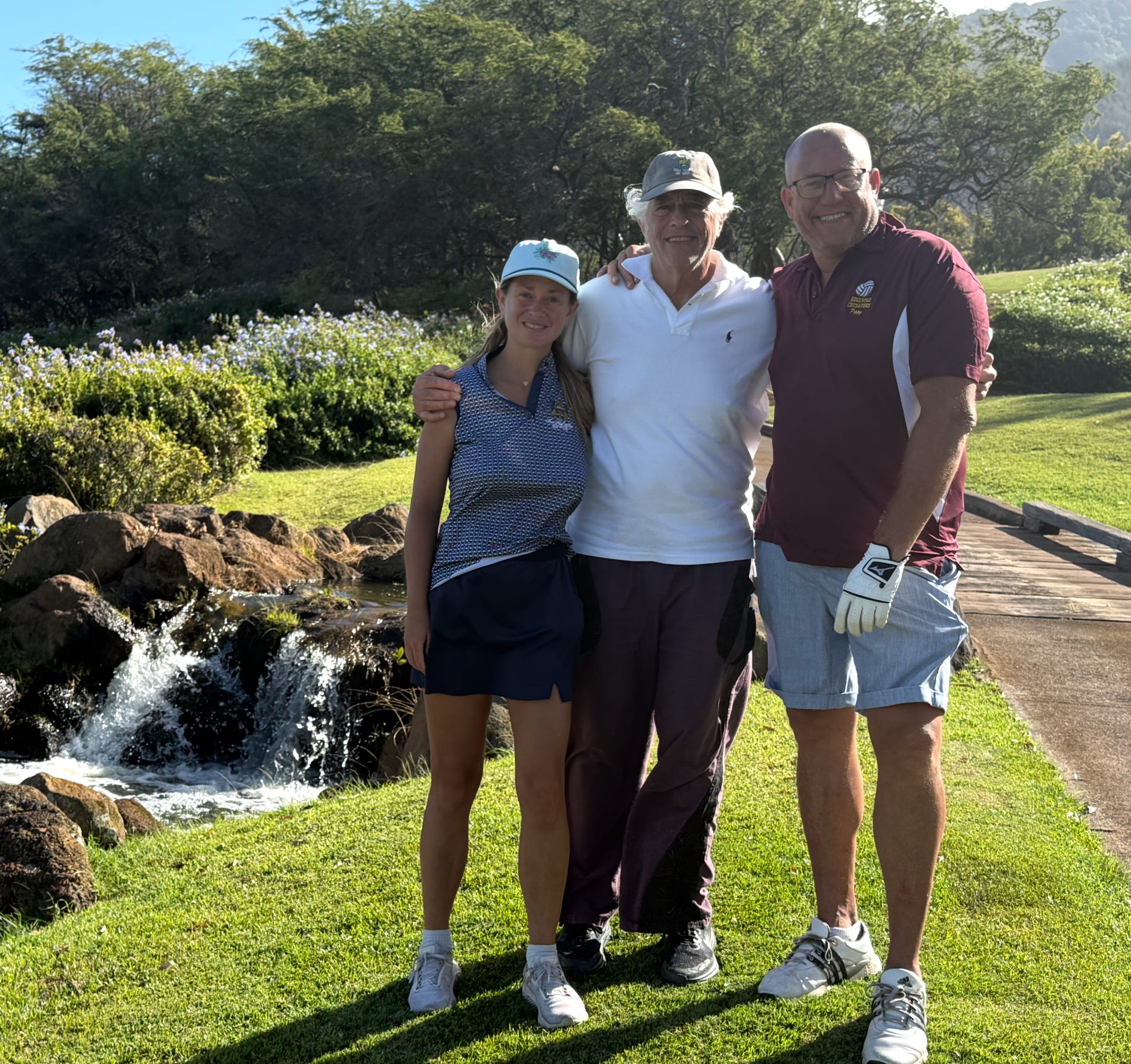
Not-so-fun fact: if you think I was having fun that day, you would be sorely mistaken for one simple reason: Lisa is an insanely good golfer; we are competitive, and I get my ass kicked regularly. Here I managed to break a smile (just kidding).
So, after ten days of paradise (except for the terrible Kona Low Storms, which visited, albeit sparing us and the house we stayed in), we finally headed to Japan.
Even leaving from Hawaii, the flight was brutally long.
We landed at night and walked what felt like three miles through the airport to reach a taxi, easily the longest walk I’ve ever taken inside an airport. Then came the modern awkwardness: a driver with no English, the two of us holding our phones up at each other, and somehow, even with my translation app set to Japanese, he was struggling. It worked out, the way it always does now. Just far less efficiently than I’d assumed.
We stayed at a very Western hotel, the Cerulean Tower in Shibuya, about a five-minute walk from the massive Shibuya station. In hindsight, staying somewhere so Western probably cost us a better feel for the city. I should say plainly: apart from the food and a couple of memorable restaurants, this was not a sightseeing trip. We spent it working and meeting the people we had come to meet. That turned out to be the whole point.
Practicing My Japanese Manners
For me, the best part of the trip was meeting Yoshio and Yasushi, the CEO and President of Shimanishi-kaken.
I had been so careful with them over months of formal email that I decided to prepare properly, and here I confess I took artificial intelligence a bit too seriously as a cultural tutor. I brushed up on my bowing. I bought a new suit, because I had read that business meetings require one. I learned how to toast with your hosts over drinks, where everyone sits at the table (by rank and age), and the importance of bringing gifts, and which kinds. And I learned that a business card is presented with both hands, which I practiced so many different ways that I still don’t think I have it right.
When I confessed all of this to them, they laughed immediately, and within minutes we were getting along like old colleagues.
Yoshio and Yasushi are both retired Toshiba executives who spent years in Canada and the United States, so they were entirely comfortable with English and with Westerners. I got an enormous kick out of what they told me the next day. They had been very nervous about meeting me, a “famous doctor” with a public profile, and were a little intimidated. Then they laughed and said that within minutes they were completely disarmed and realized I was an easy guy to talk to. That put me at ease, too.
Off we went to their offices in another district of Tokyo: humble, modest, a bit cramped. They made coffee, and we sat and talked for hours. I told them what I’d been discovering in my book research and asked a lot of questions. They took notes and asked even more questions about our US businesses, Aurmina and Primora Bio, and our plans.
They explained how the Themarox business works in Japan, which I found fascinating: it splits almost exactly into thirds. One third water purification, one third agriculture, one third mineral baths. They also walked me through the company’s history and some of the hard stretches it has survived.
Then we went to dinner, and not a Japanese one. Once Yoshio learned of Lisa’s dietary restrictions (no dairy, no eggs, no gluten), he concluded that most Japanese restaurants would make it nearly impossible, so we ended up at an American hotel (the Westin, I think) with a sprawling buffet she could actually navigate. We had drinks. We talked about spirituality. We talked about our shared mission, and how we all understood it had a humanitarian dimension.
It was a lovely evening, and I went to bed genuinely looking forward to the next day: a full day with them, touring the extraction plant. My friend and colleague Matt Bakos told me he had never known them to extend that honor to any visitor he knew of.
If you appreciate the late nights and deep dives that I do, please support my work:
Fukushima
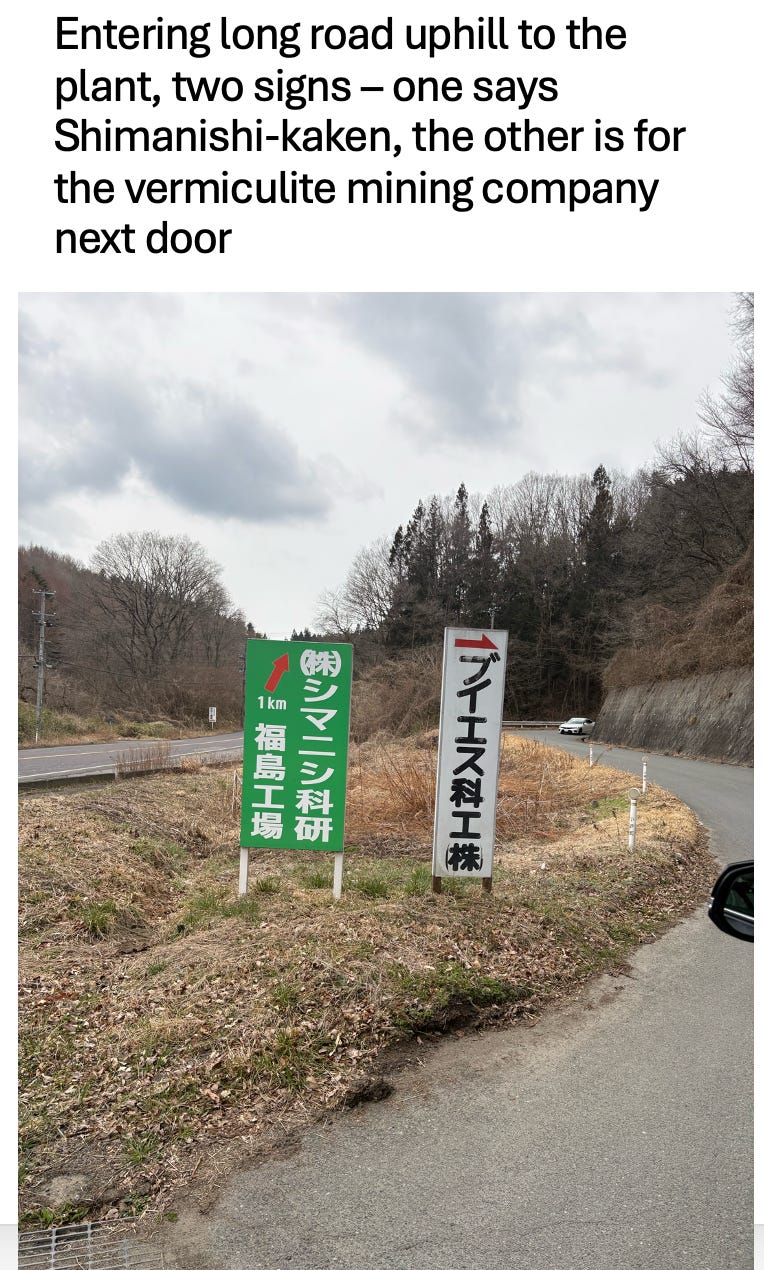
It was a full day. Yoshio and Yasushi met us at the hotel, and we took the subway, then a train, then a private car on the long drive to the plant in Fukushima Prefecture. We stopped for lunch at another very American place, again the only option that could handle gluten-free and dairy-free.
Then we arrived at the little factory, and the tour was a joy.
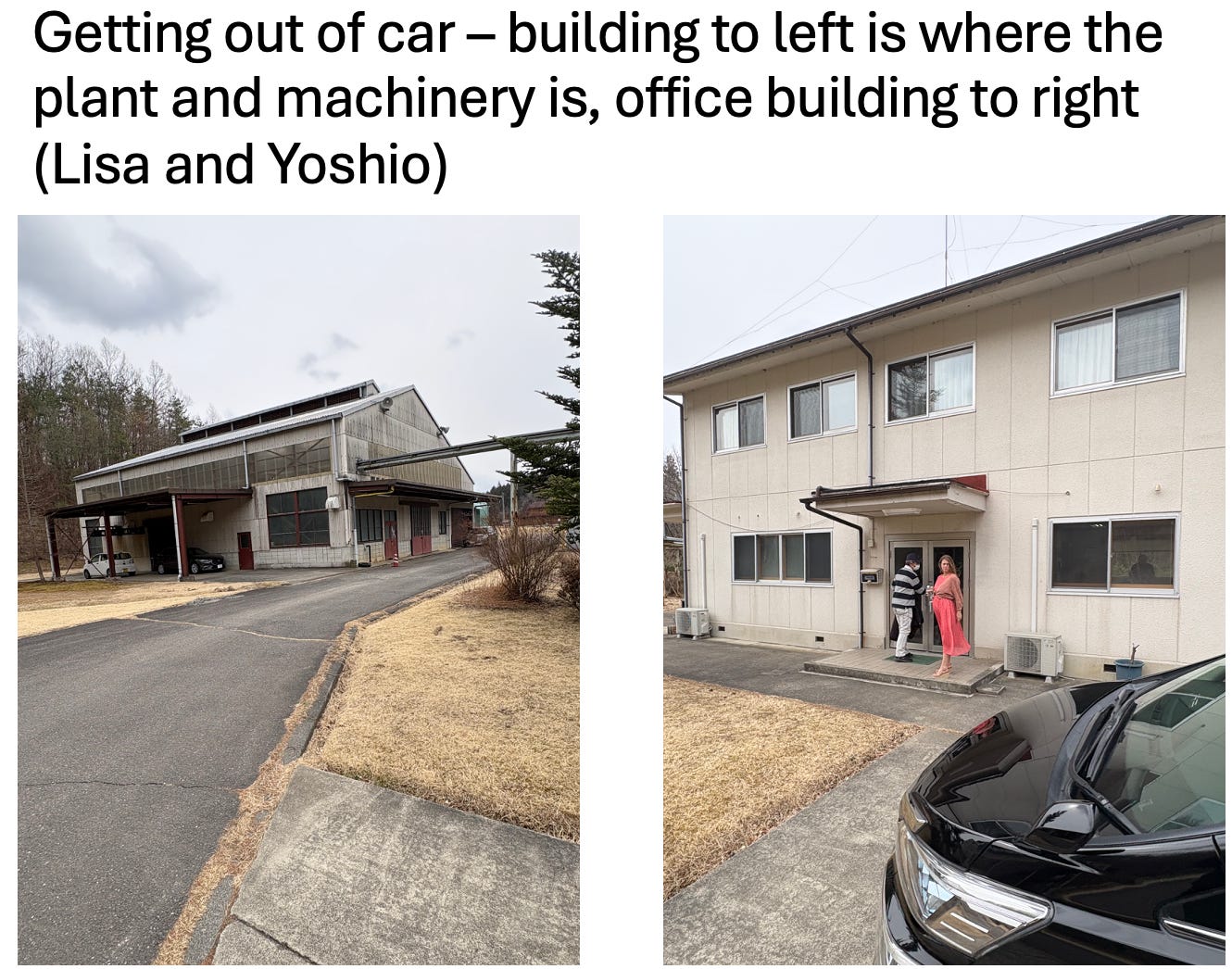
We first settled in the front room of the small office building, where Mr. Kiyokata Ishii, the plant manager, gave us a short lecture on where Themarox comes from and how it’s made:
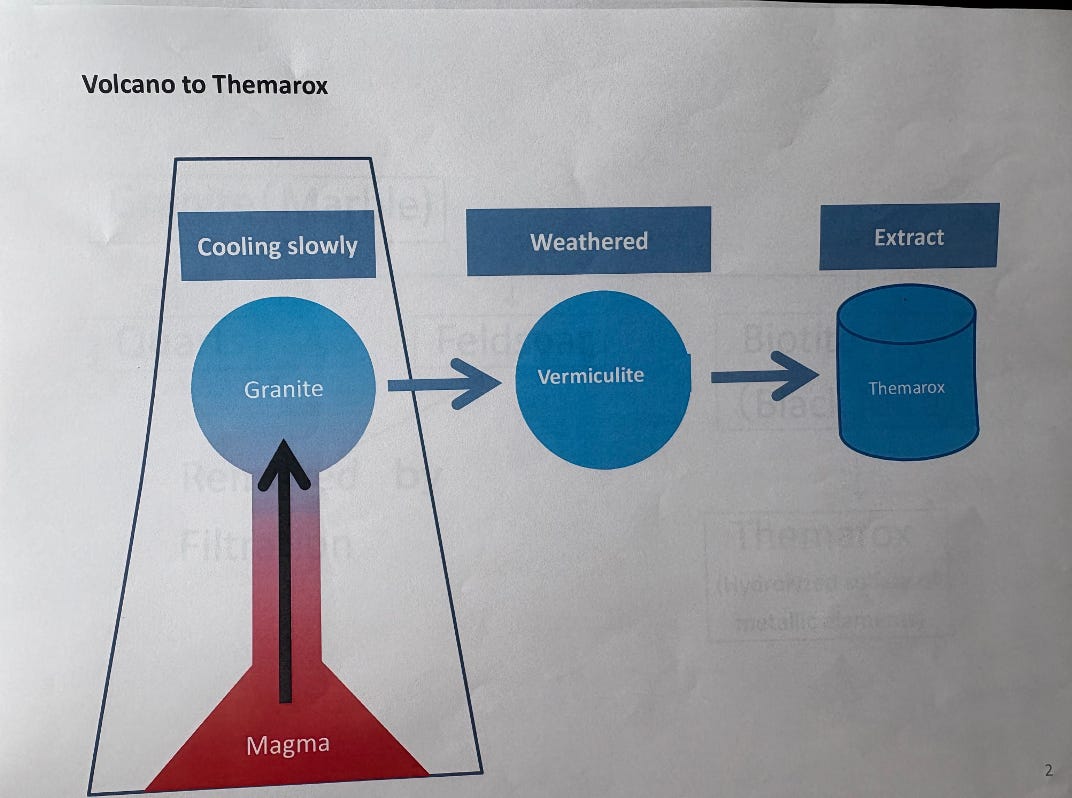
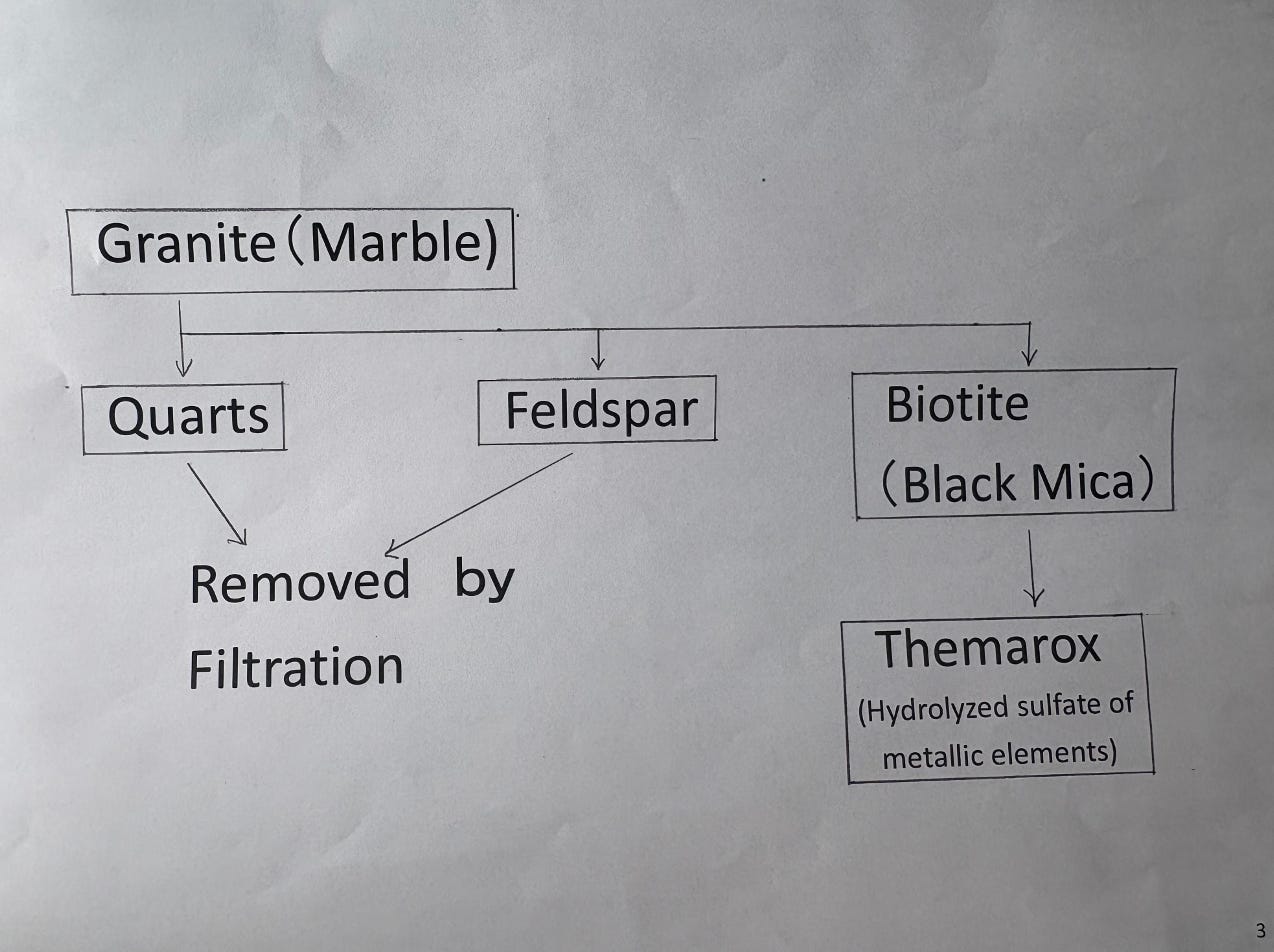
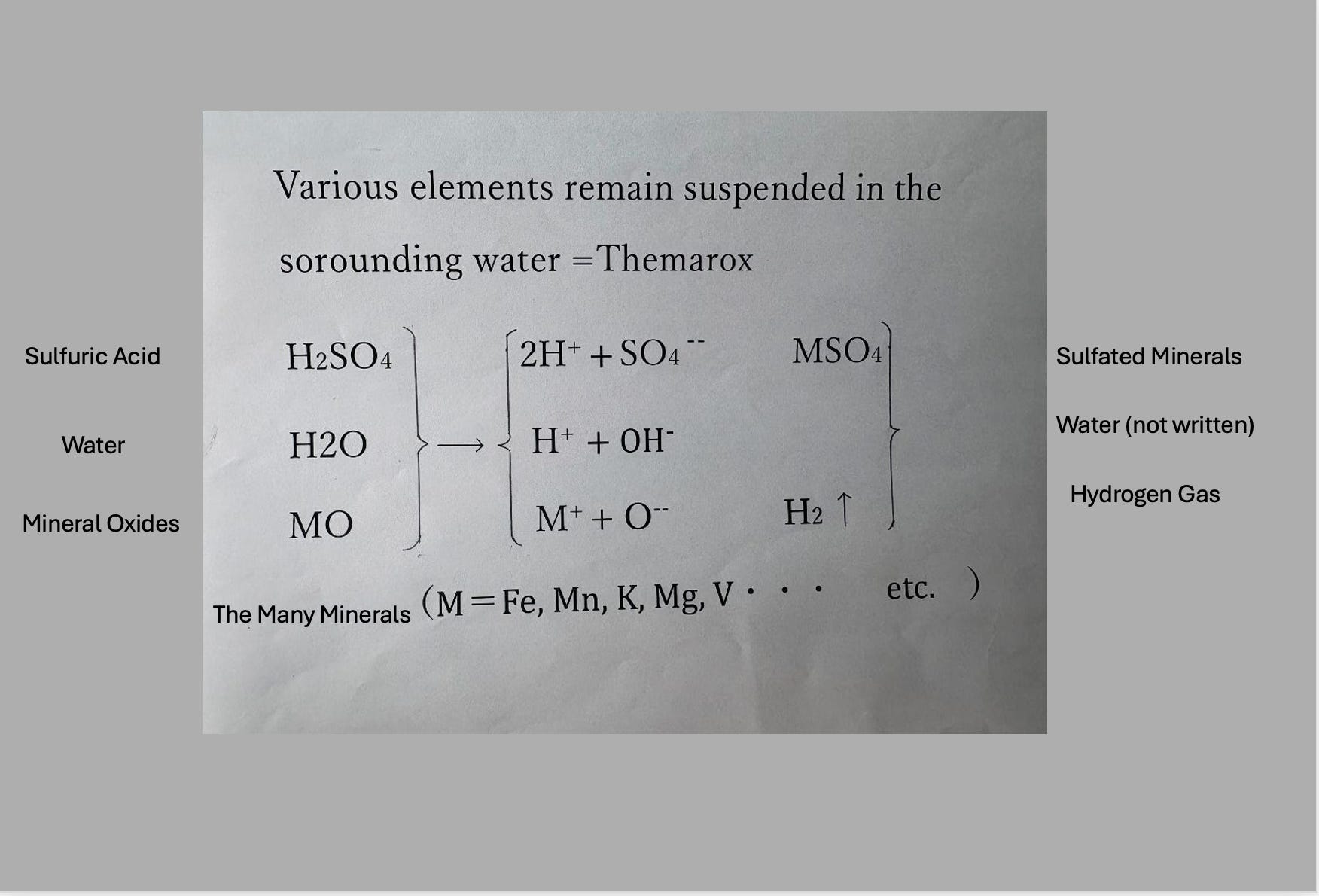
You can see the real-life results in the photo below.
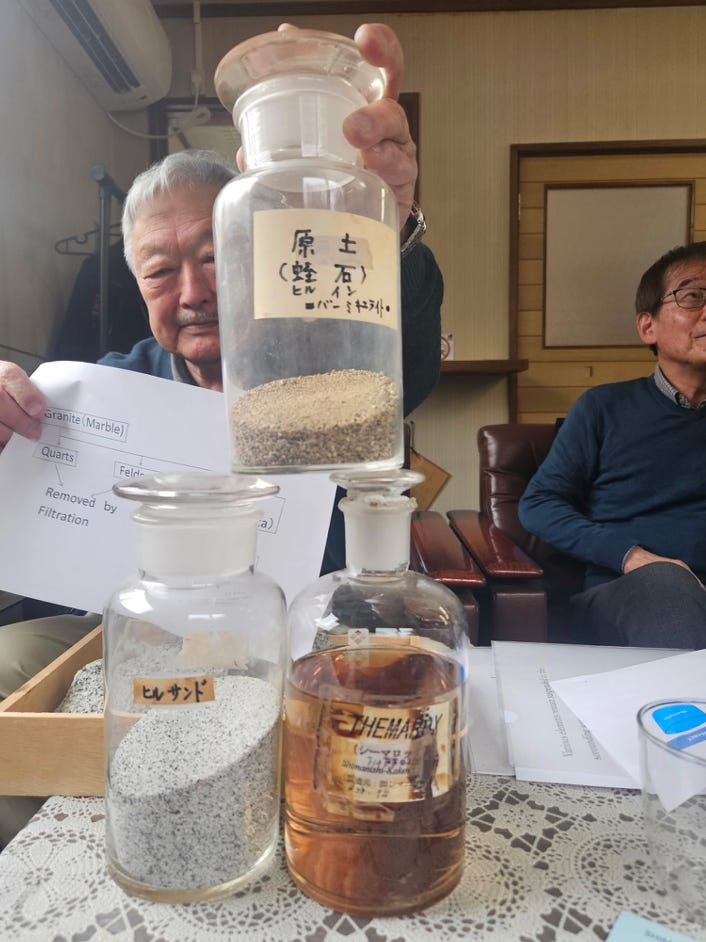
At the top is the starting material: crushed biotite-derived vermiculite, flecked with black, iron-rich specks. Below on the right is the golden-amber mineral solution that comes out of the reaction. On the left is what gets left behind: the whitened, brightened silicate skeleton of the mineral, which won’t dissolve.
Then we followed the process from end to end. The raw material, it turns out, is gravel: tailings from a vermiculite mine on the other side of the mountain, the stuff they throw away! Shimanishi-kaken collects it and spreads it out in a large, tent-like hangar to dry and exfoliate, driving off as much moisture as possible (middle picture below).
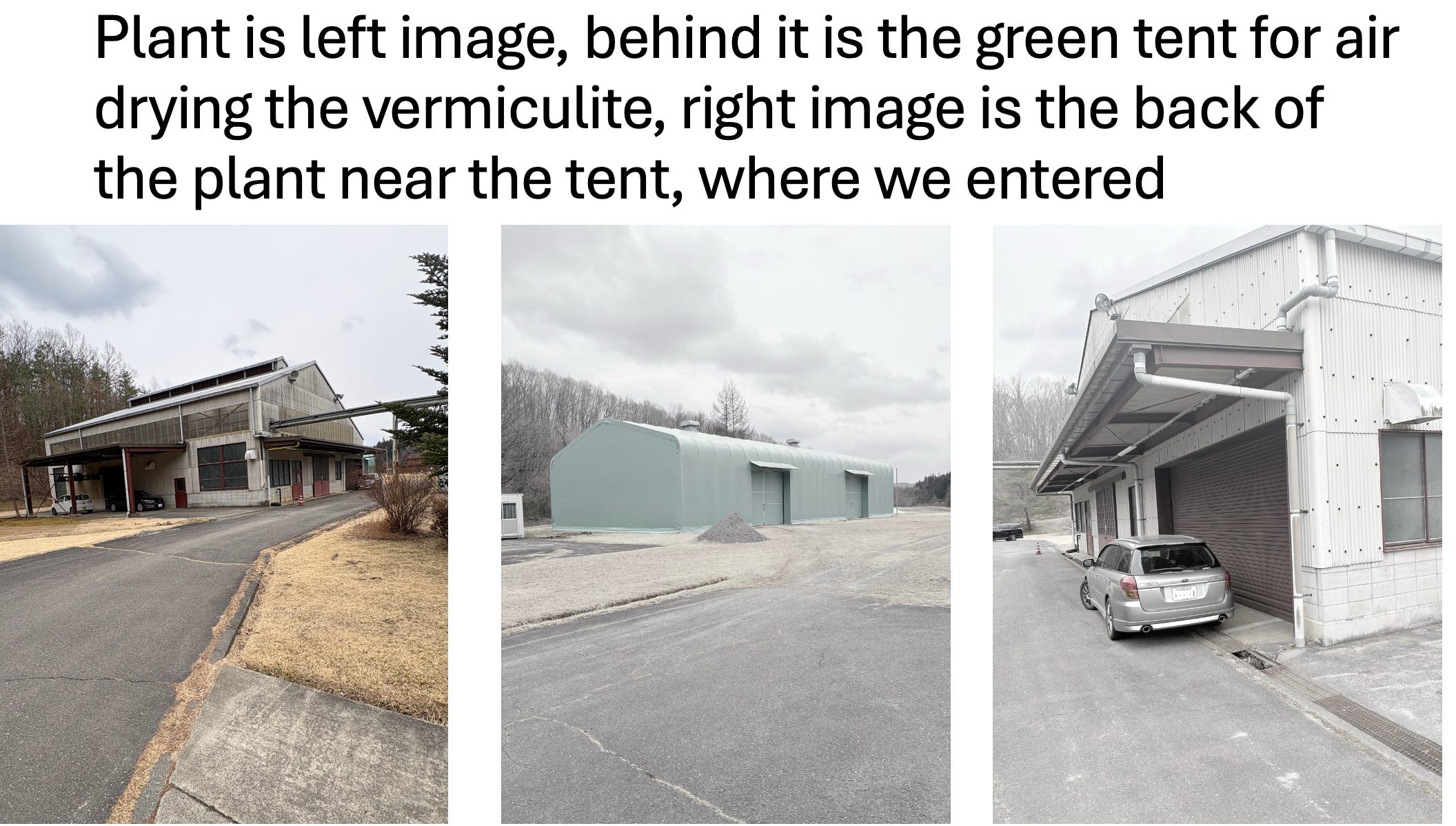
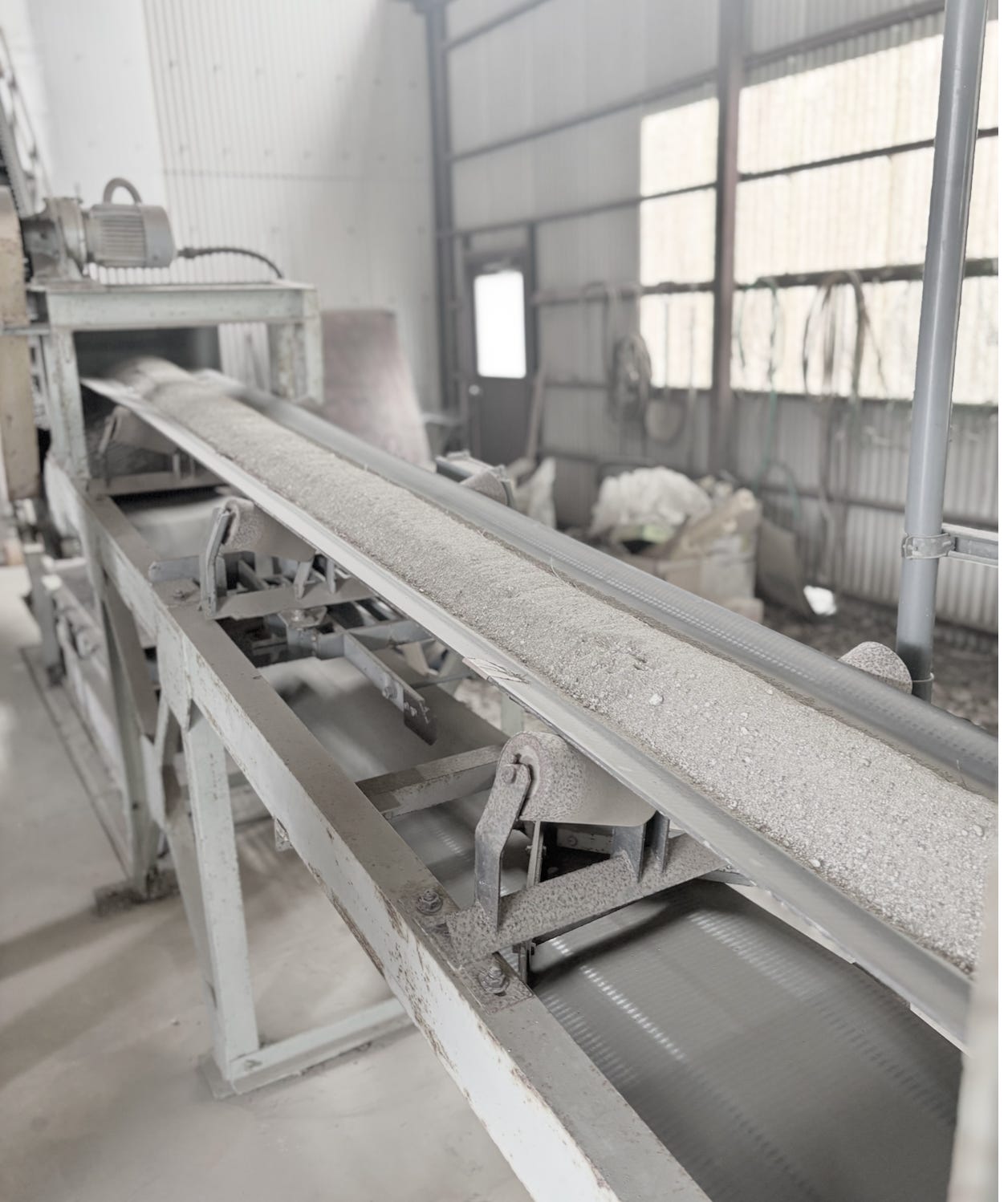
From the green tent, the hydrobiotite/vermiculite goes into this receiving container in the plant’s foyer:
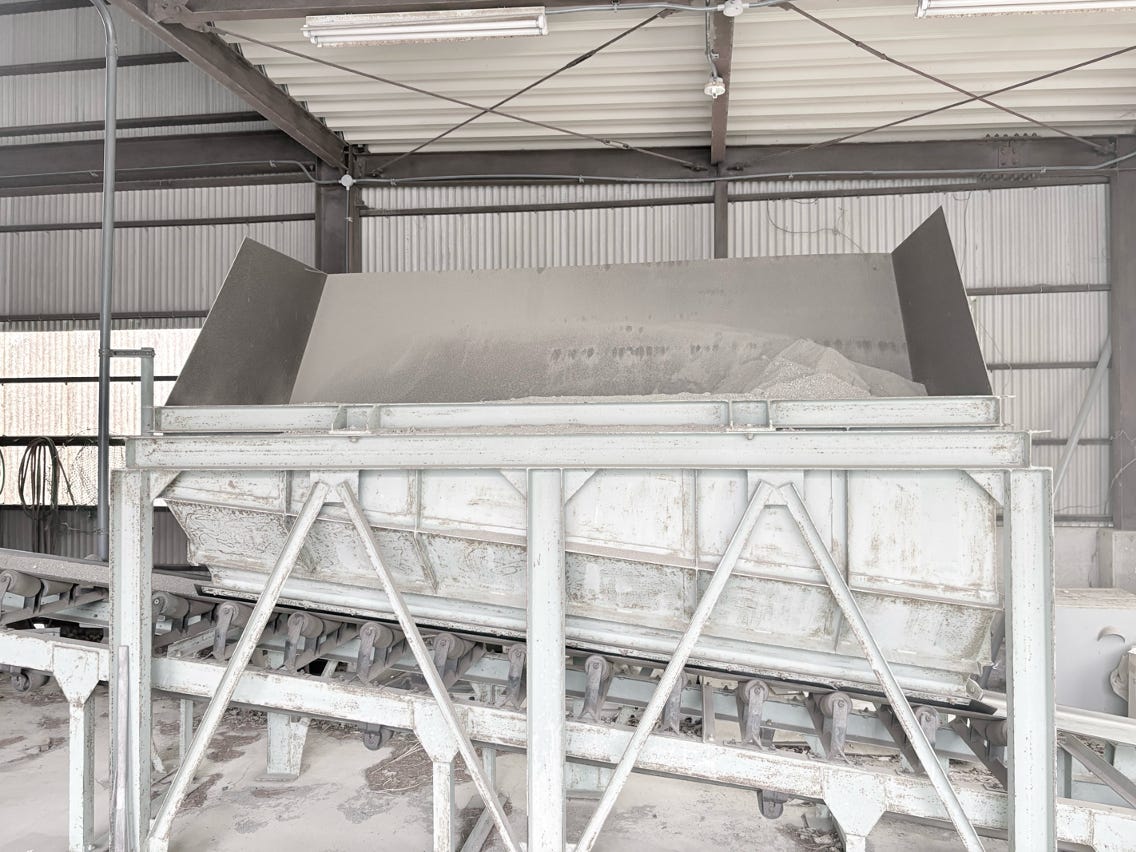
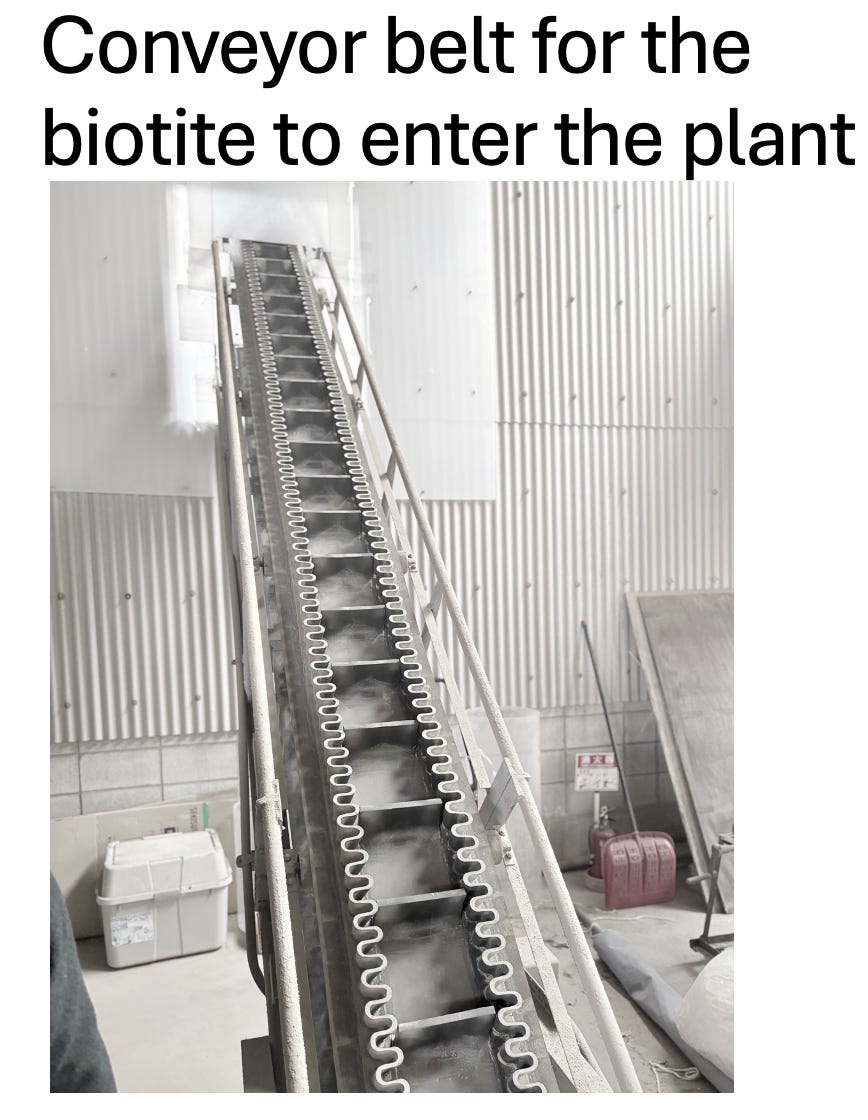
A conveyor belt carries it up into the factory:
There it’s fed into an enormous milling and crushing machine:
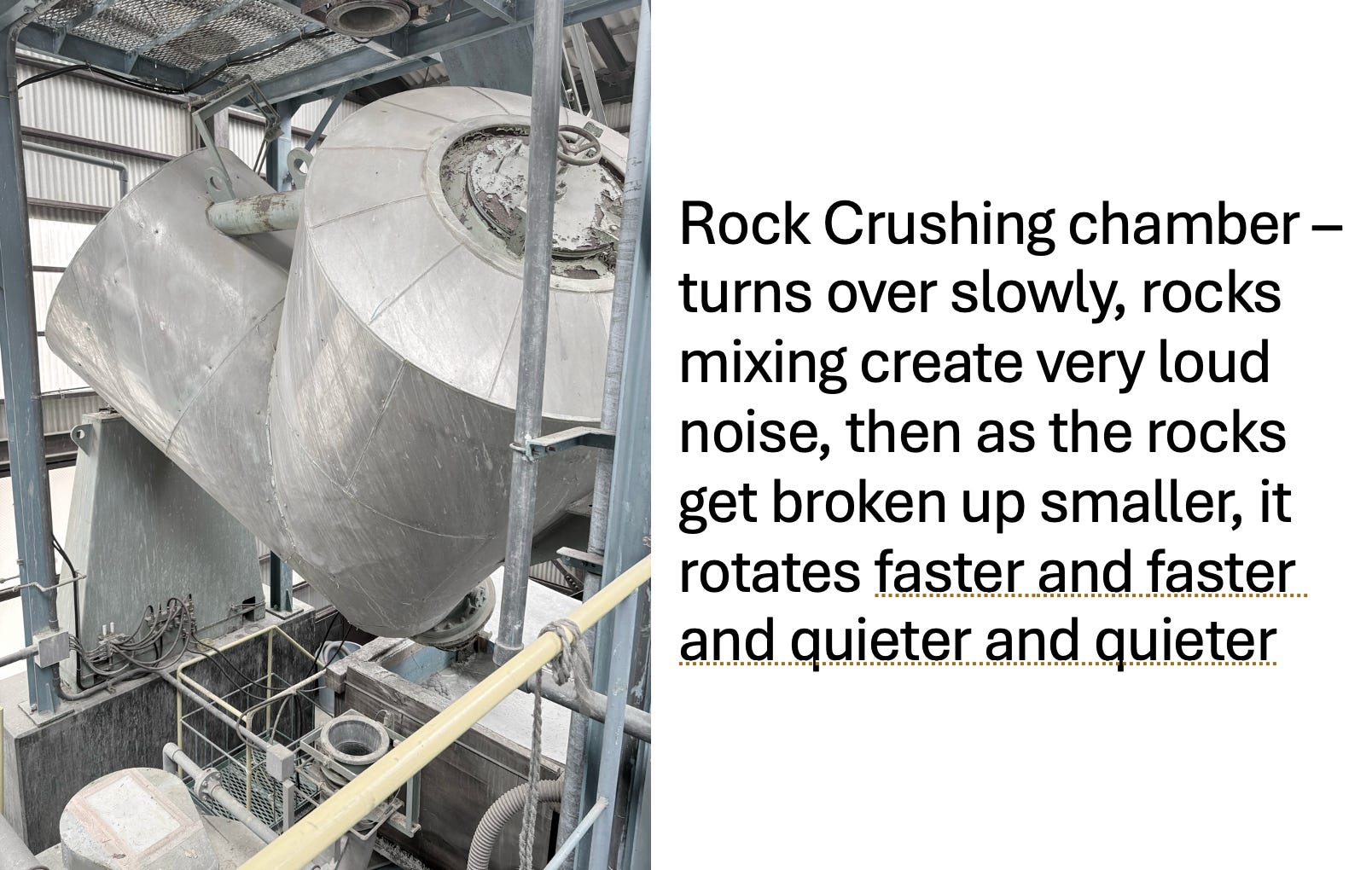
Unfortunately, we didn’t get to see the crusher running, since it apparently makes a terrific racket. The rock comes out as a very fine sand.
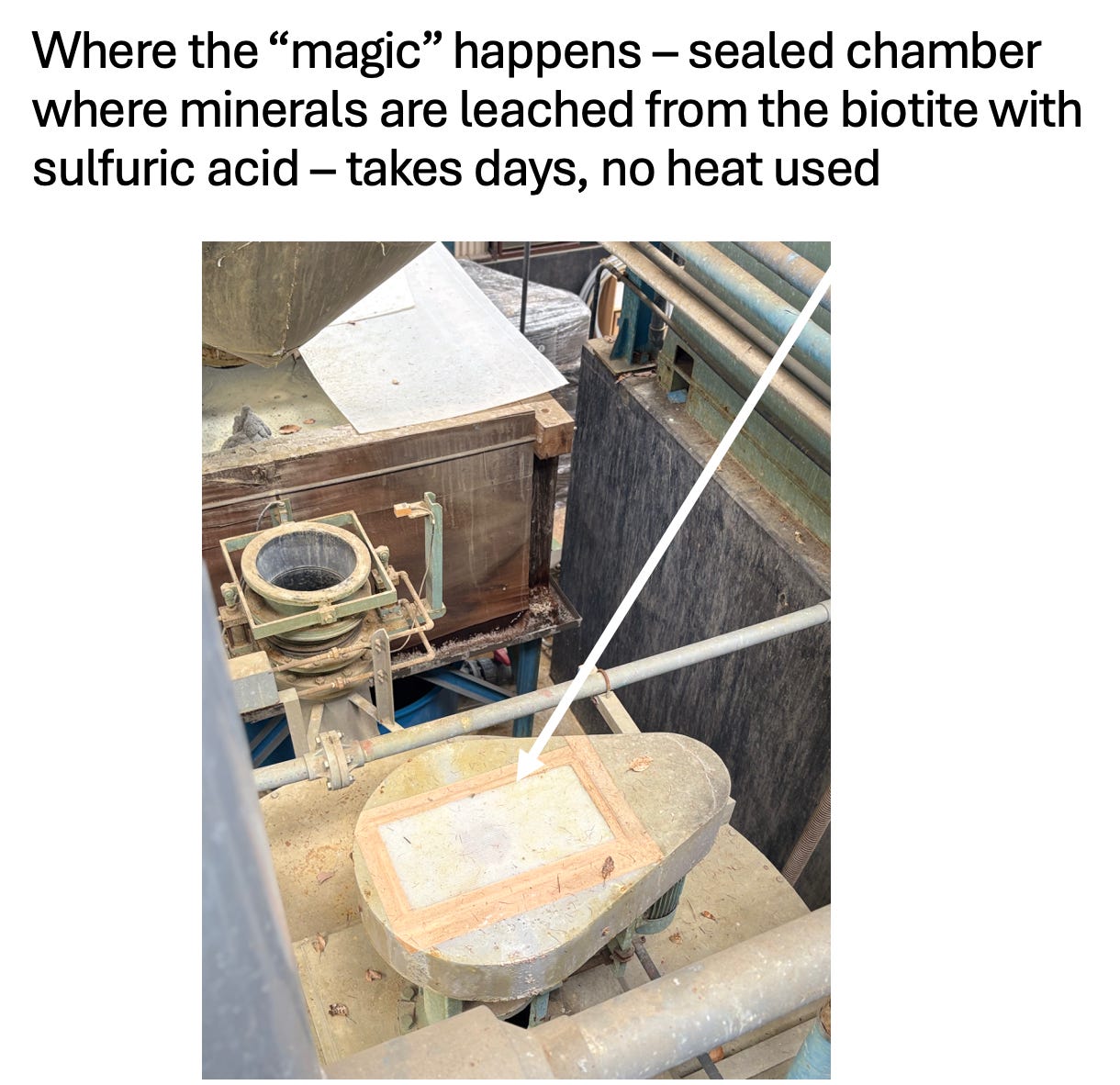
That sand is loaded into this barrel-like chamber and mixed with sulfuric acid until the leachate, the aqueous solution, comes out carrying a broad array of minerals.
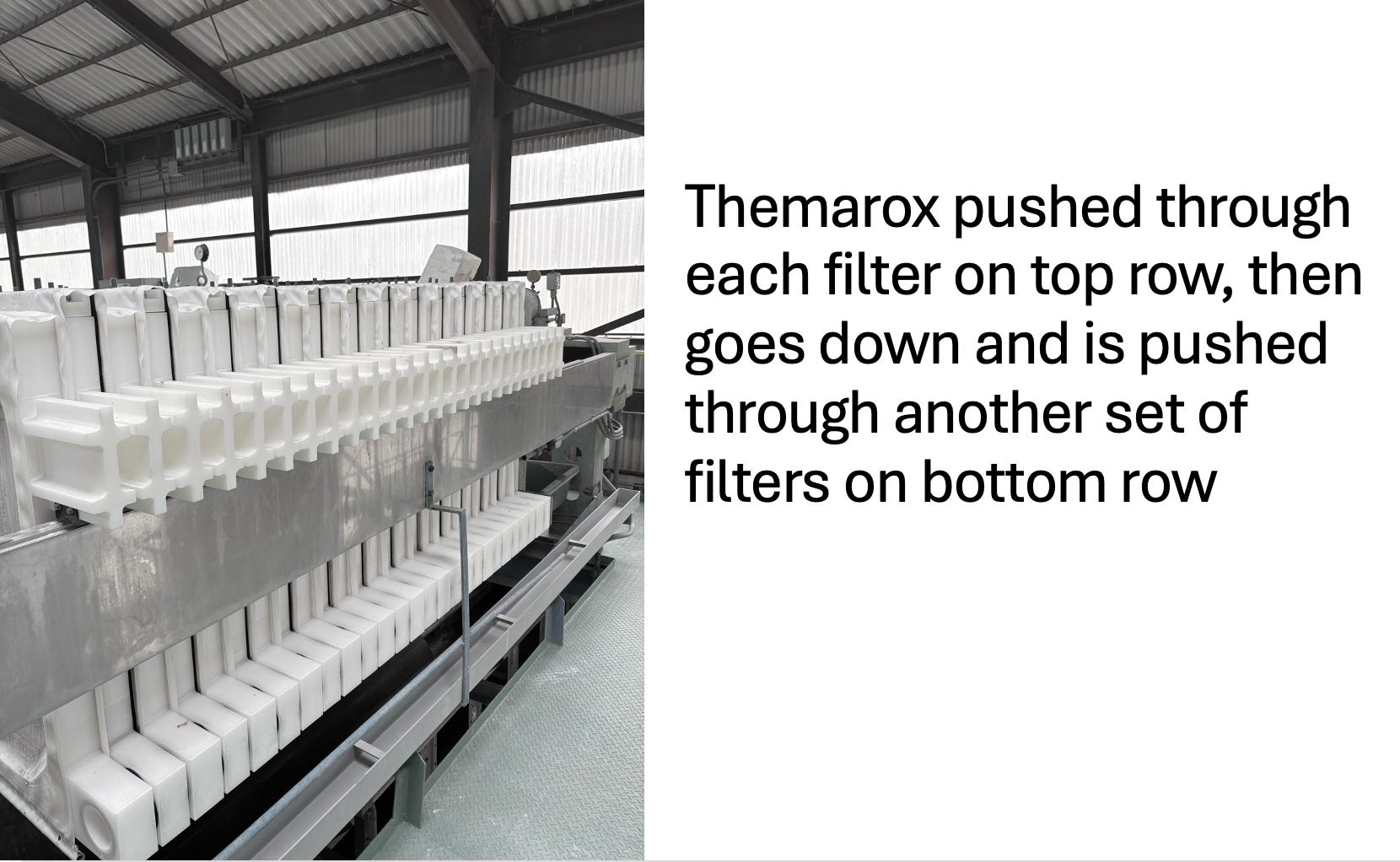
Most of the rest of the process is filtration: three stages that remove impurities and particles, including a medical-grade filter to catch any fungi or spores carried in from the rock.
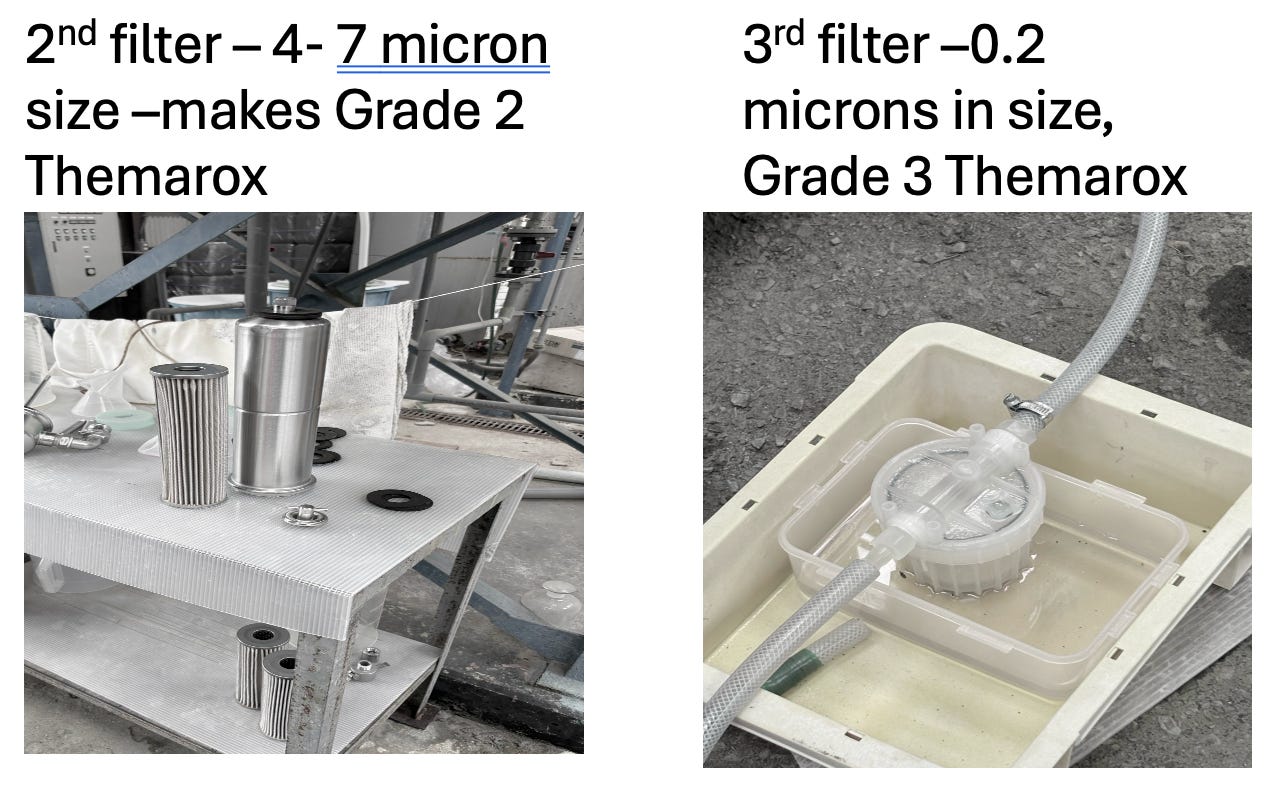
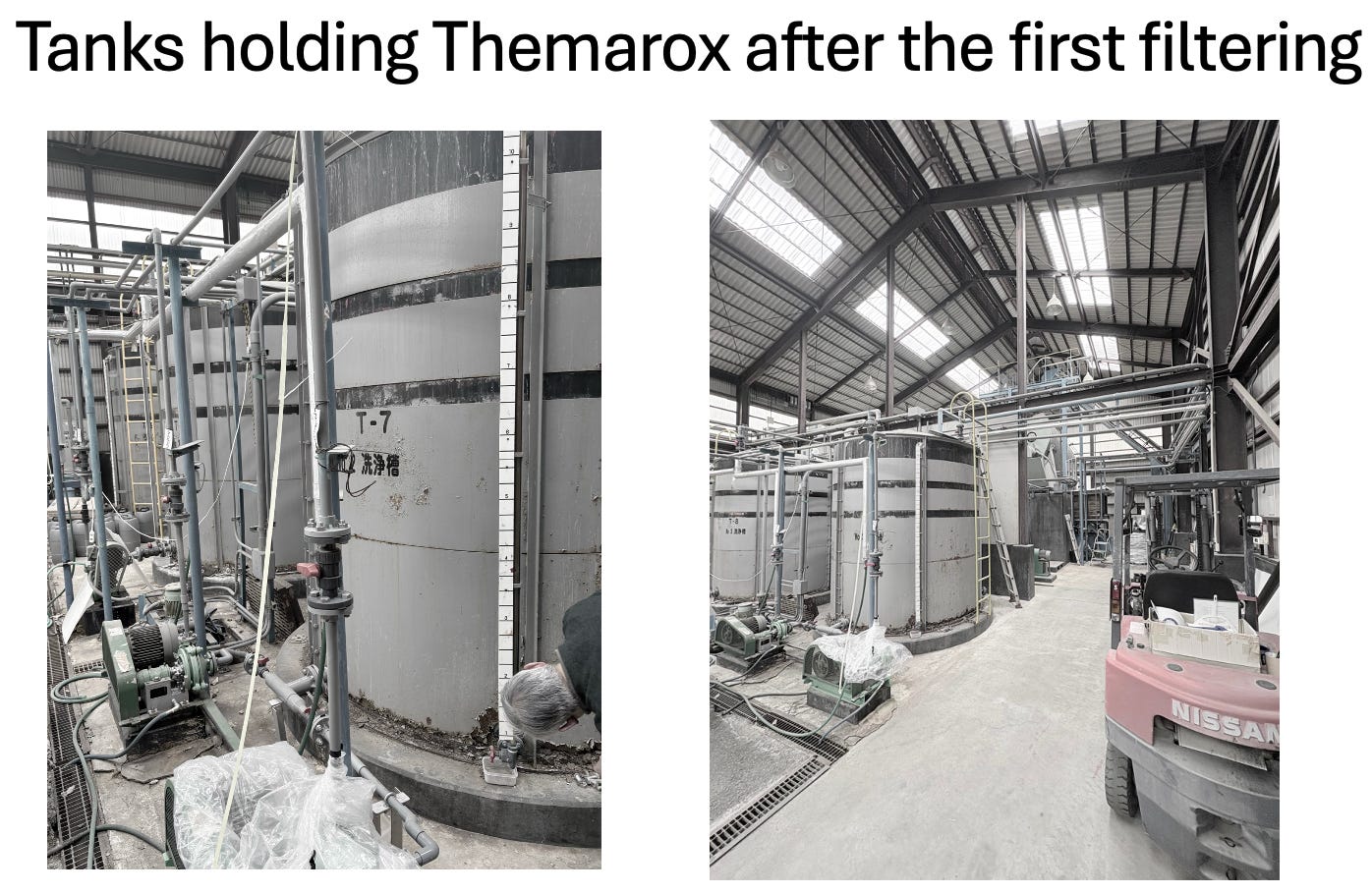
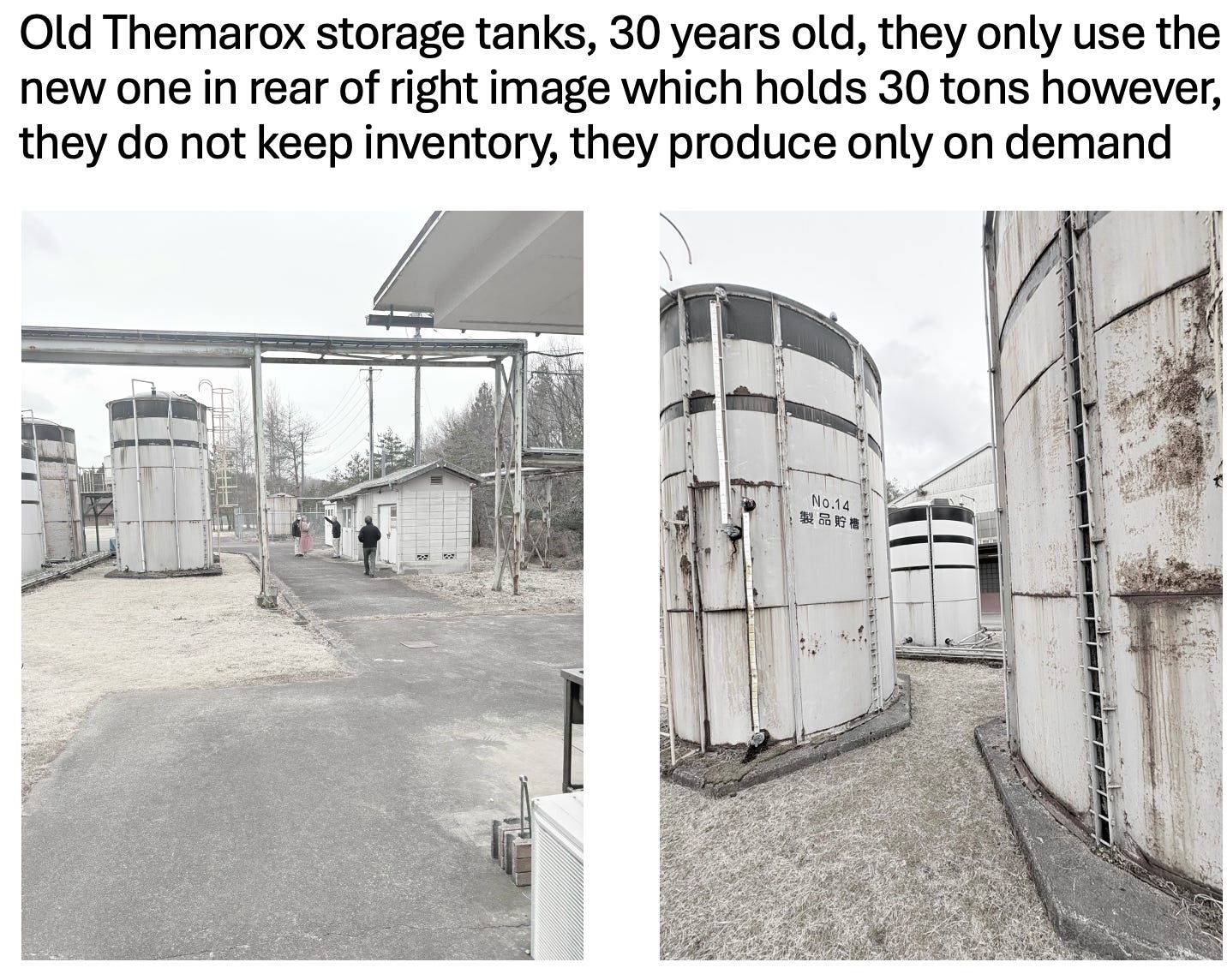
The Man Who Saved Themarox
I found all of it fascinating. But the most important part of the day came at the end, when I finally sat down one-on-one with Mr. Ishii and understood who he really was. He was the one man I had found who knew Shimanishi well. Until recently he had been Shimanishi-kaken’s longtime majority shareholder, and at eighty-six he is still, remarkably, running the plant.
He told me Shimanishi’s gifts did not lie in business or operations. Around 2000, a bitter rupture developed between Shimanishi and the company’s president at the time, and that conflict ultimately led the owners to dissolve the company and sell off its assets.
When the plant went up for auction, Shimanishi asked Mr. Ishii, apparently the only friend with the means, to buy it and keep Themarox in production. Mr. Ishii did. Shimanishi stayed on for a few months afterward, but his heart no longer seemed to be in it. He told his colleagues he wanted to retire, which was highly unusual in Japan, even at seventy-four. They later learned he had tried, and failed, to find investors to start a company of his own. No one has heard from him since.
The years that followed were hard. Shimanishi-kaken barely survived several near-bankruptcies. Mr. Ishii leaned on people like his younger brother, another retired Toshiba executive, whom he asked to work for the company without pay. Learning how dedicated and resourceful Mr. Ishii had been in keeping the company alive, I came to respect him almost as much as Shimanishi himself, which is saying a great deal.
Even now, I believe salaries remain modest, and the company’s leadership is still largely retired Toshiba executives. Corporate men of that era in Japan were often forced to retire at sixty, yet many still needed to work, since pensions alone weren’t enough to live on.
Matt Bakos, my collaborator on the central theories behind the Stone and Water Series, first met these men more than twenty years ago, when they were working without pay. When he asked them why, they answered, “Because we believe what you believe.” Matt has never forgotten that. Nor has he forgotten that in their very first conversation, when he asked about sourcing Themarox, they agreed to make him the sole importer for North America. It was an agreement sealed with a handshake, and they have honored it ever since.
I saw that same loyalty firsthand. Yoshio told me that a Japanese firm had recently approached them to buy Themarox directly. When they discovered the firm was acting for an American buyer, a potential customer of ours who had developed a sudden interest, Yoshio’s answer was simple: “We do not sell to customers of our customers.” I was moved. Knowing that this partnership had run peacefully for twenty years on nothing more than a handshake deepened my trust in what we’re building, and my sense of responsibility to carry the mission forward.
Bullet Trains
Then it was back in the car and on to the long trip home to Tokyo. A long day, but a lot of fun, and I have to put in a word for Japanese trains. They are superb. The bullet train is genuinely amazing. I loved watching it go by almost as much as riding it, and the ride was incredibly smooth.
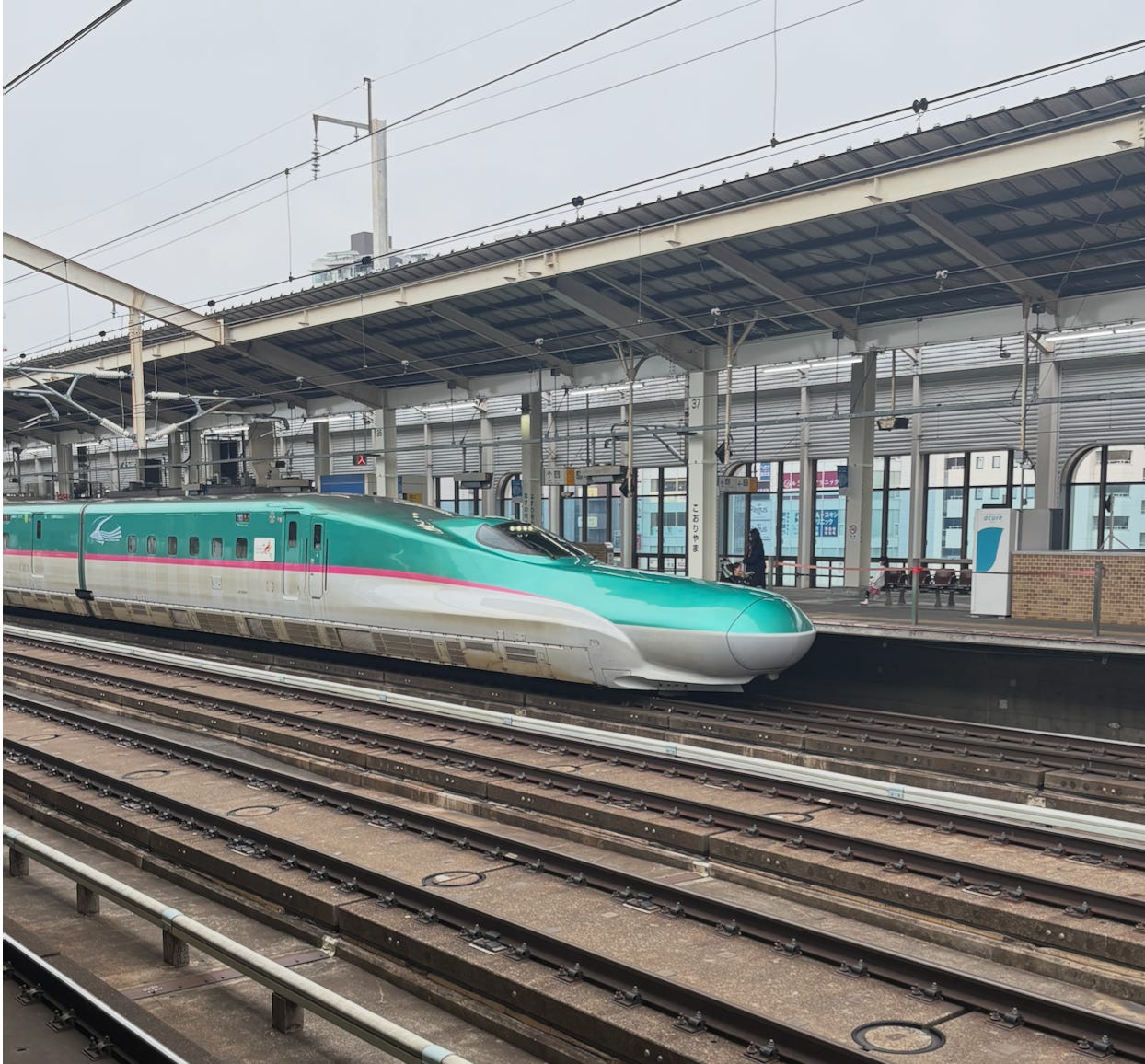
While we waited on the platform, I kept trying to film one racing past, but I simply wasn’t quick enough. They were so quiet and so fast that by the time I knew one was coming, it was too late to start recording. Wild.
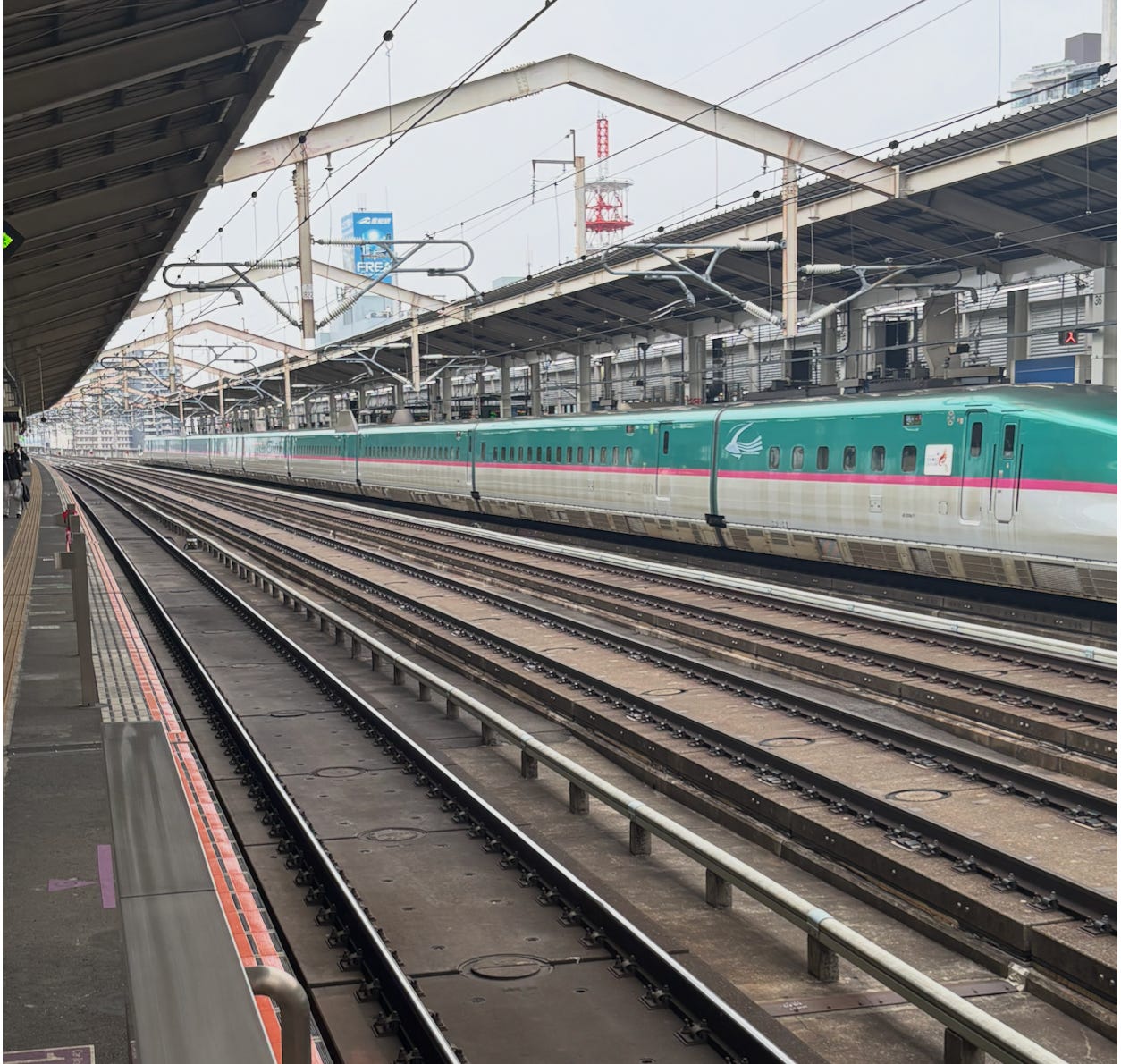
Best of all, you can swivel the seats around and turn a row into a four-seat living room. It made a great setting for talking and getting to know each other.
The Book
Last but not least, the most important find of the whole trip was the copy of Rock-Water that Kenji Torii gave me (see Part 1): an original, pristine copy of the book that supplied the evidence I was missing to finish my own. It was written by a group of Japanese and Chinese agronomists and edited by people who had taken notes at Shimanishi’s lectures.
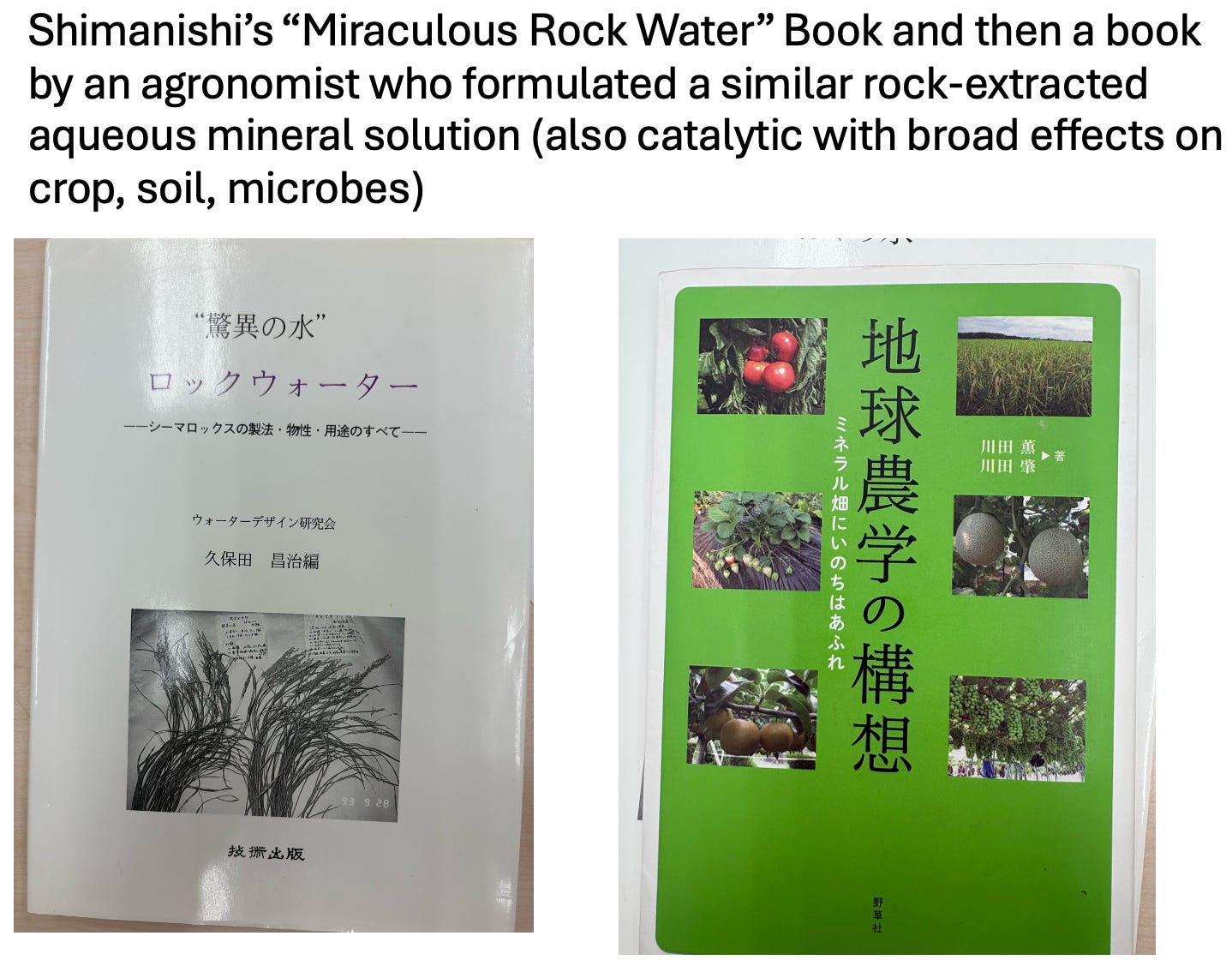
I’ve now devoted a good part of my recent life to Themarox and to the water it creates, what Shimanishi called “Rock-Water.” Connecting with the generation now running his company felt like laying more foundation for what comes next. With a small group of colleagues, I’m trying to demonstrate what this mineral extract can do for the world’s failing crop yields and, more urgently, for treating and recovering our wastewater. Then the goal is to get that in front of anyone who will listen: agronomists, policymakers, Big Ag, politicians. Who knows.
A Detour: Chlorine Dioxide in the Suburbs
The following day, we had lunch at a classic Japanese bento place with Mr. Izumi, a tireless advocate for health freedom and repurposed therapies in Japan, and part of the global network Lisa helped bring together for Children’s Health Defense Europe during COVID. He had asked me to lecture at an independent health-freedom clinic in the Tokyo suburbs, where colleagues gather each month to discuss new findings, so after lunch we headed out.
They treated me as an honored guest, partly because Izumi had been a major source of ivermectin in Japan, so many in the room already knew who I was. A couple of Americans were there, too. I spoke on chlorine dioxide, which fascinated them. There were lots of questions, though several of them already knew about it and were using it.
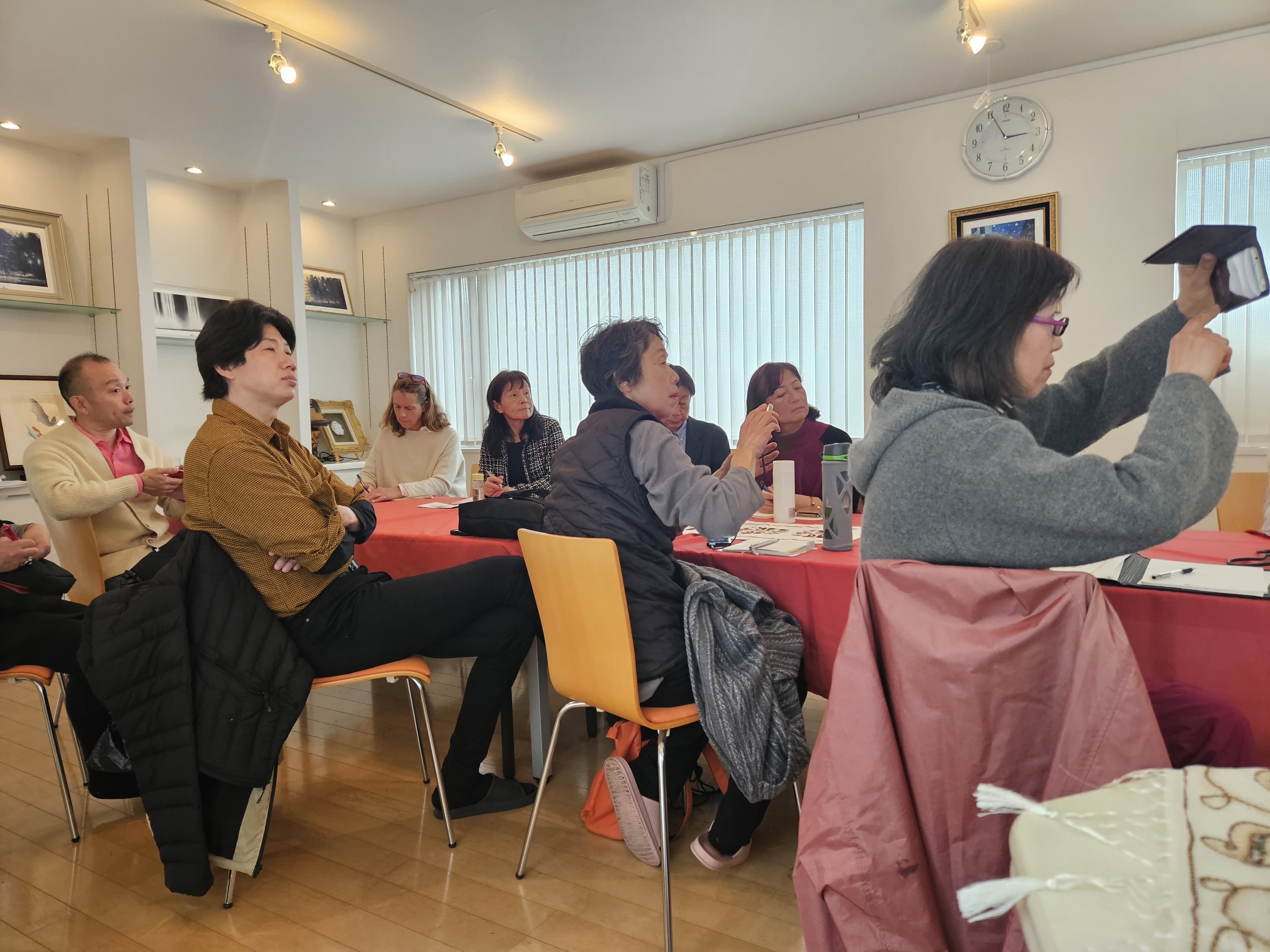
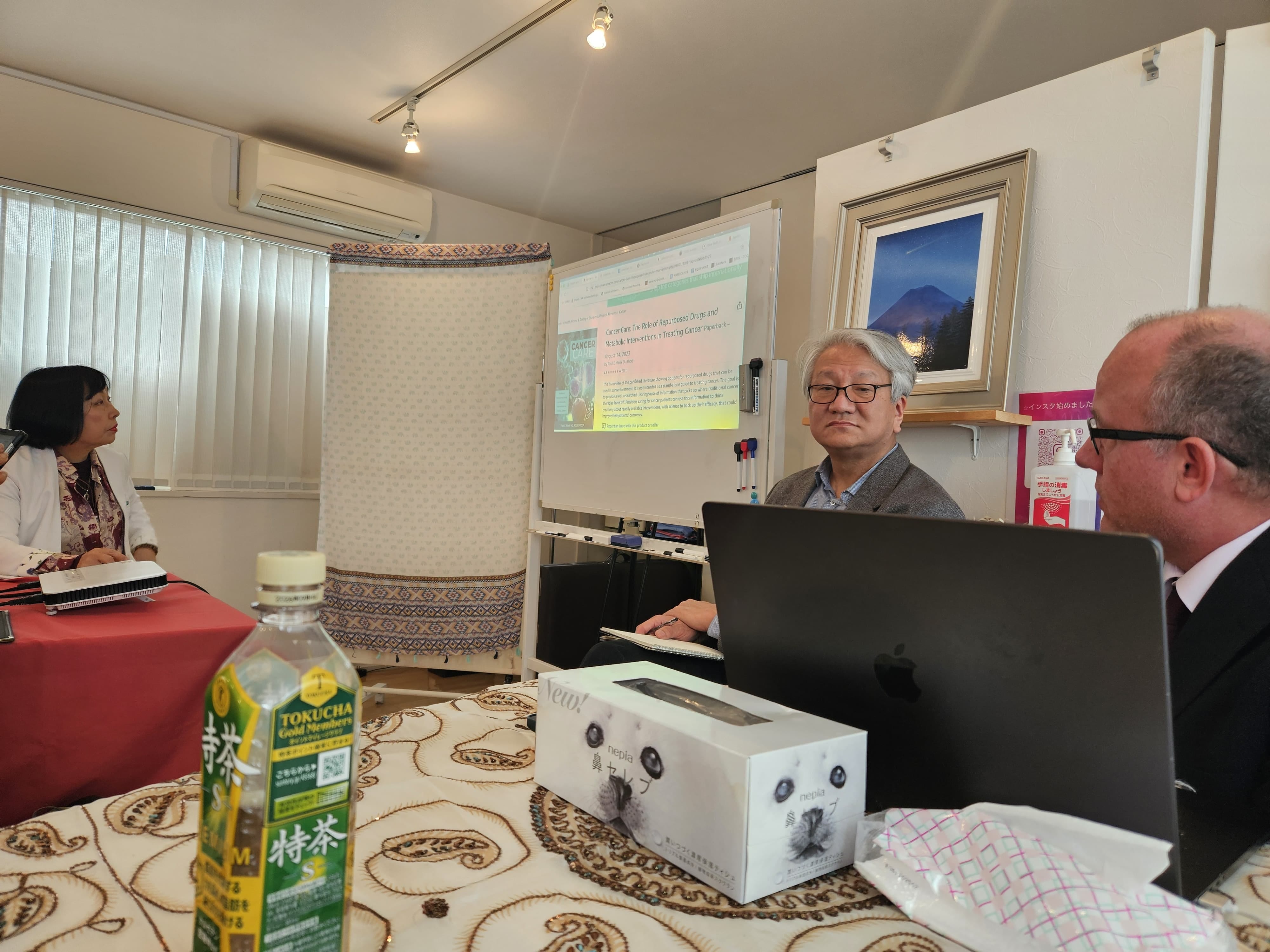
The next day was the unforgettable visit with Professor Omura and his friends and colleagues, and soon after, we headed home: happy, stimulated, and motivated.
If you appreciate the late nights and deep dives that I do, please support my work:
From the Shameless Commercialism Department:
Aurmina is a volcanic mineral water purifier that cleans water the way the Earth always has. Add it to a pitcher. The minerals bind the contaminants, the burden clumps and settles, and you pour off the clear water. Purity and mineral breadth almost always trade off. Unlike reverse osmosis, Aurmina keeps the minerals in — producing one of the purest and most broadly mineralized waters on Earth. Check out our new website here.

Primora Bio relies on the same mineral chemistry in the water that supports what we grow and love: plants, gardens, fish, and pets.

The Stone and Water Series
You can purchase the book series, in whole or in part, from my website ( where all books are personally stamped with my hanko) or from Amazon.
Always an adventure reading your posts! There is no one like you. Your curiosity and “deep dives” are always a benefit to humanity. I’m loving Aurmina!
Dr. Korry,
Thank you for the work you do. I've followed you since COVID. I purchased my Chlorine Dioxide kit but am scared to use it, especially internally.
They're ate so many "opportunists" in the holistic realm now, preying and capitalizing on society's mistrust of mainstream health... and so many deep fakes... I'm hesitant to use info on dig up myself such as Ivermectin dosing and usage for cancer, using methylene blue daily for brain fog, using chlorine dioxide Internally or in your eyes. What can you offer to help us discern fact from snake oil??? You helped lead me to see the truth about COVID. May God bless and protect you.
Have you ever read the book The Hidden Messages in Water?
It was written by the Japanese author and researcher Masaru Emoto. It's a very interesting concept.