


Yesterday, I introduced The Emerald Tablet as a record of Nature’s cycle. What follows is the next step in that sequence.
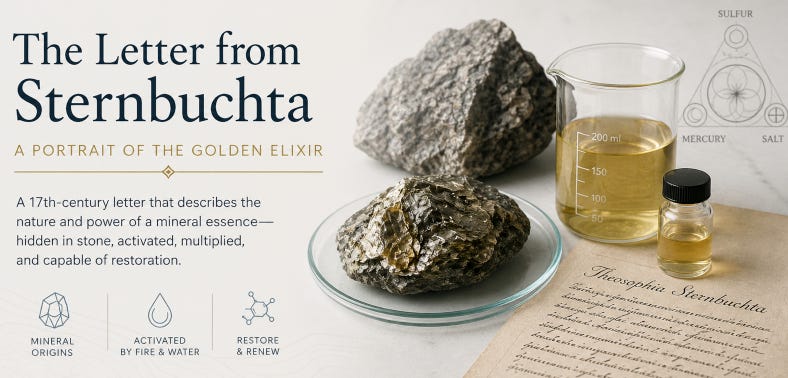
Letter from a Woman Alchemist on the True Stone of Wisdom by Theosophia Sternbuchta gives a portrait of the essence brought forth from within that cycle. Her letter does not primarily describe how that essence is extracted. It describes what it is like once brought forth: a hidden thing drawn from stone, activated, multiplied, and rendered capable of restoration.
The letter appears to originate in the late seventeenth century and was later printed in Berlin in 1779. MB first encountered it in 2006, when an acquaintance passed it along to him. Interestingly, after discovering the letter, he attempted to contact an antiquities professor to discuss it. Soon afterward, the webpage that hosted the Letter from Sternbuchta disappeared. For nearly twenty years, he searched the internet for it periodically. Although he had mentioned it in passing a few times during our initial work together, I had never seen it, so I knew little of what it really contained.
One day, as our alchemical research deepened, he discovered it on an archived Wayback Machine page dated June 5, 2002. The page introduced it as follows:
“This is a never-before-published letter from a female spiritual alchemist of the late seventeenth century. It is a complement to the kinds of spiritual treatises found in works available in The Divine Couple, edited by Robert Faas, and in Wisdom’s Book: The Sophia Anthology, edited by Arthur Versluis.”
Because the archived page includes a notice restricting duplication, I will not reproduce the full text here. Instead, I will only quote the passages necessary for analysis. Readers who wish to read the full letter can do so at this link. Its meaning will likely be much clearer after working through the interpretation that follows.
Who Sternbuchta Was—and Wasn’t
Alchemy occupied dangerous territory. Its practitioners could be accused of heresy, fraud, sorcery, or economic subversion, with gold making chief among them. For that reason, alchemical authors rarely wrote as identifiable individuals. Names were chosen to signal standing within the Great Work rather than to denote lineage, biography, or authorship. Even so, real historical alchemists, obscure as many were, usually left some trace.
Sternbuchta appears to be a constructed name. No historical figure can be securely traced to it, and no record survives beyond the letter itself. Whatever the reason for that, the text puts very little emphasis on personal identity.
In alchemical writing, a ‘feminine voice’ often signals a perspective focused on receiving, holding, and correctly recognizing a process, rather than actively driving or asserting it. “Theosophia” suggests divine wisdom as known through nature. “Stern” points toward what is fixed or celestial. “Buch” means book or record. Taken together, the name suggests a role more than a person.
When I first read the letter, I had not yet undergone what alchemy calls “preparation,” what I would describe more simply as learning to read role-grammar. In that state, the text sounded mystical and cryptic to the point of unintelligibility. Only later, after weeks and months of working across all three texts—tracing repeated words, roles, images, and patterns against the mineral chemistry, Shimanishi’s operations, and the qualities of the mineral essence brought forth from the process—did those same lines begin to resolve into specific, testable meanings.
She writes of a hidden essence drawn from stone, activated by heat, mediated by a mercurial medium, purified in stages, and rendered capable of restoring what had been corrupted. She emphasizes circulation, repetition, and return, and insists that the substance is not consumed by use, but instead “multiplies” in virtue.
What finally became clear to me was that Sternbuchta is not primarily concerned with giving the full procedure. She describes the nature, value, and restorative power of the mineral essence once it has been produced, while preserving only a few glimpses of the steps by which it is brought forth. The letter is written in a symbolic language that conceals the process from a literal reading while revealing it to those with some knowledge of the operations behind it.
Sternbuchta’s Letter, Decoded
Before going further, I should briefly restate the basic interpretive rule. The roles assigned to Sulfur, Mercury, and Salt below are not inventions of ours, but part of the alchemical tradition itself. What mattered for our work was learning to read them as functions within a process rather than as fixed substances. At the risk of repetition, I present the key again here so the passages that follow are not read literally:
Sulfur: activity, heat, oxidation, transformation
Mercury: fluidity, mediation, transport, dissolution
Salt: structure, stability, fixation
Let’s start with the first.
“Form and materia are two substances, which are our field and magnet, because every agens needs its corresponding receptacle. . .”
“Materia” refers to a raw earthly mineral. “Forma” is an activating force, that is, a fire-, water-, or sulfur-driven action. The marriage of form and matter mobilizes dormant mineral chemistry into a bioactive ionic form outside the mineral body: able to interact with water, bind impurities, structure charge, and restore balance. Read this way, the passage mirrors Shimanishi’s Themarox, produced by sulfuric acid acting on vermiculite.
“One sulfuric, one mercurial. . . king and queen. . . greatest enmity until united.”
Hermetic texts consistently describe Sulfur as solar, active, and fiery, and Mercury as receptive, dissolving, and mediating. In this passage, those opposing roles map cleanly onto sulfuric acid acting on vermiculite: sulfuric acid supplies the activating force while vermiculite serves as the receptive mineral body, and together they mediate the release of mineral essence from rock into water.
“This tincture is powerful enough to be used as medicine. . . prevent all illnesses.”
In alchemical language, “medicine” refers to a substance that restores order and coherence, while “illness” names any state of corruption, imbalance, or decay within a system, not a specific biomedical condition.
• “This is the multiplication in quality . . .”
• “The tincture . . . is multiplied in its virtue”
• “The multiplication in quantity proceeds thus”
In the older literature, multiplication did not refer to an increase in mass, but to an increase in effect, a gain in virtue disproportionate to the quantity applied. In modern terms, it describes a function whose influence extends far beyond its physical volume.
This multiplicative property is the clearest connection between Sternbuchta’s Golden Elixir and Shimanishi’s Themarox. A single milliliter of Themarox can clarify up to ten liters of water. Aurmina, a 10 percent dilution of Themarox, can clarify roughly one liter. For centuries, the Golden Elixir was described as possessing this same multiplicative property. One of the first observations Shimanishi made about his mineral extract was that it behaved in precisely this way.
A First Reading
At this point, the reader has enough of our key in hand to begin recognizing some of Sternbuchta’s recurring patterns without full guidance. What follows is a small cluster of phrases from the letter that can now be read more fruitfully than they could at the outset. They circle the same relations and operations repeatedly—one of alchemy’s most characteristic habits—and they prepare the reader for the even more elaborate repetitions of The Six Keys of Eudoxus.
Descriptions of the person who might succeed in the work appear in phrases such as:
• “Whoever wants to do something fruitful in this work should turn to it with all his diligence, work, and care.”
• “One cannot hurry the work.”
• “Whoever can make them lay together . . . can thus unite them inseparably and make something corporeally new.”
Descriptions of the substance itself, referred to as “medicine” in the alchemical sense, appear in phrases such as:
• “That is truly the beginning of our true medicine.”
• “He can be certain of an unending treasure.”
• “This tincture is powerful enough to be used as medicine . . . to restore the human body . . . with the highest usefulness.”
The language also repeats the same underlying polarity already seen in the Emerald Tablet: activating forces and receptive bodies.
• “One lunar, the other solar.”
• “Make them lay together . . . unite them inseparably.”
• “King and queen . . . though in enmity, must be joined.”
And again and again, the letter returns to the actions of sulfur chemistry:
• “The spirit of its father”
• “To extract out of it the Fixed Salt, which is the Blood of our Stone.”
• “One is mercurial, the other sulphuric.”
• “Mercury of the Wise, its secret fire.”
• “Enkindle the metallic sulphur through their fiery spirit.”
What Sternbuchta Sees Clearly
It became clear to me that Sternbuchta was not giving a practical recipe for producing such a substance. What she gives instead is more obliquely related to process: a symbolic account of the kind of union, activation, and work by which such a substance would be brought forth. Alongside that, she gives a portrait of what it would be like once produced, and of the kind of person who might succeed in the work. The letter is a remarkably precise description of both the medicine itself and the conditions under which it comes into being.
For the sequence of steps by which the essence is brought forth, we have to turn to a different kind of text: The Six Keys of Eudoxus. If this post has made you more intrigued than exhausted, the next stage of the labyrinth begins here.
A note for readers: In the next post, we will turn to a 17th-century text that describes the procedure by which the mineral solution was said to be prepared.
For those interested in how that knowledge has re-entered the world in material form, I invite you to explore Aurmina (“golden mineral essence”) — a name we chose before we fully understood what it pointed to, and one that will become clearer as this series unfolds.
Yes, this is a product, and part of a company I am building around this work, because at some point the work had to leave the page and enter the world.

*If you value the late nights and deep dives into all the “rabbit holes” I write about (or the Op-Eds and lectures I generate for the public), your support is greatly appreciated.
From Research to Practice - Links Below Image
There is nothing wrong with studying ancient texts for an understanding of what science was about in those times. We have an arrogance indoctrinated in us that says only modern science has the answers. We’ve actually been programmed in our educational systems to accept only what we are taught inside the system and to dismiss everything else. In America we took that even further and dismissed what scientists in other countries studied and discovered. In doing this we have closed off our minds and hearts to past knowledge we were using, successfully at one time. And can still rediscover and put to use, now. We humans have actually allowed religion to dictate what we study and what we can and cannot accept as useful. We also got hoodwinked by oil industry leaders and wealthy politicians to drop older versions of medicine, or other sciences, in favor of new medicine based on synthetic junk meant to keep people sick in order to turn a profit. That wasn’t good science. It wasn’t good medicine. Ultimately, it will become a bad business trap as people wake up to curative possibilities kept from them in favor of medicine that works. It definitely closed us spiritually to whole realms of understandings of life and our connectedness with the Divine and what that might be.
Your studies - as with any honest form of study - is not only valid. It might help the human species survive.
I have read fairly extensively about alchemy. To some extent herbal medicine and homeopathy are shallow remnants of that older life science. That science was inclusive of all things in life including planetary and universal energies and the discovery that there are ways to manipulate those energies. Without needing a machine to do so. It includes processes and protocols to achieve certain goals. Like anything we make, if you don’t have all the bits to the process you don’t achieve the goal. Or achieve it badly. We’ve lost those bits over time except in ancient texts such as those you are delving into. Just stay grounded in your moral and spiritual paths. Energy is energy. It can be used in the Light. It can be used otherwise. So long as you follow protocol you get a result. You still choose how that result can be used. Much like knowing how to use the energy of minerals and chemicals to make a bomb or a curative substance. Stay grounded so choices are as well.
You need not explain why you were drawn to study the ancients, Dr Kory. To realize that they, too, had discovered what you and MB have landed on is exciting. There have always been inquisitive minds, and to dismiss them is to our detriment. I would suggest that modern man has lost the ability to commune with nature as well as the ancients did because we are more removed from it in our comfortable homes that provide for our needs and protection.