


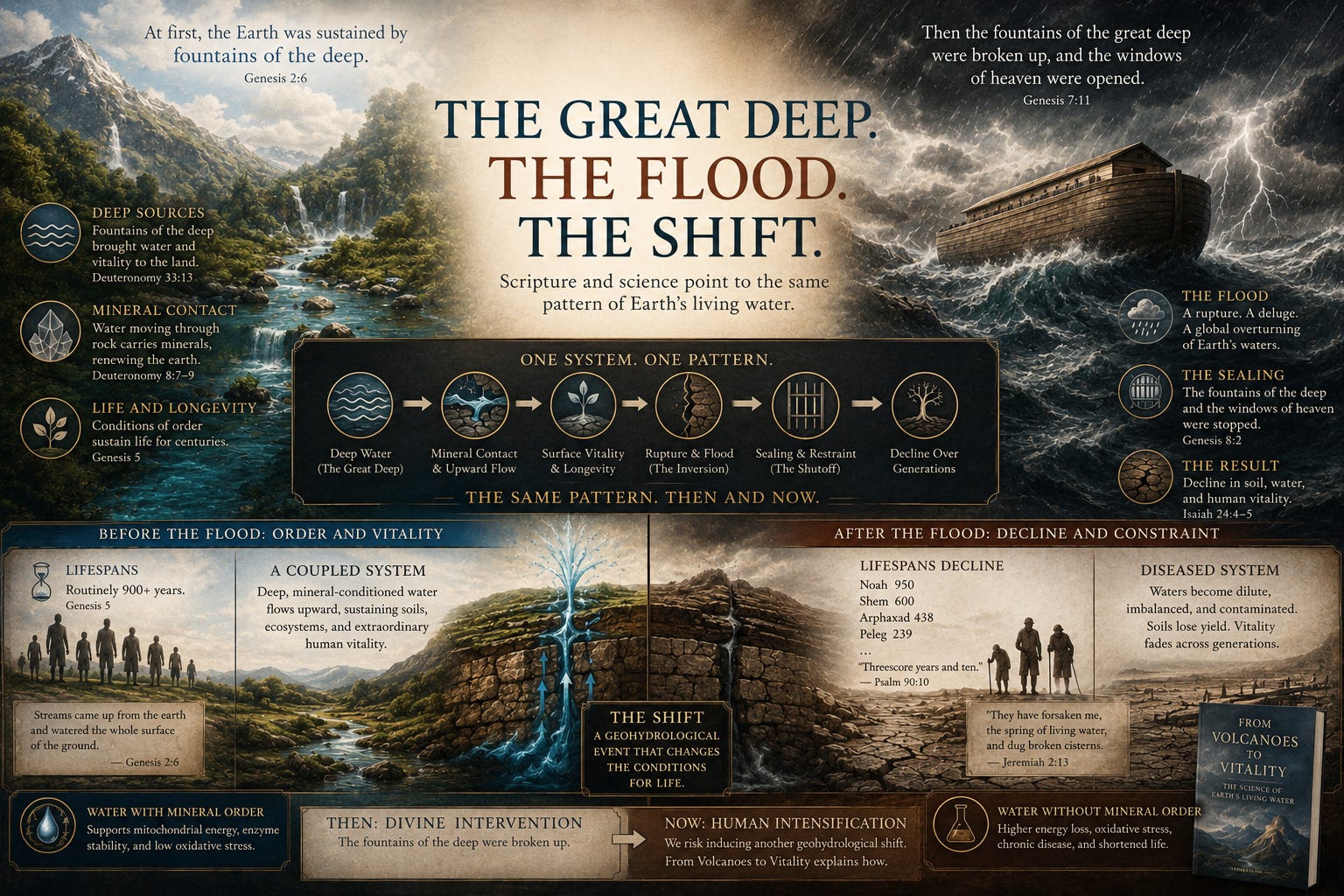
*Excerpted from “The Blueprint of Life,” which is shipping early to the middle of next month.
What follows is a hypothesis that emerged late, after enough pieces had fallen into place for a larger pattern in Scripture to reveal itself.
MB called me as I neared what I believed was, once again, the eve of submitting From Volcanoes to Vitality (FVTV). Of the hundreds of calls we have shared, many had brought some new convergence, but this one felt different. He believed he had found scriptural confirmation that the global water-quality shift we had been articulating in FVTV had happened once before. He was describing something deeper than mineral depletion: a failure of the conditions that allow water to carry mineral order, sustain gradients, and coordinate life.
He believed a Geohydrological Shift had occurred once before.
I did what I always do when someone makes a claim like that: I tried to debunk it. I asked AI to help me search widely for the recurring structure, especially in places where Scripture speaks of deep systems, fountains, rupture, sealing, and downstream consequences. What returned did not feel cherry-picked. Scripture seemed to be describing a coupled hydrologic system, followed by what happens when that system is violently inverted.
In Scripture, the “Great Deep” refers to a vast, primordial reservoir of waters beneath the Earth. It is presented as a source system, not as an inert body of liquid.
In modern terms, this resembles what our Rock–Water Circuit Theory identifies as a critical deep geologic water system, where significant quantities of water exist inside Earth as hydroxyl bound within minerals rather than as underground oceans. Discoveries involving ringwoodite-bearing diamonds, mantle plume studies, hydrothermal systems, and deep borehole data show that Earth’s interior contains enormous amounts of mineral-bound water and deep geochemical fluids capable of interacting with surface hydrology over long timescales.
These deep geological waters do not currently contribute significant volume to the larger hydrologic cycle. Their importance lies in disproportionate hydrochemical influence through mineral loading, redox chemistry, dissolved gases, hydrothermal circulation, and long-term water–rock interaction. In Rock–Water Circuit terms, the “Great Deep” resembles a deep geodynamic source system capable of chemically conditioning portions of the waters that eventually reach surface biology.
The full scientific framework for why we believe a geohydrological shift is underway in our time, along with the practical case for addressing it, is presented in From Volcanoes to Vitality. The current shift has not reached full collapse. Scripture, however, offers a striking picture of systemic hydrologic rupture carried to its end.
Here, I want to show what Scripture says that rupture looks like: the Great Deep as source system, the Flood as rupture, the resealing as shutoff, and the long decline in vitality that follows.
Biblically, the sequence is explicit. Genesis begins with the formation of the Great Deep, the Earth, and the skies above.
“Let there be an expanse in the midst of the waters, and let it separate the waters from the waters.”
—Genesis 1:6 (ESV)
“God made the expanse and separated the waters that were under the expanse from the waters that were above.”
—Genesis 1:7 (ESV)
The waters below are identified by both their extent and their vitality: “fountains of the Deep,” or “the Great Deep.” Fountains imply emergence, movement, and renewal. They point to dynamic interfaces between Earth and life.
“Streams came up from the earth and watered the whole surface of the ground.”
—Genesis 2:6 (ESV)
“For the LORD your God is bringing you into a good land, a land of brooks of water, of fountains and springs, flowing out in the valleys and hills; a land of wheat and barley. . .a land whose stones are iron, and out of whose hills you can dig copper.”
—Deuteronomy 8:7–9 (ESV)
Here, the Deep is referenced as a source of “precious things.”
“Blessed by the LORD be his land, with the precious things of heaven, with the dew, and with the deep that crouches beneath.”
—Deuteronomy 33:13 (ESV)
These are symbolic images, but they also describe a coupled system: deep water, mineral contact, upward flow, and surface vitality.
I do not want to overstate the parallel. Human beings have always known about springs, wells, fountains, and water beneath the ground, but modern geology has only recently described the deeper version of that picture: water stored in crustal rocks, moving through hydrothermal systems, rising through faults and fractures, and existing deep in the mantle as hydroxyl bound within minerals.
Scripture’s “Great Deep” is not a technical description of modern geology. It does, however, resemble the broader concept of a deep, mineral-contacted source system through which water, rock, pressure, heat, and chemistry participate in the vitality of the surface world.
Early biblical descriptions do not give us depleted soils, fractured aquifers, diluted rivers, or stripped water. They evoke a world sustained by upward flow, a hydrologic system capable of maintaining biological vitality over centuries.
As explored earlier, water conditioned by prolonged mineral contact supports lower energy loss, more stable redox behavior, tighter proton gradients, improved enzymatic function, more stable protein conformations, and decreased oxidative stress. These are the physical conditions required for mitochondria to operate efficiently, for detoxification pathways to function without strain, and for cumulative biological damage to remain low over time.
Under those conditions, vitality and longevity would be expected.
Human lifespans routinely exceeded nine hundred years in the Bible. Noah is described as being six hundred years old as if that were unremarkable. The genealogies of Genesis 5 repeatedly mention lifespans approaching a millennium. Adam lived 930 years. Methuselah lived 969 years.
These are presented as norms.
The Great Flood
Scripture then records a decisive alteration to the Earth that had been so carefully formed. God closes “the Great Deep” and lets loose “the Flood.” Scripture is clear about his reasons:
“The LORD saw that the wickedness of man was great in the earth, and that every intention of the thoughts of his heart was only evil continually.”
—Genesis 6:5 (ESV)
Violence, in particular, is emphasized:
“Now the earth was corrupt in God’s sight, and the earth was filled with violence.”
—Genesis 6:11 (ESV)
Soon after, the Great Flood arrives. For that to happen, God breaks apart the fountains of the Deep and sends massive rains over Earth:
“In the six hundredth year of Noah’s life, in the second month, the seventeenth day of the month, the same day were all the fountains of the great deep broken up, and the windows of heaven were opened.”
—Genesis 7:11 (ESV)
Something beneath the Earth ruptures, inverting the planetary hydrologic system. Scripture describes the Flood in literal terms as a rupture on a planetary scale. Rain falls for forty days and forty nights. The waters prevail for one hundred and fifty days. The mountains disappear beneath them. From onset to full drying, nearly a year passes.
The scale is clear. In my reading, this is systemic collapse, global overturning, and a hard reset of Earth’s water system.
After the Flood, Scripture records something equally explicit:
