


*Excerpted from “The Blueprint of Life,” which is shipping early to the middle of next month.
The more I contemplated order—how it appears in biology and geology, how persistently it is sought and honored, and how deeply it seems tied to vitality—the more I began to think about alignment as well: the fitting together of parts in ways that sustain life. Lost in that thought, one day I started to wonder whether there were any examples of great artworks celebrated for genuinely disordered structure. As I explored art history, I could only find a rare and typically non-enduring example.
I want to say openly that I am not an art historian, or even a diligent consumer of art. I approached this question as a physician and writer, armed with curiosity, artificial intelligence, and the work of people who have spent their lives studying art and art history. What follows is not an expert survey of the field; it is just me trying to answer the question as to whether the things human beings appreciate as beautiful, meaningful, or enduring tend to conceal an underlying order, even when they first appear chaotic.
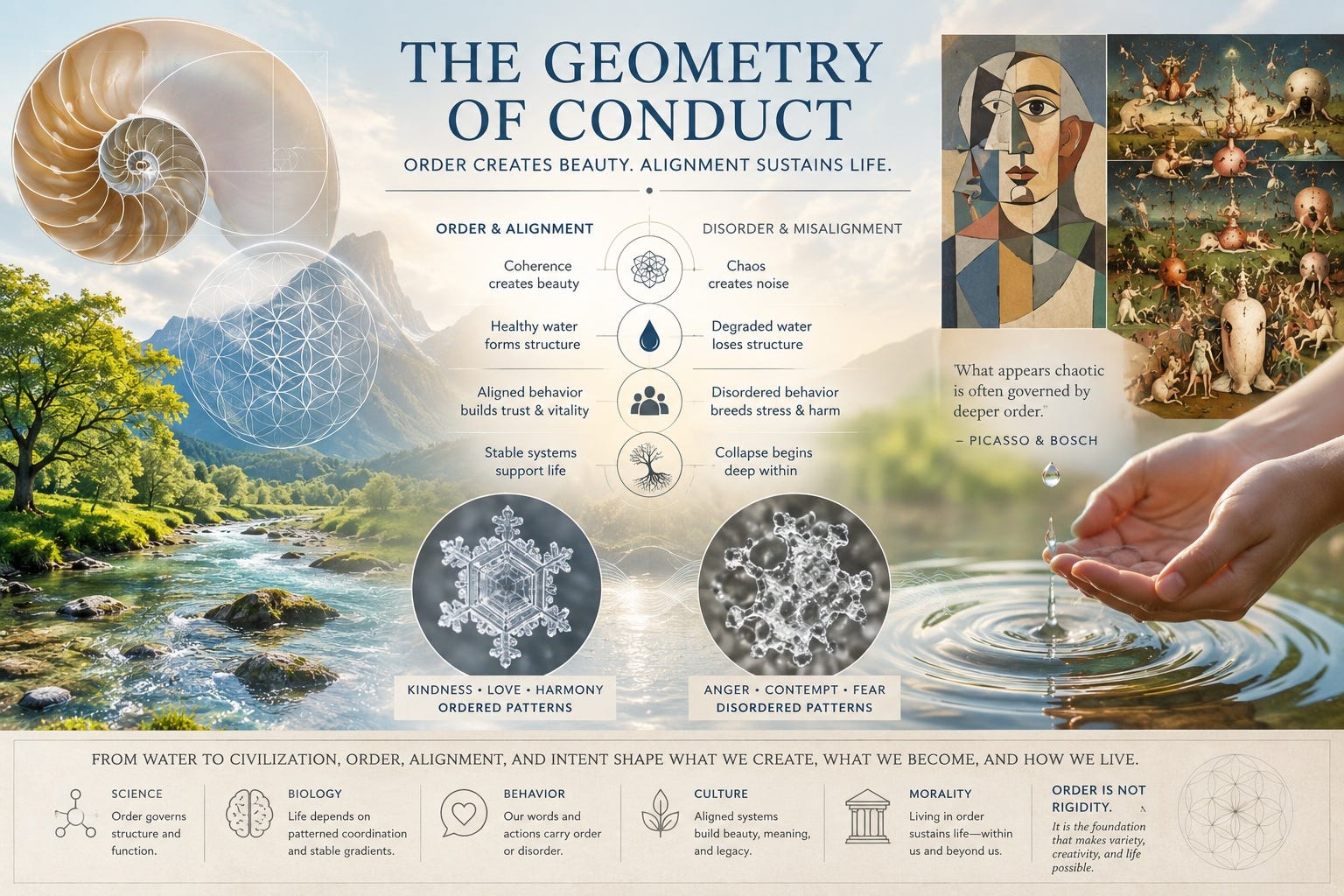
Even movements often described as chaotic—Cubism, Surrealism, Dada—are powerful because they strain against an underlying order whose internal relations remain aligned. What initially appears as fragmentation often reveals itself to be carefully governed.
Take Picasso. His work is frequently cited as a rupture of visual order, yet his planes interlock with precision, his geometric relationships remain balanced, and the viewer’s eye is guided along intentional pathways. What some see as chaotic is actually disciplined complexity.
The same is true of Hieronymus Bosch. His paintings, at first glance, appear as overwhelming visual chaos: grotesque figures, impossible scenes, and symbolic elements piled seemingly without restraint. Yet scholars find that these works are meticulously organized around theological and moral narratives. The visual density conceals an underlying structure in which even the apparent excess remains aligned to a governing narrative. The longer one looks, the more the underlying order reveals itself.
This pattern repeats across music, literature, and architecture. Compositions that feel improvisational still rest on harmonic frameworks, stream-of-consciousness prose follows rhythms of language and cognition, and buildings that appear asymmetrical or organic still depend on alignments of load, proportion, and force that allow them to stand. True disorder, when it occurs, is rarely valued aesthetically. It is experienced as noise rather than meaning and quickly forgotten.
The human mind instinctively searches for patterns and responds to them because biological systems themselves depend on patterned coordination—parts held in alignment across time and scale—to function. Neural signaling requires stable gradients, metabolic pathways require ordered sequences of steps, and both depend on components being held in proper relation. Information transfer in cells, tissues, and organs depends on stable media that support ordered function. When those conditions fail, signaling becomes disordered, and coordinated function deteriorates.
Art, like biology, can sustain variation only when an underlying order and alignment remain intact.
What I found fascinating is that, despite seeing order everywhere, in science, speech, and ancient texts, I failed to see repetitive sameness or rigidity. Instead, I saw an astonishing variety. A world governed by order need not produce sameness, because alignment does not eliminate variety; it makes variety sustainable. Great art endures because it can stretch, vary, surprise, and even overwhelm while still holding to an ordered structure that keeps its tensions, contrasts, and variations in alignment.
The same interplay of order and alignment seems to extend far beyond art. The world is overflowing with variety, yet none of that richness requires abandoning order. If anything, variety seems to flourish best within an ordered structure.
This observation reaches beyond aesthetics or art. Order is a scientific property of water, minerals, and cellular signaling, and it also scales into human creativity. Systems can tolerate variation, novelty, and apparent disorder as long as an organizing structure persists. Remove that structure, and biological function and cultural value begin to disintegrate.
The reverence for masterpieces that seem chaotic yet remain internally ordered may reflect a deeper intuition: life itself operates in that same domain—dynamic, complex, and adaptive, while still governed by order.
The Moral Hypothesis of Order
At a certain point, I returned to a possibility I had heard others argue for years: that the order and beauty of the world may have been intended. I had not begun with that assumption. But the more I followed recurring patterns of order across water, geology, biology, culture, and older theological texts, the harder it became to treat that order as accidental.
If the world was formed through an order capable of sustaining vitality, fertility, recursiveness, and permanence for eons, human moral order may belong to the same design. Ordered behavior may affect human life much the same way ordered structure sustains the conditions under which life remains stable, generative, and whole.
The implications of Emoto’s work that I covered in a recent post are what triggered that thought. A kind, loving caregiver has a consistent cadence. Their touch is predictable. Their movements are measured. Their expressions align with their words. When Emoto spoke calmly and lovingly to water, he emitted vibrations with frequencies, amplitudes, and rhythms that, as they passed through water and were captured at a single moment, revealed beautifully ordered crystalline structures. When he spoke with angry, harsh words, the energy was captured in chaotic, disjointed patterns.
A developing nervous system entrains to its environment. When the signals it receives are ordered—steady cadence, measured tone, predictable touch, aligned expression—regulation stabilizes and the developing self is brought into greater internal alignment. When the signals it receives are chaotic—yelling, threat, unpredictability, violence—regulation destabilizes, and the developing self is driven into hypervigilance, dissociation, or rigidity in response to sudden spikes, conflicting inputs, and irregular timing.
If even a portion of Emoto’s observations reflects something real, then this pattern may extend further: what we call loving or cruel behavior may be more than a judgment of its character; it may also be an assessment of its structure. Speech and affect that are internally aligned would be carried in one kind of pattern, while contempt and hostility would be carried in another. Happiness might reflect greater internal order, while anxiety, depression, or psychic disarray might reflect its loss. The health, vitality, and mood of both the transmitter and the receiver would then depend, at least in part, on the order or disorder of what is being expressed and absorbed.
The Geometry of Conduct
I started to think that the way we treat other people may carry a structural pattern, generated within us and then transmitted outward to others. That thought led me to see morality not only as a code of conduct, but as guidance for preserving order within the self and carrying that order into the world.
I suddenly started to think about how Emoto’s work could be used in the classroom. Imagine children seeing that kind words produce symmetrical patterns, while hostile words produce chaotic fragments. Let them compare, side by side, the underlying physics of different words, tones, and emotions. They speak. The medium responds. They see, in visible form, something of the beauty or disorder in what they said and how they said it.
Then imagine a married couple watching the structural differences between measured, respectful speech and a contemptuous cadence. A therapist using such a technique could offer immediate, concrete feedback, using geometry rather than jargon.
That would change how we understand morality. It would suggest that morality is more than imposed rules. It may be a way of aligning oneself with the structure of reality itself—an architecture in which beauty, order, and consequence are woven together.
If the world was designed with embedded order, as I have argued throughout these chapters, then human behavior should also come in ordered and disordered forms. Those forms would carry consequences for us and for those around us. Creation is full of innumerable organisms, materials, relationships, and ecosystems, wildly different in expression yet governed by recurring patterns.
Why would human life be the lone exception? Ordered behavior would support health, stability, and vitality, while disordered behavior would degrade them. God would not need to police such a system from outside it. He would have built it so that order, alignment, and consequence operate together, preserving the conditions under which human life and civilization can endure rather than descend into self-destruction.
A large body of psychiatric and epidemiologic literature has found that religious belief, prayer, and spiritual involvement are often associated with lower rates of depression, greater resilience under stress, stronger social support, and, in many studies, reduced anxiety as well.
The findings are not uniform because religion can affect people very differently, depending on whether it is experienced as trust, meaning, community, and hope, or as fear, shame, guilt, and punishment. Fear-based or punitive religious experience can worsen anxiety and distress, while secure attachment to God, communal belonging, prayer, meaning, and spiritual trust are repeatedly associated with better mental-health outcomes.
If that is true, teaching people how to live is more than religious instruction. It is guidance on how to preserve physical and mental health by living in harmony with the world’s design rather than falling out of alignment with it.
Collapse Beneath the Surface
The Geohydrological Shift Theory in From Volcanoes to Vitality describes a hydrologic system that appears functional even as the internal order sustaining Earth’s water chemistry degrades. The measurements do not initially appear alarming. Living systems continue to function. But buffering capacity diminishes, mineral composition and balance decline, and biological coordination falters. Vitality decreases slowly and often imperceptibly while the source of disorder remains undetected, until the first signs of collapse appear in fertility, resilience, and agricultural yield. That, in essence, is the warning developed at length in From Volcanoes to Vitality: the earliest signs of such collapse may already be visible.
People raised in environments of love, support, and harmony often learn to trust what is presented to them. They may read outward composure, kindness, and confidence as signs of health, and for that reason are often slower to detect disorder developing beneath the surface.
Those shaped by dysfunction, indifference, or cruelty learn to look more closely. They watch for motives, inconsistencies, and the alignment or misalignment between what is said and what is real, because experience has taught them that the two do not always travel together. They are often the first to recognize failure while it is still forming.
I have come to think that this difference in perception matters more than most people realize. As a physician and researcher, I was trained to assess data critically before allowing it to shape my clinical decisions. From the outset of Covid, I did exactly that. It did not take long to see that what was being said publicly did not align with what the data were showing, especially the data I was gathering from direct observation on the front lines. The inconsistencies were not subtle. The narrative and the underlying reality diverged quickly.
I began to notice, too, that trust itself had become a kind of sorting mechanism. Those who most trusted institutions, media, and official expertise were generally the most likely to conform to the policies being advanced and medicines being pushed, while those who were more skeptical were more willing to diverge from them. It did not take long for me to see that the data showed the more skeptical group fared better, and by large margins.
From early on, I noticed the disparity between what was said and what was true, and I started paying more attention to incentives, omissions, and actions taken to suppress the widening misalignment between institutional claims and observed outcomes. That experience changed the way I read systems. My skepticism now knows no bounds.
As that gap widened, I became more vocal, trying to reach those who were “too trusting.” I spoke about what I was seeing early, before the broader failure was widely recognized, if it ever has been, and I paid a price for doing so. Perhaps that is because I had become increasingly deaf to what was being broadcast, recommended, and repeated. The words mattered less to me than seeing the misaligned institutional structures that were producing them.
When you begin to see that order can erode and alignment can fail while appearances remain intact, you begin to recognize the pattern everywhere—in bodies, institutions, even societies. Some trust surfaces. Others inspect foundations. I once trusted what I was shown. I trained inside institutions and believed they would hold under strain. Then Covid came. When you watch a system fail from the inside, your attention shifts. You stop looking at the paint. You start looking at the beams.
MEMORIAL DAY SALE
To those of you who have stayed with me through this long journey across science, alchemy, Scripture, water, geology, agriculture, and spirituality, I want to say thank you by announcing that Friday marks the start of our Memorial Day weekend sale on the two products that emerged from this work: Aurmina and Primora Bio. Discount code for 25% off both: Memorialday26.

Aurmina, a name we arrived at before this work fully unfolded, means “golden mineral essence.” It is a diluted form of Shimanishi’s extract and part of my effort to carry this work into a practical form through drinking water.
Primora Bio emerged from that same effort, with the intent of delivering the water to soil, crops, plants, and animals.
So for those who want the work to leave the page and enter their world, these are our first attempts to carry it forward.
From Research to Practice - Links Below Image
“teaching people how to live is more than religious instruction. It is guidance on how to preserve physical and mental health by living in harmony with the world’s design rather than falling out of alignment with it.”
This speaks to me on such a grand level. Nature needs no help, just no interference.
Thank you for all your work, research, and dedication.
That made a whole lot more sense than I thought it would. Thank you and thank you for sharing all your knowledge during the covid years, kept me sane from all the msm crap