


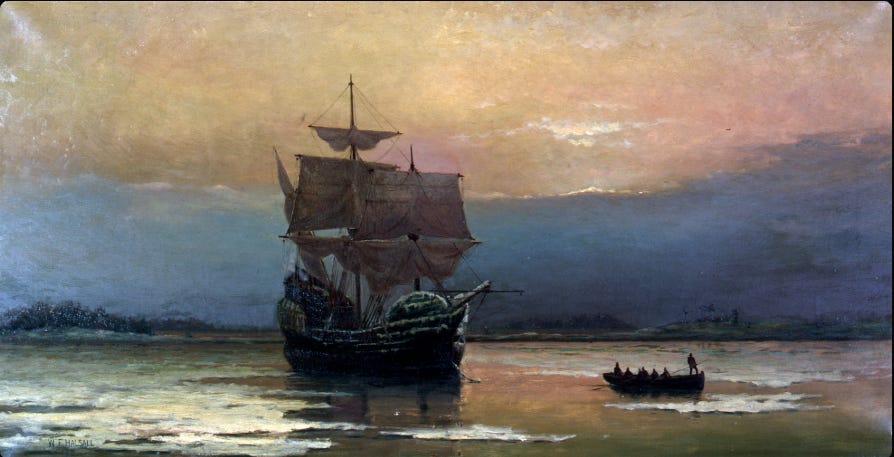
William Hull, Mayflower in Plymouth Harbor (1882)
Thanksgiving Weekend Sale! Up to 35% off Aurmina and Primora Bio: Last year, Lisa, Scott, and I learned about Black Friday roughly one day before it happened. A year older and only slightly wiser, we are doing it on purpose this time, and our reason hasn’t changed: gratitude! Aurmina keeps growing, your messages keep making our week, and this little company is still a little astonished at itself.
The sale starts this morning, Thanksgiving Day, and runs through Cyber Monday night, November 30. Single bottles are 25% off ($112.49/bottle). Three-packs are 30% off ($104.99/bottle). Six-packs are 35% off ($97.49/bottle). All bundles come with a free 6 oz bottle of biochar, and the Korea Ceramics filter is 25% off as well.
And yes, I know a post about how much the Pilgrims loved good water, sent on the morning of a water sale, looks like a marketing scheme. If it is, the Pilgrims wrote the copy in 1620.
Prelude
To write this post, I decided I first had to straighten out my understanding of how and when this country actually began, because I have to admit I get it all mixed up. Columbus, Ponce de León, the Pilgrims: I tend to blur them together and get each one's importance wrong. So here’s how the story actually goes. Columbus, sailing for Spain in 1492, never set foot in what is now the United States; he landed in the Caribbean. John Cabot reached Newfoundland for England in 1497. Ponce de León reached Florida in 1513, and the Spanish later founded St. Augustine in 1565, which makes it the oldest continuously inhabited European-founded city in the country (and is where I lived my first year in Florida after fleeing Wisconsin during Covid). The English settled Jamestown, Virginia, in 1607, thirteen years before the Mayflower. Heck, even Squanto (who you will soon meet) had been to England and back before the Pilgrims arrived.
So the Pilgrims weren’t the folks who first settled here, really. But they did found the first lasting English settlement in New England, and their story became America’s founding myth, mostly because of Thanksgiving. But I think there’s a deeper reason their story sticks: they were rebels. They were Separatists who had concluded that the Church of England was beyond reform and walked away from it, at a time when doing so could land you in prison. They fled to Holland, and when that didn’t work either, they crossed an ocean rather than bend. I think it goes without saying that I feel a certain kinship with people who decide the established institution has lost its way and go build something outside it. I won’t push the parallel too far, since nobody is putting dissident doctors in the stocks (yet). But it’s not lost on me.
The Spring at Truro
On the morning of November 16, 1620 (according to the “old style” calendar they used), sixteen armed men were stumbling through the brush of outer Cape Cod, desperately thirsty. They had come ashore with biscuit, Holland cheese and a small bottle of aquavitae, and, as one of them later admitted, “neither beer nor water.” Around ten o’clock they dropped into a deep valley, saw a deer, and found a spring.
“We were heartily glad,” they wrote, “and sat us down and drunk our first New England water with as much delight as ever we drunk drink in all our lives” (I love the “drunk drink” line and will be using it regularly from now on). Anyway, move that date forward the ten days their calendar had not yet adopted, and it lands on November 26, which this year is today, the morning of Thanksgiving. I have spent the last year writing about what water acquires from the rock it passes through, and I cannot think of a better place to begin a day of gratitude than by paying homage to our parched and half-starved forebears, sitting down at a spring.
The account comes from Mourt’s Relation, the journal William Bradford and Edward Winslow kept of those first months and published in London in 1622. I read pieces of it in school as a story about courage and a dinner. Reading it again this week, after a book’s worth of time spent on water, I was shocked at what I found. The Pilgrims were obsessed with water. Almost every page records where they found it, what it tasted like, and whether there would be enough of it in summer. Their lives depended on it, and they knew good water when they drank it.
There is a stone marker on the Pilgrim Spring Trail in the Cape Cod National Seashore that carries those words about the first New England water. The Park Service carefully calls it a site “representative” of where it happened rather than the exact spot, an honesty I appreciate. The same excursion that found the spring also found, a little further on, baskets of corn the Nauset people, a Wampanoag band, had buried for the winter, and the explorers grabbed them. Winslow wrote later that they made it right with the owners and gave them “full content.” It is the first of several debts the colony ran up that autumn and winter.
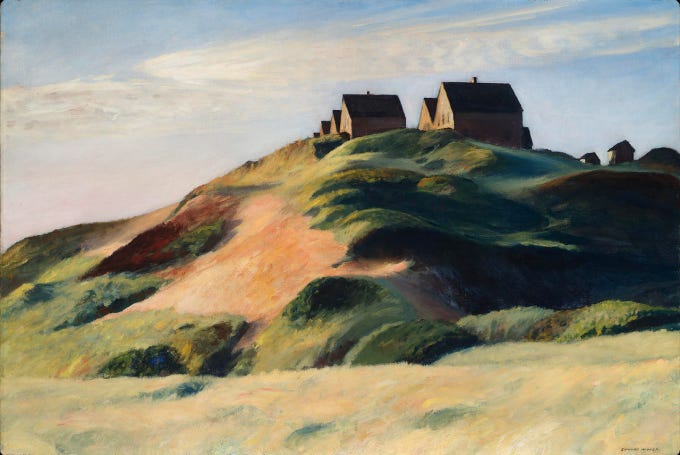
Edward Hopper, Corn Hill (Truro, Cape Cod), 1930. The hill takes its name from the corn the Pilgrims found buried there in November 1620.
The Beer Had Run Out
It has been famously said that the Pilgrims landed at Plymouth because they ran out of beer, which is only a slight overstatement. In mid-December, after weeks of coasting the bay in an open boat, they had to choose a place to settle, and the journal explains why they could not keep looking: “our victuals being much spent, especially our beer, and it being now the 19th of December.” Beer on a seventeenth-century ship was not brought aboard as a luxury for the men; it was carried because it kept, in an age when water in a cask could go bad, and nobody trusted the water of a strange place until they had tested it.
The worst of it came that winter. As sickness swept through the passengers, Bradford wrote, they “were hasted ashore and made to drink water, that the seamen might have the more beer,” and when one sick man asked for a small can of it, he was told that “if he were their own father he should have none” (whoa - they were dead serious about their beer). Half the company died in those first three months. Of a hundred and some souls, Bradford counted, “scarce fifty remained.” Which means that the first Thanksgiving was held by the rebel survivors of that deadly winter.
If you appreciate the late nights and deep dives into health, minerals, and water, I would be grateful for your paid support.
“The Best Water That Ever We Drank”
They chose the place for its water. On December 18, the day before they decided, a party walked the shore of what is now Plymouth harbor and found “four or five small running brooks of very sweet fresh water, that all run into the sea.” They inventoried everything a settlement would need, and in the middle of the list is this sentence: “Here is sand, gravel, and excellent clay, no better in the world, excellent for pots, and will wash like soap, and great store of stone, though somewhat soft, and the best water that ever we drank.”
Stone, clay, and the best water that ever we drank, in one breath. Oh man, I love it. Only now, at this point in my life and journey, do I know why those things belong together, and the reason is the subject of one of my favorite chapters in Earth’s Living Water (ELW).
When they made their decision, they gave four reasons: the cleared ground, the hill for their cannon, the harbor for their boats, and above all, the water: “a very sweet brook runs under the hillside, and many delicate springs of as good water as can be drunk.” That brook is Town Brook. It runs about a mile and a half from a freshwater pond, the one that Francis Billington spotted from a treetop that January and mistook for “a great sea.” The journal said of that pond and its outflow, “it will be an excellent help for us in time.” Within months it was feeding their corn.
In ELW, I devoted a chapter to what I call water’s geological inheritance. The premise is one the Pilgrims seemed to understand: water carries the properties of the land it has passed through. Rain falls nearly empty of minerals, a natural distillate, and then it changes the moment it touches the ground. It moves through soil, clay, gravel, and fractured rock, and along the way it trades ions, picks up minerals, and takes on the character of the land it passes through.
Why I love spring water so much is that it is water that has made that whole journey and come back up with its bounty. In the book I wrote that “water carries the imprint of the path it has traveled,” and that “contact is the principle.” I feel like the Pilgrims judged water by something that is older than chemistry. In a chapter on the history of healing springs, I described spring water as “the kind of water you trusted on sight,” and for most of human history that judgment, made by the eye and the tongue, was the only water test anyone had. When men who had been drinking stale ship’s beer and cask water for four months wrote that the springs beside Plymouth’s clay and stone were “the best water that ever we drank,” I believe they were reveling in the rock it had passed over.
The Brook that Fed the Harvest
The brook ended up offering more than drinking water. In March 1621, when the Wampanoag sachem Massasoit came to make peace, the brook marked the line between the two peoples. “Captain Standish and Master Williamson met the king at the brook,” the journal records, and when the treaty was done, “the governor conducted him to the brook, and there they embraced each other, and he departed.” That peace held for more than fifty years.
The cleared fields beside the brook that the Pilgrims admired had been planted for generations by the Patuxet, another Wampanoag people. The first Native man to walk into the settlement, Samoset, told them: “The place where we now live is called Patuxet, and that about four years ago all the inhabitants died of an extraordinary plague.” An epidemic, most likely carried by European traders and fishermen, had emptied the village before the Mayflower ever arrived. This means that the English built their homes on the fields of the dead. One of the few Patuxet who survived, because he had been kidnapped and taken to Europe, was a man named Tisquantum, whom we know as Squanto.
Squanto came back to find his people gone, and he spent the rest of his short life helping the rebels who had settled on his family’s ground. Bradford called him “a special instrument sent of God for their good beyond their expectation.” In the spring he showed them how to plant corn, and then he told them what the soil needed. Bradford wrote that “except they got fish (Ed: if they didn’t get fish) and set with it (in these old grounds) it would come to nothing, and he showed them that in the middle of April they should have store enough come up the brook, by which they began to build, and taught them how to take it.”
“These old grounds.” Even in 1621, the soil beside Plymouth seemed depleted. Fields that had been cropped for years had been drawn down, and Squanto told the English that seed alone would not be enough and that the answer was in the brook they drank from. Every April, alewives and other river herring pour in from the Atlantic and swim up Town Brook to spawn in the pond. Those fish carry the sea with them, nitrogen and phosphorus and a whole spectrum of minerals gathered from the ocean, and when the Pilgrims laid them in their corn hills they were moving the sea into the field. Historians still argue whether fish in the corn hill was an old Native practice or something Squanto learned during his years in Europe. Either way, it worked. Winslow wrote in December 1621 that “according to the manner of the Indians, we manured our ground with herrings or rather shads, which we have in great abundance, and take with great ease at our doors. Our corn did prove well, and God be praised, we had a good increase of Indian corn.”
In that same letter, Winslow left the only eyewitness account we have of what we now call the first Thanksgiving: “Our harvest being gotten in, our governor sent four men on fowling, that so we might after have a special manner rejoice together after we had gathered the fruit of our labors.” Massasoit came with some ninety men; they feasted for three days, and the Wampanoag went out and killed five deer for the table.
Thinking about it now, the corn eaten on the first Thanksgiving grew because the fish fed the tired soil. The fish came because the brook ran clear and open from the sea to the pond. And the settlement was there at all because, after months of beer and casks, sixteen thirsty men knew good water when they found it. I don’t think I am taking this too far if I maintain that the first Thanksgiving was a feast of minerals that water carried from the rock and the ocean into a field. In ELW, I wrote about volcanic soils and floodplains, the places where the land stays fertile because water keeps renewing it, and I put it this way: where the mineral interface between geology and life “stays open, the land stays fertile.” Town Brook was that interface, and the people of Patuxet, and then the people of Plymouth, lived by it.
What We Did to the Brook
What came next is the story of nearly every river in this country (some of which I disturbingly documented in a recent post called "American Rivers Used to Catch Fire. We Fixed the Flames, Not the Water”). Over the following centuries, Town Brook was put to work. Mills went in, and then dams, until a stream barely a mile and a half long was blocked by six of them. The Town of Plymouth estimates that the herring run once numbered one to two million fish. By the early 2000s, according to NOAA, it had fallen to about 150,000, and state biologists and volunteers were scooping herring out of the water by hand and trucking them around the dams so they could reach the pond at all. Yup.
The point I make over and over, is that the inheritance of water systems is geological. In modern times, what we do is cut the connection, the path from the sea to the pond to the field that picks up and carries the minerals and the life with it. We kept the water but broke the circuit, and we do the same thing, with far more sophistication, to the water that comes out of our taps.
And then there is the return, the goal of my books, an example of which we can celebrate today on Thanksgiving. In 2002, they took down the first dam on Town Brook. It was the first coastal dam removed in Massachusetts. Over the next seventeen years, four more came down, fish ladders were rebuilt, and in 2019 the last major barrier, the Holmes Dam, was removed in time for the spring run. NOAA reports that the herring can now reach 269 acres of spawning habitat on their own, for the first time in centuries. The recovery is not finished; the state’s visual count was about 120,000 fish in 2025, down from about 203,000 the year before. Although rivers do not heal on our schedule, the water’s road is open again, and apparently, every April you can stand on the platform beside the old Jenney Grist Mill on Spring Lane and watch tens of thousands of fish waiting their turn to go home.
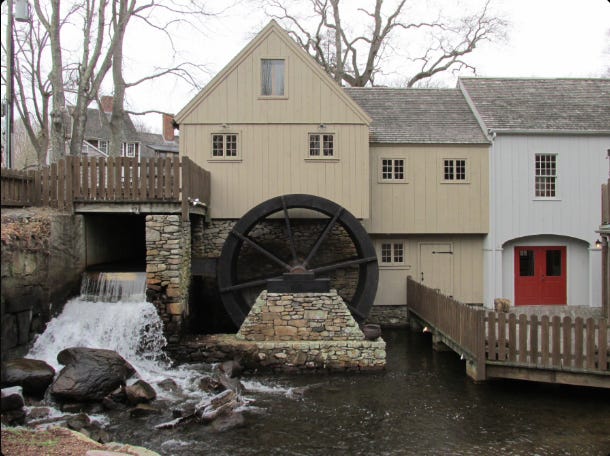
Town Brook running past the Jenney Grist Mill. Photo: John Phelan, CC BY-SA 3.0, via Wikimedia Commons.
Gratitude for Water
The man whose mineral extract set me on this whole path, Asao Shimanishi, spent his life working out why certain rocks give water such unusual properties. When I read his writing, I found that gratitude for water appeared nearly everywhere. I now share that appreciation. I have lived in a string of homes since I started this work, each with its own tap, and I have learned that no two waters are the same. So, today I am grateful for the springs that kept a desperate colony alive, for the Patuxet whose fields and whose last surviving son made their harvest possible, for the brook that fed it, and, more recently… for the people who spent seventeen years taking the dams out.
I am also grateful to all of you, for reading my books and my posts, for commenting on them and writing to us, and for staying with me through this long detour. We are still small, still learning, and still astonished by the kind messages that arrive every week.
Wherever you are this morning, I hope you have people around you and good water in your glass. Four hundred and six years ago, sixteen men who had little else sat down by a spring and drank “with as much delight as ever we drunk drink in all our lives.” That seems to me a fine place to start the day.
Happy Thanksgiving.
-Pierre
P.S. The Aurmina and Primora Bio Thanksgiving weekend sale:

P.P.S. Little Lazlo wants to say hi:

Please Register To See Bad Medicine
This is a fabulous film. But some locations (listed in the article) are underfilled, and they will cancel the screening. PLEASE buy a ticket now! Link to buy tickets for Dec. 16 screening near you.
These areas are at risk of cancellation:

The Stone and Water Series

The “War on” Series

Leading Edge Clinic

Thanksgiving blessings to you, Pierre! Hi, Lazlo! What a treasure!
On top of my gratefulness list this year will be you, Dr Kory. Trying to figure out why none of the pieces fit during the height of Covid I found you. Your bravery, your brilliance, the world is a better place because of you, Dr Kory. And me and my whole family will be forever grateful. ❤️❤️