


In a recent post, “The Water We Thought Was Safe: Why Purity Isn’t Enough” we took an uncomfortable tour through modern drinking water. We walked through the numbers on municipal systems and bottled brands, the alphabet soup of contaminants, the “forever chemicals” that refuse to leave, the pharmaceuticals, endocrine disruptors, microplastics, PFAS, heavy metals, and pathogenic leftovers that slip through even well-intentioned treatment plants.
I shared the Kory family “sparkling water experiment” from Maui, where Lisa and I added Aurmina to different commercial brands and watched, with varying degrees of horror, what precipitated out of them overnight. Only one bottle stayed clear. Nine did not.
We are living in an industrialized world, drinking from a pre-industrial water model.
Although we didn’t test the precipitants (some could be benign excess salts), we for sure know what they could have been - over 250 known contaminants known to exist in our water supply. You guys wanted data then here you go: check out these test reports showing how well Aurmina removes the below list of contaminants:
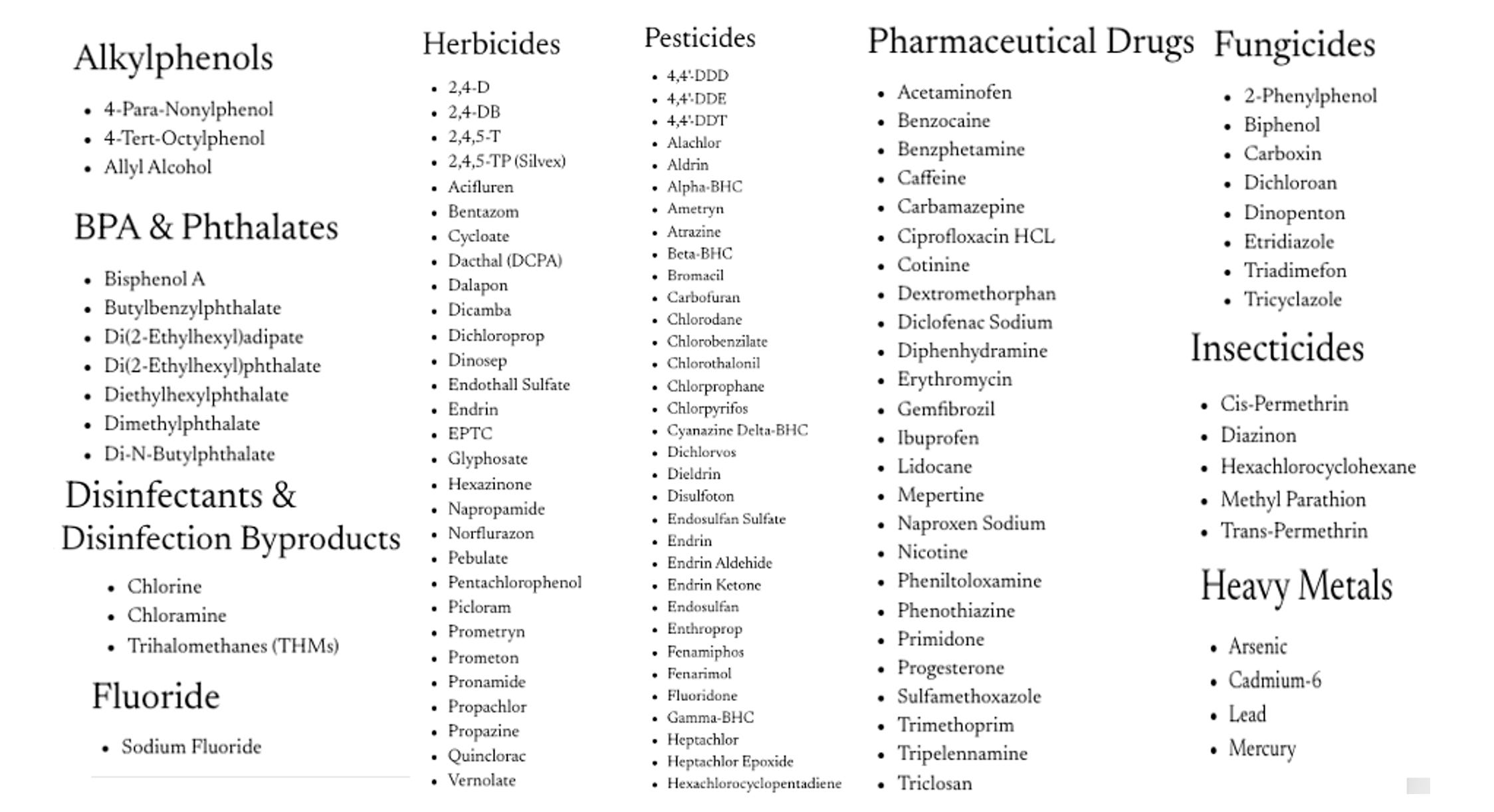
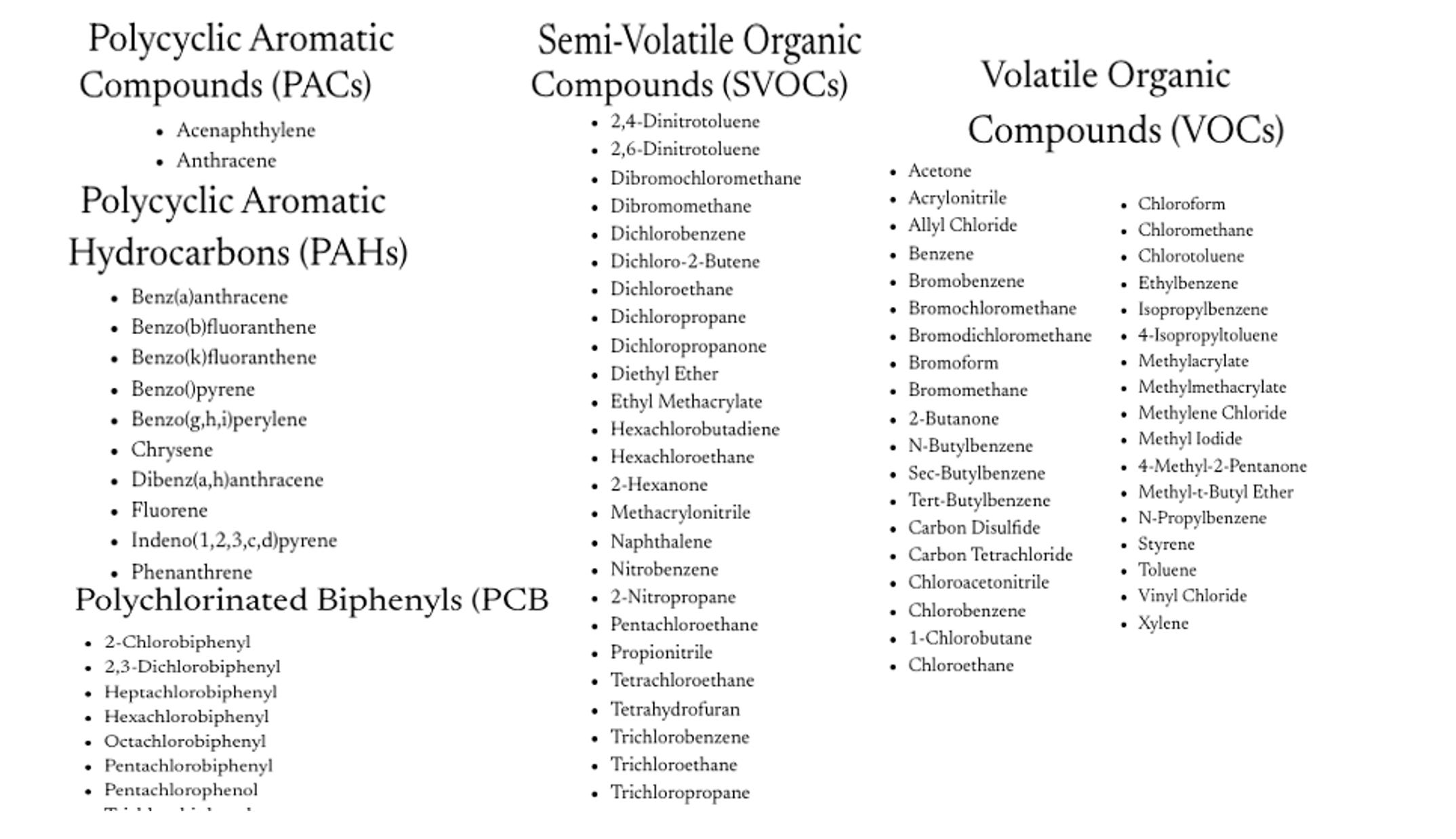
The issue is that, although municipal systems focus on and remove a significant subset of the above contaminants, they fall way short of the total. For bottled water fans, know they are even worse because it is often just filtered tap water, but with worse transparency and oversight (e.g., EPA vs. FDA).
Reverse osmosis and distillation remove nearly everything, but they also “overshoot,” in that they remove the minerals your body and tissues actually need, leaving you with water that is clean but metabolically “dead.” Another little-known fact about R.O. systems is how wasteful they are; they waste several gallons for every gallon produced unless they are paired with a “reclamation” system. Hardly a scalable solution for the world.
Anyway, that prior post ended with a simple point: Aurmina lets you take some control. Add it. Let it flocculate. Filter. Drink water that at least looks and tastes like it belongs in a mountain spring instead of an industrial park.
In the wake of that post though, as always, the best readers in the world wrote back with the right question:
“Okay, Pierre. Stories are nice. Anecdotes are cute. But show me the data. Has any independent 3rd party actually tested this stuff?”
Oh, I thought you would never ask!
In the answer to your question, one of the world’s top water toxicologists took a hard, dispassionate look at a Themarox-derived solution identical in composition to Aurmina and tried to “break it with science.” Fun fact: He did this on his own, out of interest and was not paid by the company who owned the product at the time!
Who Is Paul Rosenfeld—and Why Should You Care What He Thinks?
If you wanted to commission a glowing marketing report, Paul Rosenfeld is not the man you’d call.
He’s an environmental chemist and toxicologist, co-founder of a firm with a very unsexy, severe name (although a kind of cool acronym): Soil Water Air Protection Enterprise (SWAPE). His daily work is not wellness branding; it’s remedial investigations, risk assessments, and cleanup programs for sites contaminated by the worst things humans have invented. He is also one of the top expert witnesses called upon in litigation involving industrial contamination of water sources.
If something nasty has leached into soil, groundwater, or air, people like Rosenfeld are the ones quietly doing the analytical trench work to figure out where it went, how bad it is, and what—if anything—can be done about it.
He is, in other words, professionally trained not to be impressed.
In 2014, Rosenfeld took it upon himself to evaluate a liquid mineral formulation derived from Themarox, a product called Purinize, which had the same concentration of volcanic, ionic, sulfated trace-minerals that Aurmina has (same product, different label).
The question on the table was straightforward: Does this stuff actually purify water, or is it just glossy marketing over a bottle of fancy minerals? He approached it the way a toxicologist should: with skepticism, high-end equipment, and no interest in making anyone feel good.
How Aurmina Was Tested
Rosenfeld used EPA Method 6020 with ICP-MS (Inductively Coupled Plasma Mass Spectrometry) to analyze the treated water. ICP-MS is a machine that vaporizes samples in plasma and separates ions by their mass-to-charge ratios. If an element is present above the detection limit, it will squeal.
Before I forget, the 269 page report is here for those interested in confirming the below.
He added the mineral solution to three liquid samples at the recommended dose (1 tsp per gallon or 1ml/L), measured total recoverable metals, and then did something significant:
He looked not only at what was in the solution but also at what remained after it was used as a flocculant and the water was filtered.
First Question: What Was Measured In The Water?
When Rosenfeld looked at the mineral composition of the water after adding the Aurmina-like solution, he found what you would expect from something extracted from volcanic black mica:
A solid macro-mineral foundation:
Calcium in the ~30–32 mg/L range
Magnesium around 12–13 mg/L
Sodium roughly 36–37 mg/L
Smaller but meaningful potassium levels
Then he looked at the trace and rare elements and found: boron, strontium, barium, molybdenum, zinc, tin, copper, manganese, vanadium, titanium.
All present in micro-concentrations, consistent across samples, forming a complex multi-element matrix rather than a one-note salt solution. That mineral profile, on its own, looks very much like a naturally mineralized, volcanic-influenced spring or aquifer.
Most importantly:
Toxic heavy metals like lead, cadmium, arsenic, thallium, and mercury were not detected above reporting limits.
In plain language:
The solution was a clean ionic mineral complex, not a Trojan horse for hidden toxicity. So far, so good. But that only answers question one.
Second Question: What Does It Do to Dirty Water?
This is the part that matters to anyone living downstream of modern civilization (which is all of us).
Again, in separate work by a separate lab, the same Themarox-derived solution as Arumina was tested against over 250 contaminants across multiple categories—things you’ve seen in my previous post’s “disturbing possibility” list:
phthalates, BPA, heavy metals, pesticides (including glyphosate), industrial solvents, PAHs, PCBs, PFAS relatives, pharmaceutical residues, and more.
Time after time, the pattern held: Add the solution at low concentration. Let the ionic minerals do their flocculation dance—neutralizing charges, aggregating suspended pollutants into larger clumps. Allow those clumps to settle or be filtered.
The results weren’t subtle. those independent lab analyses showed marked reductions in contaminant levels across those categories, often to below reporting thresholds.
This is why, when you add Aurmina to certain bottled waters, you see that dark ring or cloudy sediment settle to the bottom over hours: that is the visual endpoint of an electrochemical story.
But still, a fair reader might ask:
“Fine, it pulls out contaminants. But are we just trading one problem for another? Are we dumping unnecessary aluminum and iron into our water in the process?”
That is precisely where Rosenfeld’s report gets really interesting.
Third Question: What’s Left After Flocculation and Filtration?
After using the mineral solution as a flocculant/coagulant and then filtering the water, Rosenfeld measured the residual aluminum and iron—two of the main workhorse ions in the formula.
Here is what he found:
Sample 1: Aluminum – Not Detected; Iron – Not Detected
Sample 2: Aluminum – 0.30 mg/L; Iron – 0.30 mg/L
Sample 3: Aluminum – 0.039 mg/L (below reporting limit); Iron – Not Detected
For context, the method reporting limit for both metals was 0.05 mg/L.
In two of the three samples, aluminum and iron were below detection. In the third, they were present only at low, drinking-water-safe levels, entirely consistent with what you’d expect after effective coagulation/filtration.
In other words, the minerals go in, do their job, and mostly leave with the trash. The solution doesn’t just clean the water; it essentially cleans itself out of the water as part of the same process.
When Rosenfeld summarized his conclusions, he described the product as:
a robust electrolyte base (a healthy Ca–Mg–Na framework)
diverse trace minerals similar to high-quality natural mineral waters
no detectable toxic metals
excellent batch consistency
“One Of The Best Defenses Against Water Contamination”
Rosenfeld recommended the mineral application as one of the best defenses against water contamination, explicitly noting that it can be superior to distillation and reverse osmosis because it neutralizes contaminants while leaving beneficial minerals in the water, rather than stripping everything out.
What About If you Add It to R.O or Distilled Water and Don’t Flocculate Before Drinking?
Now let’s deal with the question that always comes up when someone gets clever and asks, “Okay Pierre, but what if I put it into RO or distilled water? There’s nothing to flocculate, so the minerals in Aurmina can’t be filtered.”
Author’s note: Although I quickly tire of countering aluminum concerns, it’s also fun. Remember that I am an educator at heart (and by former profession), so I like imparting information people need to make good decisions.
So, for those who did not read my previous post entitled “Aluminum—From Feared Toxin to Forgotten Ally,” let’s do a quick run-down of the non-issue of aluminum in water:
Drinking Aurmina-treated RO water without flocculation does not create an aluminum risk.
You’re drinking the same trace, complexed, tightly-bound aluminum that nature has fed humans forever — the kind that passes straight through you (like someone you tried to date in college :). Dose matters. Form matters. Context matters. Your cup of spinach carries more aluminum than a week of Aurmina. One cup of green tea? More than a month. If Aurmina’s aluminum triggers anxiety, you should have a panic attack next time you eat a salad at Whole Foods.
And here’s the part everyone misses — nobody is putting “free aluminum” in your water. It’s locked up, sulfate-bound, low-bioavailability, the same geological form found in the spring water that hikers rave about like it’s liquid salvation. Human beings have been drinking that water forever. Mountain villages didn’t crumble from dementia. Our ancestors hauled buckets uphill with better bone density than most CrossFit gyms today (OK, maybe that is an overstatement, fine).
Why is this?
total aluminum content is in the same range as natural spring water
complexed, sulfated form → poorly absorbed
exposure tiny compared to food intake
kidneys excrete the trace that enters circulation
Humans have been drinking aluminum-bearing water as long as we’ve been human — aluminum is the third most abundant element in Earth’s crust and present in virtually every mountain spring. Aurmina adds only tiny amounts (one teaspoon per gallon — parts per billion), and almost none is absorbed; what little does is efficiently excreted. And again — it isn’t “free aluminum.” It’s complexed, natively blocked from absorption.
Aluminum Content of Natural Spring Water
Spring water flows through soil → rock → aquifer → spring. Soil and rock are silicates and aluminates — unless you’re tapping pure quartz (rare), you’re getting aluminum. Spring analyses routinely show 5–200+ µg/L depending on region, rainfall, pH, volcanic geology. People have been drinking that forever, long before bottled-water marketing invented “alkaline” and “glacial.”
Check it out:
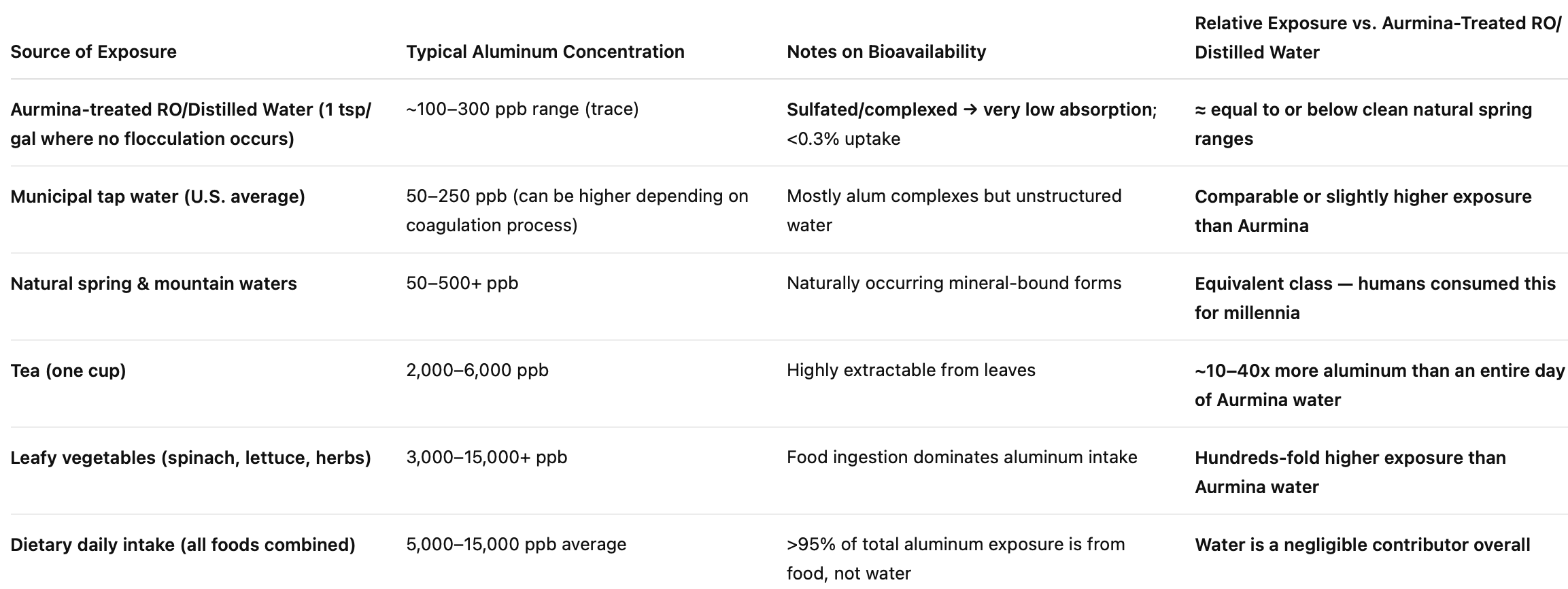
The irony is almost comedic — people fear aluminum in purified water while blissfully sipping mountain spring brands containing the same thing. All it does in RO water is remind us that water is what it used to be — mineral-bearing, structured, alive. Not magic. Not medicine. Just returning something essential that modern purification has stripped away. You feel it, taste it — water suddenly looks and tastes like it came from a glacial stream rather than a pipe.
Aurmina-treated RO water is compositionally indistinguishable from “pure natural spring water” that people pay $6 a bottle for — same aluminum form, same negligible bioavailability, same biological irrelevance — except Aurmina purifies and structures the water first.
Aurmina Testimonials
And here I go — exactly what I promised myself I’d avoid — drifting toward that slippery place where education and marketing start eyeing each other across the room (purely for illustration, of course).
Still, I can’t resist sharing a few of the messages that have come in since we launched. They delighted us, humbled us, and honestly, they make all of this worth it. We’ve removed any health claims for regulatory sanity, so what remains is simply people talking about their water — “just the water, ma’am.” To wit:
11/27/2025 - Marian Neevel
“An N of 1 but already think/feel some difference. Maybe a placebo, but after years of following the water/mineral crowd, I have finally arrived. So many thanks to the Korys and Scott for this gold.”
Another, anonymous:
It is only few days, but I feel great. Every morning I add it to my new overnight gallon of distilled water. It tastes great. I don’t filter anything, since there is nothing to filter. Only slight yellowness when you look from a distance at the glass container. Just the fact that for the first time in my life I’m very close to know what is in my drinking water - makes me feel better. Thank you a lot
Greatly improves the taste of RO water
Ronald Baznik:
Wonderful product. You can see all the contaminants taken out of water. After it’s filtered it tastes very refreshing
Amy Loesch:
The more we drink the more we learn the more excited we become. It is water that satisfies
Anonymous:
I can’t believe the amount of orange sediment it is taking from my city water!
Anonymous:
I just received my Aurmina shipment today here in France, and I’m honestly amazed: it tastes exactly like pure, surprisingly fresh, pristine water! I drink a lot while I work, and it quenched my thirst instantly—every single time (without the usual urge to run to the bathroom). Feels like a game-changer so I’m looking forward to more knowledge from your book and more personal experience. Thank you, Dr. Kory ! 🌟💧
Renee Clark:
We’re very pleased with our Aurmina purchase. Even though we use distilled water the Aurmina minerals seem to make the water come even more alive with thirst-quenching satisfaction. We like it so much we’ve already purchased more. Highly recommend
Giselle Horton:
After reading Dr. Pierre Kory’s fascinating chapters on minerals, I HAD to buy this product. I triple-filter my water before adding this product. Last week, one of my water filters was not working, so I was only double-filtering and using
Aurmina. I could see the fallout/residue on that water. I quite frankly like the confidence of knowing I’m doing all I can to make the water I drink safe and healthy. I’m looking forward to his launching his Aurviva product.
Anonymous:
Well aware of the shortage of minerals in our soil, I’m very pleased to now be drinking Aurmina water. As a student of natural health I know the importance of minerals (including rare earths) for many enzymes and metabolism in general. I love that Aurmina water is ionic and thus increases the electric potential in my body. While I don’t feel an particular results, I know that this water will help my body to be strong and resilient in today’s world. I have much to learn from Dr. Kory. Thank you!
What Aurmina Is (And What It Is Not)
Aurmina is a modern, carefully standardized water purification product , identical to the one that Rosenfeld tested and which is regulated by the EPA. It is not a drug. It is not a supplement. It is not labeled or sold for diagnosing, treating, or curing any disease.
What it does do—when used as directed—is bind and flocculate a broad spectrum of contaminants, help them settle out or become filterable, and leave behind water that retains its naturally beneficial minerals instead of being stripped down to a biologically empty solvent.
In an industrial world, you cannot control everything that enters the reservoir, the river, or the municipal pipe system. You cannot force the bottled water company to run ICP-MS on every batch or report PFAS levels that no law requires them to test. But you can, quite literally, control the last six inches between the pitcher on your counter and the glass in your hand.
For me, Aurmina is how I do that. I use it on our tap water. I would use it on certain bottled waters. I would use it to “wake up” reverse-osmosis or distilled water that would otherwise be too bland for long-term drinking, not as a magic wand, but as a chemically validated tool that has already undergone the kind of scrutiny most wellness products never see.
Rosenfeld was not trying to exalt a miracle. He was doing what toxicologists do: measuring, comparing, checking for hidden dangers, and seeing whether the claims held up. In this case, they did.
Why This Matters for You
Most of us know, on some level, that our environment has become saturated with compounds our bodies never evolved to handle in such constant, low-dose mixtures. We don’t get to choose what’s in the rain, or the runoff, or the municipal wells. But we do get to choose how seriously we take what we put in our bodies every single day, sip after sip. I can’t promise you that cleaner, mineral-intelligent water will fix your health, reverse your disease, or suddenly make life easy. Those would be claims, and I’m not making them (because, knowing my late-career trajectory, I would likely be thrown in jail if I did).
But, what I can say is this: when one of the world’s leading water toxicologists describes a Themarox-derived solution identical in composition to Aurmina as clean, stable, and remarkably effective at pulling out a wide array of contaminants while leaving beneficial minerals behind, I get to feel something I hadn’t felt about water in a long time—Not fear. Not paranoia. Just… peace of mind.
In a world that keeps adding new chemicals faster than it regulates the old ones, that peace of mind is not nothing. If you’re one of the readers who wrote and said, “Show me the data,” this post is for you. If you want your glass of water to feel less like a chemistry experiment and more like something the Earth meant you to drink, Aurmina is one way—not the only way, but a powerful one—to begin reclaiming that.
One bottle treats many months’ worth of drinking water (one bottle supports a household of two for over 6 months, and a single person for a year (i.e., $12 a month per person).
One small ritual—add, wait, filter, pour—can quietly redraw the boundary between your body and the world’s exhaust. For now, if you want to see what Rosenfeld saw—if only in your own kitchen—Aurmina is there.
And once you’ve tried it, you may find, as I did, that going back to “regular” water feels a bit like flying coach after you’ve once, just once, sat in the front of the plane.
More Stuff (Aurmina and Book Publications)
If you value the late nights and deep dives into all the “rabbit holes” I write about (or the Op-Eds and lectures I try to get out to the public), supporting my work is greatly appreciated.
If you’re curious about the volcanic-mineral water purification product described above, you can find it at Aurmina.com. Think of it as a quiet act of restoration — starting with your water.

Know that not one, but two books are dropping from yours truly (at the same time?) What?

If, instead of (or in addition to) this Substack version, you prefer the feel of a real book—or the smell of paper—or like to give holiday gifts, pre-order From Volcanoes to Vitality, my grand mineral saga, shipping before Christmas.
And if you want to read (or gift) another chronicle of suppression, science, and survival, grab The War on Chlorine Dioxide—the sequel you didn’t see coming—shipping mid-January. On this one, I say: “Buy it before they ban it.” Hah!
This chapter is original material and protected under international copyright law. No part of this publication may be reproduced, distributed, or transmitted in any form or by any means, including photocopying, recording, or other electronic or mechanical methods, without the prior written permission of the author.
© 2025 Pierre Kory. All rights reserved.
Dr Kory, As a former toxicologist and water chemist I find this extremely interesting. As the result of being a water chemist, I have distilled my drinking water for years and supplemented needed minerals. I will probably continue to do so. That said, this is a wonderful alternative and emergency measure to keep around in case of the loss of electricity needed for distillation. Thank you so much for posting this and being the wonderful, caring REAL doctor that you are. You are appreciated and loved by many of us.
I recently had a panic attack after eating a salad at Whole Foods—now I know why! ;-) Thanks, Doc!