



Today I am posting the final chapter of my book, The Blueprint of Life.
There will be an epilogue after this — really a four-part reflection on the journey this book took me on — but this chapter is the culmination of the argument I have been building for months.
I have also learned something about Substack in the process.
After more than four years here, it turns out I still have plenty to learn about how writing works on this platform. When I first decided to publish the book in serial form, it seemed like a good idea. Substack had already become the place where I wrote in public, tested ideas, followed evidence, and shared discoveries with readers in real time. But a book, and in particular this book, is a different creature.
This book required continuity. Each chapter depends on the one before it, and the argument climbs gradually, layer by layer, until it reaches places I never expected to go (like a rational proof of a Creator, or a precise interpretation of a 2,000-year-old text?). That kind of progression is easier to follow when the reader has the book in hand, can pause, return, reread, slow down, speed up, and control the pace of immersion.
Substack works differently. It is driven by the day, by the inbox, by the rhythm of new posts arriving amid news cycles that compete for attention. My readers originally came to me for medicine, Covid, vaccine injury, institutional corruption, treatment, scandal, and health politics — a category I seem to have accidentally helped invent here. They were used to variety, urgency, exposure, and practical insight.
This book asked something else of them.
It asked them to follow me into minerals, water, geology, agriculture, soil biology, origin-of-life science, ancient texts, Scripture, and systems of thought I never imagined writing about when I began my medical career. It asked for sustained attention to unfamiliar subjects, often in long chapters, often building toward conclusions that only fully make sense after the previous steps have been absorbed.
That is a lot to ask of a casual Substack reader.
And I paid a price for it. I bled paid subscribers. The losses were nowhere near offset by new readers interested in these topics. I watched the numbers fall and, to my own surprise, found that I was completely at peace with it.
Because the work was real.
My writing is me. I follow what grips me, what alarms me, what fascinates me, what I feel responsible for understanding and then saying out loud. This book took me far from the subjects many readers first came here for, but I kept following it because the work felt real, necessary, and unfinished.
Some readers left. Some stayed. Some, I know, came with me all the way into the strange country this book eventually entered. For those who did, I am deeply grateful.
This final chapter is for them. It is also an invitation to anyone who sensed that the serial posts were fragments of something larger, and who may one day choose to encounter the completed book in the form it needed all along: not as an inbox sequence competing with the day’s noise, but as a continuous ascent toward a view I could not see when I started climbing.
A Latecomer’s Admission
Before going further, I want to openly admit that I am not a religious scholar, and I am not pretending to be one now. I did not grow up with religious instruction, I have never read the Bible in any systematic way, and I did not enter Scripture alone. MB had spent decades in those texts before I arrived, and over many months, he kept dropping clues, passages, and connections into my lap — small fragments I would contemplate, follow, test, and return to.
What follows, then, is not theology in any formal sense. These are the reflections of a man who entered these texts late in life and found, to his own surprise, that they described the world with more force and precision than anything else I had ever encountered.
I also want to be clear about the spirit of this post. I am not trying to write about doom and gloom, complaint, or moral superiority. I am not trying to say that the world would be fine if only everyone else stopped behaving badly. I am trying to look honestly at where we are — as a nation, as a civilization, and as human beings living inside systems that have become increasingly disordered.
That is not a comfortable place for me to write from. My public life began in medicine, not Scripture. I wrote about Covid, vaccine injury, institutional failure, censorship, fraud, and treatment because those were the battles directly in front of me. I did not expect that the same journey would eventually lead me into geology, agriculture, ancient texts, moral order, and the spiritual meaning of judgment.
But it did.
And somewhere along the way, I began to feel that I had been brought into contact with something good. I do not know exactly how to name it. A return. A restoration. A movement back toward order in a world that has wandered far from it. The book began as an investigation into minerals, water, and biology, but it ended by changing the way I see my own life, my responsibilities, and the world around me.
That is why this chapter is not a lament. It is an attempt to describe disorder without surrendering to it.
Scripture uses the word judgment in a way I had never understood before. Judgment does not refer only to a final event at the end of time. More often, it refers to the process by which reality reveals alignment or misalignment in a person, institution, or society through the consequences of its actions. Judgment begins within the system, exposes what is there, and sets in motion the consequences that follow.
In my last post, I used the Leading Edge Clinic, which I built with my partner and a group of committed, aligned people, as an example of an institution ordered around truth, and how that ordering allowed it to endure pressure and continue serving patients.
The Anatomy of Judgment
Today’s post looks at the opposite movement: what happens when institutions are built on suppression, denial, distortion, and self-protection.
For me, that disordered structure first surfaced in medicine, then across an increasing number of institutions, and eventually inside the FLCCC, the globally known nonprofit Paul Marik and I had built. What made that episode so clarifying was the specific form the disorder took. I watched an institution built to serve truth and protect the vulnerable begin to reorganize itself around control, internal politics, and self-preservation.
Once certain people concluded that influence was shifting away from them, they did not respond with humility, correction, or honest disagreement. They responded by accusing innocent people of fraud to resolve a power struggle.
The behavior was so misaligned that I stepped away from it immediately. The mission was no longer governing the institution; insecurity, ambition, and the protection of authority were. I had already been part of multiple institutions that shifted out of alignment under pressure, and I left every time. Paul remained, but in increasing estrangement and with severely diminished authority, bound to a structure that had already turned against not only its founders, but its own founding principles.
What followed only confirmed the diagnosis: the institution was emptied of the principles that had given it life, and what remains now is a diminished shadow of what it once was. I, by contrast, flourished after leaving. That, too, was part of the judgment.
That experience changed the way I now see the wider world: a civilization in which short-term profit is routinely extracted by injecting long-term harm into air, water, food, bodies, ecosystems, and information systems; a civilization in which disordered individuals now hold concentrations of wealth and power so extreme that their disorder propagates into the institutions they control.
This is especially dangerous in medicine and public health, where one misaligned figure at the top can bend agencies, journals, hospitals, and professional societies away from their duty to the sick.
So I am now going to do something I never expected to do publicly: walk through Scripture, hesitantly, as a latecomer, and draw out lessons that lifelong students of these texts may laugh at me for only now discovering. I do not plan to do much of this going forward. But in the context of this book, it has become both unavoidable and central.
“If a ruler listens to falsehood, all his officials will be wicked.”
—Proverbs 29:12
Scripture is blunt about this. Once disorder is rewarded at the top of a system, it propagates outward and downward.
Alignment Is Not Immunity
As this unifying view of order and disorder, alignment and misalignment, came together, it forced me toward a question that has troubled human beings forever: if order protects, why do righteous people still suffer?
I quickly learned that alignment with God is not a guarantee of worldly safety. It does not remove a person from danger, disorder, or the consequences of other people’s choices. What it does is place that person under care, within truth, and in right relation to reality.
“Behold, I send you out as sheep among wolves, so be wise as serpents and innocent as doves.”
—Matthew 10:16
Wolves exist. Disorder exists. Alignment does not prevent exposure to either. But alignment can create capacities that matter under pressure: clarity, mission, endurance, restraint, and the strength to keep moving when the surrounding system breaks. I did not understand at the time that some of those capacities had been formed in me years earlier through spiritual work, and that I had mostly taken them for granted. Disorder forms the opposite traits: confusion, agitation, compulsion, self-division, alienation, emptiness, and the multiplying consequences of a life at war with reality.
Scripture repeatedly portrays order and disorder as paths that unfold over time, rather than single, isolated events. Alignment does not confer immunity; it lowers vulnerability over time. Disorder does not always destroy immediately. More often, it accumulates. Delayed judgment is not innocence. It is simply the time required for consequences to surface.
“By their fruits you will recognize them.”
—Matthew 7:16
Fruit is an outcome over time. That is why judgment often appears delayed.
“For there is nothing hidden that will not be disclosed, and nothing concealed that will not be known or brought out into the open.”
—Luke 8:17
Exposure is inevitable.
To Fear the Lord
Again, not having grown up with religious instruction, as I began studying theology and Scripture, I kept getting confused by the phrase “fear of the Lord.” The best understanding I have come to is this: to fear the Lord is to live as if God’s order is real, and that violating it carries consequences.
In that posture, people order their behavior through sobriety, restraint, truthfulness, responsibility, and care for others. That ordering stabilizes their internal state and lowers the probability of self-inflicted destruction. It does not protect them from a drunk driver, a violent stranger, or a collapsing institution. I came to understand that difference firsthand as the systems around me broke down.
Scripture explicitly acknowledges this:
“Precious in the sight of the Lord is the death of his saints.”
—Psalm 116:15
Good people do die, sometimes violently, sometimes unjustly. Their suffering is not evidence that their order failed them. It is evidence that disorder is permitted to move through the world.
From the beginning, God did not design a closed system in which obedience was enforced and harm prevented at every moment. He granted man free will. In Genesis, this is symbolized by the tree of the knowledge of good and evil placed in the garden, the sign that human life was created with a real capacity to choose. Alignment with God was not meant to be automatic, mechanical, or coerced. It had to remain voluntary, and once that freedom was real, so was the possibility that human beings would choose against the order in which they had been placed.
God did not remove causality to spare the righteous from harm. He permitted a world in which human choices move through others, for good or for ill. Once disorder is chosen, it does not remain confined to the chooser. Pride, greed, lust, aggression, neglect, and excess deform shared environments.
The same principle applies at scale. Scripture is again explicit:
“The king by judgment establisheth the land: but he that receiveth gifts overthroweth it.”
—Proverbs 29:4
A rightly ordered ruler can exercise restraint, receive correction, discern proportion, and act for the good of those under his care. He does not confuse power with wisdom, obedience with loyalty, or dissent with betrayal. By contrast, when leaders become driven by greed, ego, and power, and insulated by pride, authority, or certainty, they lose the ability to revise their beliefs. Decisions harden, and dissent is treated as a danger rather than as information. In that state, leaders begin acting as if what they believe is reality, rather than something that must answer to it.
This is not just moral collapse. It is the closing of the mind to correction.
Scripture treats resistance to correction as a mark of deep disorder. The wise receive rebuke and change course. The fool rejects correction, hardens, and continues toward ruin. Sin is not only wrongdoing, but also the refusal to be corrected once truth has made itself known.
This is why Scripture frames human action as seed and harvest. Errors compound and disordered structures amplify their effects. In disordered societies, corrective knowledge almost always resides in the minority, because once a false premise becomes institutionalized, the majority’s role shifts from inquiry to enforcement.
Correction then becomes costly, truth becomes dissident, and the price is paid by the few who volunteer for the task. I watched that sequence unfold with ivermectin, where the real struggle quickly ceased to be over evidence and became a struggle over whether correction itself would be permitted.
Modern societies add an accelerant. Mass media that are not ordered around truth, objectivity, and transparency do not just misreport reality; they manufacture a false one. They suppress correction, normalize harm, and teach entire populations to accept what is disordered as if it were good, necessary, or inevitable. For those reasons, major media have become one of the sharpest instruments through which powerful institutions propagate disorder at scale.
Major media were not alone. Many religious authorities also failed their role during Covid, when they should have helped people test fear, defend conscience, protect the vulnerable, and remain anchored to truth. Instead, many simply echoed institutional authority, accepted coercion as virtue, and treated compliance as moral responsibility. As in nearly every other sector of society, only a small minority tried to speak correction aloud.
Scripture does not treat deception as a one-sided event. It repeatedly warns people to test what they hear, resist false authority, and remain open to correction.
“Test everything; hold fast what is good.”
—1 Thessalonians 5:21
“Do not believe every spirit, but test the spirits to see whether they are from God.”
—1 John 4:1
When they do not—when they prefer comforting narratives, elevate human voices above truth, or outsource discernment—they become susceptible to deception, and, over time, unable to recognize it.
“They will gather teachers to suit their own desires . . . and turn away from listening to the truth.”
—2 Timothy 4:3–4
“The simple believe everything, but the prudent give thought to their steps.”
—Proverbs 14:15
In that state, falsehood begins to shape reality itself.
I watched people submit themselves and their children to policies and interventions they believed were virtuous, necessary, and socially responsible, often with no real understanding of the costs, the uncertainties, or that risks had been minimized, obscured, or actively suppressed.
I watched faces disappear behind masks, children lose ordinary cues for learning and social development, and long lines form at pharmacies and clinics filled with people who were wholly confident they were doing the right thing for themselves and for others. Many paid dearly for that trust. Some paid the ultimate price.
And that is the warning Scripture returns to again and again: once disorder is chosen, tolerated, or set in motion, its consequences do not remain confined to the chooser.
“The violence of the wicked will destroy them.”
—Proverbs 21:7
Scripture states the outcome for the one who acts in violence. What it leaves implicit—but what experience makes unmistakable—is that violence rarely stops there. It spreads. It reaches beyond the one who initiates it. Disorder does not remain contained.
Alignment Introduced into a Collapsing System
I am watching this same sequence unfold in real time as a man who claims no perfection, no moral exemption, and no authority beyond a willingness to submit himself to truth is placed at the head of a decaying health system and attempts to reintroduce order at scale. He is doing it through principles that should never have become controversial: honesty, transparency, accountability, and protection of the vulnerable, especially children.
Watching this has not been peaceful, but it has been clarifying. Attacks have intensified. Narratives have multiplied. Institutions and professional societies have protested, resisted, and publicly contradicted new guidance with the reactive force of threatened incentives, authority, and reputation. Media behavior, already corrosive, has in many cases become even more reckless. The system reacts as if truth itself were a threat, because for any system that has learned to survive by selling falsehood, exposure reveals not just isolated mistakes but the machinery that made those mistakes profitable.
At first, I thought the introduction of an aligned figure was causing the disorder. Then I realized that is not how it works. Alignment does not create hidden rot. It reveals it.
When alignment is introduced into a collapsing system, one of two things happens: the system reorganizes around higher-order principles and lives, or it fractures, because what was built on distortion cannot remain intact under truth. Both halt decay. Only the first restores vitality.
Judgment is the last attempt at mercy. Exposure is the only thing that makes correction possible, but correction can only be received by what is still willing to align itself with truth.
What unsettled me was not that ancient texts warned about this, but how precisely they described the sequence. Long before modern systems theory, they recognized the same pattern: alignment sustains, misalignment degrades, and resistance to correction accelerates collapse.
Judgment, as I now understand it, does not create the collapse. It exposes the collapse already present within the system once truth is introduced.
Once you understand that water is both the foundation and medium of biological order, that minerals determine whether water can carry and sustain that order, and that order creates the conditions for resilience and flourishing at every scale, reality stops feeling arbitrary. It becomes intelligible, alignable, and sustaining.
With this new understanding, I suddenly feel safer in the world—more directed, more focused, and more confident moving through it. Once reality is understood that way, it becomes impossible to pretend that misalignment is harmless or that truth can be suppressed without consequence.
This is not a call to fear.
It is a call to alignment.
Because in an ordered universe, judgment is not coming.
It is already here.
*If you value the late nights and deep dives into all the “rabbit holes” I write about, your support is greatly appreciated.
Note to readers:
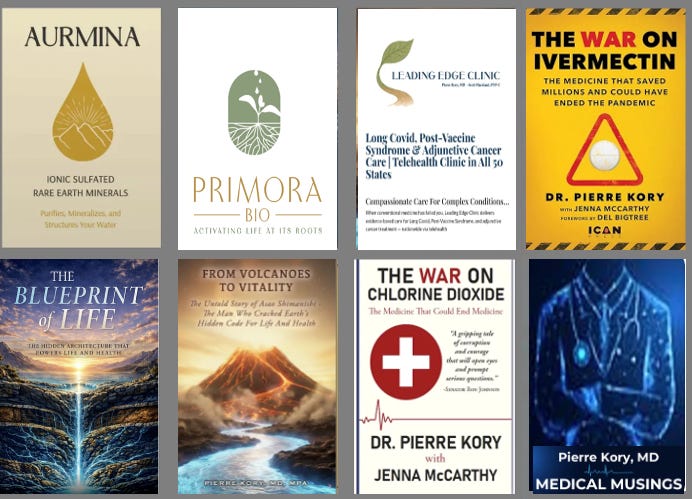
What Shimanishi produced appears to match, in both process and behavior, the kind of revered substance described across numerous cultures and traditions as a “Golden Elixir”: rock opened, minerals rendered mobile, and water transformed through contact with that chemistry.

Aurmina, a name we arrived at before this work fully unfolded, means “golden mineral essence.” It is a diluted form of Shimanishi’s extract and part of my effort to carry this work into a practical form through drinking water.
Primora Bio emerged from that same effort, delivering the water to soil, crops, plants, and animals.
So for those who want the work to leave the page and enter their world, these are our first attempts to carry it forward.
From Research to Practice - Links Below Image
I love your definition of the fear of the LORD. Beautiful. What you call alignment, the Scriptures call repentance. Returning to the truth as given, humbly asking for God's mercy. I agree with you that judgement is an expression of God's mercy, in that it prevents complete self-destruction. We crumble under the weight of our own waywardness and transgression of the truth. God is gracious to forgive, but the consequences of choosing evil are real. The Rock is Jesus. We build our lives on His perfect life and atoning death. And the future belongs to Him because He is risen and will come again to judge the living and the dead. Hallelujah! I praise God for you!
Dr. Kory, I first admired you for your courage and integrity in standing during the lies of the plandemic and vaccine. Now I admire you as a brilliant scholar and look forward to your investigation into the Scriptures. Thank you for all you are doing now.