


*Excerpted from The Silent Aquifer, Chapter 48: Who Decides What’s True: How Modern Medicine Buries What Works
Paul Marik was the most-published practicing intensive-care physician in the history of the field. In 2017, he reported something that sounded impossible: a cheap, safe combination of vitamin C, hydrocortisone, and thiamine that pulled septic patients back from near-certain death. I initially dismissed it, as almost everyone did. Then I used it, and watched the dying sit up and ask for breakfast. This is the story of that discovery, of why the trials “failed,” and of what sepsis really is underneath: a form of scurvy.
The Reflex
My first major collision with the modern medical evidence system began with the fight over intravenous vitamin C in sepsis, alongside Professor Paul Marik. Like most of the critical care community, I reflexively dismissed Paul’s 2017 study. A couple of vitamins and a modest dose of a stress hormone reversing multi-organ failure was simply absurd. Especially the magnitude of the response: he was reporting one of the largest reductions in mortality in a critical illness, or any illness really, that I had ever heard of. In my whole career, only one intervention had produced a bigger drop: putting paddles on a heart in ventricular fibrillation.
My dismissal was not really my own. The colleagues I respected had waved the study off, so I did too; that is how the reflex works. And the form of the study gave me cover: a small, single-center, retrospective before-and-after study, exactly the kind of evidence I had been trained to file under “interesting but unproven.” Soon after came the part that, at the time, sealed it away for me for good.
Marik’s hospital, hearing the recoveries its own staff could not quite believe — patients, families, and nurses all describing the same thing — sent its media office to bring in a local television crew, which interviewed Paul and the nurses on camera. Someone forwarded me a clip ( I play one at the end of this post). Paul was talking about how “he never intended to discover the cure for sepsis,” and I remember thinking how bizarre that was: a physician, even one as widely known and respected as Paul, on a local news station, being interviewed about discovering the cure for sepsis, all off a single, just-published retrospective paper that I was taught couldn’t “prove” anything. The rules said that real proof only arrives at the end of a long, sober process, in a large, prospective, double-blind, randomized controlled trial published in one of the high-impact medical journals, not in a local ABC news affiliate broadcast from Norfolk, Virginia. So I did what my training had taught me. I ignored it.
That is, until about a year and a half later. I was taking care of an elderly Chinese man with septic shock in multi-organ failure, rapidly approaching death, and his family surrounded me, begging me through an interpreter to try something, anything. The memory of Paul’s protocol came back, so I treated the man with it. He died anyway; I had known he would. Nothing else could have saved him at that point. But because it had been so easy to do, and was super safe and really cheap, I figured I would try it again, since I had always liked learning about and trying new approaches to treating disease. The next patient was a woman in septic shock who, hours later, had to be rushed to the operating room for debridement of necrotizing fasciitis, a disease almost uniformly fatal without surgery. As a result, I did not get to observe her for long because she was transferred to the surgical critical care service, and even though I asked my surgical colleagues to continue it, they didn’t (surgeons are so much smarter than medical doctors that they generally ignore our treatment recommendations, because if it were something that was indicated, they would have thought of it first). Forgive me, for I digress.
The Man Eating Scrambled Eggs
Anyway, in those first few hours I thought I saw something: a slowing, a softening, a touch of steadiness returning to her blood pressure and heart rate. It was enough to make me try it once more the next day, when, during rounds, a man was rushed into the ICU from the bone marrow transplant floor with new-onset septic shock, four of four blood culture bottles growing E. coli, and a white count of zero. Not low. Zero. He was breathing fast, his oxygen and pressor needs were escalating rapidly, delirium was setting in, his urine bag was bone dry, and his wife was becoming increasingly frantic at the bedside.
He proceeded to turn around with a speed and magnitude that I had never seen before.
So much so that the next morning when his transplant specialist came to see him in my ICU, he found him sitting up out of bed eating scrambled eggs. I was leading rounds, Dr. House-style, on the other side of the unit, and he walked quickly over to me; I will never forget his face. “What the hell did you do to that guy? I was sure I’d find him with a tube and a circuit” — meaning a ventilator and dialysis.
It went that way again and again: pressure steadying, urine returning, color coming back, heart rates falling, minds clearing. I began discharging people I had been near-certain would die.
But not always. That is the part I have to be honest about, because it confused me at the time and also because I had started to get cocky. Some patients barely moved. A few showed nothing at all, and I could not see what separated them from the man eating scrambled eggs. I told myself it was luck, or that they were simply too far gone, and I kept going. It would take my own study to show me exactly why that was happening.
Either way, I became obsessed with what Paul had started calling the “iHAT” protocol (intravenous hydrocortisone, ascorbic acid, and thiamine). I tried to learn everything I could about it.
A Thousand Emails
Soon after the first few patient experiences, I reached out to Paul. Our first conversation ran for hours, and we became close colleagues quickly. He told me he had by then received more than a thousand emails from emergency and ICU physicians around the world describing the same dramatic recoveries.
Two things from that call have stayed with me ever since. He said his ICU length of stay for septic patients had plummeted to a little more than a day, “Just like my bone marrow transplant patient,” I shouted, probably too loudly. Then he said, more cynically, that he sensed the hospital’s nephrologists were getting annoyed because his unit had largely stopped calling them for dialysis. Unsurprisingly, dialysis begun in hospital is billed by the nephrologist for every day the patient stays on it, and a patient discharged still dialyzing becomes an outpatient on dialysis, which is a revenue stream that does not end. In the sickest cohort of patients, such as those included in Paul’s study, the data showed exactly why. Among treated patients with acute kidney injury, ten percent needed dialysis. In the control group, thirty-seven percent did.
He then told me that a random data contractor from the Centers for Medicare & Medicaid Services (CMS), managing one of the largest health datasets in the country, had, out of nowhere and unprompted, sent his hospital’s CEO the below data chart, showing a sudden, progressive, and eventually massive reduction in his hospital’s sepsis mortality, beginning right after his ICU team began using it systematically around February of 2016.
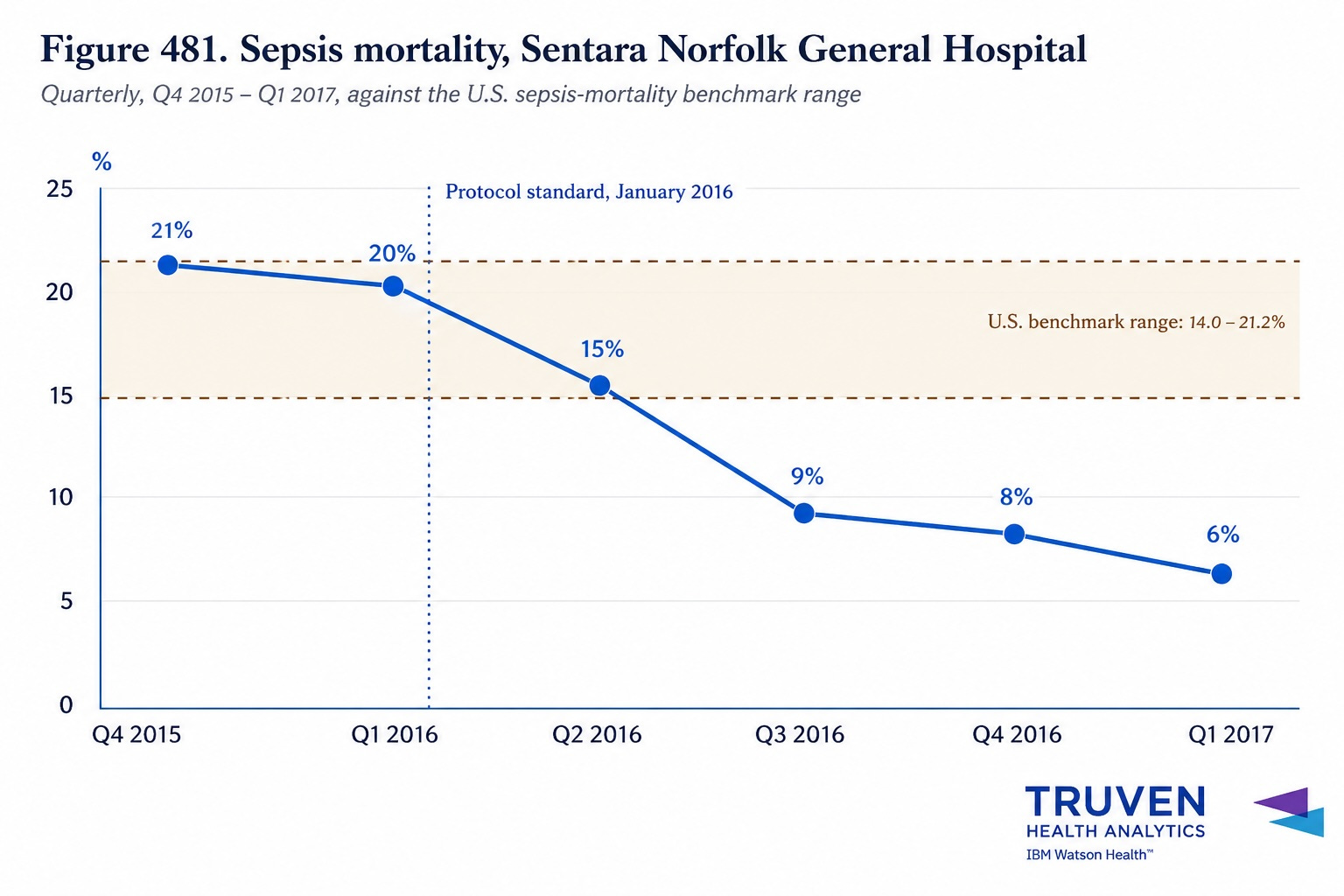
Sepsis mortality at Sentara Norfolk General Hospital, Q4 2015–Q1 2017. Redrawn from a chart prepared by Truven Health Analytics. Shaded band: the U.S. benchmark range for the period, from 14.4 percent (claims-based, in-hospital deaths only) to 21.2 percent (clinical criteria, counting hospice discharges).
To this day, the stories still find me. A few years ago, my dear friend and colleague, A Midwestern Doctor, called me about a loved one who had been admitted with sepsis. "I never realized sepsis was so serious," they said. "In the hospital where I worked, the intensivists always gave IV vitamin C, and no one ever got that sick." Sit with that: a physician who had worked in a hospital where the protocol was routine had never seen how deadly sepsis usually is, because where they worked, it wasn't.
Paul and I quickly became phone pals, and I started to learn even more fascinating details, like the fact that, somewhere back in our ancestry, humans developed a mutation in the gene for the enzyme that makes vitamin C, a trait shared only with guinea pigs and fruit bats. Which makes calling it a vitamin an accident of our own biology — for almost every other mammal it is something the liver produces on demand, and studies show that all other mammals produce large amounts of it under stress or illness. Paul made that argument in print, in a paper titled “Vitamin C: an essential ‘stress hormone’ during sepsis.”
Then I learned that ICU patients, particularly septic ones, typically enter the ICU disturbingly deficient in vitamin C due to their bodies consuming it (and not being able to make it anew) while battling whatever is ailing them. In one 2017 study, they found that 88% of patients with septic shock had levels below the minimum range, and 38% had levels that met the criteria for scurvy. Worse, all the patients in the study received standard repletion doses, either oral or IV, and their levels didn’t budge at all during their stay, meaning they were consuming vitamin C as fast as they were getting it, so their levels stayed in the basement the entire time they were in the ICU (or until they died).
*If you value the late nights and deep dives into all the “rabbit holes” I write about, your support is greatly appreciated.
Your Septic Patients Have Scurvy
I am still disturbed that, despite papers showing severe vitamin C deficiency is near universal in severe sepsis, there is no national or international guideline or protocol to restore levels to normal. If potassium or magnesium drops below the lower limit of normal in an ICU, it is immediately repleted by the nurse, authorized by order sets that do not even require them to contact the doctor before infusing. They do this immediately and routinely. Yet, to this day, the entire field of critical care lets patients languish in severe vitamin C deficiency without a second thought.
Paul did what he could by publishing a paper whose title was not subtle: “Doctor — your septic patients have scurvy!”

Unsurprisingly, advanced scurvy and septic shock present near identically, at least in terms of the collapse of vascular tone. Which makes perfect sense, since the main catecholamines that maintain vascular tone all require vitamin C in order to do so. I remember being shocked when I first realized that I had spent twenty years treating scurvy… without treating scurvy.
A Stupid Electron Deficiency
I understand now what that collapse of vascular tone actually is, and it follows directly from the chemistry I have focused on in this book. A body holds its own blood pressure by making catecholamines — above all norepinephrine, the very vasopressor the ICU spends its nights infusing by the bagful. And it builds that norepinephrine from dopamine, with an enzyme called dopamine β-hydroxylase. That enzyme cannot take a single step without vitamin C.
The reason is redox, the same transferring and accepting of electrons that I followed through soil and water and minerals. The critical enzyme for making norepinephrine has a copper atom at its center which does its work by giving up an electron; the instant it does, it is left oxidized, spent, unable to fire again until something restores what it lost. Vitamin C is that electron donor, the reducing agent that hands the copper back its electron and resets the enzyme for the next cycle of production. Vitamin C is simply the source of electrons that lets a human being manufacture the very drug we pour into them when they can no longer make it themselves.
So a septic patient who has burned through his vitamin C has run out of the reducing power to make his own norepinephrine, and his pressure falls for the same reason a scorbutic sailor’s did three hundred years ago. When I pushed ascorbate into that patient, I was not giving a vitamin; I was just giving him some electrons because he was suffering from a stupid electron deficiency. I did not think in those terms then. I do now, and I have come to see redox, the arithmetic of electrons lost and regained, as one of the quiet governing laws of the living world, the body no exception.
The Ambush in Belfast
Those were the most satisfying and inspiring years of my career. Until they ended when I finally met Paul in person, at a major critical care conference in Belfast right before Covid hit the US in January 2020, where investigators from Australia presented the highly anticipated results of the VITAMINS trial, the world’s first in a series of large, expensive RCTs of IV vitamin C in severe sepsis that were done to confirm Paul’s ground-shaking study.
The trial found no significant improvement in time alive and free of vasopressor support when IV vitamin C and thiamine were added to hydrocortisone; mortality also did not differ significantly between the groups. Though we did not know it yet, that trial was the opening salvo in what would become a years-long war on IV vitamin C in sepsis.
Both of us had come expecting a celebration: a validation of our research and advocacy. Instead, Paul was set up. He had been invited to “moderate” the very session in which the trial would be presented, and was not told its results until we were already on our way to Ireland. He was already at the airport; I was still packing at home, and I will never, ever forget that phone call and the next two days leading up to the session, where we put together a defense of his work and results. We used my recent data to mount a damning critique of the trial, but he was professionally humiliated all the same. On a world stage, in front of an entire field that he had been one of the most widely respected leaders of.
Six Hours
My study easily exposed the flaw in the trial, and it was shockingly simple: timing. My team had analyzed the sepsis outcomes on my own ICU service, a seventeen-member unit I was chief of, from the day “some of us” began using Paul’s protocol. I recall only about four of my seventeen colleagues were moved enough by my lectures and advocacy to change their practice, one of whom was my wife at the time, so let’s say three.
In our published analysis, after adjustment for severity of illness, we found a large and statistically significant reduction in overall ICU mortality between docs who used the protocol and those who didn’t, from 26.0 percent to 11.4 percent. But to Paul and me, that wasn’t the real story. In patients who received iHAT within six hours of arrival to the Emergency Room, not a single person died in the ICU. The benefit then faded the longer treatment was delayed, and although we still saw improved survival up to 12 hours, the “statistically significant difference” was isolated to those who were treated within six. Another striking observation is that we saw no mortality benefit among patients transferred from other hospitals, who were already far along in their illness. I had finally figured out why some of my patients responded little, while others bounced back like springs.
The way I have come to explain it is this. A patient in early sepsis is Humpty Dumpty on the wall, wobbling. Give him vitamin C in that hour, and he rights himself and stays up there. Once he has gone over the edge and broken — once the organ failure is established — you can bring everything you have, and it will not matter. All the king’s horses and all the king’s men. That is what an intensive care unit is.
Which relates to a piece of this that never gets mentioned, and that I have come to think is the most important part of the whole story. Nearly all of Paul’s patients were started on his protocol soon after arrival to the Emergency Room because of how his hospital was organized. A patient who arrived there in septic shock was assigned to an ICU service almost immediately, which meant the intensive care team came down and wrote the treatment orders themselves, while the patient was still in the ER.
Almost nowhere else works that way. In most hospitals, emergency physicians assess the patient, stabilize them, begin treatment, and then call the ICU for evaluation. The ICU service then comes down to evaluate and decide whether the patient is sick enough to be given one of its beds. Learning to make that call was one of the core skills I had to develop, and I made it thousands of times, because intensive care beds are in short supply and someone has to triage them. It is a defensible system. It is also slow at every step. The US median length of stay in an ER prior to ICU admission
(a figure which varies widely by hospital, day of week, time of day, and ER volume) is approximately 4.6 hours, and since length of stay data tend to be right skewed with a long tail of very long waits, the mean is always higher than the median, so say… about 6 hours.
What separated Paul’s patients from everyone else’s was not only what he gave them. It was that his hospital, without intending to, had removed the delay. Every trial that followed set out to test what he gave. Not a single one of them came close to reproducing when he was able to give it.
Which is why Paul and I were enraged in Belfast. In the Australian trial, patients were not treated with vitamin C until 29 hours after admission to the ICU so it is anyone’s guess what the actual delay was, given the ER stay before transfer to the ICU. Just on its own, that delay should be considered malpractice: withholding a potentially life-saving therapy for over a day in a life-threatening medical emergency? Either way, treatment was started long past the window in which it could have saved a life.
The trials that followed all shared the same flaw and added new ones, such as including patients with surgical sepsis or those transferred from other hospitals. Every one of them enrolled patients who had already fallen. Ultimately, the critical care journals and professional societies settled into a consensus: Paul’s protocol was ineffective in severe sepsis, one of the leading causes of death in the world.
The World’s First Randomized Controlled Trial Was a Vitamin C Trial
There is an irony here so complete it feels staged. The modern randomized controlled trial, the very instrument raised over Paul's head to pronounce vitamin C useless, began its life as a vitamin C trial.
In 1747, aboard HMS Salisbury, a Scottish naval surgeon named James Lind ran what is still called the first controlled clinical trial in the history of medicine. He took twelve sailors dying of scurvy, matched them by severity, split them into six pairs, and gave each pair a different remedy—cider, vinegar, seawater, sulfuric acid, a spiced paste, and, to the last two, two oranges and a lemon a day. The citrus pair all but rose from the dead: one fit for duty within six days, the other recovered enough to nurse the rest. The method we built to find cures like that one was then used, three centuries later, to bury the cure that gave rise to it.
And consider what that cure was worth. Scurvy was the greatest killer of sailors in that era. By the historian Stephen Bown’s estimate, more than two million sailors between Columbus and the coming of steam died of scurvy, more than storms, shipwreck, combat, and every other disease combined. On Commodore George Anson’s voyage around the world, of the roughly twelve hundred men aboard his three ships only three hundred thirty-five came home; almost all the rest were buried at sea with scurvy, while exactly three died in battle. A ship could sail with hundreds and return with a handful, the difference rotting away from a want of citrus no one yet understood.
Here is the part that is as familiar to me as the day is long. Lind proved his cure in 1747. The Royal Navy did not adopt it as standard practice in stocking its ships until 1795, (forty-eight years later!), when Gilbert Blane finally convinced the Admiralty to issue lemon juice to the fleet. And when they did, scurvy all but disappeared from British ships, and healthy crews could hold a blockade of the French coast for years.
Historians draw a straight line from that to the naval supremacy that built the British Empire, which means you can make a serious case that the reason so much of the world speaks English today can be traced back to a bag of lemons and a controlled trial that the establishment ignored for half a century. They buried Lind’s cure for forty-eight years, and it still redrew the map of the world. Paul’s has only been buried for a handful. Imagine the reckoning when that account comes due.
The attacks on Paul did not end in Belfast. A couple of years later, an Australian researcher filed a formal fraud complaint against Paul and demanded that Chest, the prominent journal where he had published his study, retract it. The complaint was investigated, no wrongdoing was found, and the paper still stands. Yet today, if you or someone you love is admitted to a hospital, in the United States or nearly anywhere else, and you ask that they receive Paul's protocol—those missing electrons—you will be denied.
The End of the War
We would have fought every step of that war. But Covid intervened soon after Belfast, and our subsequent and very public dissent from U.S. public health policy during that time ended our academic careers. My initial exit from academics was voluntary; I resigned from the University of Wisconsin within two months of our first COVID patient's arrival, in protest of the institution's initial “supportive care only” approach.
Paul’s was uglier, more traumatic, and more public. He woke up one day to go round in the ICU to find an email that had just been sent to the entire Sentara Norfolk General hospital staff, written by a hospital administrator, announcing a new hospital policy targeting Paul: the memo announced that from that day forward, the hospital formulary would no longer fill any orders for any of the repurposed medicines on our FLCCC protocol for Covid (including IV vitamin C).
In one of the many heartbreaking scenes from the Covid war, many of us will never forget watching Paul break while testifying about that episode in one of Senator Ron Johnson’s Covid roundtables, sobbing, “I had to stand by idly, watching people die!” We all need to remember the history of what was done to Paul, and to all of us. Sen. Johnson’s 4.5 hour roundtable is here, Paul’s must-watch testimony begins at 4:18:55.
Children’s Health Defense provided the funds and legal support for Paul to sue his hospital for “practicing medicine without a license” (at the risk of stating the obvious, a hospital is not a doctor). Sadly, and unsurprisingly in the clown world we now live in, he lost, was terminated, and his clinical career ended. He created a new one by becoming what, to me, is the world’s leading expert in the metabolic theory of cancer and the use of repurposed drugs to treat it. Please support his Substack as his income has been markedly diminished (understatement), or buy his book, Cancer Care for you or any loved one who might benefit.
Ultimately, Paul and I were added to the pile of “discredited, controversial, fringe, quack” doctors. At least we don’t have to plead the 5th when someone asks us what color tie we are wearing.
I now look back on the vitamin C fight as our first rodeo against the establishment. Covid was the last.
Pauling's Ghost
Only later did I realize how closely that pattern echoed what had happened to Linus Pauling, the only two-time individual Nobel Prize winner in history. The clinical work was actually done by Ewan Cameron, a Scottish surgeon at Vale of Leven Hospital; Pauling was his collaborator and his megaphone. Their protocol began with ten grams of vitamin C a day given intravenously for ten days, and only then continued by mouth. They reported that patients with advanced cancer survived several times longer than matched controls.
The Mayo Clinic tested the claim twice, in 1979 and again in 1985, and found nothing. Problem: neither trial gave a single dose of intravenous vitamin C. They gave 10 grams a day, but by mouth.
The dose was not the problem. The route was. Vitamin C swallowed runs into absorption limits that hold blood levels below roughly 300 micromolar no matter how much you take. Infused, it reaches twenty millimolar, more than sixtyfold higher, and at those concentrations it is a pro-oxidant. Low-dose oral vitamin C is an antioxidant. They are not the same intervention, and only one of them was ever formally tested.
The negative results were enough. The consensus hardened into “vitamin C is ineffective in cancer,” and it has held for forty years.
What "Controlled" Really Means
My experience with Paul, and what I later learned about Pauling’s work, changed how I interpret clinical trial reports. It made me hostile to the worship of trial design divorced from biological plausibility, clinical timing, dose, pharmacology, and institutional incentive. When I hear the public told that “high-quality evidence” has spoken, I ask who funded it, how the dose and timing were chosen, and which patients were studied.
Learning those lessons changed me permanently. I can no longer read the word “controlled” in a trial report at face value, because I have watched too many studies in which the only thing truly controlled was the outcome. It became the line Paul Marik and I now use whenever the subject comes up: the only thing controlled about a multimillion-dollar randomized controlled trial is… the result.
*If you value the late nights and deep dives into all the “rabbit holes” I write about, your support is greatly appreciated.
Although it pains me to watch it now, I will leave you with one of the almost half dozen TV newscasts of “Paul’s “discovery” in 2017, about 2 minutes long:
Note to readers:
One discovery consumed my last year: a volcanic mineral extract made by the Japanese scientist Shimanishi fifty years ago — the "Golden Elixir" of the old traditions, made real. It led me to write two books, retire from my patient panel (but not from our Leading Edge Clinic), and start a company with one mission: to carry this forgotten chemistry off the page. Aurmina for the water we drink, and Primora Bio for soil, crops, and animals.

From Research to Practice - Links Below Image
Thank you for summarizing and bringing up again Marik's lifesaving sepsis treatment which is still being completely ignored by hospitals and doctors tragically. I actually have his eye hat protocol written in my instructions to my family in case I can't make my own medical decisions and get sepsis for whatever reason. I feel certain the hospital will refuse to use Marik's protocol even if I'm dying and even if one of my loved ones will try to insist. I have shared it with others whose loved ones landed in the hospital at risk for sepsis. One with a serious rattlesnake bite . They usually look at me like I have two heads. But thank you because this is so important and could be life saving for so many. The key of course is the timing and actually doing it correctly. A recent experience I had with the loved one with a bowel obstruction is that we sat in the ER waiting room for 10 hours before ever being seen. I'm afraid that is typical. But thank you for summarizing it so well and bringing it out into the open once again. Both of you are heroes. Thank you
A book that has made a great difference in my life and my health is Anatomy of an Illness by Norman Cousins. (I read this book around 1987 after my physician father had past in the hospital with sepsis. Of course I did not make any connection then but am very grateful to read this post!) Norman Cousins was friends with Linus Pauling and was able to recover from a very serious / critical illness with his own personal protocol featuring large doses of Vitamin C. This is after he gave up on Dr.'s orders. It's a great book which reached bestseller status. Highly recommended :).......