


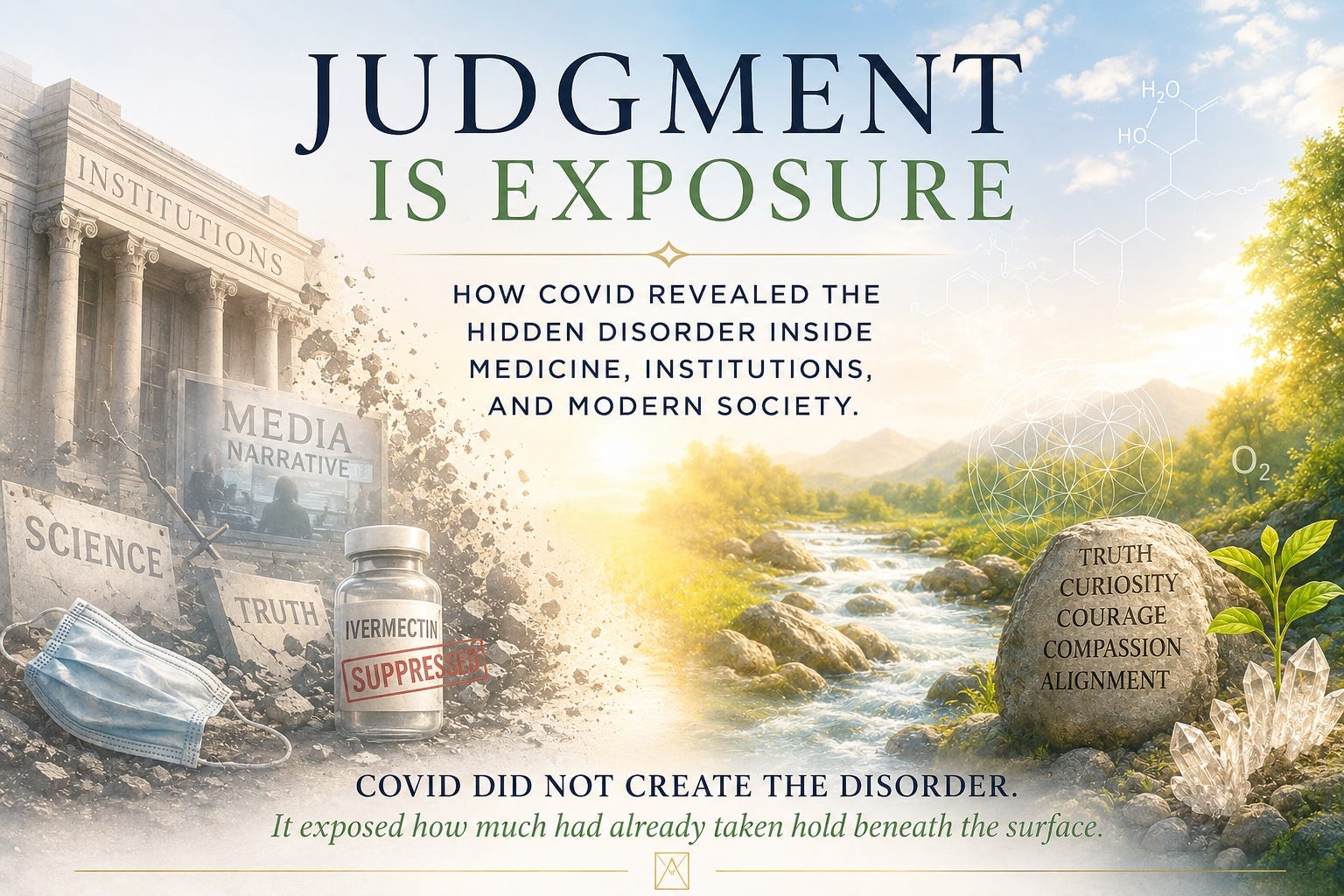
I am speaking at The Better Way Conference next weekend in Providence, RI. Use KORY10 for 10% off live or virtual viewing.
*Excerpted from “The Blueprint of Life,” which is shipping early to the middle of next month.
The previous posts explored a recurring principle across physics, biology, geology, and even human behavior: systems remain healthy only when order, alignment, and coherent transmission are maintained. We saw it in water responding to structure, in Retallack’s experiments on biological sensitivity, in electrochemical gradients that sustain life, and in the way living systems organize themselves under stable conditions. But every principle becomes easier to see under strain. Pressure does not create the underlying structure of a system. It reveals whether that structure was ever stable to begin with.
This chapter is not about blame. It is about what happens when alignment is violated at scale.
Judgment is often heard today as punishment, condemnation, or sentence. But I am using it here in its Scriptural sense. Judgment is the moment when what is hidden becomes visible, when a person, nation, or system is revealed for what it truly is.
In Scripture, judgment does not only punish disorder. It exposes it. It separates appearance from reality. It reveals whether a structure was built on truth or falsehood, courage or fear, service or self-protection.
That is the meaning I intend here. When institutions, societies, and individuals are placed under sufficient strain, what is hidden becomes visible. Incentives reveal themselves. Fear reveals itself. Courage reveals itself. Integrity reveals itself. Some systems maintain alignment under pressure and continue transmitting order outward. Others fracture internally and begin propagating confusion, distortion, self-protection, and harm.
Covid was not just a crisis. It was exposure.
A key insight running beneath this entire book is that life depends on ordered systems and on fluids capable of carrying that order.
Life unfolds in media through which matter, charge, energy, and information can move; that is, it operates in fluids. And fluid does not mean water alone. Air is a fluid as well—a medium through which sound, signals, and energies propagate between bodies, just as aqueous media carry charge, gradients, and communication within and between cells. Ordered human behavior moves through the air—through speech, tone, action, restraint, panic, courage, and command. The medium differs. The principle does not.
What is carried in a medium, and how it is carried, exists on a continuum. Fluids either carry ordered gradients, signaling, and structure, or they carry distortion, noise, and disorder instead. Living organisms either maintain internal order and propagate it around them, or, when that order breaks down, propagate disorder in its place. Systems—whether biological, social, or institutional—either maintain order under pressure and extend it outward, or they begin to fracture from within and spread disorder both internally and outward into everything they touch.
For many months, I could recognize ordered systems in water, soil, and biology, but not yet in society. As a physician, I understood how biological systems behave when internal order is lost and the consequences of that loss. Then memories of Covid kept returning, and that entire period began to look far more profound and unsettling than it once had.
Before Covid
Before Covid, I lived inside a world that made sense to me. It was not perfect, and it certainly was not always just. I knew that wars, massacres, famines, and humanitarian catastrophes occurred, but they mostly felt distant, fragmented, and exceptional.
In my personal life and career, I was more focused on flawed institutions, misaligned incentives, and a bureaucracy that I found deadening. I did not yet suspect how completely they might fail when truth, courage, and human life came under real pressure.
Looking back, I now see that I believed something I had not openly acknowledged to myself: that when real danger arrived, when lives were truly at stake, I trusted that institutions would remain oriented toward truth, care, and the search for what worked. However imperfectly, I believed the people entrusted with responsibility inside them would remain faithful to that purpose, despite the professional, financial, and social incentives pulling them elsewhere.
Then Covid arrived, right as the second of my daughters was fighting the same devastating illness that had already traumatized my family two years earlier.
Covid came as a pulmonary and critical care disease, squarely in my lane as a pulmonary and critical care leader. I stepped forward the way physicians trained for crisis do. I gave up sleep. I gave up my normal life. I gave up attention that should have belonged to my wife and, most painfully, to a very sick child who needed me in ways I can never fully make right. I told myself it was temporary. I told myself nothing could be more important. I told myself this was what I had been trained for.
At first, it felt like war in the noble sense of the word: chaotic, exhausting, terrifying, but shared. We were all learning in real time. Or so I believed.
When Disorder Reveals Itself
When disorder begins to propagate through a system, those still ordered enough to recognize the truth are often the first to feel the strain, because they are the least able to normalize what does not fit. Looking back, from the very first days of Covid, long before the collapse became obvious to most people, I watched the medical system I had trained in, believed in, and served for decades begin to fail. At first slowly, then quickly.
I knew almost immediately that something was off. At first, it was only one or two concerns, but they were not subtle. The system was moving under the weight of fear and confusion, trying to stabilize itself through policy at exactly the moment when curiosity, innovation, and urgency were most needed.
That was enough for me to resign early on from my clinical leadership position at one of the largest academic medical centers in the country, lodging a moral and ethical objection to an institution that had chosen to block a safe and effective intervention—IV vitamin C—while insisting that “supportive care only” was the appropriate default treatment, and that placebo-controlled trials should proceed even while patients were dying in front of us. In an emergency, that meant valuing the production of sanctioned knowledge above the duty to attempt rescue.
Then, without seeking it or wanting it, I found myself drawn into something else entirely. I became a public figure in what I would later title my book, The War on Ivermectin. I did not choose that role. I entered it because I did what physicians are supposed to do when confronted with a new disease: I studied the data, followed the physiology, and observed how profoundly a treatment was helping patients, both in my practice and around the world.
As reports, case series, observational studies, and preprints began pouring out from every corner of the globe, I immersed myself in them obsessively, trying to make sense of a fast-moving body of evidence that few seemed willing to synthesize in real time.
In doing so, I became, almost by accident, one of the world’s leading clinical experts on the emerging ivermectin data. That expertise, built under pressure, eventually led to Senator Ron Johnson’s invitation to testify before the United States Senate, speaking not only to the country, but to the world, about what I believed the evidence was already showing. The testimony quickly went viral, and with it, my role in that conflict changed overnight.
What followed was unlike anything I had encountered in medicine.
Media hit pieces targeting both me and my non-profit organization appeared almost immediately. Journals behaved in ways I had long been too naïve to imagine. My paper, along with others, was blocked and then retracted in a manner that violated publishing practices. Agencies issued policies devoid of both logic and scientific courage, then contradicted themselves without accountability. The FDA posted its now-infamous “You are not a horse. You are not a cow” tweet, and the world’s media followed by reducing a Nobel Prize–winning human medicine to a “horse dewormer.”
Several of the world’s leading universities fraudulently designed and manipulated large “rigorous” trials to prove that ivermectin did not work. Beneath nearly every amplified narrative sat the same unspoken force: institutional and industry self-protection reinforced by money, status, or fear, together with the determination to preserve authority even as grievous errors were being committed and harm was being widely disseminated.
Covid did not create the disorder. It exposed it.
I felt it escalating long before most people were willing to admit that anything was wrong. I was speaking, writing, testifying, organizing, and warning as loudly as I could through every channel available to me—through my organization, my Substack, interviews, podcasts, and public appearances—and yet much of society remained insulated from what was happening, in no small part because censorship, propaganda, and media attack were functioning exactly as intended. Things once anchored in care, judgment, and responsibility bent toward profit, compliance, and self-protection. The language stayed calm. The rituals stayed intact. But the center was not holding.
I watched people I respected normalize things that made no sense, justify actions that violated their own values, and place their own interests—professional, financial, and personal—ahead of the needs of the sick. Eventually, I could see that staying meant participating in something I no longer could recognize as ordered. I left in protest and in anger, because once a system begins consuming what it claims to protect, anger is a proportionate response to moral collapse.
What failed was integrity and courage, which made science itself elusive. By then, the language of evidence-based medicine had already been captured. Only one kind of evidence was permitted to govern care: the kind produced through immensely expensive, tightly controlled randomized trials, the very currency affordable only to industry and out of reach to repurposed therapies and urgent bedside innovation. Everything else—mechanistic reasoning, observational evidence, clinical experience, and early signs of benefit—could be ignored, no matter how many lives hung in the balance. In that system, protocols hardened, dissent was criminalized, and moral responsibility was outsourced to policy.
I also watched something I never expected to see in my lifetime: an entire society submit, with astonishing speed, to levels of centralized control that would have been unthinkable only months earlier. Movement was restricted. Businesses were closed. Families were separated. The ordinary rhythms of life—work, travel, gathering, worship—were suspended by decree. It did not unfold gradually. It happened almost overnight. And while a small number of voices objected, the overwhelming response was compliance. As an American who had long taken that kind of freedom for granted, the shock of it was profound. It revealed how quickly a population can accept sweeping restrictions when fear is sufficiently amplified and dissent is sufficiently marginalized.
At the same time, I watched as a global medical intervention was recklessly deployed at unprecedented scale and speed, under intense social, institutional, and economic pressure. People were urged—at times compelled—to accept a novel gene therapy product under conditions that left little room for hesitation, questioning, or individualized judgment. The cost of refusal escalated: loss of employment, restricted access to public spaces, exclusion from travel and participation in normal life, and even estrangement from their own families. Public discourse narrowed, and those who raised concerns were frequently dismissed, censored, or portrayed as irresponsible. The force of that pressure, combined with the uniformity of the messaging, created an environment in which open scientific and ethical debate largely disappeared.
This was not a sudden misfortune cascading into a random series of errors. It was a disordered society revealing itself under pressure.
The Cost of Seeing Clearly
It became even more personal to me when I watched colleagues—many of them people I had known, worked with, and trusted for decades—stop thinking for themselves because it was easier, safer, and more professionally survivable to follow guidance than to ask whether that guidance matched reality. I watched patients get hurt and die unnecessarily. Paul Marik and I, as co-founders of the FLCCC, fielded hundreds of calls from desperate families whose loved ones were effectively imprisoned in hospitals, where doctors refused to abandon failing protocols and institutions hired lawyers to block families from trying something else.
Whenever we could, Paul and I would try to reach the physicians in charge of those ICU patients directly. Despite our national and international reputations—particularly before but also in Covid—the resistance was overwhelming. Doctors did not want guidance. They did not want contradiction. They did not want outside voices, no matter how experienced or how urgently we believed their patients needed a change in course. The hours poured into those calls, only to meet wall after wall of refusal, became unbearable.
Eventually, we stopped trying, not because we stopped caring, but because to continue meant breaking ourselves entirely. I will never forget the day Paul and I made the decision to stop fielding calls for hospitalized patients. From that point on, for the first time in my life as a physician, I had to say to another human being who came to me for help with a loved one in a hospital: “There is nothing I can do.”
The consequences did not stop even as the pandemic began to fade. Our jobs were taken from us. Our academic careers were destroyed. Our specialty certifications were revoked. Our credibility and achievements were marginalized or dismissed. Our health failed. Our marriages collapsed. All of it happened in full view of institutions whose leaders could have chosen curiosity, courage, and honesty, and chose none of them.
What finally shifted something fundamental in me was not the harassment, the loss, or even the professional destruction. It was understanding why it happened.
Dissent itself had become dangerous. Biomedical ethics collapsed overnight. Laws were written to police doctors’ speech. I repeat: laws were written to police doctors’ speech. A frighteningly small minority rebelled. Most complied.
Only later, while writing this book, did I recognize what I had witnessed: a severely disordered and misaligned system collapsing in front of me. It was structural, human, and lethal.
Order and alignment are no longer abstractions to me. I can see clearly what happens when they disappear—in patients, in institutions, and on a national, if not global scale.
How Judgment Unfolds
In the wake of all I had witnessed, and all I had been subjected to, I did not move back toward institutions. I moved away from them. I built my own clinic, became my own boss, and resolved never again to place my conscience, judgment, or livelihood in the hands of an authority I did not trust. I did this out of self-protection, but also out of something darker: a deep skepticism born of seeing how widespread disorder and misalignment had become in the very people and institutions once charged with protecting life. I do hold out hope that the distrust does not remain permanent in me. But for now, it has become a kind of shield.
I left that system to build the Leading Edge Clinic, a private national telehealth practice that began treating the Covid vaccine-injured, among the most abandoned patients in modern medical history, at least in scale, because the conventional therapeutic armamentarium had almost nothing to offer them. From there, the clinic widened. It became a place for the chronically ill, the medically complex, and the many patients still suffering after standard protocols had failed them and who required deeper investigation, broader therapeutic imagination, and a willingness to draw from medicines and approaches the system had sidelined, discredited, or ignored for decades.
Rather than confront the vaccine-injured, the system closed ranks. Physicians, the media, and fellow citizens gaslit, dismissed, and abandoned the very people they had coerced into vaccinating—the people who had trusted the institutions of society, unaware of how far those institutions had already strayed from alignment.
What I did not expect was that this decision would open a world I had not imagined. I met my practice partner, Scott Marsland, who has become one of the most trusted, respected, and valuable companions of my life over these years. Even more striking were the people who came wanting to work with us. All were refugees from that same broken system. Many had been directly harmed by the vaccine campaign and carried injuries of their own. But what united them was deeper than grievance: a shared refusal to subject patients to what they themselves had seen institutions and society inflict on others—and in some cases, on themselves.
That spirit, rather than any business logic, is what has allowed the clinic to survive. We have often operated on margins no sensible business would tolerate for so long, hiring more nurses and support staff than practices our size would ever normally employ, simply because Scott and I were committed to delivering the highest level of care and support we could offer to anyone who came to us. By ordinary standards, it may look improbable that we endured at all. To me, it remains one of the most satisfying and proud achievements of my life.
That endurance did not come from perfect management. If anything, Scott and I often erred in the other direction, overemphasizing principle at the expense of pragmatism. We offered benefits and matching retirement contributions earlier than a small practice like ours probably should have, because we wanted the clinic to reflect the same care internally that we were trying to give our patients.
Over time, however, we learned that alignment also requires discipline. The structure has to hold first. It cannot be exposed to weakness, folly, or ego disguised as generosity. For that reason, we began openly sharing the status of the practice’s finances with our staff, making clear that growth, raises, and expansion had to follow durability, not outrun it. Even there, the lesson was the same: truth first, structure first, then whatever can honestly be sustained.
In time, I began to understand that this, too, was part of the same pattern. Judgment does not only expose what fails. It also reveals what holds. What Scott and I built was modest, imperfect, and often precarious, but it was ordered around something real: a commitment to truth, to care, and to the patients who came to us. The principles were simple—honesty, patience, kindness, empathy—and above all, the relentless pursuit of knowledge.
*If you value the late nights and deep dives into all the “rabbit holes” I write about, your support is greatly appreciated.
Right from the beginning and in the years since, we have been researching numerous therapeutic options with countless hours studying, questioning, testing, and refining them—not in the service of reputation or growth, but for one purpose alone: to relieve the suffering of the people who came to us. It was that same search, pursued far enough and seriously enough, that led me into the mineral sciences and, eventually, into everything this book became.
The suffering of the patients we encountered was immense. Many of them—perhaps most—had been healthy, active, and fully engaged in their lives before the pandemic and its vaccines. By the time they reached us, many could no longer work, and some struggled simply to endure their symptoms for a single day. Their situation was compounded by the perverse, yet well-described, reality that myalgic encephalomyelitis/chronic fatigue syndrome—the clinical pattern underlying much of Long Covid and Long Vax—often yields normal standard laboratory results, imaging, and physical exams.
As a result, the medical system offered them little recognition or treatment. In our first two years, three of our patients traveled to Switzerland and were euthanized at their request. I will never forget that. Ever.
To witness such suffering over the years changes you. It clarifies what matters and what does not.
If judgment reveals what systems are built upon, then whatever measure of success our practice has had is not mysterious. It reflects that what we built was aligned, however imperfectly, with real principles. That kind of alignment prevails.
Memorial Day Sale
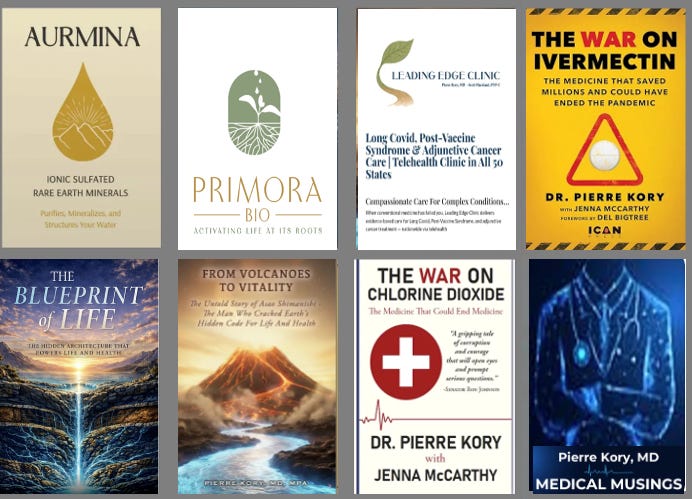
Today is the last day of our Memorial Day weekend sale on the two products that emerged from this work: Aurmina and Primora Bio. Discount code for 25% off both: Memorialday26.


From Research to Practice - Links Below Image
This is a devastating account that brings tears to my eyes. As a retired, elderly woman who refused the so-called covid vaccine, I came through covid relatively unscathed, except for emotional pain, which continues to this day. I lost some relationships, but not my marriage, as my husband and I were in agreement about what was happening. I struggle today to not be angry because people seem so oblivious and uncaring about what has happened, and is still happening to us. I feel like screaming when I encounter the church elder who refused to read Dr. Peter McCullough's book because he said it was divisive. I stopped supporting the seminary near our home because they pushed the shots and even sent out a letter mocking students who didn't want to take it. I am profoundly sorry for the price you paid for trying to help people. It doesn't make up for the loss of your marriage, but thank you for helping us get through this terrible time. The FLCCC was a lifeline for us.
This hits right where it hurts. As a pharmacist I too felt betrayed and abandoned by the "system" that allowed my fellow travelers to be consumed by the lies told in defense of the indefensible. I watched as a system I was wholly incorporated within became something that I was ashamed of. I can only continue to soldier on, trying to educate those willing to hear. I will be sharing this as often as I can.