


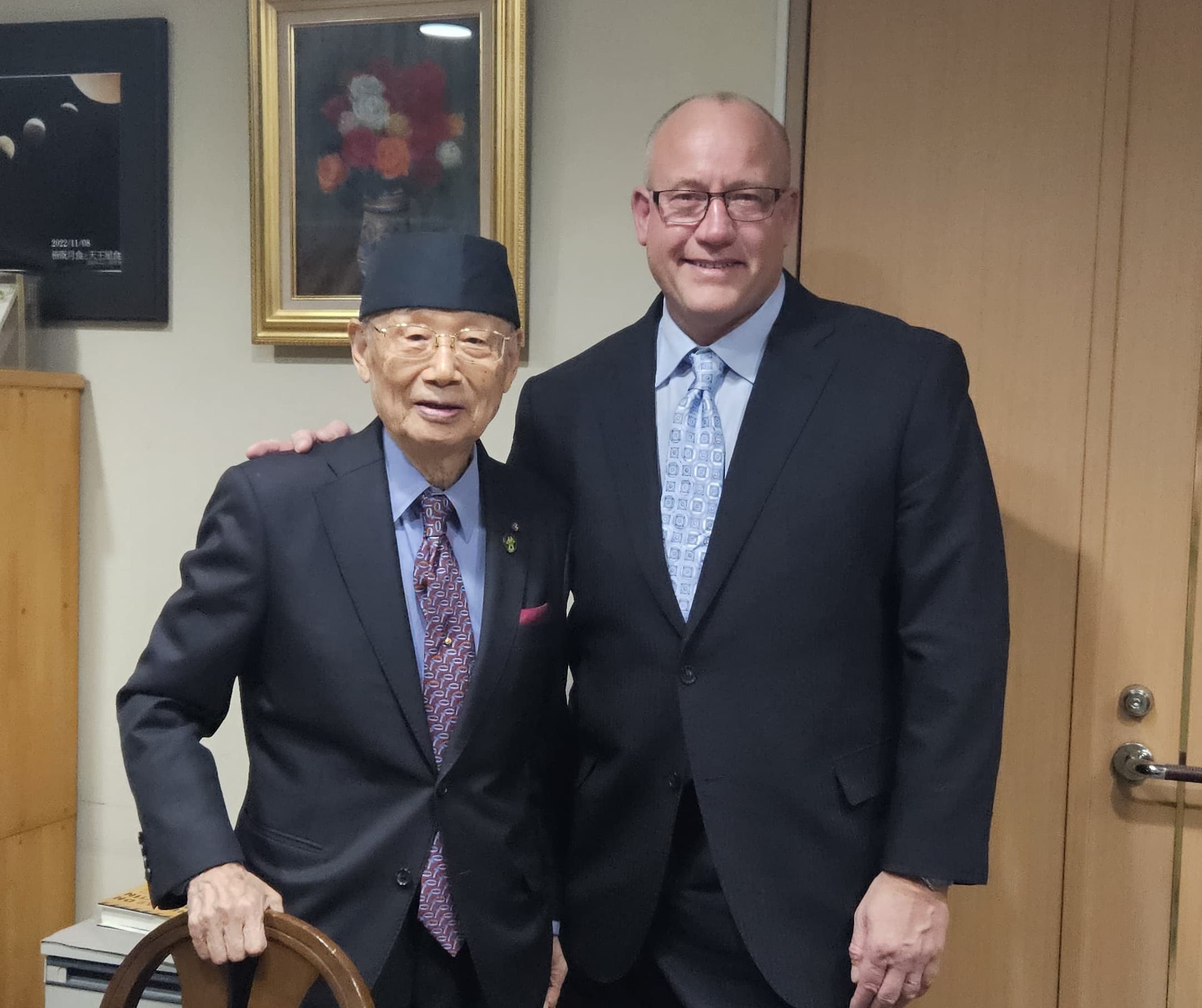
OK folks, today I’m going to try my hand at travel writing and photography journaling: part Bill Bryson, part 1970s living-room slideshow :).
A quick note before we begin: this post is more personal than most, not only for me but for those I met during my trip, so out of respect for them, the second half is for paid subscribers. The first half, including why this trip meant so much to me, is free for everyone. And my visit to Shimanishi-kaken, the company that still makes Themarox, deserves its own post, so that story is coming separately.
Why Japan?
It’s hard to overstate how important visiting Japan had become to me. It comes down to two Japanese researchers I came to admire deeply, whose work had literally taken over my career. One of them cost me part of my old career; the other gave me a new one.
The desire started early in COVID, when I learned that Professor Satoshi Ōmura, who shared the Nobel Prize for discovering ivermectin, had been admiring the work Paul Marik and I were doing with the FLCCC to spread the word about ivermectin as a treatment for COVID. It wasn’t long before I thought to myself, “How cool would it be to meet Professor Ōmura? I’ve just got to make sure I visit Japan someday.” As you’ll learn below, that desire only grew over the next few years.
What made the trip urgent this year was a second Japanese researcher: Asao Shimanishi, a deeply obscure, extremely private man who, I believe, made history in 1977 when he successfully extracted an aqueous mineral solution from volcanic black mica, one of the most broadly mineralized and abundant rocks in Earth’s crust.
As my readers know, I believe his work is of historic and global importance, which led me to write three books, the Stone and Water Series, available on my website (personally stamped) or on Amazon. But eight months into writing them, I was increasingly weighed down by how little written record existed from or about him.
Given the magnitude of what he accomplished, how little exists is beyond shocking: a single chapter in an agronomy textbook (which I only discovered while in Japan), a 12-page company manual he wrote, a transcript of the only public interview he ever gave, and a five-second appearance in a ten-minute news clip (at the 2:10 mark) from when his Themarox was used to purify and clarify a famous Shinto pond that had turned brackish. Beyond that, I had only oral histories, almost all passed on to me by people who knew people who knew him, rather than by anyone who knew him directly. (That would change in Japan.)
I also wanted to meet the executives of Shimanishi-kaken, Shimanishi’s legacy company, which has manufactured Themarox in the twenty-five years since he left. Since starting Aurmina and Primora Bio, we had corresponded by email for months, but everything had to be translated, and it was formal and careful, as translated business email always is. I wanted to get to know them personally, and they felt the same. (That visit gets its own post.)
Underneath all of that, honestly, was something I still can’t fully explain: I had become fascinated with Japan, and a little mystified by how many threads of my life ran through it. Ōmura. Shimanishi. Ivermectin. Themarox. Two separate obsessions that led to two career-altering trajectories, both ending on the same island. My career has always been marked by periods of intense research into novel therapies, but these last two sprang from the work of two Japanese men of the same era, both trained in pharmacy and chemistry; Shimanishi got his initial pharmaceutical degree in 1950, Omura in the late 50s. But get this: both made a determined decision early in their careers to study “nature’s chemistry” instead of the synthetic petrochemical research that was all the rage back then (and still is), and where all the money was. Omura’s biography describes his field as “natural product organic chemistry,” while Shimanishi devoted himself to what he would have described as “natural product inorganic chemistry.” Why had my career, and more accurately my entire life, become so deeply connected to those two men, that era, and those fields?
Lastly, I had always heard about the quirks and idiosyncrasies of Japanese culture, and about the country’s strange and outsized presence in modern history, and I wanted to see it for myself.
The Dream
When Paul Marik and I were leading the FLCCC, a Japanese Doctor of Pharmacy named Morimasa “Mori” Yagisawa reached out to me. Through Mori, I came into contact with the people around Professor Ōmura.
Ōmura’s laboratory discovered the soil organism that gave the world avermectin, and from it, ivermectin. My COVID work had intersected with his, if not nearly duplicated it. Like me, he did not stay quiet during COVID. From the very beginning of the pandemic, he reached out to Merck, imploring them to fund trials. Like me, he and his colleagues published a major, highly positive review of the dozens of ivermectin studies available at the time. He also wrote a book about ivermectin’s role in COVID, though its title, Ivermectin: Can It Become a Lifesaving Treatment for COVID-19?, was more optimistic than mine, The War on Ivermectin.
The world’s press, which had been perfectly happy to celebrate him in 2015, decided it didn’t want to hear from him in 2021. Only when I met him did I learn how complete that silence had been, even at home. His book became a bestseller in Japan, yet the Japanese media barely covered it, and no one invited him to give a single interview. No major publisher would take it. A Nobel laureate in his own country, writing about the drug that won him the prize, couldn't find a mainstream publisher.
I had seen a glimpse of that silencing from the other side of the world, years before we ever met. Because of my highly public advocacy for ivermectin and my role in the FLCCC, I slowly became fairly visible on Twitter, reaching over 600,000 followers. My single most popular tweet to date was me reporting that YouTube had taken down an interview with Ōmura about using ivermectin. Check out the retweet count, for a man not named Elon Musk:
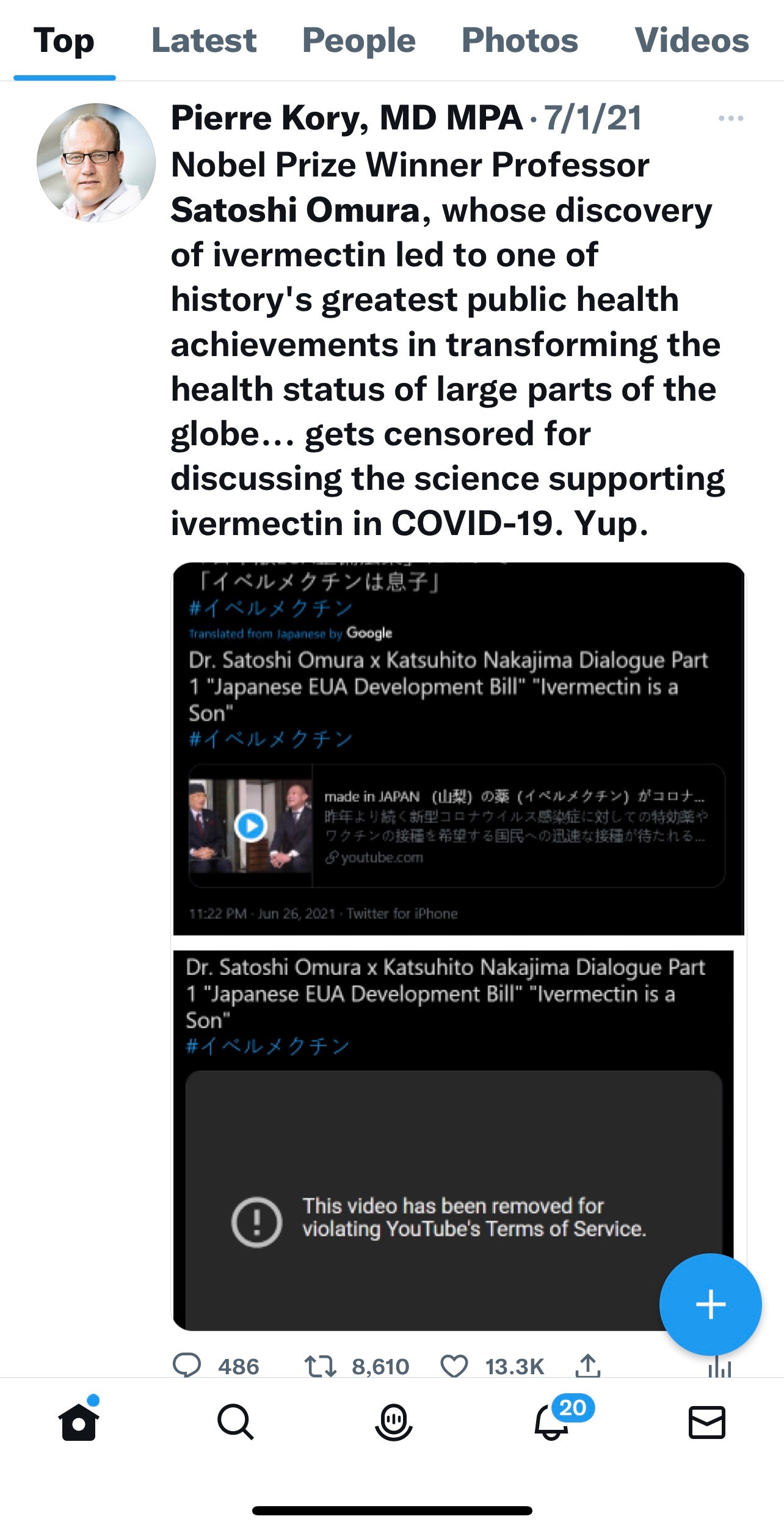
That tweet was paired, in an old post, with a video clip I want to reshare: a fiery diatribe by Professor Masanori Fukushima, Professor Emeritus of Kyoto University, delivering a scathing and scientifically accurate critique of pretty much every aspect of the COVID vaccine campaign. The world had only a handful of truly prominent academics bold enough to publicly criticize their country’s COVID response, and no one came close to Fukushima’s fury (it’s even angrier than my ivermectin Senate testimony). When I watch it, I feel like I did as a kid watching the training montage in Rocky, with the theme music cranked up. Best line: “a bunch of incompetent scholars who cannot be called scholars... a total disregard for science and medicine.” Amen.
But the biggest reason I couldn’t wait to meet Professor Omura was to thank him in person for one of the greatest gifts I have ever received. It came when I was lost, no longer employable in any ICU, and feeling down (a feeling I rarely, if ever, suffer), and it lifted me up when nothing else could.
** If you're considering a paid subscription, know that after an extended period of infrequent posting, I have tons of posts generated from excerpts of chapters from my three books that I am going to start sharing regularly…
