


Author Aside: We’re in the middle of a brief run of what I call the “Deep Science” posts. They’re a bit more technical than usual, but they’re necessary to understand the larger story we will return to tomorrow, about water, minerals, and life. Hang in there for this one more rabbit hole, then we’ll return to one of, if not the, most important tales I have ever told.
RECAP
Before continuing, it is worth briefly recalling the elemental logic of the iron-sulfur-aluminum-water engine itself (ISAW). In earlier sections, I argued that Earth’s mineral–water chemistry operates through a kind of division of labor among four elements. Iron governs the movement of electrons, cycling between oxidation states and keeping energy in motion. Sulfur mediates proton activity and drives mineral transformations that reopen reactive surfaces. Aluminum provides the stable aluminosilicate framework within which these reactions can occur without collapsing the system. And water serves as the mobile medium that links them all together, dissolving minerals, carrying charge, and transporting the resulting chemistry outward into soils, oceans, and eventually living organisms.
Living Water and the Deep Earth Circulation System
In the previous act, I examined ISAW at the elemental scale, where water plays a critical role in activating mineral chemistry in rock and then carries both its energy and mineral inputs from rock into life.
As I followed that chemistry outward from mineral reactions into planetary processes, one realization became unavoidable.
The planetary energy system is not the cause of ISAW chemistry.
It is the cumulative expression of it.
Across the crust and mantle, iron-, sulfur-, and aluminum-bearing mineral systems continuously interact with circulating water. Wherever this interaction occurs, iron-bearing minerals oxidize, water is reduced, and electrochemical gradients emerge.
Modern mineral physics confirms that this circulation is not confined to the crust. Two well-documented geological processes illustrate how circulating water and iron-rich rock naturally generate electrochemical energy long before biology appears.
Natural Electrochemical Systems in Rock and Water
One process that repeatedly appeared in discussions of early planetary energy systems is serpentinization. When water infiltrates deep fractures in iron-rich mantle rocks, a powerful chemical transformation begins. The minerals reorganize into rocks such as serpentine and magnetite, releasing hydrogen and heat.
The surrounding fluids become strongly alkaline. When these fluids encounter comparatively more acidic seawater, steep redox and proton gradients develop. In energetic terms, this stores electrochemical potential, the same kind of energy difference that biology later exploits through electron transport chains and proton gradients.
For this reason, serpentinizing hydrothermal systems are widely considered among the most powerful natural energy engines operating on the early Earth.
Not long after encountering this process, I came across a closely related phenomenon described in the geophysical literature: what some researchers call “natural geobatteries.” In many regions of the crust, reduced iron- and sulfur-bearing minerals at depth are electrically connected through rock and groundwater to more oxidized environments closer to the surface.
The arrangement resembles a battery: reduced minerals act as electron donors, oxidized zones act as electron acceptors, and groundwater serves as the ionic pathway that closes the circuit. Portions of the crust therefore behave as distributed electrochemical circuits, quietly moving charge through the coupled pathways of rock and water.
At that point, the implication became difficult for me to ignore.
Wherever water circulates through iron-rich rock under conditions of chemical imbalance, electrochemical gradients emerge that allow electrons and protons to move simultaneously through mineral structures and water.
The metabolic machinery of life may therefore represent something deeper: not a new invention, but the internalization of an energy system that had long operated within rock and water.
Water Circulation Through the Deep Earth
When I zoomed out to view Earth’s energy cycle as a whole, water again emerged as the central medium through which planetary chemistry operates continuously.
Heat rises from below, but it is the circulation of water, descending into rock, dwelling within fractures, exchanging charge and minerals, and eventually returning upward, that connects Earth’s interior chemistry with surface environments. Through this circulation, mineral reactions occurring at depth are carried outward and redistributed.
Rainwater enters fractured bedrock worldwide. Once below the surface, water slows dramatically and transitions from an atmospheric process into a geochemical one. Moving through faults, fractures, and porous zones, it remains in prolonged contact with iron-, sulfur-, aluminum-, and silica-rich minerals as pressure increases, temperature rises, and time extends, thus becoming chemically conditioned by the geological environments it traverses.
Some of this subsurface water returns quickly to springs and streams, but much of it remains confined for decades or centuries, repeatedly contacting the same mineral interfaces. One example of such transformation is the gradual alteration of biotite into vermiculite, in which potassium is released, without collapse of the structure.
Eventually, this deep, mineral-conditioned water returns upward, sometimes gently through springs and seeps, and sometimes violently through ruptures, geysers, and volcanic systems.
Ancient texts referred to these events as “the fountains of the great deep,” but the mechanism is physical: heat rising from the mantle drives portions of this conditioned water back toward the surface, carrying with it the chemistry acquired at depth.
From Local Gradients to a Planetary System
One discovery genuinely surprised me: just how much water the Earth stores at depth.
Vast quantities of water are held directly within mantle minerals themselves, chemically bound as hydroxyl groups. Laboratory experiments and seismic observations indicate that mantle minerals may store one to three percent water by weight, suggesting that the mantle alone may contain an amount of water comparable to, or even exceeding, all surface oceans combined.
The 2014 identification of water-bearing ringwoodite provided direct confirmation that water is embedded deep within the planet’s interior, not merely flowing above it.
I present the sequence above as a conceptual framework that helps make sense of how several well-established geological processes, deep iron-rich reservoirs, circulating water, and persistent redox gradients, could couple into a continuous planetary energy system.
Primordial Circuit Stabilization
As I began connecting these pieces, a broader picture gradually came into focus.
Over geological time, as these systems expanded and interconnected, Earth assembled into a planet capable of sustaining continuous electrochemical disequilibrium.
Iron-rich mantle and crustal systems act as vast reservoirs of reducing potential, forged under immense pressure and heat. From these environments, heat, pressure, and reducing power propagate upward through the mantle and into the surrounding crust.
As water infiltrates iron-bearing rock, iron oxidizes while water is reduced, producing hydrogen and alkaline fluids rich in dissolved hydrogen. These fluids move upward through fractures and hydrothermal systems, carrying chemical potential toward the surface.
At the same time, the early oceans followed a different chemical trajectory. Influenced by volcanic gases, atmospheric reactions, and rainfall, surface waters were comparatively oxidized and more acidic.
Wherever reducing fluids rising from depth encountered these more oxidized surface waters, strong redox and proton gradients emerged. These interfaces appeared repeatedly wherever rock, water, and chemical imbalance intersected.
Within these environments, electrons moved through mineral networks while ions moved through water, establishing a planetary-scale architecture capable of sustaining continuous energy flow.
Once sustained electrochemical gradients formed between Earth’s interior and its surface waters, their influence no longer remained confined to the depths where they originated. Circulating fluids carried heat and dissolved minerals through the crust, hydrothermal systems altered ocean chemistry, and reduced gases entered the atmosphere. Over immense spans of time these exchanges linked rock, water, and air into a continuously operating planetary system.
Only after this planetary architecture stabilized did a fourth domain emerge from within it: the biosphere.
At that point a realization began to take shape in my mind.
Life did not invent this energetic logic.
It inherited it.
Long before the first cell assembled its membranes and enzymes, the Earth itself had already become a working electrochemical system.
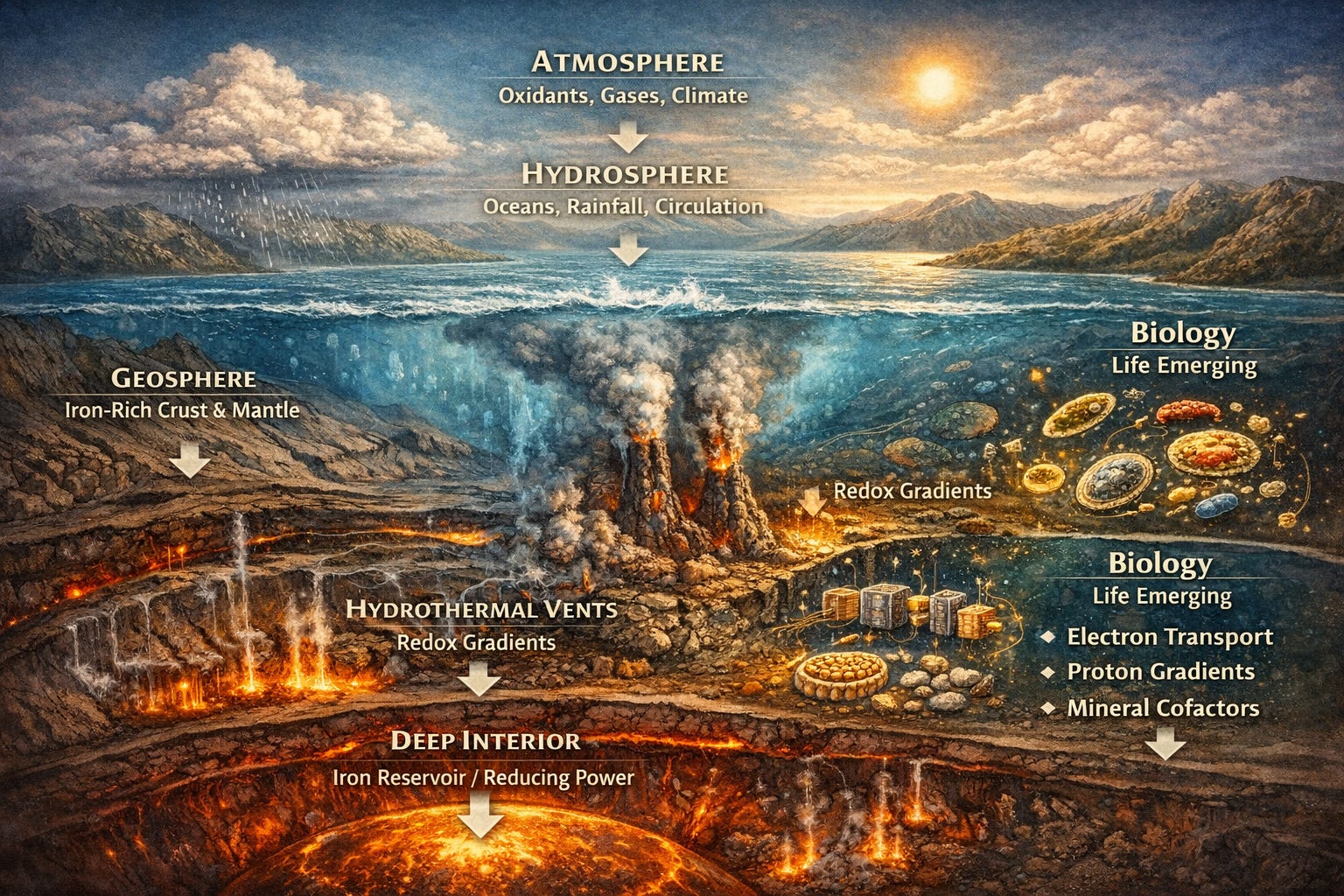
Figure D. The Planetary Energy Architecture: From Rock–Water Gradients to Biological Metabolism
Caption:
Persistent electrochemical gradients arise wherever circulating water interacts with iron-rich rock under conditions of chemical disequilibrium. The iron–sulfur–aluminum–water (ISAW) chemistry described in yesterdays’ post represents one of the mineral architectures through which those gradients form, stabilize, and propagate through rock and water.
In living systems, the same energetic logic reappears in miniature: electrons move through redox centers, protons accumulate across boundaries, and biological metabolism internalizes a pattern of energy flow that had long operated within the geology of the Earth itself.
What I refer to as the Primordial Circuit Stabilization marks the stage at which Earth’s internal chemistry and global water circulation became sufficiently integrated to sustain persistent electrochemical gradients across the planet.
Death, Decay, and the Chemical Return
Why Life Is Not Immortal
Up to this point, the Mineral–Water–Energy Cycle has been described within stone, followed by its journey into water, then into life, and the work it does to sustain all life—plants, animals, microbes, and humans.
Now we must examine what happens when organisms reach the end of their cycle. What is the mechanism by which we give ourselves—literally—back to the Earth, to the same mineral–water chemistry we borrowed and that sustained us during our lifetime?
ACT VII: Death as the Loss of Energy Governance
Viewed cosmologically, death is a chemical transition. Nothing disappears. Heat it, freeze it, scatter it, bury it, dissolve it: the matter persists. Minerals do not die. Water does not die. Even carbon, the backbone of life, does not decay in any meaningful sense. It rearranges endlessly.
What dies is control.
Life is defined by the ability to govern the flow of energy. To move electrons and protons in precise sequences. To maintain gradients, timing, pressure, and coordination across trillions of interacting parts. A living human is not a thing but a process: a vast, synchronized choreography of movement. When that choreography holds, a person exists. When it fails, personhood vanishes instantly, even though every component remains behind.
From this perspective, aging and disease are not mysteries. They are failures of flow.
The minerals remain intact, but the structures that guide them degrade. Ligaments stiffen. Vessels calcify and narrow. Muscles lose elasticity. Nerve impulses slow as insulating sheaths thin and fragment. Carbon-based architectures, the proteins, membranes, and scaffolds that once flexed, conducted, and responded, begin to lose precision. Not because they disappear, but because they lose alignment.
Pipes clog. Valves stick. Signals arrive late or not at all.
Blood thickens. Clots form more easily. Circulation falters. Oxygen delivery stutters, areas of dead tissue or scar from, removing them from participation. Iron can no longer cycle smoothly through hemoglobin. Calcium and magnesium drift out of rhythm along nerve and muscle pathways. Stress hormones assemble imperfectly or fire at the wrong time. Receptors miss their signals. Feedback loops overshoot or collapse.
Every system depends on uninterrupted cycling. When flow slows, pressure builds. When pressure builds, damage accumulates.
Cancer is not chaos; it is obstruction. A mass presses on a vein, a nerve, an intestine. Flow is distorted. Signals back up. Energy pools where it should not. Elsewhere, starvation begins.
Infection is an invasion with the destruction of cell or organ units needed for coordinated energy cycling. Pathogens slip past cilia, mucus, filters, and currents designed to keep surfaces moving. Cells sense danger and call for help. Inflammation floods the area with water, heat, and immune cells, firehoses aimed at a blockage that cannot be cleared.
Autoimmunity is misrecognition within a machine too complex to tolerate confusion. Something in the environment mimics a familiar component. The guards misread the signal. Soldiers descend from the watchtowers and attack the courtyard itself. The system expends energy destroying its own infrastructure.
Eventually, a threshold is crossed. The heart muscle, starved of oxygen and flow, can no longer maintain its rhythm. Electron transport fails. Proton gradients collapse. Energy production halts. The orchestra stops mid-measure.
The minerals remain. The water remains. The atoms remain.
But the battery is no longer regulated.
Death is the moment when a system built to channel energy loses the ability to do so. The universe does not notice. Chemistry continues. But the person, the singular pattern of motion, response, memory, and intention, vanishes completely.
Not because matter failed.
Because harmony did.
In living systems, this recursion has a hard limit. Unlike the Earth, the human body cannot recycle its own primary fuel indefinitely.
Iron is the courier. Oxygen is the fire. Together, they are the gas that keeps the engine turning.
Death arrives when coordination collapses.
In older language, this was called the departure of the animating force, not because anything vanished, but because the pattern that once braided stone, water, and charge into a person dissolved. The stones still hold charge. The water still flows. But the cycle no longer closes.
What follows is chemical reassignment.
Closure and Renewal: How the Cycles Relate and Reset
Once that organizing pattern dissolves, the elements that once participated in it begin their return.
Iron and sulfur re-enter soils, waters, and sediments. Aluminum remains bound within silicate frameworks. Over time, sometimes very long spans of time, burial, pressure, and heat reorganize these materials back into layered mineral structures such as biotite.
What life borrows, it returns.
While thinking about this phase of the cycle, something else became apparent to me as well: water itself changes roles.
During life’s emergence and operation, water helps maintain gradients, supporting organized flows of charge across mineral surfaces and biological membranes. But when biological structures begin to break down, water is no longer held within those ordered systems.
Instead, it moves through heterogeneous environments shaped by microbial activity, enzymatic cleavage, fluctuating pH, and oxidation. The state of the water changes as the system around it evolves.
Where once it helped preserve gradients, it has now become the medium through which those gradients dissolve. The same medium that once sustained structure now enables its dismantling.
Water dissolves, mobilizes, and redistributes minerals, carrying them through soils, sediments, and aquifers, returning elemental components to the geochemical domain from which they came.
Once I began to notice this pattern, I realized you can see the difference almost anywhere.
Picture water emerging from a mountain spring, issuing cold and clear from a rock face. It may have spent decades or centuries moving slowly through fractured rock, pressed, filtered, and conditioned by mineral lattices. Such water supports gradients. It holds a charge. It sustains vitality, not because it is “pure,” but because it has been organized through prolonged contact with rock.
Now picture water in a bog, dark, tea-colored, heavy with dissolved organic matter. It moves slowly as well, but through a very different environment: one dominated not by ordered mineral surfaces but by decaying leaves, microbial mats, and collapsing biological structures.
Here, water performs a different role. It dissolves structure. Acids accumulate. Oxygen is consumed. Charge dissipates. Minerals are released back into circulation as organic architecture breaks down.
Both waters are doing exactly what the system requires: one supports life by maintaining order, the other supports continuity by enabling return.
Together, they complete the cycle.
Conclusion
By the time I reached this point in the work, the distinction between the different cycles had finally become clear to me.
The Primordial Circuit Stabilization allowed planetary-scale energy flow to occur, as comparitively proton-rich surface waters began to encounter alkaline, electron-rich fluids seeping up from depth.
ISAW is the recursive loop operating within that energized planet. It governs how energy and matter are organized, transferred, and sustained across rock, water, and life.
And when life ends, the circuit does not stop. The chemistry returns to Earth, where water once again becomes the medium through which minerals dissolve, migrate, and eventually reform into new geological structures.
Nothing disappears.
One event established the planet’s energy architecture. A second system governs how life operates within it. What life releases returns to rock, and through water, pressure, and time, the system continues.
But arriving at that realization raised one final question for me.
For billions of years this mineral–water chemistry operated only within the slow machinery of the Earth itself.
Until, at one point in the twentieth century, a human being managed to isolate a functional phase of that planetary chemistry and carry it forward intentionally.
The person who did this was not a famous academic or a researcher at a government laboratory.
That story begins with a man named Asao Shimanishi.
If you value the late nights and deep dives into all the “rabbit holes” I write about (or the Op-Eds and lectures I generate for the public), your support is greatly appreciated.
If what you just read raised questions about the mineral system at the center of it, you can explore it further at Aurmina.com, where we are working to make Shimanishi’s extraordinary discovery more widely available.
From Research to Practice - Links Below
And there you have explained how precise God was when He created the earth, and the order in which He created it, and when He created every living thing in the seas and on the earth afterwards. And then, after the full cycle system was created to sustain life, He created man - and you have explained what the Lord meant by "ashes to ashes, dust to dust."
Amazing. Just amazing.
Enlightening and a lot to absorb. I would offer that “departure of the animating force” at death is also describing the departure of the soul from the human body.