



At a certain point, researching alchemy no longer felt like an esoteric pursuit. Once I began to recognize that the texts were describing the same Rock–Water Circuit we had arrived at through modern literature in geochemistry, cosmology, biology, and physics, I could no longer dismiss them.
That led to a simple question: if this level of insight was recorded here, where else might it appear? What other traditions, texts, or cultures might contain comparable observations about the processes underlying the Rock–Water Circuit?
And the oddest part is where that trail led first: straight into the center of mainstream science, to the National Science Foundation, and from there to black mica.
The Engine Before Biology
Helen Hansma, a biophysicist at UC Santa Barbara who also served as a program director at the National Science Foundation, proposed something that would have sounded outrageous not long ago: that life did not begin in ponds or vents, but between sheets of mica.
Her “Mica Hypothesis” suggests that layered silicate minerals formed natural nanoreactors—thin, charged compartments that concentrate ions, structure water, and generate mechanical energy through flexing and shear. These spaces, she argues, could have provided the conditions prebiotic chemistry needed to move toward cellular life, making mica not just a setting for emergence, but part of what enabled it.
Mica supplies:
● Structured water films
● Potassium-rich lattices that mirror modern cells
● Charge separation and confinement
● Mechanical energy capable of driving polymerization
In other words, before biology existed, the Earth had already established many of the conditions from which biology could emerge and on which it would later depend. The Emerald Tablet points to the same idea in symbolic form: “And as all things were from one, so all things are born from this one thing by adaptation.” Hansma gives the claim a biophysical vocabulary.
Then I started to wonder, if modern science could get this close, what would I find in a culture that had lived for centuries among volcanic rock, sulfur springs, and mineral water?
Japan Never Needed a Tablet
Around this time, I also began wondering whether Shimanishi’s worldview had been shaped by something analogous to the Emerald Tablet. I knew he had never encountered Hermetic texts, as none had been translated into Japanese at the time of his achievement. So I started to explore how Japanese antiquity and theology spoke about life, matter, and order. I was looking for the assumptions that shaped how the natural world was understood and portrayed in Japanese culture.
Although I could not find an equivalent to the Emerald Tablet, neither could I find much effort to explain the structure of the Earth or the workings of stone and water. And then it became clear why: Shinto never set out to explain what it already assumed.
Shinto, the Japanese way of understanding the world—its theology, if the word even applies—begins from a different assumption altogether: that life, order, and vitality already exist within nature.
In Shinto thought, the divine is already present within water, stone, mountain, and flow. Purification is the restoration of original order. Creation is understood through musubi, a generative process through which form arises from what precedes it.
In Japan, volcanic landscapes, steam vents, and sulfurous springs are treated as places where the earth’s vitality comes openly to the surface. Onsen culture grows from this assumption: people wash, then enter the mineral springs to soak, warm the body, and let fatigue dissolve in the water. The purpose is quiet restoration, a return to balance in which heat, minerals, and stillness help the body settle back into its own order.
What struck me immediately was that Japanese thought seemed, from the outset, to begin much closer to the phenomena I had been trying to understand, while modern Western science usually starts by breaking those same realities into parts and working backward. We will return to that idea in the next chapter.
Once I understood that, I felt that the Emerald Tablet’s insights would not sound foreign in Japan at all. They would sound like something already assumed.
*If you value the late nights and deep dives into all the “rabbit holes” I write about (or the Op-Eds and lectures I generate for the public), your support is greatly appreciated.
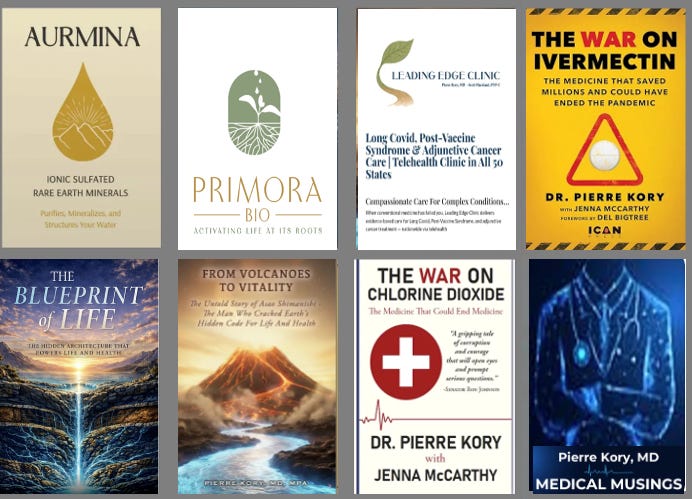
From Research to Practice - Links Below Image
A Japanese translation of The Blueprint of Life would be an appropriate gesture.