By Pierre Kory and Matt Bakos
The theory I am about to present in this chapter emerged gradually while I was writing From Volcanoes to Vitality (FVTV). By then, I was already deep in mineralogy, soil science, geochemistry, water chemistry, and the biological effects of Shimanishi’s extract. My original question had been narrower and more practical: why did this material appear to clarify water, improve plant performance, and produce effects in people that were difficult to explain by ordinary mineral supplementation alone?
But when my colleague MB began connecting some of our mineral observations with descriptions recorded in much older texts, the inquiry widened. What had begun as a biological and agricultural investigation expanded into Earth’s larger systems: mineral—water cycling, origin-of-life chemistry, and the possibility that the same rock—water architecture had been recognized long before modern science had names for it.
This theory did not emerge from one discipline, or even one line of inquiry. It formed where several fields met. Its development was made possible in part by modern AI tools, which allowed us to explore connections between multiple fields at a scale that would have been difficult to manage otherwise.
More uniquely, our work was informed by a body of texts from antiquity, particularly those associated with the Hermetic canon, that have long resisted clear interpretation. For centuries, these writings have been treated primarily as symbolic, philosophical, or mystical literature. Through our understanding of Shimanishi’s experimental work, we were able to recognize descriptions of natural processes that had not previously been fully appreciated. When those depictions were examined alongside modern scientific knowledge, an unexpectedly coherent system began to come together.
Although not yet peer-reviewed or formally published, what we call the Rock–Water Circuit Theory is a planetary systems theory proposing that mineral chemistry and water interact to form a recurring energetic architecture linking geology and biology across the Earth system.
Rock and water are the two visible anchors of the circuit. Rock stores the mineral architecture. Water opens it, mobilizes it, carries it, and returns it. Only later did we begin to understand the deeper chemistry operating inside that relationship: aluminosilicate mineral architecture, charged exchange surfaces, and water as the flux medium through which the system becomes active.
Origin of the Hypothesis
This theory began with our fascination with a particular rock. Before we had language for the core mineral chemistry involved, and before we had any model of a planetary circuit, we encountered a liquid mineral extract developed from it by Shimanishi whose effects were difficult to explain. In clinical settings, agriculture, and water systems, it repeatedly produced outcomes that suggested something fundamental in nature.
When we analyzed its composition, certain elements appeared consistently and in unusually high concentrations, especially iron, sulfur, and aluminum in an aqueous medium. At first, that led us to describe the system as iron—sulfur—aluminum—water chemistry. That was useful, but imprecise. Aluminum alone was not the point. The point was the aluminosilicate and clay-like mineral architecture from which that chemistry emerged: charged mineral surfaces capable of storing, exchanging, releasing, and organizing a far broader mineral inventory.[i]
What began as an attempt to understand Shimanishi’s liquid gradually expanded into a broader hypothesis: that this mineral—water chemistry might represent a core architecture through which energy is stored in rock, opened by water, expressed through ion exchange and redox chemistry, and eventually internalized by living systems.
The Rock–Water Circuit emerged as our attempt to follow that possibility wherever it led.
A Note on Method
One feature of this theory deserves mention. It emerged during a period in which new computational tools made it possible to move across disciplines at a speed and scale that would have been difficult only a few years ago. That does not settle whether the theory is correct, but it does mean that its pieces can now be examined, challenged, and compared more directly than they once could.
The same tools that helped us move across mineralogy, hydrology, soil science, biology, origin-of-life chemistry, and older symbolic texts are also available to others. A broad range of readers can examine the literature, compare mechanisms, identify weak links, and decide for themselves whether the relationships proposed here hold together.
The Rock–Water Circuit is a working model, not a finished doctrine. If it has value, it will survive contact with better evidence. If parts of it fail, they should be corrected, restrained, or abandoned. From the beginning, the work moved in that spirit. We followed the observations first and allowed the theory to emerge afterward.
Before we move on, I need to acknowledge authorship. As with the Geohydrological Shift Theory in FVTV, MB is again not only a co-author but also the senior author. This chapter carries his insights as much as mine.
Next, I must cite the work of the geochemists, biologists, physicists, and earth system scientists whose work informed ours, in particular Vernadsky, Cairns-Smith, Hazen, Russell, Lane, and Kappler, among others. Without them, our ability to make the connections below would have been impossible.
Author’s Note
For readers who do not come from a scientific background, or who do not naturally gravitate toward scientific material, I ask for a bit of patience. These three short chapters are the only sections of the book that lean heavily on scientific concepts, and they do not require technical mastery.
These three chapters move in sequence. This chapter introduces the Rock–Water Circuit itself. The next chapter examines the chemistry operating within it: the switch, the scaffold, the flow, and the exchange system. The following chapter traces that architecture through rock, water, life, decay, and return. A final movement expands outward to ask whether similar mineral—water architectures may recur beyond Earth.
The science asks only for conceptual engagement. You do not need to retain granular details of how each component operates. What matters is that you grasp the overall sequence and recognize the boundary between the modern scientific framework through which Earth’s systems are currently understood and the point at which we believe this work extends that framework.
A Brief Primer Before We Begin
Before entering the Rock–Water Circuit, a few words need simple meanings. These chapters use terms from chemistry, geology, and biology, but the underlying ideas are not complicated.
Electron
An electron is a negatively charged particle. When electrons move between atoms, minerals, or molecules, energy moves with them. Much of biology depends on the controlled movement of electrons from one place to another.
Proton
In these chapters, proton usually means a positively charged hydrogen ion. Proton movement is central to biological energy because protons can accumulate across a boundary and then flow back through structured pathways to perform work.
Ion
An ion is an atom or element carrying an electrical charge. Once minerals dissolve in water, they often act as ions. This is the form in which minerals move, exchange, become biologically available, and participate in work. In water, minerals are no longer inert pieces of rock. They become charged participants in chemistry.
Redox
Redox means electron transfer. One atom, molecule, or mineral center gives up electrons; another accepts them. Each transfer releases a small amount of energy, not as an explosion, but as a controlled step. Life depends on that controlled release. Cells do not burn fuel all at once. They pass electrons through a sequence of centers, releasing energy in small increments that can be captured, directed, and used.
Charge Separation
Charge separation means keeping positive and negative charges apart long enough to store usable energy. This is one of biology’s fundamental energy tricks. A cell separates charges across a membrane or interface, much like water held behind a dam. The stored imbalance becomes potential energy. When the charge is allowed to move back toward balance through the right pathway, that stored energy can do work.
Gradient
A gradient is an imbalance across a boundary. It may involve charge, concentration, acidity, or another difference. A dam offers the simplest analogy: water stored higher on one side holds potential energy. When the gate opens, that stored imbalance can do work. Living systems use gradients in a similar way. They hold difference across membranes and interfaces, then release it through controlled pathways.
Proton Gradient
A proton gradient is one of the most important forms of charge separation in biology. Protons accumulate on one side of a membrane or interface. That imbalance stores energy. When protons flow back through narrow protein channels, the cell converts that movement into work, most famously by making ATP.
Interface
An interface is the boundary where two different environments meet: mineral and water, membrane and water, rock and water. Many important reactions occur at interfaces because that is where charge, minerals, water, and structure come into contact.
Ion Exchange
Ion exchange is the process by which charged surfaces trade one ion for another. This is central to clay minerals, soils, water treatment, agriculture, and biology. In the Rock–Water Circuit, ion exchange helps explain how minerals are held, released, buffered, and made available.
Aluminosilicate Scaffold
An aluminosilicate scaffold is a mineral framework built largely from aluminum, silicon, and oxygen. These structures are common in clays, mica, and many rock-forming minerals. They can hold charge, host ions, organize nearby water, and give chemical reactions a stable place to occur.
Rock–Water Circuit
The Rock–Water Circuit is the proposed cycle in which mineral architecture forms within rock, is opened and activated by water, becomes mobile through hydration and ion exchange, enters living systems, and eventually returns through decay, sedimentation, burial, and geologic renewal. In this circuit, rock stores the architecture, water opens and carries it, life temporarily organizes it, and geology gathers it back again. Once returned, the cycle begins anew.
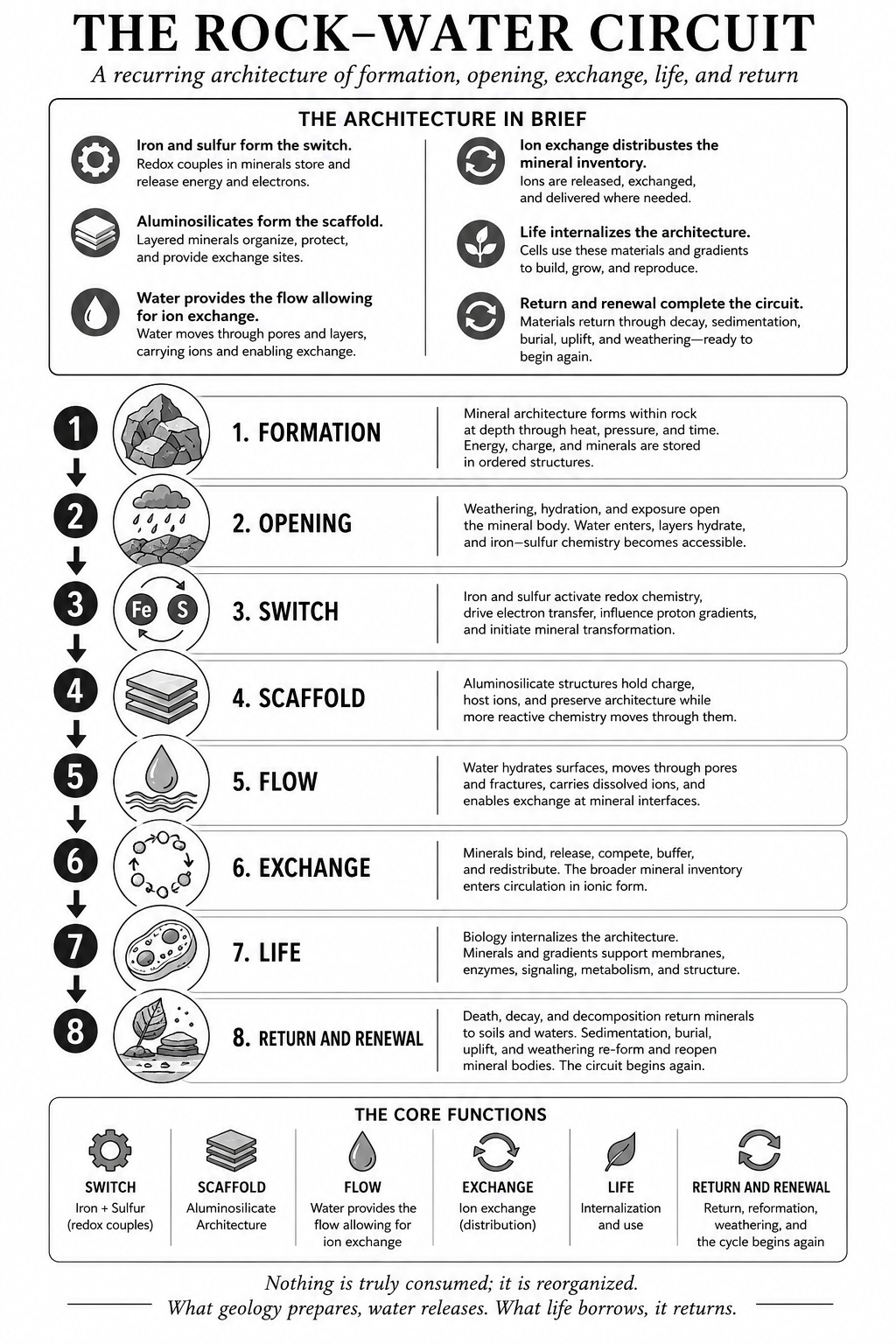
Figure 1. The Rock–Water Circuit
An Outline of The Rock–Water Circuit
With those terms and components in place, the circuit itself can be stated simply.
Deep within the Earth, minerals assemble into rock in specific structures, ratios, and compositions. Those rocks store latent energy in their charge relationships, redox-active minerals, and layered mineral architecture. Geodynamic processes lift, fracture, and expose that rock.
Water enters, opens the mineral body, and releases its chemistry into mobile ionic form. In such crystalline basement environments, water moves largely along fracture networks, where flow is constrained and water residence times lengthen.[ii] Under these conditions, water does not simply pass through, dissolving a few minerals while in brief contact before moving on. It resides against fracture walls, repeatedly acquiring minerals from rock surfaces over extended periods.[iii] [iv]
Those ions then enter soils, microbes, plants, animals, and eventually human biology, where they help regulate metabolism, charge movement, enzyme function, structure, signaling, and the countless exchange processes on which life depends. At the end of life, that same chemistry returns through decay, sedimentation, burial, and geologic renewal.
That cycle is what we began calling the Rock–Water Circuit.
It is recursive, meaning that its output becomes part of its next input. What geology prepares, water releases. Earth largely preserves the same water and mineral inventory while continually reorganizing it through weathering, ion exchange, hydration, biological uptake, sedimentation, burial, and uplift.
What life borrows, it returns. What returns to the Earth can, over time, be reorganized into new mineral bodies and released again.
The later chapters examine the architecture inside that movement: iron and sulfur as the energetic switch, aluminosilicate matrices as the scaffold, water as the activating medium, and ion exchange as the behavior through which the broader mineral inventory becomes available.
Biotite matters enormously in this book, though the theory does not rest on biotite alone. Biotite was the doorway. It was the mineral body most directly suggested to us by Shimanishi’s process, its transformation toward vermiculite, and by what we believed we were seeing in Hermetic texts such as the Emerald Tablet and The Six Keys of Eudoxus.
Biotite was not important because it was unique. It was important because it contained, in one mineral body, nearly every major feature of the architecture we were trying to understand: iron, magnesium, potassium, layered aluminosilicate structure, exchange potential, and a natural weathering pathway toward hydrobiotite, vermiculite, and clay systems. Biotite was simply the place where that larger architecture first became visible to us.
For now, the important point is simple: the Rock–Water Circuit begins with formed mineral architecture that water later opens.
*Part 2 of this three-part series is here.
*If you value the late nights and deep dives into all the “rabbit holes” I write about (or the Op-Eds and lectures I generate for the public), your support is greatly appreciated.
A note to longtime readers:
Everything I have written about over these past months eventually led me here.
This work began with a volcanic mineral extract that seemed, at first, simply unusual. The deeper I followed it, the more it opened: into water, minerals, soil, biology, ancient texts, Scripture, and finally into a framework I believe is real, enduring, and much larger than a product.
Aurmina and Primora Bio are not side projects to me. They are the first practical expressions of what this research uncovered. Aurmina carries this mineral-water chemistry into drinking water. Primora Bio carries it into soil, crops, plants, and animals.
I do not feel the need to sell you on any of it. If the work has not persuaded you, ignore it. If my writing over the years has earned your trust, and if what I have found here seems sound to you, then I invite you to take part in it.
My wife and I have given ourselves to this because we believe it matters. I have no anxiety about whether it sells quickly, slowly, or not at all. I know what I found. I know what it means to me. And I believe it can help people, animals, soil, water, and living systems in ways I was never able to help before.
For those who have followed me through the hardest years, through the late nights, the rabbit holes, the losses, the fights, and the search for truth: this is the most real thing I have ever uncovered.
If you feel drawn to it, the link is below.
From Research to Practice - Links Below Image