
Chapter 4 - The Blind Spot in Mineral Science: What We Never Measured, We Never Knew
A forensic look at how bureaucratic definitions and technological limits erased dozens of potentially life-supporting minerals from nutrition science

Yesterday, I was gifted the moniker ‘Mineral Muse’ by a reader who goes by ‘Le Chevalier Vit.’ I think the title they granted has to be a keeper (note the name of my blog). Even though I am pretty sure “muses” were traditionally women, and I am a man, with gender identity being so fluid these days, I’m pretty sure I can pull it off.
For those who don’t speak French, the reader’s moniker above stands for “Chivalry Lives.” You figure it out.
Anyway, if you survived Chapter 3, you now know why your spinach has the mineral density of a friggin' Post-it note. Modern agriculture didn’t just strip our soil—it quietly starved the entire food chain of vitality.
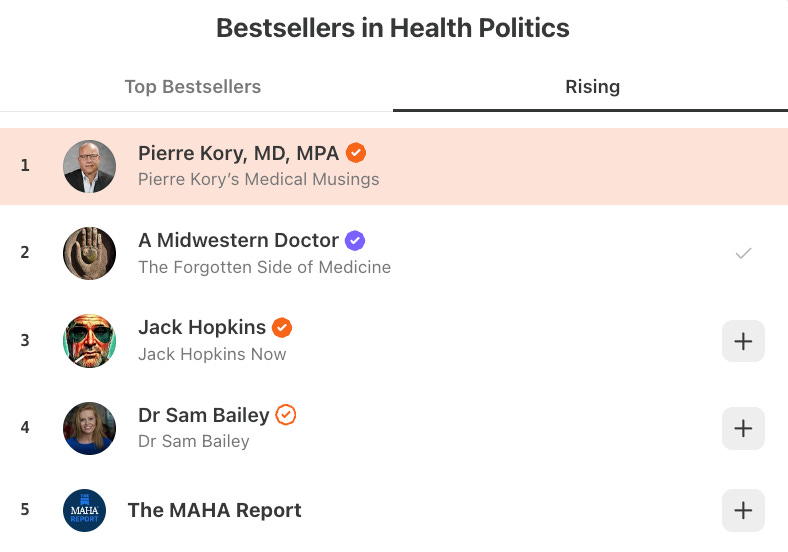
Hey, can I take a moment to thank all of you for turning “Mineral Month” into a bona fide thing on Substack? You guys rock—literally and metaphorically. Lookie here, my friends:
Love it, love it.
Fun fact: I only learned of the above when my close, Covid-found friend and colleague — the now 2nd-place “AMD” — called me last night to congratulate me. My God, that bitch/bastard has been #1 on the list forever. Not anymore! My “mineral minions” have vaulted me into “top spot” (for now). Yeah baby.
So what does this all mean? The mineral matrix that sparked life on Earth is returning to relevance after 3.5 billion years? On Substack? With my help? So weird.
Anyway, today, in Chapter 4, I show how the long-ago bureaucrats of mineral science, armed with early-20th-century lab gear and mid-20th-century arrogance, decided which minerals were “essential” and which were “irrelevant.”
Spoiler: if a mineral was hard to measure, it didn’t make the list. For decades and continuing to the present day, entire categories of potentially life-supporting trace minerals were erased—not by malice, but by measurement limits and institutional inertia.
We’re heading into the forensic crime scene of mineral science, where the victims are the minerals themselves, the suspects are the gatekeepers, and the smoking gun is the ICP-MS machine that showed up 50 years too late.
If you’re just joining us (or skipped ahead), no shame—head to the Table of Contents page to catch up. The mineral mystery only gets deeper.
Elements vs. Minerals
OK, folks, let’s start with the basics:
If you remember the periodic table from grade school, Earth contains 118 elements. An element is a pure substance made of only one kind of atom. At the same time, a mineral is a naturally occurring, inorganic solid with a crystal structure, usually formed from two or more “elements” chemically bonded together.
Apropos of nothing but a fun fact: scientists discovered the last element, “oganesson” (element 118), in 2016. Researchers may find more, but apparently they will be “very heavy” and “short-lived.”
Categories of Minerals
When you try to categorize minerals, the options seem endless: major vs. trace, essential vs. non-essential, primary vs. secondary (solidification within magma vs. appearing from erosion), hydrophilic vs. hydrophobic (dissolvable/non-dissolvable), and so on.
Although I will not use this categorization scheme to group minerals, I do feel it is essential to understand the differences in behavior between “hydrophilic” (water-soluble) and “hydrophobic” (water-insoluble) minerals.
Rocks and soil contain “metallic minerals,” which are hydrophobic and hard for the body to absorb. In contrast, both sulfated and/or plant-derived minerals are hydrophilic—they dissolve in water, carry a negative charge, and the body easily absorbs them.
Hydrophilic minerals deliver much greater benefits and bioavailability. The body uses only a small percentage of metallic minerals from rocks; it absorbs them and expels the rest as waste. Foreshadowing again—although metallic minerals from rocks are difficult to absorb, if they are sulfated, then they can dissolve in water, be ingested, be absorbed by the body, and be transported into cells.
The point: again, minerals form the very source of physical life. Even metallic minerals play a crucial role in balancing and metabolizing bodily functions. However, you cannot live on soil or rock because they are not alive or enzyme-active, unlike sulfated or plant-derived minerals.
These hydrophilic minerals, unaltered by man-made chemicals, are often described in the literature as “active” or “living minerals.” In nutritional science, they’re considered to play supportive roles in a wide range of cellular and organ processes.
Categorization Of Minerals And The Needs Of The Human Body
First, concerning elements, four of the 118 elements on the periodic table make up about 96% of our body, namely oxygen (65%), carbon (18%), hydrogen (10%), and nitrogen (3%), all in the form of macronutrients (water, protein, carbohydrates, and fat).
The remaining 4% of the human body is composed of seventy or more minerals—most present only in trace amounts. Many of these elements went unrecognized until the advent of ultra-sensitive techniques like ICP-MS, and even today, most are not routinely measured in soils or crops. It is therefore likely that the concentrations of numerous trace minerals in both our bodies and our soils have fallen far below their historical or optimal levels.
Let’s start with the simplest categorization scheme and layer in others later (isn’t this going to be super fun?).
Major And Minor Minerals
We generally categorize minerals into major and trace minerals based on their presence in the body and the amounts needed each day. Major minerals are required in amounts greater than 100mg per day. “Trace” minerals are required in smaller quantities (<100mg/day) and make up less than one one-thousandth of our body weight.
In terms of “essentiality” (if that is a word), we can also divide minerals into essential, conditionally essential, non-essential, or toxic categories. A mineral counts as “essential” if a deficiency causes health problems and normal function is restored when you replace it—a central point of this book.
The Blind Spot In Mineral Science
Here is where I introduce one of the central tenets of this book, which is, as of this writing, outside of “the Big 14 essential minerals,”:
No clinical trials have ever been done that tested the effects of deprivation of ultra-trace minerals or REEs in humans.
No clinical trials of the physiologic effects of ultra-trace or REE supplementation have been done in humans.
Actually, that is not entirely true. There have been precisely two human nutrition-style trials in “ultra-trace” minerals (i.e, outside of “the big 14”):
Boron — Controlled metabolic-unit studies in postmenopausal women showed that boron deprivation altered mineral and hormone metabolism; repletion (≈3 mg/day) reversed effects. This is the clearest evidence of human deprivation/repletion among ultra-trace elements.
Silicon — Randomized, placebo-controlled trials of orthosilicic acid in adults (including osteopenic women) reported changes in bone turnover markers and bone-related outcomes; these were supplementation—not deprivation—studies.
So why has “Science” not done more human trials of ultratrace minerals or REE’s?
Firstly, to measure trace minerals and/or REEs, especially the rarer ones that exist at very low levels, both in the soil and body, you need Inductively Coupled Plasma Mass Spectrometry (ICP-MS). This technology only appeared in 1983 and didn’t become the gold standard until 1989, about 35 years ago.
As my dear friend Dr. Ryan Cole has said for years in reference to the world’s pathologists' refusal to ‘stain’ for disseminated mRNA-generated spike protein in autopsies and cancers—"You cannot find what you do not look for.’
The historical lack of measurement tools in the early and middle parts of the last century (when the WHO and other institutions were determining the “essentiality” of minerals) prevented hypothesis testing in humans. What I discovered is that, once ICP-MS came into use in the early 1990s, for whatever reason, the near totality of its use in mineral research was in assessing the toxicity (not utility) of ultra-trace and REEs.
Thus, to date, the near entirety of the body of knowledge of ultratrace minerals and REEs characterizes their “toxicologic aspect.” Here is where I think it is important to remind you of the examples of selenium, molybdenum, and fluoride above—they had long been viewed as toxins or poisons until they were discovered to be “essential” to physiologic functioning.
My concern with the above is that just in the last decade, mechanistic microbiology has found bona fide lanthanide-dependent enzymes (although only in microbes, not humans). However, without a recognized deficiency syndrome or a clear biochemical target in humans, ethics boards and funders have balked at supporting research into the area. Shocker.
Rare Earth Elements: Pharmacologic Applications and Irony
What I found in my research is that public-health agencies fund “exposure” (toxicology) science. At the same time, supplement companies have limited IP protection and thus face regulatory hurdles if they propose lanthanide “nutrients.”
So what we’re left with is a so-called ‘consensus’—my least favorite word—that treats rare-earth elements as dangerous poisons in their natural form, yet valuable drugs once patented and packaged. Predictably ironic, no?
For instance, lanthanum carbonate has been put into use as a phosphate binder rather than a nutrient supplement. Gadolinium has been found indispensable as an MRI contrast agent. Check out the other applications for which they have been studied (to make money, obviously):
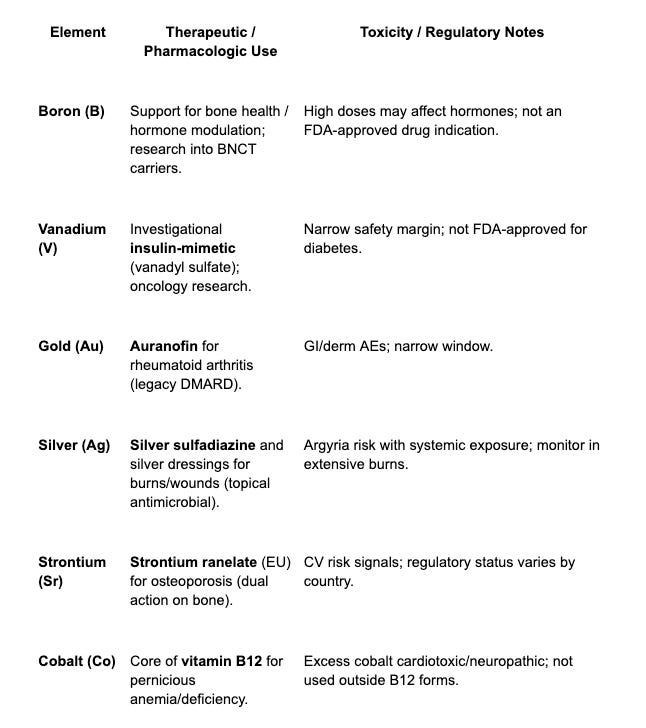
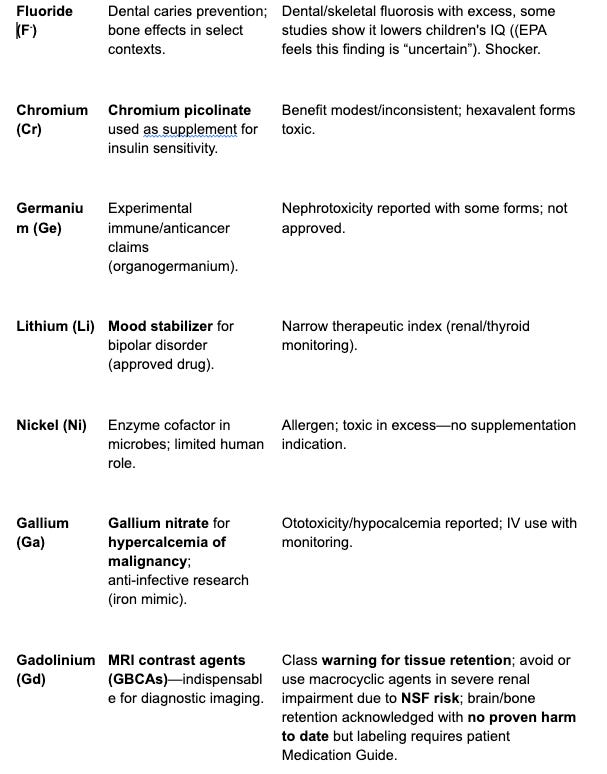
My overall impression from my research into this “lack of research” is that the funding follows risk management or profit potential, not nutrition. Most funding has gone to bio-monitoring and toxicity (mining/processing regions, occupational cohorts) and to drug trials, which typically yield narrow therapeutic indices and associated adverse events. Where are studies on the impacts of naturally occurring ultra-trace amounts on human physiology (and in a complex or combination)? They are not happening!
Another issue I identified is the field's excessive complexity, which creates “translational friction from non-human data.” Plant and livestock outcomes don’t automatically predict human benefit, and when mammalian signals exist, they’re often indirect (antioxidant markers, feed efficiency) and heterogeneous. Review authors explicitly call results “promising but inconsistent,” urging more mechanistic work before human trials.
Thus, I maintain that for the above reasons, these ultra-trace and REEs, to date, have no confirmed human physiologic roles identified in the peer-reviewed scientific literature. However, one of my most repeated axioms when I was a Professor rears its head again, “absence of evidence is not evidence of absence!”
So, after weeks of immersion in mineral science, despite trace elements showing potential implications for growth, metabolism, and genetic regulation in animals, I hypothesize that rare-earth elements (or combinations of them) may one day be found to have subtle or even overt roles in human biology.
What This Reveals
Caution dominates. Most nutritionists and regulatory authorities remain “cautious,” citing potential toxicity or confounders until dedicated research establishes essentiality, safety, and therapeutic range (note that these are all “trigger words” for me: “regulatory authorities remain cautious,” “potential toxicity,” and the worst of all, “confounders”).
Although “consensus” is still lacking, ICP-MS has prompted further investigation into dozens of elements, but conclusive data remain missing for many. Criteria remain narrow. “Only minerals meeting strict clinical and biochemical criteria are ruled 'essential ‘ by international expert panels. However, ICP-MS technology enables broader studies, and there is a growing push to examine additional trace minerals for possible health roles (this admission gives me some hope.)
How Many Minerals Really Exist?
While researching and drafting this book, I found estimates of the number of minerals ranging from 80 to just over 100. Then I came across a paper which stated that there were “over 3,000 in nature.” What? That prompted a conversation with AI, which powerfully “brings home” the central point of this chapter:
Me: “This paper says there are over 3,000 minerals in nature. But how many can be found in our soils?”
AI: “Although over 3,000 minerals exist in nature, most soils contain only dozens of mineral types, with perhaps fewer than 50 regularly observed and only a few mineral groups making up the bulk of typical soil composition.”
ME: “Hold on. In many other sources, the number of minerals (including trace) is estimated to be anywhere from 80 to 90 to over 100. What is the true number, and why the discrepancy?”
AI: “There is no single ‘true’ number of minerals found in soils, but most scientific sources agree (Ed: more “trigger” words) that while soils may contain trace amounts of up to 80–100 or more different minerals, only about 10–20 mineral types are typically abundant or significant in most soils.
Artificial intelligence (a.k.a “consensus theory regurgitator”) then starts to really piss me off.
AI: Only a small fraction of this total mineral diversity significantly affects soil biology, fertility, or geochemistry, so most soil science literature focuses on the dominant/common groups.
I fire back:
Me: “Dude, isn’t your statement paradoxical? You wrote: “Only a small fraction of this total mineral diversity significantly affects soil biology, fertility, or geochemistry, so most soil science literature focuses on the dominant/common groups. Meaning, if these minerals are so difficult to find and measure—and the technology to identify them so recent—isn’t it premature, or even incorrect, to say that “only a small fraction affects soil biology, and by extension human biology?”
AI: Yes, there is a paradox or at least a strong assumption in that statement. The claim that only a small fraction of total minerals in soil significantly affects soil or human biology is based on what is most abundant and most easily measured with established methods rather than what may be functionally relevant at trace levels.
AI went on, this time, playing right into my hands:
AI: Even tiny concentrations of rare minerals could act as essential enzyme cofactors, signaling agents, or growth factors—functions we might not yet recognize because of the limits of current soil and biomedical science.
Bias Toward Abundance: Scientific focus has historically centered on the most prevalent and easily measured minerals. With improved detection, our understanding of trace elements’ importance—especially for soil microbes, plants, and by extension human health, is still evolving.
Thus, I got AI, after some prodding, to agree with my entire thesis that scientific focus has historically been placed on the most easily measured minerals; even tiny concentrations of rare minerals could act as essential enzyme cofactors, signaling agents, or growth factors.
Thus, it is premature to definitively state that only the main, abundant minerals impact soil and/or human biology. Regarding ultra-trace and REEs, their actual physiological and/or biological impact must remain an open area for future research.
Next: Chapter 5 - The Enzyme Enigma: The Missing Mineral Keys to Human Metabolism
Upcoming Book Publications
Yup — not one, but two books are dropping from yours truly. At the same time? What?

From Volcanoes to Vitality: if, instead of (or in addition to) this Substack version, you prefer the feel of a real book—or the smell of paper—or like to give holiday gifts, pre-order my grand mineral saga, shipping before Christmas.
The War on Chlorine Dioxide: if you want to read (or gift) another chronicle of suppression, science, and survival, grab the sequel you didn’t see coming—shipping mid-January. On this one, I say: “Buy it before they ban it.” Hah!
© 2025 Pierre Kory. All rights reserved.
This chapter is original material and protected under international copyright law. No part of this publication may be reproduced, distributed, or transmitted in any form or by any means, including photocopying, recording, or other electronic or mechanical methods, without the prior written permission of the author.
CONGRATULATIONS and WELL EARNED: My “mineral minions” have vaulted me into “top spot” (for now).
"So what does this all mean? The mineral matrix that sparked life on Earth is returning to relevance after 3.5 billion years? On Substack? With my help? So weird." (END QUOTE).
Doc, what is weird, is that you have a perfectly sound premise for your book, in this post-Covid era of truth being the new currency, yet you insist on denying God's creation of all life, by attributing His work to the sparking by mineral matrix's as the source of life. Why?
Denying God is a universal propaganda tool, used widely in academia. Why submit to, endorse, or participate in propaganda Doc? You need not.
How about a forensic look at the issue of the creation of all life on the planet by God, who made man from the elements, minerals, and rare earths, and then breathed life into His creation, as related, in the Bible? It does not detract from your current thesis, by allowing that God used many synergies in His creation formula. It follows that the general conceit of man is muddying the creation story and substituting a false narrative, injurious to health, and harming all that was created by removing the knowledge of the need of these trace elements, minerals, and rare earths to maintain health and support life.
You have an opportunity to end the false narrative of both issues, and knit the truth together very clearly, i.e. that men on earth are lacking in knowledge about how the body works together with all creation. Eating margarine is bad. Butter is good. High fructose corn syrup is bad, while honey is good. Vaccines are bad, while natural, God-given immunity is good. All substitutes for the truth are bad. All truth is good.
Let only the truth be heard here Doc. You've earned the audience, don't be tempted to squander the benefits by inserting adulterants, like "3.5 billion years". The generations on Earth are documented in the Bible, and can be calculated very closely.
They are lying about the dates of geological history, by magnitudes. Do not comply.
I am looking forward to reading Chapter 5.