
Chapter 18B: U.S: The Disinformation Campaign Against Adya Clarity
Inside the 2010 dogpile—who said what, what actually happened, and what the FDA did (and didn’t) do.


As many readers know, I have published two books in a series of Disinformation campaign “exposee,” the first being “The War on Ivermectin” and the most recent “The War on Chlorine Dioxide” (available for pre-purchase here). Interestingly, one of my initial inspirations to write this book stemmed from my early knowledge that the original retail water-purification product, called Adya Clarity, got absolutely crushed by one of the most brutal Disinformation campaigns I have witnessed.
Yet, I did not title this book, “The War on Shimanishi’s Themarox,” because the book is so, so much bigger than that small, albeit devastating chapter in its history. But it has to be discussed because there is a lot, and I mean a lot, that people reading this can learn from it, so that it never happens again (actually, given the content of what is in this chapter,” such a campaign would instantly fail).
The Adya Clarity Smear Campaign of 2010
The second major campaign unfolded in the United States, targeting a Themarox-derived water purification product called Adya Clarity®, made by Adya, Inc.. Adya Inc was founded in 2004, which worked in partnership with Shimanishi Kaken Co. of Japan to bring Themarox into the U.S. market. Themarox comes in a highly concentrated form, while Adya Clarity—like several “private label” brands—is instead prepared by diluting that concentrate for use in water purification.
In the period leading up to the 2010 disinformation campaign, my colleague Kacper Postawski was involved in marketing Adya Clarity through a reseller of Adya, Inc.. The product was gaining in popularity, sales were strong, and momentum was building—until the smear campaign hit. Kacper will readily admit that he too made health claims not supported by data - he was young and had a lot to learn.
I really wish I didn’t have to go into this one, because it brings me sadness to recall how Adya Clarity’s business was gutted—reduced to a shell of what it had once been, where it has largely remained for the past 15 years.
The campaign unleashed a flood of accusations, all of them demonstrably false. What began as suspicion quickly snowballed into a coordinated effort to discredit the product and the company behind it.
Let’s go through each and every critique of the product, one by one. The claims were that Adya Clarity:
Contained “toxic,” “high levels,” or even “heavy metal” aluminum
Was “battery acid” (i.e., sulfuric acid)
Was not approved by Health Canada
Was “caught” deceiving Health Canada in a licensing scam
Was seized by the FDA
Used misleading labeling and was “forced” by the FDA to change it
Was sued for misrepresentation and fraud by a reseller
I know that the above is not nearly as long and varied as the Covid disinformation campaign against ivermectin (an analysis of which led to my first book totalling 312 pages). Fun fact: I have another book I am about to publish about the decades-long disinformation campaign against chlorine dioxide, titled, unsurprisingly, “The War Against Chlorine Dioxide” which totals a similar amount of pages. Pre-orders can be bought here.
Anyway, although the brazen falsities against Adya Clarity were fewer, it is still a whole lot of stuff to counter. So, let’s go through these claims against Adya one by one, shall we? This is going to be fun for me as I love doing this kind of stuff:
Rebuttal to Claim #1 (that it contained “toxic” levels of aluminum)
See Chapter 17: Aluminum: The Great Misinformation Metal
Rebuttal to Claim 2: Adya Clarity Is Full Of “Battery Acid” (i.e., Sulfuric Acid)
Battery Acid
Battery acid is typically 30–50% sulfuric acid. At that strength, the hydrogen ions (H⁺) remain free, highly reactive, and corrosive. That is why true battery acid will burn skin, destroy metal, and require protective equipment just to handle.
Themarox
Themarox, the raw mineral concentrate used to make Adya Clarity® is produced using a process that involves sulfuric acid. But what comes out of that process is not raw acid. It is a liquid mineral solution containing about 5% sulfates and 25% biotite mineral complex in ionic form.
That distinction is crucial. As explained in the previous “science” chapter, when minerals are dissolved in sulfuric acid, the free hydrogen ions react with the mineral matrix, forming stable sulfate salts. In this bound form, the hydrogen is no longer a free, highly reactive acid but part of a neutralized mineral complex. That chemistry makes Themarox fundamentally distinct from pure sulfuric acid. This is the same natural chemistry that produces the sulfates essential for biological processes and energy metabolism.
By contrast, battery acid remains dangerous because its hydrogen ions are unbound and reactive. That is why Themarox, even at its concentrated 5% strength, does not burn skin, whereas true battery acid would.
Themarox is diluted tenfold to create Adya Clarity, leaving about 0.5% mineral sulfates in the bottle. When Adya Clarity is used as directed—one teaspoon per gallon of water—it is diluted by another factor of roughly 1,000. By the time it reaches a drinking glass, the final concentration is only 0.0005%.
When used to treat potable water—such as tap, spring, or well water—the resulting water maintains a pH close to neutral. This completely removes the notion of “acidic” water, since the solution contains no free acid, only stably bound mineral sulfates in trace amounts.
For perspective:
Battery acid: 30–50% free sulfuric acid (corrosive)
Adya-treated water: 0.0005% mineral-bound sulfates (non-corrosive, near-neutral pH)
Both chemically and practically, the claim that Adya Clarity is “battery acid” cannot withstand scrutiny.
Why the Import Label Said “Battery Acid”
The smear also relied on a paperwork technicality. Themarox concentrate was imported under a customs category of “battery acid.” This designation has nothing to do with the actual composition of the product. It is simply a broad shipping category applied to sulfate-based concentrates for insurance and hazard labeling purposes.
As Adya, Inc. founder Matt Bakos explained:
“When you’re importing raw materials, especially a concentrate in higher acid form, they have to go under a category. Battery acid is what all sulfate-based products are imported under. That was the only reason. The subcategory is ‘inorganic minerals.’ People get confused looking at the main category, but it has nothing to do with what the product actually is.”
Adya Clarity is no more “battery acid” than vinegar is “industrial acetic acid.” The allegation was built not on evidence but on fear, jargon, and a misunderstanding of basic chemistry.
Rebuttal to Claim 3: Not Approved by Health Canada
The first two allegations required some deep dives into chemistry. This one is far simpler given that Adya Clarity is licensed by Health Canada as a Natural Health Product (NPN #80028256), as I’ll cover below. Health Canada reviewed the complete formulation, including aluminum content, before granting this approval.
Adya, Inc.’s Health Canada consultant explained the regulatory perspective perfectly:
“In regards to Aluminum Sulfate this is a component of Black Mica which we have clearly listed on the product label. The Aluminum Sulfate is not an issue for several reasons: a) it is a very, very small trace amount but more importantly b) we did not base a claim off of aluminum sulfate and black mica has been reviewed for safety and deemed just fine and henceforth aluminum sulfate is the same…
The regulatory review assessed biotite black mica as a complete mineral matrix—not as isolated chemical constituents. This is the appropriate way to evaluate naturally-derived mineral complexes.
The claim that Adya Clarity was “not approved by Health Canada” can be factually debunked in about two minutes. A quick search in Health Canada’s own public database of licensed natural health products shows Adya listed with two active licenses.
How to Verify It Yourself
Go to the Health Canada Licensed Natural Health Products Database
Scroll down to the “Simple Search” section.
In the Search Field dropdown, select “License Holder.”
In the Criterion box, type “Adya.”
Click Search.
Both Adya Minerals (Clarity) and Themarox will appear, complete with their active NPN numbers and approved health purposes.

Clicking on each entry will show the official Health Canada listing, including recommended use and safe dosage levels.
NPN #80028256 – Adya Minerals (another name for Adya Clarity®)
Recommended use/purpose: “A factor in the maintenance of good health. Helps to prevent iron-deficient anemia.”
NPN #80024735 – Themarox (the raw concentrate, 10x stronger than Adya Clarity)
Recommended use/purpose: “A factor in the maintenance of good health. Helps to form red blood cells and helps in their proper function.”
These are not marketing phrases — they are approved health claims set by Health Canada. They even set an upper safe daily limit of 7 teaspoons per day of Adya Clarity
As Health Canada itself states:
“Products with a licence have been assessed by Health Canada and found to be safe, effective and of high quality under their recommended conditions of use.”
In plain terms: the idea that Adya Clarity was “not approved” by Health Canada isn’t just misleading — it’s a flat-out lie.
Rebuttal to Claim 4: Adya Clarity Had Been “Caught” Deceiving Health Canada in a Licensing Scam
As I just covered in the last rebuttal, Health Canada’s own database shows both Adya Minerals (Adya Clarity®) and Themarox listed with active NPNs. If there had been any deception, those licenses would have been revoked. They weren’t.
Adya Clarity still holds its licenses to this day.
Rebuttal to Claim 5: The FDA Confirmed High Levels of Aluminum in Adya Clarity® and “Seized” a Shipment in 2011
As already covered in Rebuttal #1, the allegation of “toxic” or “high levels” of aluminum is scientifically false.. What remains here is the supposed FDA “seizure.”
Here’s what actually happened: The FDA did not suddenly receive a flood of consumer safety complaints. The “complaints” were manufactured— encouraged by the same outlet behind the smear campaign, which urged followers to contact the FDA and file reports. In other words, the outrage was orchestrated, not organic.
When the FDA investigated, an inspector visited Adya’s facility, took a sample, and tested it. The result? Silence. No warning letter, no recall, and no enforcement action of any kind.
Later, when one of Adya, Inc.’s officers filed a Freedom of Information Act (FOIA) request to review the FDA’s internal report, the conclusion could not have been clearer: “No regulatory action needed.”
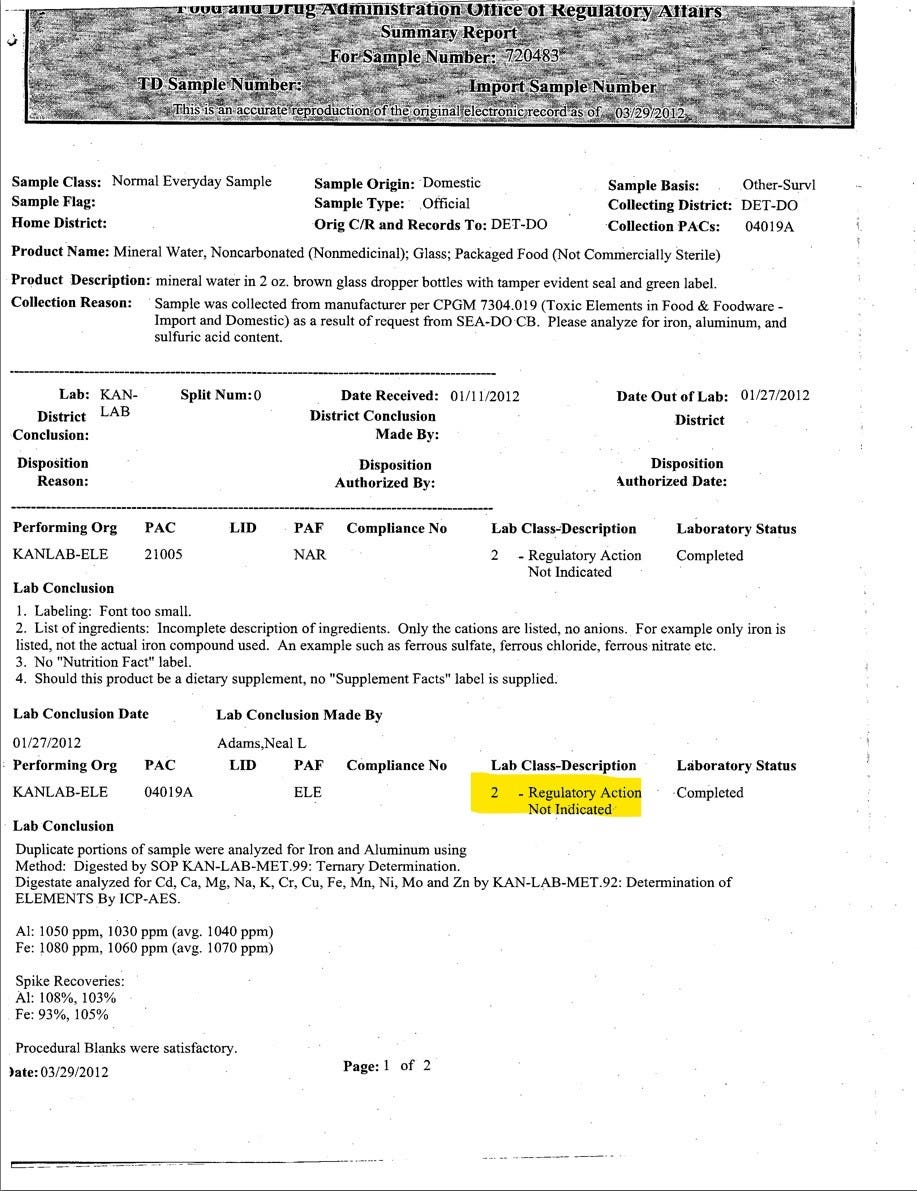
If the FDA had actually seized Adya Clarity®, the product would not still be on the market — instead it has been continuously sold since 2004.The claim collapses under its own weight.
Rebuttal to Claim 6: Adya Clarity’s Labeling Was Misleading and the FDA Forced a Change
The FDA never required Adya to change its label. The ingredients are listed the same today as they were during the smear campaign. The claim that aluminum was “omitted” is simply false.
Aluminum is listed as aluminum sulfate—commonly known as alum—and it appears in alphabetical order alongside the other trace minerals. Nothing was hidden.
The FDA’s internal notes only flagged minor formatting issues: small font size, listing cations without paired anions (e.g., “iron” instead of “ferrous sulfate”), and the absence of a “Nutrition/Supplement Facts” panel, which only applies if a product is marketed as a food or supplement.
Adya Clarity is not a food or supplement; it is a water purification solution. The FDA issued no warning, no recall, and no mandated change.
Rebuttal to Claim 7: Adya Was the Subject of a Lawsuit Accusing It of Misrepresentation and Fraud
Adya was never sued for misrepresentation or fraud. The reality is the opposite: Adya, Inc. filed suit against a reseller for breach of oral contract and the value of goods delivered.
The case went to trial in Ventura County in 2012. The judge ruled in favor of Adya, Inc., awarding over $200,000 in damages plus interest. Here is a copy of the tentative ruling and the final judgment.
The myth that Adya “lost a fraud case” is a complete inversion of the truth: Adya won its case for damages.
To date, no lawsuit has ever been brought against Adya.
Aftermath & Lessons
Reading through the details of this saga left me exhausted—and yes, angry. The sheer depravity and viciousness of competition within the biomedical field never ceases to astonish me. I have written extensively about Big Pharma’s well-documented scorched-earth tactics against any product that might threaten their unconscionable profit margins. Heck, I’ve even been in their crosshairs—twice. First for advocating ivermectin, then for speaking out against COVID-19 mRNA vaccines. They haven’t killed me, but they did a bang-up job ruining my reputation and ending my academic career.
To see those same tactics mirrored in the “wellness” world was both demoralizing and, I suppose, unsurprising. Even in the alternative health space, rival interests have learned to weaponize disinformation ruthlessly.
For Postawski and Bakos, the attacks were devastating. Within weeks, resellers dropped the product, and many customers stopped buying; as a result, the Adya Clarity brand nearly collapsed. Though it has survived over the years — kept alive by a loyal customer base and occasional spikes in renewed interest from a few wellness influencers — it remains a shadow of its former self.
Next: Chapter 19: What’s Really in Your Water: The Hidden Crisis Beneath the Surface
P.S. If you’re curious about the volcanic-mineral water purification product that I helped develop, you can find it at Aurmina.com. Think of it as a quiet act of restoration — starting with your water. And yes, I know — I’ve become the guy who includes links at the end. But this one just might change your water (and your mind).

© 2025 Pierre Kory. All rights reserved.
This chapter is original material and protected under international copyright law. No part of this publication may be reproduced, distributed, or transmitted in any form or by any means, including photocopying, recording, or other electronic or mechanical methods, without the prior written permission of the author.
Thank you very much for the story of Ayda clarity’s disinformation campaign. I was a victim of that campaign. I bought gallons of the stuff thinking it would last a lifetime. Then,I believed the lies and stopped using it… I packed it away in a dark,cool location which I’m going to unpack,now. My understanding is it is STILL viable..and,I’m very grateful for this new information,Dr.Kory!
Adya