
Chapter 17: Aluminum—From Feared Toxin to Forgotten Ally
The same element long accused of harm is, in truth, one of nature’s oldest purifiers and an invisible architect of life.


A deep but, as you will learn, misplaced, concern about many mineral supplements is that they all contain aluminum (with the possible exception of seaweed derived minerals). By the end of this chapter, you’ll know more about aluminum—its chemistry, abundance, and actual health relevance—than most supposed “experts” that are incessantly warning you about it.
Let’s start by saying this clearly: aluminum is not inherently toxic. In most natural forms, it’s chemically inert, non-bioavailable, and has quietly coexisted with all life on Earth’s surface as the most abundant metal since the beginning.
Aluminum Sulfate: The Engine of Purification
Far from being a “contaminant,” sulfated, complexed aluminum is what makes Themarox work as a water purifier. Together with iron, it binds impurities through flocculation—forming clumps that settle and can be filtered away.
This isn’t fringe chemistry. It’s one of humanity’s oldest and safest purification technologies.
As early as 2000 B.C., Egyptians and Romans clarified drinking water with “aluminous earth,” lime, and salts to precipitate impurities.
Today, virtually every municipal water system on Earth still relies on aluminum salts to remove contaminants. Themarox simply revives this ancient, proven chemistry.
Form = Function
Critics love to shout “toxic aluminum!”—but they ignore a basic principle of chemistry: the form of a substance determines its behavior and safety.
Metallic aluminum (cookware, foil, industrial dust) is not the same as ionic aluminum in natural minerals.
By contrast, the aluminum in Themarox exists in a naturally complexed, non-bioavailable mineral form—similar to the stable aluminum compounds commonly found in:
Natural mineral springs
Volcanic mineral waters
Clay minerals such as bentonite, montmorillonite, and French green clay
Aluminosilicates (naturally occurring aluminum–silicate minerals that make up much of the Earth’s crust)
Fulvic and humic acid complexes
In all these natural sources, aluminum exists as part of a stable mineral lattice, not as a free ion.
Context: Aluminum Is Everywhere
Aluminum is the third most abundant element in Earth’s crust—after oxygen and silicon—and the most abundant metal on the planet. It’s in virtually every plant, fruit, nut, and grain you eat.
Average daily intake: 7–9 mg of aluminum from food, soil, and water.
A single potato contains about 100 ppm (≈ 17 mg) of aluminum — over 100× more than a liter of Themarox-treated water.
The Math: Real-World Exposure
Themarox concentrate contains about 1,000 ppm aluminum—but no one drinks the concentrate. When properly diluted (1 teaspoon per gallon; ~1:1000 ratio), the resulting water has < 1 mg/L aluminum, and that is before flocculaion!.
During purification, 80–90% of that aluminum precipitates out with impurities.
Final water: ~0.1 mg/L aluminum
EPA guideline: 0.05–0.2 mg/L
WHO limit: ≤ 0.9 mg/L
Now, before we go further, I need to point out a common misconception regarding the above “guidelines” and “limits.” They are NOT safety limits, they are “cosmetic limits. What? Follow along my friend.
Misunderstanding the “Aluminum Limit”
1. The EPA number isn’t a health standard.
The 0.05–0.2 mg/L “limit” people quote comes from a Secondary Maximum Contaminant Level (SMCL) — not a health-based rule. Secondary standards are for aesthetics—taste, color, and cloudiness—not toxicity.
As the EPA puts it:
“Secondary standards are non-enforceable guidelines regulating contaminants that cause cosmetic or aesthetic effects.” (40 CFR § 143.3)
In short: the value was chosen because aluminum can make water cloudy and clog pipes, not because it harms humans.
2. There’s no U.S. health limit for aluminum in water.
EPA never set a primary (toxicological) MCL because:
There’s no solid evidence that normal oral aluminum exposure harms healthy people.
Aluminum is naturally abundant in soil and water, and diet contributes far more exposure than drinking water ever could.
If aluminum were dangerous at low levels, it would have a primary limit—like arsenic or lead. It doesn’t.
3. The common error: treating an aesthetic guideline like a toxicity threshold.
People often assume:
“EPA recommends ≤ 0.2 mg/L” = “Aluminum is toxic above 0.2 mg/L.”
Not true. Again, that number simply avoids cloudy pipes and stained laundry—not disease.
4. Real toxicology limits are 100× higher.
Health agencies that do assess risk—EFSA and JECFA—set tolerable weekly intakes at:
EFSA: 1 mg/kg/week
JECFA: 2 mg/kg/week
That’s about 10–20 mg/day for a 70 kg adult from all sources. To reach that from water at 0.2 mg/L, you’d need to drink 50–100 liters a day.
So: EPA’s number keeps your water clear, not your health protected. There’s no health-based “aluminum limit” in U.S. law—because the science never justified one.
So, with that in mind, lets think about the amount of aluminum in Themarox-treated water compared to everyday foods:
One potato adds around 170× more non-toxic aluminum to your diet than a liter of Themarox-treated water.
Absorption: The Real Exposure
Here’s why: even when consumed, aluminum is barely absorbed.
Intestinal absorption is roughly 0.1%, sometimes up to 0.3% under acidic conditions. The rest passes through. In the below table, I calculated the “worst case scenario.” i.e. if you assume that the aluminum in Themarox is all aluminum sulfate (which it is not - it is complexed with other minerals and thus has near nil absorption but lets to the below calculations for kicks).
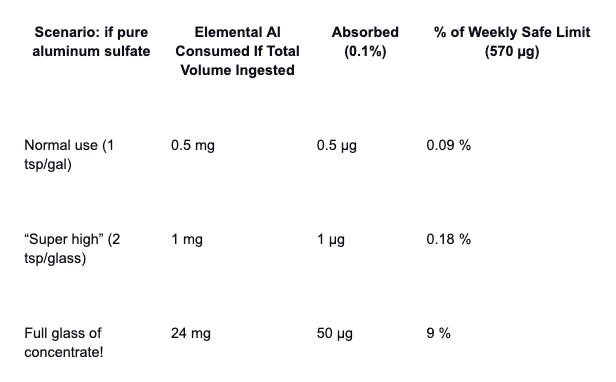
Even in the absurd “drink-the-concentrate” scenario of an imagined pure aluminum sulfate solution, absorption remains well below safety thresholds.
The Real Chemistry: Why the Risk Is Even Lower
Even these calculations exaggerate risk. In water, aluminum sulfate dissociates into Al³⁺ ions, which immediately react with hydroxide or phosphate to form insoluble aluminum hydroxide—the same harmless compound used in antacids.
In multi-mineral systems like Themarox, aluminum is co-precipitated with iron and sulfates into hydroxy-complexes that are:
Poorly soluble
Non-bioavailable
Designed to flocculate impurities—and then remove themselves
These complexes clean the water and then settle out. The aluminum isn’t “added” to your drinking water—it’s the tool that purifies it.
Summary: From Fear → Fact
Aluminum sulfate purifies water—it doesn’t contaminate it.
Themarox’s aluminum is naturally bound to other minerals in a stable complex and is not bioavailable.
Final water levels meet or exceed every global safety guideline.
Food contributes hundreds of times more aluminum than treated water.
Only 0.1% of ingested aluminum is absorbed—and nearly all is excreted.
If aluminum were as dangerous as critics claim, every potato, grain, and glass of spring water on Earth would be a poison. Instead, they’re part of what sustains life.
At the risk of hammering the same point over and over:
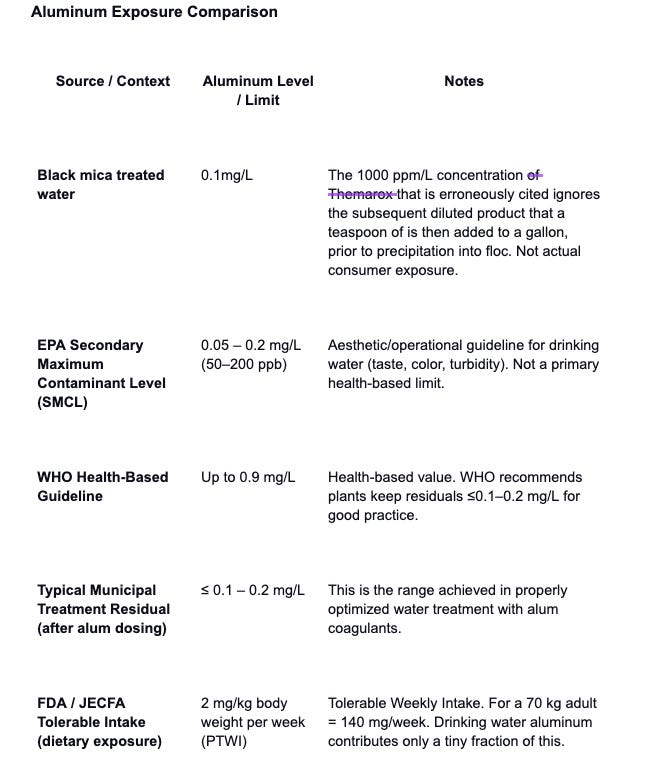
Why Not Just Remove the Aluminum?
First, because of the above, it does not get absorbed and has less than all foods. Second, aluminum isn’t “added”—it’s naturally present in biotite mica as a fundamental part of its crystal structure. Removing it would mean:
Chemically altering the natural mineral complex
Potentially destroying the synergistic properties of the full-spectrum mineral matrix
Creating something synthetic rather than natural
Removing a trace element that, in this form, has been part of therapeutic mineral waters for thousands of years
Shimanishi’s extraction process preserves the natural mineral profile as it exists in the source rock, but in an ionic, sulfated form, thus dissolvable, (not colloidal or suspended), mimicking minerals found in natural spring water.
What About Aluminum Cookware?
Now, although this has nothing to do with water purification or minerals, since you brought it up, let’s talk about it. Aluminum cookware is a different concern entirely and illustrates why form matters.
In cookware, the aluminum is mostly metallic aluminum (Al³⁺ ions) which can leach into the food — but only under certain conditions:
Cooking highly acidic or salty (tomato sauces, brines)
Extended cooking times at high heat
Using scratched or worn pans (most concerning)
Under these conditions, leaching can range from negligible to several milligrams per serving—that’s elemental aluminum in milligrams, not micrograms, and its free ionic aluminum. While GI absorption remains low (~0.1–0.3%), the total ingested amount can significantly exceed what’s found in treated water.
The Bigger Picture: Structural Essentiality of Aluminum
To truly understand aluminum, we need to expand our concept of what’s “essential” to life. Mineral expert Matt Bakos argues that our understanding of aluminum needs to distinguish between biochemical aluminum (problematic when bioavailable) and structural aluminum (fundamental to Earth’s mineral systems).
Biologists typically define essentiality as something metabolically required inside living cells—like magnesium or iron. But at the planetary level, certain elements such as aluminum are “structurally essential.”
Aluminum forms aluminosilicate minerals—the scaffolds of soils and clays that make terrestrial life possible. These lattices generate the electrochemical and proton gradients that support biological reactions, effectively serving as the hardware on which life’s chemistry runs.
He likens aluminum to a “silent conductor”—it doesn’t carry biological current itself, but it builds the conductive matrix that allows life’s circuits to function. Without aluminum, Earth’s crust would lack the layered, charge-holding properties that sustain soil fertility, trace-element exchange, and the proton flows fundamental to energy metabolism.
Thus, while aluminum may not be biochemically essential within the body, it is environmentally and structurally essential—a foundational component of the planet’s bioelectrochemical architecture and the conditions that make life possible.
Next: Chapter 18A: Japan: The Disinformation Campaign Against Super Mineral Solution
P.S. If you’re curious about the volcanic-mineral water purification product that I helped develop, you can find it at Aurmina.com. Think of it as a quiet act of restoration — starting with your water. And yes, I know — I’ve become the guy who includes links at the end. But this one just might change your water (and your mind).

© 2025 Pierre Kory. All rights reserved.
This chapter is original material and protected under international copyright law. No part of this publication may be reproduced, distributed, or transmitted in any form or by any means, including photocopying, recording, or other electronic or mechanical methods, without the prior written permission of the author.
I’m still pondering aluminum storage in brain tissue in Alzheimer’s and autism. Is the problem actually by injecting the 0.6 mg of aluminum adjuvant per vaccine dose, bypassing the lack of GI absorption? Or is it stuck there due to inflammation and WBCs phagocytosing aluminum going to the CNS to die?
I have the same question about aluminum in vaccines? Also, I purchased Aurmina and have been using it in our RO water, up to 1/2tsp per 1/2 gallon of water. It then says to filter water to rid it of impurities. What kind of filter should be used. I see no sediment or layer skimming the top but I pour it through a simple strainer. Should I have something more sophisticated?