
Chapter 10 - The Mineral Water Hypothesis: The Science and Stories of Healing Springs.
What early trials, big anecdotes, and a mechanistic mystery reveal (and don’t yet) about relief and repair.

Peer-Reviewed Evidence-Base
At this point in our exploration of the global consequences of trace mineral depletion and heavy metal excess in our soils—and the warnings of visionary thinkers about the hazards this poses—it’s natural to ask: can restoring minerals tangibly improve health, beyond the theoretical?
While the evidence is still emerging, intriguing case studies and a growing body of preliminary research suggest that mineral-rich environments and therapies may hold considerable promise.
This chapter brings together clinical anecdotes, early studies and compelling hypotheses. Here, readers will encounter the fascinating frontier where scientific inquiry meets therapeutic possibility, setting the stage for later chapters on the unique biochemistry of volcanic-derived trace minerals.
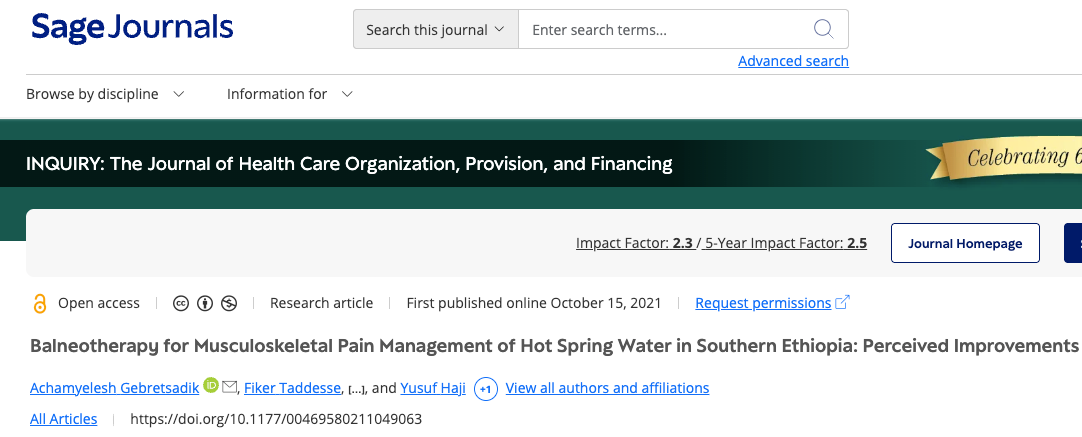
The hot springs featured in the Ethiopian study above are geologically fed by volcanic rocks characteristic of the Main Ethiopian Rift region. Specifically, these springs are often surrounded by and interact with rhyolite lava domes, pyroclastic deposits (including ignimbrites), and basaltic lava flows—all products of extensive volcanic activity over the past 1 -- 1.2 million years.
Researchers assessed the effects of balneotherapy (hot spring bathing) on musculoskeletal pain in 1,279 adult users of four hot springs in Southern Ethiopia. Participants, primarily suffering from joint and muscle pain, were followed for at least three days of immersion. After treatment, 83% reported complete pain relief, along with additional improvements in joint stiffness, swelling, and rheumatoid arthritis symptoms.
The study concluded that hot spring baths are a safe, low-cost, and effective supportive therapy for musculoskeletal disorders, including arthritis, and recommended integrating balneotherapy into routine care for those with chronic arthritic pain.
Let’s review that data again: 1,279 patients with joint and muscle pain bathed in a volcanic rock-fed hot spring for 3 days, and 83% reported complete pain relief. Complete pain relief in 83% of sufferers?
2. Balneotherapy in Rheumatic Diseases
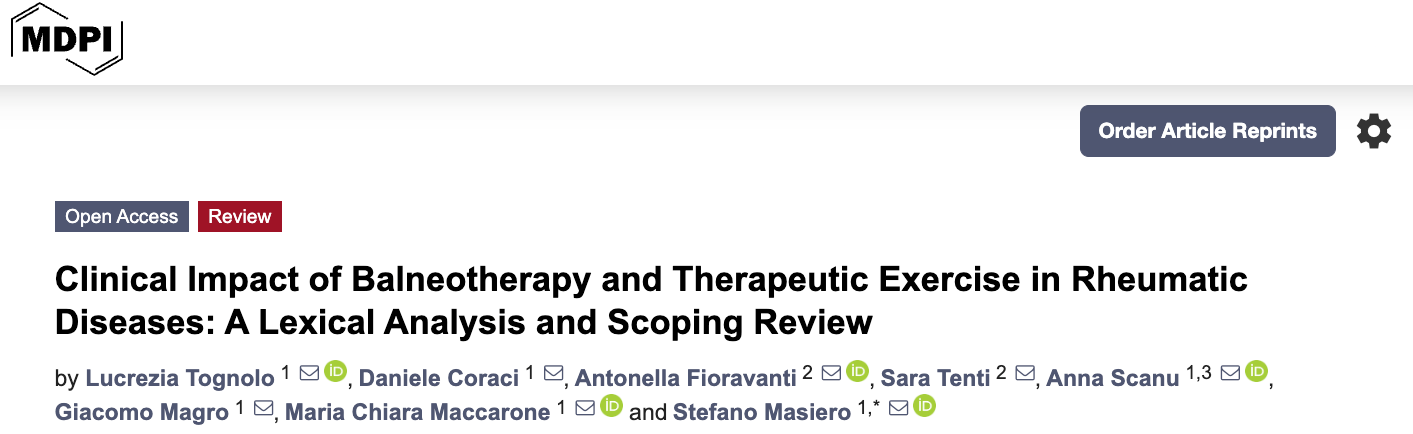
A meta-analysis of 14 studies found that “spa therapy” had a favourable effect on pain, function and quality of life in patients with Osteoarthritis, Fibromyalgia and Rheumatoid Arthritis.
3. Systematic Review of Balneotherapy For Chronic Low Back Pain
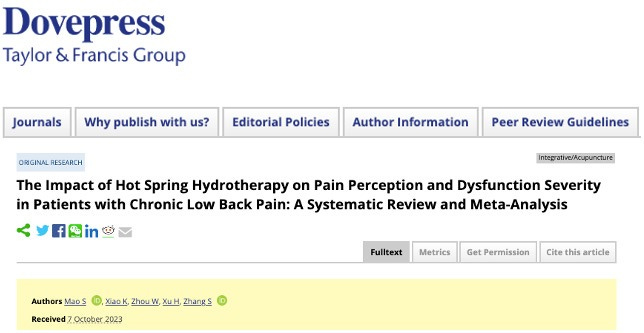
The authors identified 16 studies with 1,656 participants and examined the effectiveness of hot spring hydrotherapy for chronic low back pain (CLBP). Results showed that hot spring hydrotherapy significantly reduced pain intensity and functional disability, as well as medication usage for CLBP. The benefits were most pronounced for patients aged 60 and above.
The authors concluded that hot spring hydrotherapy is a promising complementary treatment for chronic low back pain, particularly in older adults, though, as always, “more research is needed for younger patients” and “to understand the underlying mechanisms.”
Did you catch that last sentence? “More research is needed to understand the underlying mechanisms.” This will become important when we get to the case histories that occurred at the Grotto Of Marabeille, at the Shrine in Lourdes, France.
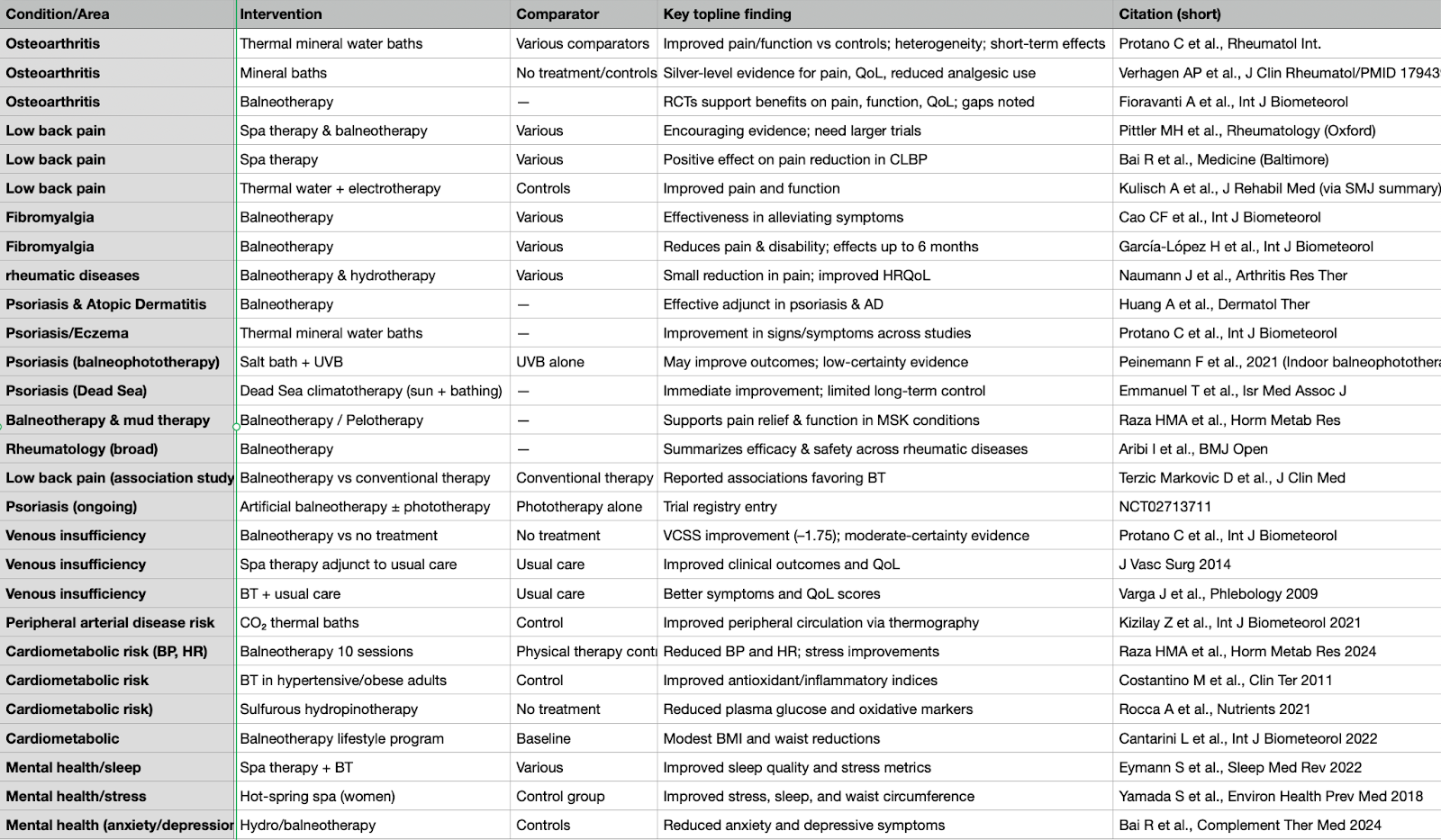
Using AI, I discovered that, since 2010, at least 28 balneotherapy studies have been published in the peer reviewed literature on a diverse set of symptoms and conditions (note many were systematic reviews which included various numbers of studies).
Balneotherapy studies and their outcomes (all are positive):
The “Unknown” Mechanisms of Healing Hot Springs
I found the above balneotherapy papers particularly compelling. Those three studies led me to ask AI the following:
Q: Identify all locations of purported healing water mineral hot springs and then find any and all detailed accounts of healing from illness with dramatic or miraculous recoveries:
AI then provided specific examples of such springs and gave links to sites where accounts of clinical recoveries have been compiled, but only eight springs were listed. Suspicious that AI was holding back, I then asked:
Q: Can you reproduce the same list above but include all springs that you found in your search, not just the notable ones.
Brace yourself. What followed was a comprehensive list of 203 healing mineral hot springs worldwide, organized by region and spanning every continent:
Africa: Hammam Chellala, Hammam Essalihine, Hammam Guedjima, Guelma, N’Gaous, Kambo (North Kivu), Uvira (South Kivu), Hammam Musa, Oyoun Mossa, Siwa, Dallol Hot Springs (Ethiopia), Sodere (Ethiopia), Ain al-Ati, Fezouane, Moulay Yacoub, Sidi Harazem (Morocco), Ikogosi Warm Springs (Nigeria), Wikki Warm Springs (Nigeria), Bugarama Hot Springs (Rwanda), Mashyuza Hot Springs, Nyakabuye Hot Springs (Rwanda), Aliwal North, Badplaas, Brandvlei, Caledon Spa, Goudini Spa, Montagu, Tshipise, Warmbaths (South Africa), Kikuletwa (Chemka) Hot Springs (Tanzania).
Americas: Banff Upper Hot Springs, Cave and Basin, Miette Hot Springs (Canada), Harrison, Liard River, Nakusp, Fairmont, Radium, Skookumchuck, Lussier, Sloquet Hot Springs (British Columbia, Canada), Glenwood Hot Springs, Hot Springs National Park, Calistoga, Palm Springs, Desert Hot Springs, Paso Robles, Hot Creek, Mammoth, Wilbur, Esalen, Yosemite, Mono, Travertine (USA), Ojo Caliente, Truth or Consequences, Faywood, Jemez (New Mexico, USA), Pagosa, Steamboat, Ouray, Idaho Springs, Glenwood, Conundrum (Colorado, USA), Warm Mineral Springs (Florida, USA), Boiling River, Mammoth Hot Springs, Yellowstone (Wyoming, USA), Hot Springs (Arkansas, USA), Tolantongo, La Gruta, Los Azufres, Aguascalientes (Mexico), Termas de Río Hondo, Termas de Molulco, Termas Geométricas, Termas de Puritama, El Tatio, Aguas Calientes (Argentina, Chile), Tabacón, Arenal, Ecotermales Fortuna (Costa Rica), Baños de Agua Santa, Papallacta (Ecuador).
Asia: Hakone, Beppu, Kusatsu, Arima Onsen, Gero, Noboribetsu, Yufuin, Nyuto, Izu, Dogo, Unzen (Japan), Heosimcheong Spa (Busan), Suanbo, Yusong Spa (South Korea), Soaking towns in Taiwan (Beitou, Jiaoxi, Wulai, Guanziling, Ruisui), Garam Chashma (Pakistan), Chumathang, Manikaran, Vashisht, Tattapani, Rajgir, Suryakund, Sohna (India), Borang, Reshi, Yumthang (Sikkim, India), Mengurada (Flores, Indonesia), Ciater, Cipanas, Cisolok, Maribaya (Java, Indonesia), Hot springs in Cambodia, Vietnam (Bang Spa, Kim Boi, Bình Châu).
Europe: Blue Lagoon, Deildartunguhver, Mývatn Nature Baths (Iceland), Lake Hévíz, Budapest’s baths (Hungary), Saturnia, Bagni San Filippo, Montecatini Terme, Chianciano Terme, Rapolano, Terme di Sirmione, Petriolo, Ischia, Bagno Vignoni, Grotta Giusti (Italy), Baden-Baden, Wiesbaden, Aachen (Germany), Karlovy Vary, Teplice (Czech Republic), Vichy, Dax (France), Edipsos, Loutraki, Pozar, Kamena Vourla, Kaiafas (Greece), Bath (Somerset, UK), Buxton (UK), Băile Felix, Băile Herculane (Romania), Chaves, São Pedro do Sul, Caldas da Rainha (Portugal), Afyonkarahisar, Pamukkale, Yalova, Termal (Turkey).
Oceania: Dalhousie Springs, Peninsula Hot Springs, Innot Hot Springs, Hastings Caves (Australia), Rotorua, Hanmer Springs, Taupo, Whitianga, Maruia Springs, Hot Water Beach (New Zealand), Savusavu (Fiji).
Antarctica: Deception Island (Antarctica, volcanic springs).
Central and South America & Caribbean: Eco Termales, Tabacón, Río Perdido (Costa Rica), Baños de Agua Santa, Papallacta (Ecuador), Termas Geométricas, Puyehue, Termas de Puritama, El Tatio (Chile), Termas de Río Hondo (Argentina), Arapey Thermal Resort, Daymán, Almirón (Uruguay), Fuentes Georginas (Guatemala).
Middle East: Ma’in Hot Springs, Dead Sea region (Jordan, Israel), Ein Gedi, Hamat Gader, Tiberias (Israel).
The list included both highly developed spa resorts and rustic, natural pools, all celebrated for their mineral content, traditional healing use, and sometimes for dramatic accounts of healing from illness.
Interesting, no? Hypothesis generating yes?.
Next, one of my newfound mineral expert colleagues suggested I “look deeper” into the accounts surrounding one particular site of “healing water.” So I did.
The Shrine of Lourdes
I then dug into data from, surprisingly, Catholic Church archives. History—and scripture—overflow with “healing water” stories, mostly in mineral and hot springs, where countless have claimed remarkable recoveries.
The History Of The Massabeille Spring at Lourdes
From February 11 to July 16, 1858, a young woman named Bernadette Soubirous reported 18 apparitions of what she felt was the Virgin Mary. On Mar 25, the Lady identified herself as the Immaculate Conception (a Catholic dogma defined in 1854). Bernadette uncovered a spring after being told to “drink from the fountain,” and reports of recoveries soon followed.
After investigation, the local bishop declared the apparitions worthy of belief. Pilgrims began to pour in and the sanctuary took shape
Today, Lourdes is one of the world’s largest Christian pilgrimage centers, welcoming millions yearly (more than the Taj Mahal), especially the sick, who bathe in or are blessed with the spring’s water. The shrine’s identity blends prayer, service to the ill, and careful medical evaluation of recoveries—all centered on the grotto where Bernadette prayed.
Since 1858, over 7,000 healings have been reported; with 72 of them having been confirmed as an official “miracle”—these latter accounts survived intense medical and ecclesiastical scrutiny. Once no natural mechanism for healing is found, a cure is deemed “miraculous.”
Lourdes Grotto Geology
Know that the water at Lourdes flows from a natural spring through karstic limestone caves—the Mountain of Caves—creating a mineral-rich profile. Volcanic rock, including dark porphyry, adds complexity, with the area shaped by magma intrusions during the Pyrenees’ formation. Volcanic rock is apparently part of the healing waters’ recipe.
The Miracles
Of 72 confirmed miracles, each has passed rigorous medical investigation: cures are near immediate, complete, lasting, and inexplicable. The “International Medical Committee of Lourdes” and a diocesan bishop verify each case.
For those hungry for specifics, both the website Miracle Hunter and the Lourdes Sanctuary site archive every case, which describe dramatic recoveries following immersion in, or consumption of, water from the grotto at Lourdes. Interestingly, a handful show no water contact—fodder for future explorations into ”mind-body healing.”
Each tale shares familiar patterns: dire prognosis, sudden recovery at Lourdes, and long-term follow-up confirming lasting relief.
Signature Cases
Catherine Latapie: Hand paralyzed and pregnant, she bathed in the spring and regained full motion, then delivered her child that evening.
Louis Bouriette: Blinded in one eye, he repeatedly bathed it in the spring and regained his sight.
Mrs. Blaisette Cazenave: Chronic eye disease, declared incurable, resolved after two applications of spring water.
Henri Busquet: Tuberculosis-induced ulcer, cured overnight with spring water from Lourdes.
Justin Bouhart: Chronically ill and failing to thrive, bathed as a last resort and recovered fully.
Mrs. Madelaine Rizan: Nearly 20 years paralyzed, drank Lourdes water and her strength, mobility, and skin health returned.
Marie Moreau: Severe vision loss, bandaged eyes with Lourdes water overnight and awoke healed.
Joachime Dehant: Incurable leg ulcer, healed after baths at Lourdes.
Elisa Seisson: Chronic bronchitis and heart disease, resolved after one bath.
Sister Eugenia Marie Mabille: Longstanding abdominal infection, healed after visiting the Baths—her health remained excellent for decades.
Miracles or Minerals?
What got me started on this path was that, as I was reading through all the cases one particularly resonated with me. I got a “spidey sense” that some may have been the result of a striking “physiologic” response to immersion in uniquely mineralized spring water. A hypothesis mind you. In particular, the hypothesis was generated from the case of Sister Bernadette Moriau—the last official Lourdes miracle, confirmed in 2018.
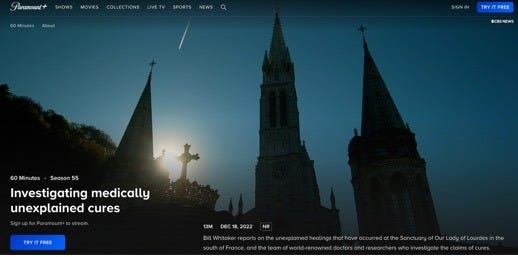
The above image is the opening shot to a televised interview with Sister Moriau by journalist Bill Whitaker for 60 Minutes, recounting her story: decades of complete paralysis, failed surgeries, braces, and unremitting pain.
Yet, after bathing at Lourdes in 2008, as she was returning home, she began to experience the onset of “excruciating burning pain” in her legs (which had not had sensation in 20 years). On the 3rd day, she found herself able to walk again—an event verified by the International Committee at Lourdes as having no medical explanation for the recovery.
As an experienced clinician, my intuition has been shaped by years of observing healing trajectories (the majority in the severely and critically ill), some of them memorably striking (like with IV vitamin C in sepsis).
In Sister Bernadette’s case, the recovery was clearly not “instant”—it took three days and was preceded by the onset of “excruciating burning pain.” I began to develop the sense of an activation of a profound immune (e.g. inflammatory) or repair response. Knowing what I know now of the myriad biochemical impacts of minerals, I began to wonder if either some sort of dormant genes were being triggered, or a novel enzymatic function was being stimulated, or the sudden restoration of energy to damaged cells was occurring (the proton gradient, which you will learn about later).
If so, it sure seems it led to some “supercharged” cellular and immune response, which initiated a focused healing of tissue. I know, maybe I was hallucinating, but I decided to pursue this hypothesis.
The first order of business was to determine if the Grotto at Lourdes had a unique mineral content, which would not only help support my hypothesis, but would also provide insight into the “unknown mechanisms” of the recoveries reported in the earlier volcano spring balneotherapy studies.
Analyses Of The Water At Lourdes
Unfortunately, at first glance, I discovered that despite numerous analyses of Lourdes water—ranging from classic tests of major ions in 1858 to modern geochemical profiles—the official stance remains: Lourdes water is unexceptional.
However, using AI, I was able to find a study in a Polish geochemical journal, Annales Societatis Geologorum Poloniae. Published in 2017 (a year prior to the 72nd and last declared Miracle). The researchers, Dobrzyñski & Rossi—a Pole and an Italian—were the first in history to employ ICP-MS technology to analyze the water from the grotto. They also analyzed water from three other springs in the region and compared their geochemical profiles.
First, their stated rationale for the study:
Geochemical studies on the waters of four springs, including the Massabielle (MS) Spring, were carried out at Lourdes (France) following a long, rainless and warm period, with the aim of at least documenting the groundwater chemistry that was affected by the current meteoric input. The existence of anecdotal reports about anomalously elevated concentrations of trace constituents in the water of the MS Spring in the absence of any detailed studies inspired these first geochemical investigations of trace elements in the spring waters at Lourdes.
Another section, (paraphrased for brevity):
From its discovery in 1858, the Marabeille Spring’s water has drawn interest. Initial chemical analysis by Édouard Filhol in1858 compared the spring’s composition to nearby mineral springs but found no significant differences.
In the early 20th century, hypotheses suggested high radioactivity as a healing factor; tests by Albert Nodon (1915) and Adolphe Lepape (1938) found no such elevation.
Additional claims from this era included potential enrichment in oxygen, ozone, penicillin, and bacteriophages—none were supported by tests. To date, no component explaining the water’s alleged healing effects has been scientifically confirmed
Here is where it gets weird. They then cite the numerous “claims” from “popular science publications” and “health-oriented websites” that the healing properties of the MS water are due to anonymously high concentration of particular constituents, specifically germanium or hydrogen gas. Why the focus on one trace mineral and/or hydrogen gas?
Here’s why:
“Germanium dissolved in water was proposed as an active and beneficial substance, following successful tests involving Ge-rich Dunaris mineral water (Eifel, Germany) in the treatment of cancer (Goldstein 1927, 1932).
Kazuhiko Asai (1981), the Japanese chemist (Ed: interesting), who espoused the beneficial role of germanium in human health, after analysing germanium in healing waters from well-known sites around the world, claimed that the amount of germanium in Lourdes water was far greater than that found in other waters.
This opinion, while not supported by any quantitative data on the germanium concentration in Lourdes water, began to take on a life of its own, restated by other authors, e.g., Loren (1987), and Wallach and Lan (1994).
They then state that their data “definitively invalidated” the hypothesis above because the germanium concentrations they measured in the MS water was “significantly lower” than in average fresh groundwater. They end the paper by literally recommending that future studies be done to measure whether there is increased content of hydrogen gas. Weird (but cool at the same time because they reveal themselves to believe that it is “something” in the water that must explain these healings, maybe its hydrogen gas, who knows?
However—hold on to your hats here folks—while they harped on germanium and hydrogen gas, the data presented in their own paper showed that Lourdes Marrabielle Spring water was “measurably enriched in lithium, sodium, cesium, barium, bromine, sulfur, fluorine, boron, antimony, bismuth, and rare earths compared to neighboring springs and even crustal standards.” An “anomalous geochemical fingerprint shaped by deep, mineralized fluids migrating along tectonic faults”.
Wait, what? Why was the uniqueness of the mineral content of the Lourdes spring dismissed (or more accurately, not even hypothesized) as a possible medical explanation for the recoveries? The Pole and the Italian didn’t want to “rock the boat?”
That may explain their reluctance, but a better guess is that the peer-reviewed literature has not attributed any importance to, or revealed awareness of, the possibility that these “ignored” trace and rare earth elements have a biological impact (Ed: at the risk of stating the obvious, that is exactly the point of this book - to research this possibility further).
Based on the lack of scientific research into many trace and rare earth minerals (let alone their combinations), the scientific consensus instead would conclude that the concentrations of these minerals don’t reach known pharmacological thresholds, nor do they have established mechanisms of action for minerals in dramatically reversing disease.
But that’s my central contention: optimal pharmacological levels have never been established for most trace minerals, nor have their effects and mechanisms been adequately explored. Again, we have identified the function of only 9% of the over 16,000 enzymes in the human body, let alone understood their myriad possible mineral cofactors. In this “blind spot” of biomedical science, my hypothesis stands unrefuted (and untested, unfortunately—another point of this book, which is, again, to try to spur research into biological applications of trace and rare earth minerals).
So, you decide—minerals or miracles? You might want to let the Pope know (or at least the “Medical Committee of Lourdes”), so they can further investigate the “Kory Hypothesis.” If I haven’t explained my fondness for naming medical findings after myself, please read this half humorous post I once wrote, called the “Kory Scale.” Anyway, I hope they do this otherwise they run the risk of erroneously(?) declaring miracles every time a pilgrim experiences relief from a decades-long ailment.
Similar Anecdotal Reports From Other Mineral Springs
Although I was pretty convinced of the soundness of my hypothesis based on the study from the Polish geochemical journal, I wanted to see if I could find more data to support this contention. So I researched whether any of the 203 “healing” springs around the world had also had their water undergo a similar geochemical analysis with ICP-MS. Lo and behold, there have been several such analyses, and in each case, “unique geochemical profiles of trace minerals” were found.
Yellowstone Hot Springs
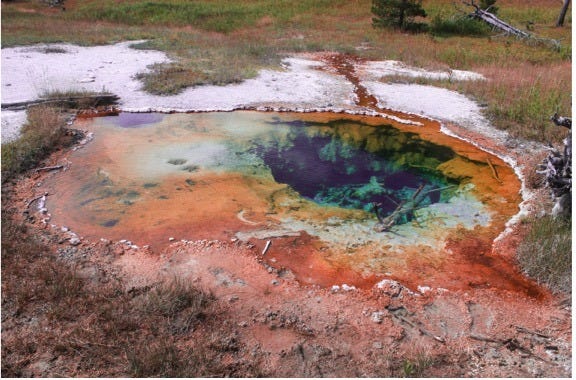
At Yellowstone Hot Springs, not only do modern visitors report pain relief and muscle recovery, there are also first-hand accounts of chronic conditions resolving—like the story documented, in this article by a hiker himself:
Recovery #1
“I had been struggling with a painful mid-foot sprain for the past 1,000 miles. It had culminated in foot drop– two of my toes have ceased to function as usual and are unable to flex upwards naturally as I walk.
Enter: Heart Lake Geyser Basin. The multitude of sulfur vents scattered throughout this isolated basin heats Witch Creek to near-boiling temperatures. As the creek flows through the forest, it cools slightly to a hot tub-esque 108°. Obviously, we dip.
After a long soak, in which I’m able to find and repair a hole in my sleeping pad and pseudo-bathe, I stand to walk back to my clothes and shoes. After a few steps, I realize my toes aren’t pulled down by the pressure of the water. I take a few more tentative steps to confirm what I already know: Witch Creek healed my foot.”
Recovery #2
I had trouble getting my head around this one, but, as a former, long-time ICU physician, I found it both compelling and horrifying. In this case, a patient was severely burned by the Yellowstone hot springs when she accidentally fell in a spot where the water was 200 degrees. Yes, 200 degrees.
She was burned to an almost unimaginable extent: 2nd degree burns over 70% of her body and 3rd degree burns over 20%.
Having worked at times in some burn ICU’s, I can say that that kind of burn is literally unsurvivable. The prognosis for recovery from severe burns is calculated using something called the Baux scale. Her Baux score was 160. My God, a Baux score above 140 is generally considered unsurvivable, and a score of 160 indicates nearly 100% predicted mortality.
Yet, not only did she survive, but she was conscious all the way to the hospital?
“I just remember hearing Rusty (Ed: the dog she was trying to save) yelping a lot and it makes me sad,” Laiha recalls. “I was in the worst pain I’ve ever felt in my life and I don’t think I can really compare it to anything. We had to drive 16 miles because there was no service to call 911. I was awake for all of that and when we got to the ambulance, I kept asking them to put me to sleep.“
Although she spent months in the hospital and required numerous surgeries, she survived and was eventually discharged.
Further, numerous accounts refer to the fact that Indigenous peoples historically used Yellowstone’s pools for medicinal bathing, and visitors today describe improvements in various conditions.
Arrowhead Springs
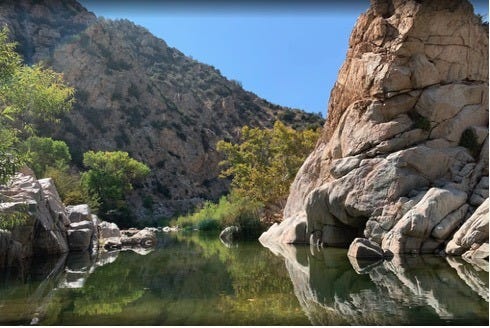
Arrowhead Springs in California carries a reputation for healing dating to the 19th century, with early physicians proclaiming benefits for tuberculosis and rheumatism via “hydrotherapy.” Even in more skeptical times, anecdotal reports persist.
“In 1864, D.N. Smith, emigrated to the San Bernardino Valley, and established a tuberculosis and healing sanitarium at the site, where he practiced hydropathy, a “water cure” branch of medicine. According to the San Bernardino Sun Telegram in 1908, “So enthusiastic was he of the springs’ value in curing the ailments of man that his sanity was questioned even by those who knew of the wonderful healing properties of the water.”
Intrigued, I decided to dig deeper to find more accounts of dramatic cures at Arrowhead. Even with AI, I couldn’t find anything online except references to a history book (shown below), which I had to buy a hard copy of for $75 (ugh - I say that because I did not like the book):
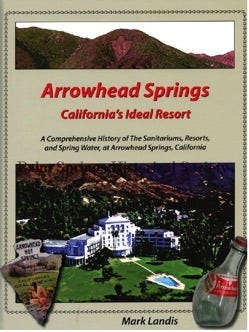
The reason I did not like the book is that, incredibly, very few accounts of healing were described—in fact, I could only find them “alluded” to on one single page of the 217-page book.
The reason for their absence was quickly apparent: the author of the book was a complete skeptic in regards to the notion of “healing waters.” One issue was that one of the book’s central figures and the spring’s most ardent proponent, “Dr.” D.N. Smith, frequently referred to himself as a doctor during his lifetime, though he most certainly was not.
Although Smith played a central role in the history and development of Arrowhead Springs and earned many friends over his lifetime, some of his behaviors and decisions resulted in business and marital troubles. For this reason, I believe the book’s author regarded neither Smith nor his claims as credible.
Thus, the leading historian of Arrowhead Springs produced a massive volume on its history—yet entirely disregarded any mention of the spring’s reputed healing properties.
Either way, what little crumbs he included, I found compelling:
“There are no records of Smith’s successful cure rate at Arrowhead Springs. Deaths and failures to cure could be attributed to the fact that the patient was “too far gone” by the time they came to the facility.”
“Paying little heed to science or facts (Ed: author’s opinion unfortunately), many patients gave heartfelt testimonials for Smith’s care, and the facility in general, based on their personal experiences. “
However, the author did include a passage from an April 1868 letter, signed by a correspondent calling themselves “Invalid,” who offered the following words of praise for “Doctor” Smith:
For the past 5 years, Dr. Smith of Arrowhead Springs has been diligently and honorably endeavoring to establish his Infirmary, and show by actual cases of cure that it is useless to buy an interest in a drug store to recover from the “ills that flesh is heir to,” and we are happy to say that he has accomplished it.”
“Invalid,” concluded:
“Let our citizens be up and doing, giving aid and comfort to all who wake early, strive hard and accomplish something for the general good. If the good people of San Bernardino will visit the Arrowhead Springs, they will see that the proprietor thereof belongs to this class, and that it is good to have such an institution among us.”
Again from the clearly biased author, denigrating “Doctor” Smith:
“Concocting explanations of unwanted medical circumstances was undoubtedly familiar territory for Smith. Despite his shortcomings and lack of true medical knowledge, Smith remained committed to providing patient care until his dying day.”
Well, Mr. Landis, I at least value D.N. Smith for his lifelong dedication to healing others, and I only wish you had given him greater credit for that.
Hamam al-Alil, Mosul, Iraq
An AI summary of this article (which lacked details of specific healings):
This may be one of the oldest. Its sulfurous baths have reportedly cured skin disorders (psoriasis, scabies), arthritis, and provided emotional relief for war survivors. First-person and media accounts describe recurring benefits—sometimes dramatic, usually substantial—after regular bathing, mud application, and mineral water use.
Conclusion
Now, obviously, I don’t want to get “carried away” here. Although these historical reports of healing at hot springs or rock springs exist worldwide, and some evidence suggest benefits from their mineral water content, the mechanisms still remain poorly understood and require further research given they are hypothesis generating only.
Further, towards the end of the book, a water purification product derived from Shimanishi’s Themarx will be discussed. It’s important to clarify: this product is approved for water purification only, not as a mineral supplement. The dosing used for purification does not significantly enrich water with therapeutic levels of minerals, and therefore the product is unrelated to the high-mineral-content hot springs and healing waters described in this chapter. Any discussion of potential health applications of concentrated mineral therapy represents areas for future research, not claims about currently available products.
However, my sense of the potential for such higher dose mineral therapy rests on the fact that water from numerous “healing” springs that have been analyzed with modern techniques like ICP-MS repeatedly reveals unique enriched trace mineral profiles.
Accounts of these springs share remarkable similarity: rapid pain relief, skin improvement, emotional restoration, and functional recovery, often deemed medically “unexplainable.” The similarity of outcomes, paired with shared anomalies in the mineral content, points to a mechanism—one not yet elucidated by science, but supported by my clinical intuition and mounting circumstantial evidence.
I also posit that the unusually large number of such recoveries reported at Lourdes is simply due to the volume of visitors—recall that more pilgrims visit Lourdes each year than the Taj Mahal. However, conversely, due to the fact that the miracles and dramatic healings are so few in relation to the overall volume of visitors, I also feel that there is another, missing element to those miracles—a human one. Meaning specifically, that for those healings to happen, the patient must have been in a unique state of mind such that the minerals may have triggered the response, but the mind did the rest? Who knows.
So, dear reader: again, are the healings at Lourdes miracles, or minerals—or both? Meaning if God (or primordial volcanoes) endowed the springs with unique minerals, I trust that the Catholic Church will recognize that. I also hope that they champion and fund further biochemical research—particularly into the epigenetic and physiologic effects of a spectrum of rare and trace minerals.
Next: Chapter 11 - The Middle Mile of the Mineral Journey: Known Quantities, Unknown Catalysts
P.S. If you’re curious about the volcanic-mineral water purification product that this book led me to help develop, you can find it at Aurmina.com. Think of it as a quiet act of restoration — starting with your water. And yes, I know — I’ve become the guy who includes links at the end. But this one just might change your water (and your mind).

Upcoming Book Publications
Yup — not one, but two books are dropping from yours truly (at the same time? What?)

If, instead of (or in addition to) this Substack version, you prefer the feel of a real book—or the smell of paper—or like to give holiday gifts, pre-order From Volcanoes to Vitality, my grand mineral saga, shipping before Christmas.
And if you want to read (or gift) another chronicle of suppression, science, and survival, grab The War on Chlorine Dioxide—the sequel you didn’t see coming—shipping mid-January. On this one, I say: “Buy it before they ban it.” Hah!
© 2025 Pierre Kory. All rights reserved.
This chapter is original material and protected under international copyright law. No part of this publication may be reproduced, distributed, or transmitted in any form or by any means, including photocopying, recording, or other electronic or mechanical methods, without the prior written permission of the author.
Dr. Kory this is fascinating stuff. I’m enjoying your research. Last night I added the Aurmina solution to already filtered water (clearly filtered water pitcher) and this morning there is a thin brown layer floating on the bottom. I assume this is the sediment. It’s so thin, I’m unsure how to filter it out. Any suggestions? While I also plan to drink (and make coffee) my newly filtered water, I’m also going to use it to help root an olive tree cutting. :-)
Great reading so far Dr. Kory. I have a question. What are the differences in Aurmina and Adya Clarity treatments of water in terms of re-mineralizing? Is one different thus healthier than the other? Of all water restructuring products out there, I'd love to see comparison studies of them all - if such a thing exists. Thanks for all you do to inform those willing to learn. I appreciate you so much.