
Chapter 1 - The Missing Minerals of Modern Life: How Depletion Breeds Disease, Chapter 2: The Fire Beneath the Sea: How Volcanic Minerals Forged Life’s First Energy
In volcanic darkness, minerals forged life’s first metabolism—what happens when those trace elements fade?

Hey friends, it's your self-proclaimed “Mineral Maestro.” Thanks for sticking with me through the Introduction and Preface — you’re already ahead of 99% of people when it comes to understanding how minerals keep life charged.
Today, in Chapter 1: “The Missing Minerals of Modern Life,” we dive into what happens when the mineral spark fades from our soils, waters, and bodies — and how restoring it might just restore us. However, it is a short chapter, so (and I will do this rarely) I am including the equally short Chapter 2 as well, “The Fire Beneath the Sea: How Volcanic Minerals Forged Life’s First Energy.”
Basically, the argument I will build is that, beyond vitamins and diets, lies a forgotten variable: the trace minerals that make biology flow. Chapter 1 reveals what happens when they disappear, and Chapter 2 highlights the vital essence of what disappeared. Let’s go!
Chapter 1: Beginning Hypothesis
What does a deficiency of trace minerals and rare-earth elements represent?
A significant contributor to lack of “resilience,” potentially leading to a diverse range of illnesses affecting the modern human population.
The deprivation of little studied, critical co-factor function of thousands of enzymatic, biochemical, metabolic, and epigenetic processes, leading to sub-optimal functioning and repair.
A combination of the two.
In contrast to MAHA’s appropriate focus on removing unproven or toxic additives from food and pharmaceuticals—and exposing the toxicity of the therapies for the diseases they create—I argue that the more serious problem is what’s missing from our food, not what’s added. I am talking about the much broader range of minerals, numbering over 80, the names of which most have never even heard of (I hadn’t either when I began this research).
And it ain’t just MAHA that overlooks the importance of depleting trace minerals, I’d include anyone who thinks that simply avoiding food raised with toxic pesticides is enough to preserve their health. The problem begins with the soil: the minerals are no longer present—organic or not—unless the farmer actively regenerates and remineralizes the soil (and even then, the choice of minerals is suspect). Not all organic food is created equal.
Even if you are one of the few with access to food from such a farmer, I can confidently state that whatever they use to mineralize their soil is only a fraction of the diversity your body craves, and almost certainly not in an optimally bioavailable form.
Why This Matters
I believe their scarcity may now be contributing to an increasing number of illnesses, playing a larger role than in the past. As AMD once told me, their most senior mentors remarked that treating chronic illness used to be easier and simpler in the past. Today, patients seem to respond to therapeutic interventions more slowly and with less magnitude.
At the risk of foreshadowing, don’t despair: A discovery from 50 years ago, born of a little-known, but fascinating scientific achievement by a Japanese engineer and chemist holds promise as a solution that’s simple, accessible, and affordable (and, no, I’m not talking about ivermectin). Although it has already proven an efficient and formidable remedy for our increasingly polluted drinking waters, I believe that its impacts in revitalizing our soils, plants, and bodies (animal and human) will prove historic. Bold statement, I know. More on that later.
Water: Clean but “Dead”
Equally concerning is the state of our contaminated water supply, which has led health seekers to obsessively purify and filter their drinking water with water distillers or reverse osmosis (RO) filters. Although such efforts produce undoubtedly “clean” water, I now view such water as “dead” because both reverse osmosis (RO) and distilled water remove almost all trace minerals—along with “major” minerals like calcium, magnesium, sodium, and iron. RO filtration is designed to leave water nearly pure, with only water molecules passing through; benefical minerals are almost all eliminated in the process.
Worse, studies have found that such pure, “mineral-free” water can leach minerals out of our own bones and bodies, unless sufficient trace minerals are absorbed from our food, which, as I’ve argued, is not the case today. This compounds the problem.
Yes, some are knowledgeable enough to restore minerals in their drinking water with remineralization filters, mineral drops, or mineral-rich salts after filtration, but, like with the few organic farmers who apply minerals, what you do it with and how you do it is critically important.
Ok, enough scaremongering, come with me into the science and the solutions—but we have to start at the beginning, hundreds of millions of years ago.
Chapter 2 -The Fire Beneath the Sea: How Volcanic Minerals Forged Life’s First Energy
Deep in volcanic darkness, heat and minerals joined forces to forge the planet’s earliest metabolism long before sunlight powered the surface.
The Origin of Cellular Life On Planet Earth
There is significant scientific evidence and consensus that the origin of life is closely tied to the unique electrochemical properties of minerals in Earth’s early rocks.
I bet you didn’t know this, but scientists believe the first life forms on Earth appeared approximately 3.5 billion (yes, billion) years ago. Where and how did the first life forms appear, you ask? Although the two places might seem disparate, they are more similar than not - you can choose from alkaline hydrothermal vents in the ocean or geothermal hot springs on land.
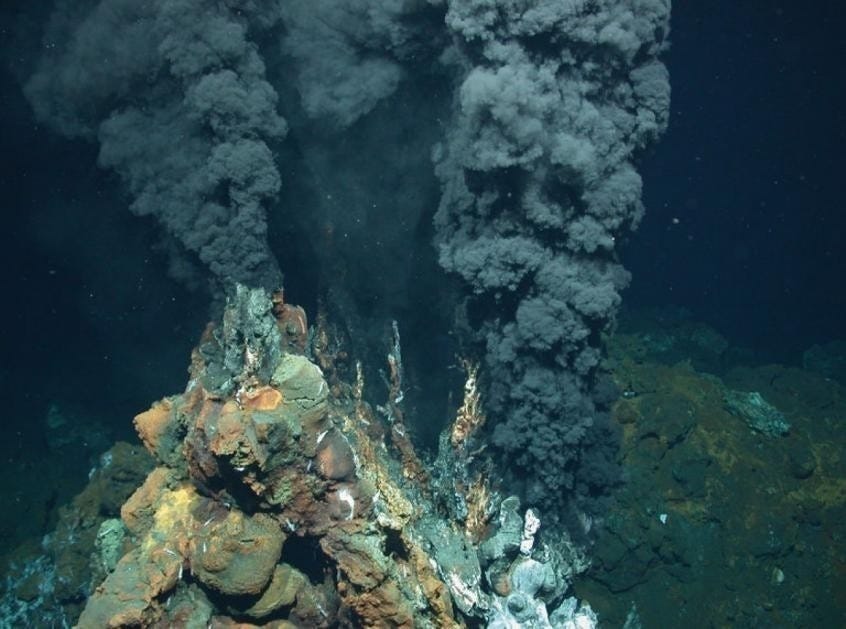
For reasons you will soon learn about, my money is on the deep oceans of our planet. At depths where sunlight is absent (if you thought the sun kicked this whole thing off, you would be wrong) and temperatures are so low that life shouldn’t exist, marine biologists have been stunned to find a plethora of abundant sea life near the presence of underwater volcanic vents. Check out this amazing deep sea underwater photo:
The Birthplace of Life: Fire, Minerals, and Electrical Gradients
These volcanic vents pictured above are teeming with life. They spew black ash—a detail that will matter later—and the scene is visible only because a submarine drone illuminates the abyss. Without it, there would be total darkness. Yet in that darkness exist heat, iron, sulfur (also important later), and the focus of this book—biotite mica.
Life was likely sparked here, where a free-energy gradient—a difference in electrical charge—developed between the acidic, proton-rich early ocean and the alkaline fluids venting from the seafloor. The iron- and sulfur-rich minerals emitted with the black ash formed primitive electrochemical membranes, creating the first natural energy gradients.
These same minerals possessed a “magical” property: they acted as natural catalysts, electrically concentrating and organizing molecules to facilitate the formation of amino acids, lipids, and nucleic acids. Their interplay with hydrogen ions (protons) generated the energetic reactions that built the precursors of living systems.
In this way, minerals functioned like microscopic batteries, powering the earliest metabolic networks—a central concept of the alkaline hydrothermal vent hypothesis, which proposes that life began in mineral-rich, electrically active ocean environments.
Renowned mineralogist and astrobiologist Robert Hazen has demonstrated through pioneering research that minerals were essential to life’s emergence. They served not only as catalysts but also as protective scaffolds—vital drivers, not accidental bystanders, in bridging the gulf between non-living chemistry and the first living systems.
The Critical Contribution Of Volcanoes
Thus, volcanoes are also considered a key contributor to the origin of life on Earth, providing several critical ingredients and conditions. However, they were not the only factor responsible for the spark of living matter.
Recent studies and hypotheses suggest that volcanic eruptions, accompanied by intense lightning in ash clouds, produce large quantities of nitrates and other compounds essential for life. Volcanic gases like carbonyl sulfide (COS), released by eruptions, can catalyze the formation of peptides—short chains of amino acids—fundamental to life’s chemistry.
Laboratory experiments demonstrate that when volcanic gases interact with lightning or energy discharges—like the famous Miller-Urey experiment in 1952—they can form amino acids and other ‘building blocks of life.’ If you don’t find that as fascinating as I do, there is something wrong with you (or me).
Microbial life discovered at these vents survives purely on chemical (i.e. mineral) energy from the Earth, not sunlight, supporting the idea that similar volcanic systems could have seeded the earliest life forms on Earth’s surface as well.
Paraphrased from the amazing book, The Untold Truth by Elmer Heinrich, a man who obsessively studied and advocated for the supplementation of diverse trace minerals to promote and restore health:
“Life as we know it requires liquid water, energy, and organic and inorganic molecules. These inorganic molecules are minerals, the very source of physical life. Minerals initiate, regulate and control every organ and function in your body. Proper breathing depends on minerals. Mental and physical ability depend on minerals. Heart and blood pressure stabilization are directly related to minerals. A complete spectrum of minerals strengthens the immune system, enhances appearance, produces energy, fights off disease and common colds, eliminates depression, reduces stress and produces more positive attitudes.”
Thus, minerals control millions of chemical and enzymatic processes and reactions that occur in our one-trillion-cell body at all times. The same is true for animals.
I know the above sounds so cool, full of vitality and wonder. But remember, this is Medical Musings, and I don’t typically dwell in that space long. So here we go—this time, not only am I exposing a disturbing reality, but I will lead you to a (potential) solution.
Next: Chapter 3 - The Dying Ground: How Modern Agriculture Is Unmineralizing the Earth—and Ourselves
Shameless Commercialism Section: Upcoming Book Publications
Because apparently, I’ve entered my “multiple book launch” era. In the category of “What was I thinking?” — I somehow ended up finishing two books at once. Both will be launching soon, and I am excited to share them with you.

From Volcanoes to Vitality: if, instead of (or in addition to) this Substack version, you prefer the feel of a real book—or the smell of paper—or like to give holiday gifts, pre-order this grand mineral saga, shipping before Christmas.
The War on Chlorine Dioxide: if you want to read (or gift) another chronicle of suppression, science, and survival, grab the sequel you didn’t see coming—shipping mid-January. On this one, I say: “Buy it before they ban it.” Hah!
© 2025 Pierre Kory. All rights reserved.
This chapter is original material and protected under international copyright law. No part of this publication may be reproduced, distributed, or transmitted in any form or by any means, including photocopying, recording, or other electronic or mechanical methods, without the prior written permission of the author.
Pierre, this is a really great service to offer these chapters.
I fervently wish is that this gets people out of their comfort zones and inspires go far beyond the USDA organic label as a deeply compromised protection to food safety.
The short circuiting by way of modern agriculture's destruction is a huge host of necessary elements and mineral complexes which is in many ways intentional . The medical, fertilizer and pesticide industries are all joined at the hip.
Careful field / crop / and livestock observations reveal severe malnutrition has long been a plague on the land and has damaged humanity's foundations for centuries. Uncompromised soil ( a rare thing these days ), is a powerhouse of elements and ionic exchanges of differing electro magnetic charges which generate frequencies that insects and more diverse life recognizes , (over the horizon by the way). Healthy soils can be living batteries that recharge life force 24/7 as long as the depth and breadth of soil particles is not shorted out by compaction, hypoxia, and draining of the ionic / electrical magnetic differentials that drive life along.
Chemical salts fertilizers and systemic herbicides / fungicides, are so destructive to the building of humus, the storehouse / banking system of soil life that we fail to see it leaking away over generations. Another dynamic that gets sneers of dismissal is the diamagnetic / paramagnetic exchange of energy which is found at peak levels where volcanic minerals are naturally occurring or intentionally supplied along with humic materials such as properly made composts, to recharge the soils biochemical batteries . Most volcanically derived minerals , molten in their last lifetime, are paramagnetic . Humus rich topsoils are diamagnetic .
here is an energetic factor for farmers to consider. Soil amendments need to be formulated with both positively and negatively charged components to rekindle the exchange . Any substance or practice that diminishes fungal / bacterial , decay / rebirth webwork depletes our nutritional base. M
Thomas Gold first introduced me to the idea that life originated at deep-sea vents, and yes, it is fascinating. Thanks for pursuing this subject.