

Epilogue — Movement IV: The Line That Broke Me
A single sentence breaks open a life, a theory, and a responsibility that can no longer be ignored.


What I later realized was that the conviction I felt in Montana had already begun to build months earlier, when I first heard Shimanishi’s voice in a written note I had discovered.
One day, I received a reply to an email I had sent to Professor Satoshi Ōmura and several people around him. I did not know Ōmura personally, but I had come to know some in his circle because one of his close friends and colleagues had been a vocal supporter of the FLCCC and had kept him apprised of our work. Kenji Torii, who was copied on the exchange, was a publisher of a book on ivermectin that Paul Marik later edited, collecting the experiences of physicians around the world who had used it to save thousands of lives. I had simply asked what they knew of Asao Shimanishi and his work. The response came from Mr. Torii. His message was brief, generous, and deeply human. He expressed pride that a Japanese researcher like Shimanishi was finally being recognized and regretted that so few in Japan knew his name.
I was reading the email in the passenger seat of our car, with Lisa driving, while I was on the phone with MB. I forwarded it to him. As he opened it on his computer, he noticed that Mr. Torii had included a link to a website.
MB opened it first.
The site belonged to a company Shimanishi had apparently tried to build after his original company dissolved, one that MB had never encountered in more than twenty years of importing Themarox through Shimanishi-Kaken. The homepage opened with a message. Shimanishi himself had written the first half.
As MB began reading the first lines aloud to me over the phone, I felt something shift in my chest, and my eyes were already filling. I do not think Lisa noticed until I hung up and was softly crying—well, maybe not so softly—but I recovered quickly and told her, “Hearing that made me emotional.”
That was nothing compared to what happened later.
When I got home, I went into my office, opened the website myself, and read the message alone for the first time. By then, I had spent months immersed in Shimanishi’s work, his minerals, his methods, his restraint, and his refusal to claim authorship over what he believed had been entrusted to him. I thought I understood the man.
I was wrong.
In the car, I remember thinking that in all the months I had spent living inside his work, although I had read descriptions of his method and a few technical statements attributed to him, I had never encountered his voice. I had never read his thoughts. I had only known the science, the minerals, the discipline, and the result.
That evening, sitting alone in my office, was the first time I was alone with his words.
And I did not make it past the first sentence.
“In the beginning there was a rock.”
I broke. And it was not quiet.
What came out of me was sudden and involuntary, something between a sob and a wail, physical and immediate, like an eruption triggered by something I could neither control nor understand. I have cried as an adult before. This was different.
And what still shocks me is that it has not changed.
I have gone through this manuscript dozens of times since adding this passage. Many dozens. And every time I get to that line, it happens again, without exception. It hits me all over again, and I begin sobbing in bursts, eyes tearing, chest heaving, while my mind simply stands there and watches, unable to explain why it is happening.
I wish I could tell you that I am embellishing this for dramatic effect. I am not. I am writing it because it is true, and I no longer care whether admitting it makes me seem unstable, sentimental, or ridiculous. Every time I reach that line, I feel the same sudden, visceral, overpowering reaction—emotional, spiritual, whatever word one prefers. It simply breaks me.
I am not especially interested in explaining it. I might have tried if it had happened once. But when it happens every time, without exception, explanation begins to feel beside the point.
All I can do is tell you what happened and what followed from it. Before turning to his words, I want to show you the man they came from.
This is the only photograph I have of Asao Shimanishi.
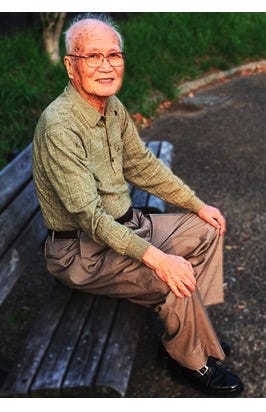
What follows is the message written by Asao Shimanishi himself. The remainder of the page, explanatory material added later by others, I have intentionally omitted.
In the Beginning, There Was a Rock
About 4.5 billion years ago, the Earth was born. Over a long span of time, the solid surface of the Earth—what we call the crust—was formed. Water, air, and oceans appeared, and from them emerged microorganisms, plants, fish, animals, and, much later, human beings.
That which was born first—the crust, the rock—is what forms Mother Earth.
The Earth is composed of rocks and stones, and of soil created by their weathering. All rocks and soil are made of minerals.
All living things are born from minerals as their womb, grow and develop, and eventually complete life and return to the soil. In this sense, all life returns to the world of minerals.
There are dozens of minerals on Earth that function as biocatalysts within living organisms. Although the required amounts vary greatly depending on the organism, minerals ordinarily exist in solid form. Animals and plants have therefore been able to obtain them only in very small quantities—either from trace amounts dissolved in water or from food.
I have been involved in many research projects over the course of my life, but I was drawn to rocks. I collected rocks and soil from Japan and from volcanic regions around the world and repeatedly analyzed them.
Through this work, I discovered that vermiculite—a weathered granite produced in the Abukuma mountain range of Fukushima Prefecture—contains a well-balanced composition of dozens of minerals.
I came to believe that, in order for living organisms to ingest and absorb this exquisite mineral balance without disturbing it, the vermiculite would need to be liquefied.
With the firm conviction that research can only be called successful when it serves people, this was realized in 1977, with the creation of what I called Rock Water.
We now live in an age in which minerals such as calcium and vitamins can be easily taken as supplements. And for acute physical disorders, there are few people today who have not benefited from advanced pharmaceuticals that have saved lives.
Yet precisely because scientific progress has become so great, I believe it is time once again to reflect on the origins of human life.
As a researcher, I sincerely hope that this Rock Water will gently return to the environment and to the human body, and in doing so, help improve the quality of life of many people.
—Asao Shimanishi
The longer I sat with Shimanishi’s words, the more I felt I was dealing with a man who had approached matter with unusual patience, reverence, and humility, and had learned something from it that no one else had.
Although I do not fully understand why his opening line breaks me, and maybe I never will, as I sit here on the last pass, at the very end of this book, with my work on it finally coming to a close, one thought has come into focus strongly enough that I want to share it.
As I write this, while again crying after reading those words, my best guess as to why they affect me so deeply is how much they contain. “In the beginning there was a rock” states, with shocking simplicity, the deepest material truth this book has uncovered. Life starts there. It rises out of rock, moves through water, becomes living form, and returns to rock. Shimanishi saw that with a clarity that never stops feeling astonishing to me. He wrote the whole thing in a sentence so simple that it lands like revelation. That, I think, is why I cry when I read it.
A sentence like that comes from a life, not just a passing thought.
He spent fifteen years working with stone, waiting until he found the narrow doorway where it could change state without being destroyed. Themarox did not come from conquering rock. It came from working with it long enough to discover the conditions under which stone could become water-borne life.
And yet almost nothing of the man remains in public history.
For someone who understood water, minerals, biological signaling, and environmental restoration decades ahead of his time, his absence from the record is almost total. There are no thick stacks of peer-reviewed papers under his name, no major academic archive, no institutional lineage preserving his place. Almost no public footprint at all.
For a long time, that felt like a contradiction.
Ultimately, the truth is simpler, and more unsettling.
Shimanishi did not come out of academia. He came out of the real world. He was not rewarded for publishing. He was hired to fix things—golf courses with dead grass, ponds fouled beyond recovery, agricultural land that no longer responded, environments that had stopped functioning. Places where outcomes were the only currency that mattered.
So he communicated by demonstration.
What remains of his work today is not a library of journal articles, but grainy footage, scattered recordings, fragments of documentation, and memories passed orally through those who worked with him and understood him. Even the limited formal records that once existed were later largely destroyed, including in a coordinated computer attack that wiped out digital archives held by both Shimanishi-Kaken and MB’s company. What survived did so almost accidentally: a few DVDs, scattered materials, and the memory of those who had seen the work firsthand.
By every account I have been able to piece together, he was intensely private. He did not seek recognition. He did not appear to care whether the world knew his name, so long as the work did what it was meant to do. As far as I can determine, his entire public footprint consists of remarkably little: a brief appearance on a Japanese newscast documenting the cleanup of a Shinto pond, a single magazine interview late in his career, and undocumented accounts of a presentation at a World Water Conference.
Even there, he was not understood.
He spoke in a language that preceded the science available to receive it. He described his work in terms that sounded mystical because the scientific framework needed to recognize electrochemically ordered water and biological coordination as parts of a single process had not yet matured. Scientifically, he was too early. Culturally, he spoke too openly in theological terms to an audience that had already decided such language disqualified a person from being taken seriously.
His work passed through unnoticed because it exceeded the conceptual bandwidth of its time in both directions. Scientifically, it was ahead of its time. Culturally, it was too openly theological to be taken seriously.
And so it faded. He had never arranged his life around recognition, only around the work itself.
What survived did so quietly, in fragments, moving through unlikely channels, carried forward by a small number of people connected in ways that only make sense in hindsight. Eventually, improbably, it reached me. And with time I began to understand why that fact struck me with such overwhelming force.
What I came to see in Shimanishi was far more than intelligence, discipline, or scientific persistence, though he clearly had all three in unusual measure. I came to see a man whose whole way of approaching matter was shaped by reverence, patience, restraint, and what I can only call piety. He approached rock with humility. He studied it, stayed with it, and worked with it for years, allowing it to reveal what it would on its own terms.
I think that is part of why his opening line breaks me every time I read it. “In the beginning there was a rock.” It hits me with a force I cannot control because it feels complete. It feels whole. It feels like the words of a man who had drawn so close to the structure of reality, and so close to God, that science, reverence, humility, and truth were no longer separate things in him. They had become one.
That is why I cry. I am not reacting only to a sentence. I am reacting to the presence of the man behind it. I am reacting to a life that seems to have been lived in unusual submission to reality and, through that submission, allowed to uncover something immense. What he brought forward was not only a practical mineral process. It was a glimpse into the deeper order by which life is sustained.
And there is another reason I cry. He was nearly forgotten. A man through whom so much seems to have passed, a man without whom this work could never have become what it became, was left almost entirely unrecognized. Every time I read that line, I feel both truth and loss. I feel the weight of how easily the world can fail to recognize the people through whom something sacred has moved.
That is what has changed the meaning of this work for me. I do not think of what I am doing as authorship in the ordinary sense. I think of it as bringing something back into view. I am trying to place Shimanishi’s work inside a language the modern world can recognize, test, argue with, and, if it is willing, finally understand.
I do not fully understand why this came to me. I only know that once it did, I could not leave it buried.
Shimanishi’s place in history has not yet been written. This book is my attempt to begin that restoration. It is the recovery of what passed through him: a deeper understanding of order, water, minerals, and life that the world was not ready to receive when it first appeared.
And if this work now reaches the world, the deepest significance will not be that a forgotten name is restored. It will be that something fundamental about the architecture of life has become visible again.
What matters most is not that Shimanishi be remembered, but that what he uncovered be seen.
I cry whenever I read something about Angelic intervention.
I cried when I read those words “in the beginning,there was a rock”. But,only the first time I read it. It is beautiful,really. The whole concept of “Ashes to ashes. Dust to dust”, but,with Water in the middle…
You have impressed your readers that you sensed Divine Guidance at every turn.
Your explanations are thorough, exciting and remarkably entertaining!
The subject is astounding in its significance, and it makes perfect sense.
Thank you for making Aurmina available.
You have honored Mr, Shimanishi and the ancients.
And you have remembered the Lord